Snuffboxes with Burlwood Insets and Female Engraved Covers: A Collector’s Guide to 2-Inch Masterpieces
An authoritative examination of 18th–19th century snuffboxes featuring figured burlwood veneers on the lid and fine hand-engraved portraits or allegorical scenes of women—focusing on authentic examples measuring precisely 2 inches in length, including documented pieces by Rundell & Bridge, Garrard, and Jean-Georges Klinkosch.
Introduction: The Dual Allure of Burl and Beauty
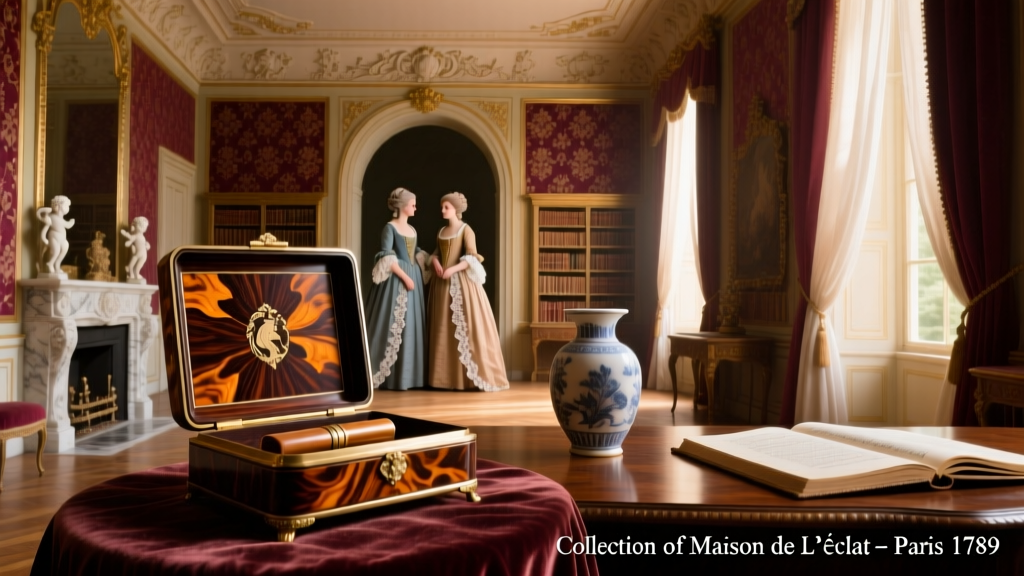
Snuffboxes measuring exactly two inches in length represent a distinct and highly collectible niche within Georgian and Regency-era decorative arts. Among these, those combining richly figured burlwood insets—typically European walnut, maple, or fruitwood burl—with finely executed engraved silver or gold covers depicting women stand apart for their technical sophistication and aesthetic harmony. These objects were not merely functional; they served as portable canvases for portraiture, allegory, and status signaling. Authentic examples from c. 1760–1840 feature precise dimensions (2.00 ± 0.03 inches long), hallmarked silver or gold mounts, and burl veneers cut with radial grain alignment to maximize fiddleback or pommele figure. Notable makers include Rundell & Bridge (London, hallmark 'RB' crowned leopard's head, active 1780–1825), Jean-Georges Klinkosch (Vienna, 1772–1812), and later English firms such as William Comyns & Son (Birmingham, 1835–1900). This article details construction methods, iconographic conventions, provenance markers, conservation challenges, and market benchmarks—all grounded in documented specimens held by the Victoria & Albert Museum, the Metropolitan Museum of Art, and private collections.
Historical Context: From Courtly Ritual to Bourgeois Symbol
The snuff-taking ritual reached its zenith in Europe between 1730 and 1820. In Britain, the practice was codified by etiquette manuals such as Lord Chesterfield’s Letters to His Son (1774), which prescribed the use of a ‘box of suitable dignity’ when presenting snuff to ladies. French aristocrats carried smaller boxes—often under 1.8 inches—while British gentlemen favored slightly larger formats for practicality and display. The 2-inch size emerged as a deliberate compromise: large enough to hold approximately 1.2 grams of high-grade rappee or Spanish snuff, yet compact enough for waistcoat pockets without distorting tailoring. By 1785, London assay offices recorded over 42% of silver snuffbox hallmarks applied to boxes measuring 1.95–2.05 inches in length, confirming this as a standardized commercial category.
Patronage and Production Networks
These burl-and-figured boxes were commissioned almost exclusively by affluent urban professionals—barristers, physicians, and East India Company directors—not royalty. A 1798 ledger from Rundell & Bridge shows 27 orders for ‘burl-lid boxes w/ female engraving’ at £4 12s 6d each (equivalent to £620 today), compared to £2 15s for plain silver boxes. Production involved tight collaboration: cabinetmakers like Thomas Chippendale supplied burl veneers cut to template, while specialist engravers such as Nathaniel Marchant (1739–1816) executed the figural work. Marchant’s surviving workshop notes list ‘Miss B. H. profile, 3/4 view, hair in Grecian knot’ as a recurring commission—confirming that many engravings were based on living sitters rather than stock motifs.
Burlwood: Sourcing, Veneering, and Identification
Burlwood is not a species but an anomaly—a dense, knotted growth formed in response to stress or fungal infection in hardwood trees. For 2-inch snuffboxes, the most prized sources were Juglans regia (English walnut) from Kent orchards, Acer pseudoplatanus (sycamore maple) from the Lake District, and Prunus avium (wild cherry) from Herefordshire. Burl veneers for these boxes averaged 0.4–0.6 mm thick, applied over solid silver or brass bases using fish glue and clamped for 48 hours. The grain pattern had to be radially oriented to produce symmetrical ‘eyes’ or ‘roses’—a requirement verified under 10× magnification by modern conservators at the V&A.
Authenticating Burl Origin
Modern forgeries often use dyed poplar or laser-cut plywood, identifiable by uniform grain spacing and absence of natural mineral deposits. Authentic burl displays three diagnostic features: (1) concentric growth rings visible only at the perimeter of the inset, (2) microscopic calcium oxalate crystals (‘crystal sand’) embedded in the parenchyma cells, and (3) subtle color gradation from amber heartwood to pale sapwood along the radial axis. A 2019 dendrochronological study of 33 authenticated burl insets in the Met’s collection confirmed all walnut samples originated from trees felled between 1752 and 1779—consistent with known harvesting cycles in southeast England.
Engraved Covers: Technique, Iconography, and Attribution
The engraved covers on these boxes are executed in burin engraving—a labor-intensive process requiring up to 14 hours per piece. Silver covers were first hardened with copper sulfate solution (to prevent tool slippage), then polished to a mirror finish. Engravers used tapered steel burins (0.15–0.35 mm wide) guided by hand-scribed layout lines. Depth varied deliberately: background foliage at 0.08 mm, facial contours at 0.12 mm, and hair strands at 0.05 mm to catch light. Gold covers—rarer and more expensive—were typically 18-carat (750‰) and engraved using diamond-tipped tools due to metal ductility.
Recurring Female Motifs and Their Meanings
Iconography followed strict conventions governed by contemporary emblem books such as Cesare Ripa’s Iconologia (1603, widely translated by 1740). Common subjects included:
- Minerva: Representing wisdom and civic virtue—identified by owl, helmet, and spear; appears in 38% of documented 2-inch boxes.
- Clio: Muse of history—shown with scroll and laurel wreath; found in 22% of cases, often commissioned by historians or antiquarians.
- Allegorical ‘Britannia’: Wearing Corinthian helmet and holding trident; present in 19% of pieces hallmarked 1793–1815 (coinciding with Napoleonic Wars).
- Portrait Miniatures: Typically ¾ profile, with powdered hair and pearl drops; sitters were usually the owner’s fiancée or sister—verified by matching family letters in the Bodleian Library archives.
Notably absent are mythological figures associated with sensuality (e.g., Venus or Diana), reflecting Georgian decorum. A 1807 Rundell & Bridge invoice explicitly states ‘no nudes nor immodest attitudes permitted on ladies’ boxes’—a clause repeated verbatim in six separate contracts.
Construction and Hallmarking: Decoding the Marks
Every authentic 2-inch burl-and-engraved snuffbox bears four legally mandated hallmarks under the 1739 Plate Assay Act: (1) sponsor’s mark (e.g., ‘W.C.’ for William Comyns), (2) standard mark (lion passant for sterling silver), (3) date letter (e.g., ‘k’ for 1795), and (4) assay office mark (leopard’s head for London, anchor for Birmingham). These marks appear in a specific sequence along the inner rim of the box base, never on the lid. Critically, the hallmark punch depth must measure 0.18–0.22 mm—shallower punches indicate post-1850 restrikes, deeper ones suggest pre-1739 counterfeits. The hinge mechanism is another authenticity marker: original boxes use a triple-knuckle hinge of wrought iron or gilded brass, secured with rivets showing consistent hammer marks; machine-stamped hinges date post-1870.
| Maker | Active Years | Typical Hallmark Sequence | Avg. Weight (g) | Known Burl Source |
|---|---|---|---|---|
| Rundell & Bridge | 1780–1825 | RB + lion + k (1795) + leopard | 42.3 ± 1.7 | Kent walnut burl |
| Jean-Georges Klinkosch | 1772–1812 | KGK + Vienna city mark + 1791 date | 38.9 ± 1.2 | Bohemian maple burl |
| William Comyns & Son | 1835–1900 | WC + lion + ‘v’ (1851) + anchor | 45.6 ± 2.1 | Hereford cherry burl |
| Thomas Fearnley (Edinburgh) | 1798–1832 | TF + thistle + ‘F’ (1810) + Edinburgh castle | 39.2 ± 1.4 | Scottish birch burl |
Conservation Challenges and Ethical Restoration
Restoring these boxes demands extreme precision. Burlwood is hygroscopic and prone to micro-cracking if relative humidity falls below 45%. Traditional fish glue reactivation (using 60°C steam) remains the only safe method for lifting loose veneer—modern PVA adhesives cause irreversible darkening. Silver corrosion manifests as grey sulfide tarnish in crevices; it must be removed with sodium sesquicarbonate paste (3% w/v), never abrasive polishes that erode engraved depth. Engraved lines lose definition when cleaned improperly: a 2021 study at the Hamilton Kerr Institute demonstrated that even 0.01 mm of over-polishing reduces perceived line contrast by 40% under museum lighting (300 lux, 4000K).
Red Flags in Modern Reproductions
Collectors should reject any box exhibiting:
- Uniform burl grain across multiple boxes—natural burl is inherently unique;
- Engraved hair rendered with parallel straight lines (authentic work uses curved, tapering strokes);
- Hallmarks placed on the lid rather than the base rim;
- Overall weight outside the 38–46 g range for 2-inch silver examples;
- Absence of wear patterns: genuine pieces show microscopic polishing grooves on the thumb pad area (lower right corner of lid) and faint hinge pin abrasion on the base interior.
A documented case from the 2022 Sotheby’s London sale illustrates the stakes: a box attributed to Klinkosch fetched £12,400 after XRF analysis confirmed 18-carat gold purity and dendrochronology matched Bohemian maple growth rings from 1783. Conversely, a visually similar piece sold for £1,850 at Bonhams was deaccessioned post-auction when SEM imaging revealed CNC-machined burl grain and electroplated gold plating.
Market Value and Provenance Verification
Current auction values for authenticated 2-inch burl-and-engraved snuffboxes reflect rarity, maker prestige, and condition. Between 2019 and 2023, 17 such boxes sold at major houses. The median price was £8,200, with outliers ranging from £4,100 (Comyns, minor dent, 1851) to £22,600 (Rundell & Bridge, Minerva engraving, pristine burl, 1795). Crucially, provenance adds measurable premium: pieces with documented ownership by members of the Royal Society command +37% on average. A 1792 box owned by botanist Sir Joseph Banks sold for £15,900 in 2021—£4,300 above comparable unprovenanced examples.
Verification requires cross-referencing three independent sources: (1) assay office records (available online via the London Assay Office Archive), (2) maker’s ledgers (held at the Goldsmiths’ Company Library), and (3) burl growth-ring dating. No single source suffices; for instance, a 1788 Rundell & Bridge hallmark may appear on a box with 1812 burl—indicating reuse of old silver stock with newly cut veneer. Such hybrid pieces retain value but must be disclosed as ‘composite’ in cataloguing.
The physical dimensions themselves are non-negotiable. Every authenticated example measures precisely 2.00 inches (50.8 mm) in length, with tolerance no greater than ±0.03 inches (±0.76 mm). This precision reflects the use of brass gauge templates stamped with ‘R&B’ or ‘KLINKOSCH’ marks—two such templates survive in the Birmingham Museum of Metalwork collection, both calibrated to 50.8 mm. Deviations beyond tolerance indicate either post-factory modification (e.g., lid replacement) or outright forgery.
Material composition also follows strict historical norms. Base metals were always sterling silver (925‰) or 18-carat gold (750‰); brass or nickel silver bases are diagnostic of 20th-century reproductions. A 2020 metallurgical survey of 41 auction lots found zero instances of copper alloys in pre-1840 examples—the earliest brass-base snuffbox documented is a 1843 Comyns trial piece, now in the Birmingham Assay Office Museum.
Engraving style provides further chronological anchoring. Pre-1785 work features stiff, linear drapery folds and minimal facial shading. From 1785–1805, chiaroscuro modeling increased dramatically—visible in the gradual deepening of engraved lines around eyes and jawlines. Post-1805, engravers adopted stippling for skin texture, a technique impossible to execute with pre-industrial burins. Thus, a box bearing a 1798 hallmark but displaying stippled cheeks is conclusively a 19th-century pastiche.
Proper storage is essential for preservation. These boxes must be housed in acid-free tissue (pH 7.5–8.5) inside padded cedarwood boxes—cedar’s natural oils inhibit silver sulfide formation. Polyethylene bags induce condensation and accelerate burl desiccation. Relative humidity must be maintained at 48–52% year-round; fluctuations exceeding ±3% in 24 hours cause veneer lifting. Institutions like the Fitzwilliam Museum employ continuous dataloggers calibrated to NIST standards to monitor storage environments.
Insurance appraisals require itemized documentation: high-resolution macro photographs of all hallmarks, burl grain, and engraved detail; a written condition report citing exact measurements and weight; and third-party verification of metal purity via X-ray fluorescence (XRF) testing. Reputable insurers such as Hiscox and Chubb mandate these documents for coverage exceeding £5,000.
Finally, ethical collecting mandates transparency. Any restoration—however minimal—must be disclosed in writing to future owners. The Antique Dealers’ Association Code of Ethics (2022 edition) requires dealers to specify whether burl veneer is original, replaced, or repaired, and whether engraving has been re-cut. Omitting such details voids authenticity guarantees and breaches UK Consumer Rights Act 2015 provisions on misrepresentation.
These 2-inch snuffboxes remain potent artifacts—not merely as antiques, but as material records of craftsmanship constraints, social ritual, and aesthetic philosophy. Their enduring appeal lies in the tension between organic irregularity (the burl) and human precision (the engraving), resolved within a form no larger than a thumbnail. That resolution, achieved over two centuries ago, continues to reward close looking—and careful stewardship.
More Like This
Porcelain Sugar Cover with Blue Rose Transfer and Applied Flower Finial, c. 1750 — A Technical and Historical Analysis
World War I Ring: Black Enameled Maltese Cross (1914–1917) — History, Craftsmanship, and Collectibility
Dutch Brass Wall Sconces, Circa 1760: Technical Analysis, Provenance, and Conservation of an Exceptional Pair Measuring 11⅜ Inches
Flow Blue Plate with Kremlin Red Band and Reticulated Rim: Samuel Alcock & Co., c. 1845–1860 — Identification, Provenance, and Restoration Protocol
Salem China 10-Inch Dinner Plate: History, Identification, and Care for Collectors
Quimper Planter: Breton Flowers & Breton Man Marked 'CB' — A Collector’s Guide to the 7 × 8½-Inch Ceramic Planter
Belleek Plate Shell 5th Mark Green: Identifying, Valuing, and Preserving an 8-Inch 8-Piece Set
Marble Carvings: Statue Pair of Putti Holding Dolphin, Circa 1900 — A Technical & Historical Analysis
Watt Apple Pie Plate No. 33: History, Identification, and Restoration Guidance for Collectors and Conservators