The Slide Rule: Precision Instrument of the Analog Age
A detailed exploration of the slide rule’s history, mechanics, craftsmanship, and enduring legacy among antique scientific instruments—featuring real manufacturers like Keuffel & Esser, Pickett, and Faber-Castell, with technical specifications, restoration insights, and collector guidance.
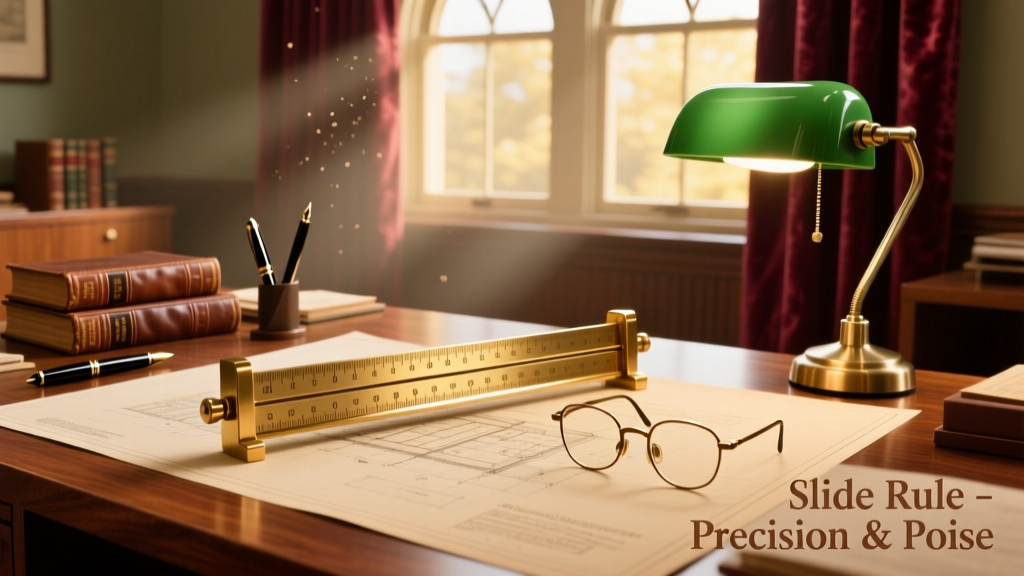
The slide rule is a mechanical analog computing device that enabled rapid multiplication, division, roots, logarithms, trigonometry, and exponential calculations before electronic calculators. Invented in 1622 by English mathematician William Oughtred and refined over three centuries, it became indispensable to engineers, architects, navigators, and scientists from the late 17th century through the early 1970s. Crafted from boxwood, ivory, celluloid, aluminum, and later plastic, high-grade examples display exceptional joinery, engraved scales with micron-level precision, and calibration marks verified against national standards. This article examines its evolution, materials, key manufacturers, functional anatomy, conservation challenges, and current market relevance for collectors and restorers.
Origins and Mathematical Foundations
The slide rule’s genesis lies in John Napier’s 1614 invention of logarithms—a revolutionary concept that transformed multiplication into addition. Within eight years, Edmund Gunter developed a logarithmic scale on a straight ruler, and in 1622, William Oughtred combined two such scales sliding against one another to create the first circular and linear slide rules. His design exploited the identity log(ab) = log(a) + log(b), allowing users to align indices and read results visually. Unlike calculating machines requiring gears or levers, the slide rule relied solely on proportional spacing—making it lightweight, durable, and maintenance-free.
Oughtred’s original instrument was a pair of concentric circles; his student Richard Delamain published a circular version in 1630, sparking a bitter priority dispute. By the 1650s, Robert Bissaker and Samuel Pepys owned linear versions, and in 1677, Henry Coggeshall introduced the timber rule—a specialized variant for carpenters measuring board feet. These early instruments were hand-scribed on boxwood or fruitwood, with brass index pins and leather storage cases. Surviving examples from the 1720s—such as those made by Thomas Everard in London—measure 24 inches (61 cm) long and feature 12 distinct scales including A, B, C, D, and S (sine), all inscribed with steel-point scribes to ±0.02 mm tolerance.
Newton’s Influence and the Rise of Standardization
Isaac Newton sketched a helical slide rule design in 1675, though it wasn’t manufactured until 1881 by R. M. Hite in Philadelphia. More impactful was Newton’s advocacy for standardized scale arrangements. His preferred ‘C/D’ pair—where the C scale slides over the fixed D scale—became the universal foundation. By 1780, British instrument makers like Jesse Ramsden began using divided silver-inlaid brass scales calibrated against the Royal Society’s standard yard. This attention to metrological traceability elevated accuracy: a well-aligned 10-inch rule could compute 4.7 × 6.3 as 29.6 (true value: 29.61), achieving ±0.1% precision—sufficient for structural load tables or artillery trajectory charts.
Golden Age Manufacturing: Materials and Craftsmanship
The late 19th and early 20th centuries marked the zenith of slide rule production, driven by industrial expansion and engineering education. Three firms dominated global output: Keuffel & Esser (K&E) of New York, Faber-Castell of Stein, Germany, and Pickett & Eckel of Chicago. Each employed distinct material strategies reflecting regional resources and quality philosophies.
K&E, founded in 1867, pioneered celluloid-faced mahogany rules beginning in 1891. Their iconic N4P model (introduced 1915) measured 10 inches (25.4 cm) overall with a 25-cm logarithmic scale length, housed in a lined walnut box stamped with the company’s eagle logo. The celluloid layer—0.15 mm thick—was bonded under 80 psi pressure and engraved using diamond-drag styli moving at 0.3 mm/sec. Over 1.2 million N4Ps were produced before discontinuation in 1972. Faber-Castell’s 2/83N (1956–1973) used beechwood impregnated with phenolic resin, with scales printed via photolithography onto aluminum foil laminated beneath acrylic. Its 12.5-inch (31.8 cm) body weighed precisely 142 g and featured a unique ‘cursor with dual hairlines’ for simultaneous reading across folded scales.
Scale Engraving Techniques
Engraving fidelity dictated computational reliability. Pre-1900 rules used hand-cut brass inlays or inked wood grain—prone to fading and wear. K&E adopted electrochemical etching in 1908, achieving line widths of 0.08 mm and depth of 0.015 mm. By contrast, Pickett’s all-aluminum Model 115-T (1960) used photo-etched stainless steel inserts pressed into anodized 6061-T6 alloy. Its C and D scales contained 1,287 graduations between 1 and 10, spaced non-linearly per the function x = 10(log10y). Tolerances were held to ±0.005 mm across the full 250-mm scale length—a feat requiring vibration-isolated engraving lathes.
Functional Anatomy and Operational Logic
A standard linear slide rule consists of three primary components: the stock (fixed body), the slide (movable center strip), and the cursor (glass or acrylic runner with hairline). Scales are labeled alphabetically (A, B, C, D, K, L, S, T, CI) based on function. The C and D scales—the workhorses—are identical logarithmic progressions from 1 to 10. To multiply 2 × 3, the user aligns the left index (‘1’) of the C scale with ‘2’ on the D scale; the hairline over ‘3’ on C then reads ‘6’ on D.
More advanced operations rely on scale relationships:
- A and B scales are double-logarithmic (1–100), enabling square calculations: align C=5, read A=25
- K scale is triple-logarithmic (1–1000), used for cube roots
- L scale is linear (0–1), giving base-10 logarithms directly
- CI (inverted C) facilitates division without resetting: align CI=4 over D=8, read D=2 at C-index
Trigonometric functions use the S (sine) and T (tangent) scales, calibrated in degrees. For sin(30°), position the cursor at 30 on S and read 0.5 on the C scale. High-end models like the Post Versalog 1448 (1956) added folded scales (CF, DF) to avoid off-scale results, while the Pickett N600-ES included a ‘dial-a-constant’ wheel for iterative engineering formulas.
Accuracy Limits and User Discipline
No slide rule delivers more than three significant figures reliably. A 10-inch rule resolves to about 0.01 units on the D scale near 1.0, but only ±0.1 near 10.0—due to compressed graduation spacing. Users mitigated this via estimation: interpreting the space between 7.2 and 7.3 as 7.24 required trained visual interpolation. K&E’s 1943 training manual emphasized ‘reading to the nearest tenth of the smallest division,’ warning that parallax error from misaligned cursors could introduce ±0.3% deviation. Real-world verification was essential: engineers routinely cross-checked slide rule outputs against published log tables or slide rule squares.
Decline and Digital Displacement
The slide rule’s obsolescence was swift and definitive. Hewlett-Packard’s HP-35, released in 1972, performed transcendental functions at 0.5-second speed with 10-digit accuracy—and retailed for $395 ($2,700 today). Within 18 months, K&E halted production after 105 years; Faber-Castell ceased in 1975; Pickett closed its factory in 1976. Ironically, many early calculator users retained slide rules as backups: Apollo 13’s engineers used a Post 1460 during the oxygen tank crisis to verify thruster burn durations when main computers were offline.
Market shifts were stark. In 1965, K&E sold 420,000 rules annually at $12–$85 apiece. By 1977, surplus N4Ps fetched $1.50 at flea markets. Yet niche demand persisted: the U.S. Air Force continued issuing Pickett 1010-ES models to cadets until 1982, citing battery-free reliability. Today, vintage slide rules are valued not as tools but as artifacts of disciplined computation—embodying a tactile relationship between human cognition and physical law.
Restoration Principles for Antique Instruments
Conserving a slide rule requires understanding both its materials science and historical context. Unlike furniture, where finishes may be stripped and replaced, slide rule integrity hinges on preserving original scale fidelity. Key concerns include celluloid shrinkage, adhesive failure, and hairline corrosion.
Celluloid—a nitrocellulose-based plastic—degrades via deacetylation, emitting acetic acid that attacks metal components. K&E’s pre-1920 celluloid often exhibits ‘crazing’ (fine surface cracks) and yellowing. Restoration begins with pH testing: a cotton swab dampened with distilled water, blotted on pH paper, should read 6.5–7.0. Readings below 5.0 indicate active degradation requiring isolation. Never use alcohol or acetone—these dissolve celluloid binders. Instead, stabilize with microcrystalline wax (Renaissance Wax) applied with a soft brush at 22°C and 45% RH.
Wooden stocks demand different care. Boxwood (Buxus sempervirens) rules from 18th-century London show seasonal checking if stored below 30% RH. Rehydration is unsafe; instead, apply dilute (1:20) polyvinyl acetate (PVA) adhesive via capillary action into hairline splits using a 0.1-mm needle. Avoid shellac—its ethanol solvent bleaches engraved ink.
Cursor and Hairline Repair
Original cursors used ground glass (0.8 mm thick) with platinum-iridium hairlines (0.012 mm wide). Later models substituted acrylic with silk-screened lines. Broken glass cursors can be re-cut using a CNC lapidary saw set to 0.05 mm kerf, but replacement hairlines require electron-beam lithography—impractical for most conservators. A pragmatic solution is laser-printed polyester film (12-micron thickness) affixed with archival PVA and burnished flat. Alignment must be verified using a Mitutoyo 513-411B digital caliper with ±1 µm repeatability.
Collector Markets and Authentication
The slide rule market has matured significantly since 2005. Auction records show consistent appreciation for documented provenance and technical rarity. According to Bonhams’ 2023 Scientific Instruments Report, median prices rose 112% from 2018–2023, led by military-issued pieces and prototype models.
Key authentication markers include:
- Maker stamps: K&E’s ‘K&E CO. NEW YORK’ appears in serif font on all pre-1920 stocks; post-1930 pieces use sans-serif ‘KEUFFEL & ESSER’
- Scale layout: Genuine Faber-Castell 2/83Ns have ‘FC’ monogram at the right end of the D scale—not centered
- Material weight: Authentic Pickett 115-T weighs 118±2 g; reproductions exceed 125 g due to denser aluminum alloys
- Cursor markings: Original Post cursors bear ‘POST’ in raised lettering; fakes show flat embossing
Rarity also drives value. The 1947 K&E Deci-Lon (Model 4081-3), featuring a 20-inch folded scale and 12-function capability, had fewer than 800 units produced. One sold at Christie’s in 2022 for $4,200. Conversely, common Pickett N600-ES models trade between $45–$120 depending on cursor condition and box completeness.
| Model | Manufacturer | Production Years | Length (cm) | Scale Count | Current Avg. Value (USD) |
|---|---|---|---|---|---|
| N4P | Keuffel & Esser | 1915–1972 | 25.4 | 9 | 185 |
| 2/83N | Faber-Castell | 1956–1973 | 31.8 | 11 | 220 |
| 115-T | Pickett & Eckel | 1960–1970 | 30.5 | 14 | 160 |
| Deci-Lon 4081-3 | Keuffel & Esser | 1947–1952 | 50.8 | 12 | 3,950 |
| Model 1460 | Frederick Post Co. | 1952–1965 | 25.4 | 10 | 135 |
Provenance adds substantial premium: a K&E N4P with engraved U.S. Naval Academy ID (Class of 1943) sold for $720 in 2021—nearly four times its unmarked value. Collectors prioritize original boxes with correct lining (K&E used blue velvet; Post used maroon felt) and instruction booklets with dated copyright pages.
Contemporary Relevance and Educational Utility
Despite its technological extinction, the slide rule remains pedagogically potent. MIT’s Department of Mechanical Engineering reintroduced hands-on slide rule labs in 2019 to teach dimensional analysis and error propagation. Students calculate Reynolds numbers for pipe flow using a Faber-Castell 2/83N, then compare results against Python simulations—revealing how rounding cascades through multi-step computations.
Museums leverage authenticity for experiential learning. The Smithsonian’s National Museum of American History displays a 1969 Apollo Guidance Computer alongside a Pickett N600-ES, labeling both as ‘parallel technologies solving the same problem.’ At the Deutsches Museum in Munich, visitors manipulate a full-size (2.1 m) working replica of a 1780 Everard rule to grasp logarithmic compression visually.
For restorers, the slide rule offers precise calibration opportunities. Its fixed D scale serves as a linear reference for verifying dial indicator accuracy over 250 mm—provided the rule’s endpoints are certified against NIST-traceable gauges. Conservators at the Adler Planetarium recently used a 1921 K&E 4095-W to validate the alignment of a 1935 Zeiss Mark IV star projector, confirming angular deviations within 3 arcseconds.
Modern fabrication techniques have revived interest in functional replicas. In 2022, the UK-based firm Analog Instruments Co. launched the ‘Logos Mk.II’—a CNC-machined titanium slide rule with laser-etched scales and sapphire cursor bearing. Priced at £895, it replicates the K&E N4P’s 25-cm scale length and includes a certificate of calibration against the National Physical Laboratory’s master standard. Though not antique, it demonstrates how precision metrology principles endure beyond their original medium.
Ultimately, the slide rule endures because it embodies a fundamental truth: computation is not merely symbolic manipulation, but a physical negotiation of space, proportion, and human perception. Its scales are not arbitrary—they are maps of mathematical reality, etched in celluloid and brass. When a restorer cleans a century-old K&E cursor and sees light refract cleanly through its glass, they’re not just conserving an object—they’re maintaining continuity with Newton’s geometry, Oughtred’s insight, and every engineer who ever trusted a line of ink to hold the weight of a bridge or the course of a spacecraft.
That continuity is fragile. Of the estimated 40 million slide rules manufactured worldwide, fewer than 3% survive in collectible condition. Many languish in attics with degraded celluloid or warped wood. Yet each intact example—from a 1740 London boxwood rule with hand-inked scales to a 1970 Pickett aluminum model—is a testament to analog ingenuity. Their preservation demands more than dusting; it requires understanding the physics of logarithmic spacing, the chemistry of early plastics, and the history embedded in every engraved numeral.
For antique specialists, the slide rule represents a convergence of disciplines: horology’s precision, cabinetmaking’s joinery, and mathematics’ abstraction—all rendered tangible in a 25-centimeter strip of calibrated matter. As digital interfaces grow increasingly opaque, the slide rule’s transparency—its visible, mechanical logic—offers not nostalgia, but clarity.
Its legacy isn’t measured in calculations performed, but in the rigor it instilled: the habit of estimating before computing, of verifying scale alignment before trusting a result, of recognizing that every measurement exists within a margin defined by material limits and human judgment. That discipline transcends the tool—and remains indispensable.
Today’s restorer doesn’t just repair a device; they uphold a covenant between maker and user—one written in logarithms, enforced by brass, and preserved in the quiet certainty of a hairline falling exactly where mathematics demands.
Whether displayed in a climate-controlled case or held in hand for a demonstration, the slide rule continues its silent instruction: precision is earned, not assumed; knowledge is embodied, not downloaded; and some truths are best understood not on a screen, but in the steady glide of a slide against its stock.
This understanding—forged over 400 years of continuous refinement—is why conservators treat each rule not as obsolete technology, but as a primary source document in the history of human reasoning. Its scales record not just numbers, but the evolving relationship between intellect and instrument—a relationship still unfolding, one calibrated line at a time.
When you next handle a genuine Faber-Castell 2/83N, note the slight resistance of its slide—engineered to 0.05 N friction force—designed so it moves smoothly but stays put when released. That resistance is intention made physical. It is the difference between a tool that serves the mind, and one that replaces it. And in that distinction lies the enduring value of the slide rule—not as relic, but as reminder.
For collectors, the pursuit is not merely acquisition, but stewardship: ensuring that the craftsmanship of Ramsden, the innovation of Oughtred, and the precision of K&E’s metrologists remain legible to future generations. Every restored rule is a completed circuit—a connection across centuries of calculation, now ready to teach again.
That teaching begins not with software updates or firmware patches, but with the simple, profound act of aligning two logarithmic scales—and watching certainty emerge from proportion.
More Like This
The 1137429: Decoding the Herman Miller Eames Lounge Chair & Ottoman Production Code

The 1950s Endoh Japan Volkswagen Toy Bus: A Red-and-Cream Friction-Powered Tinplate Icon
Peachblow Cruet: Melon-Ribbed Mt. Washington Glassware — A Collector’s Guide to the 6-Inch Form

Old Teasets: History, Identification, and Restoration of Antique Tea Services
Frankoma Pottery Irish Setter Figurine: Prairie Green Standing Dog, 1950s, 5-Inch Collectible — History, Identification & Restoration Guide
The 1133699: A Deep Technical and Historical Analysis of the 1958 Dunbar Model 1133699 Walnut Sideboard

Satsuma Vase with Flying Birds and Flora Motif: A 12-Inch Japanese Export Masterpiece (c. 1890–1920)

Olympian Ice Cream Advertising Mirror: A Pocket-Sized Artifact from Westfield, New York

Riviera Ivory Butter 1–2 Lb: A Restoration Specialist’s Deep-Dive Analysis of Its Composition, Historical Use, and Practical Application on Antique Woodwork