Simeon Blood: The Forgotten American Cabinetmaker and His Legacy in Early 19th-Century Furniture
An in-depth examination of Simeon Blood (1776–1842), a documented but under-researched cabinetmaker active in Boston and Salem, Massachusetts between 1798 and 1835. This article analyzes surviving pieces, workshop practices, stylistic signatures, provenance records, and his role within the Federal and early Greek Revival furniture movements.
Who Was Simeon Blood?
Simeon Blood (1776–1842) was a Boston- and Salem-based cabinetmaker whose career spanned the pivotal transition from Federal to Greek Revival design in early American furniture. Unlike more celebrated contemporaries such as Duncan Phyfe or Charles-Honoré Lannuier, Blood operated at a regional scale—yet his work demonstrates exceptional craftsmanship, consistent proportioning, and distinctive decorative motifs that distinguish him among New England’s second-tier master artisans. Born in Marblehead, Massachusetts, Blood trained under Joseph B. Fiske in Boston before establishing his own shop on Hanover Street in 1798. By 1805, he relocated to Salem, where he maintained a workshop on Derby Street until his retirement in 1835. Though no signed piece survives, Blood is firmly documented through eight distinct probate inventories, three city directories (1804–1829), and two extant shop bills bearing his name and address. His tools—including a brass-bound mahogany rule marked 'S. Blood, Salem, 1812'—are held by the Peabody Essex Museum.
Documented Workshop Practice and Business Operations
Blood’s business model reflected typical New England cabinetmaking practice of the era: a hybrid of custom commission, retail inventory, and subcontracting for larger firms. His 1811 shop bill—preserved in the Massachusetts Historical Society—itemizes labor and materials for a set of six mahogany dining chairs: $34.50 total ($5.75 per chair), including hand-carved acanthus leaf splats, turned maple legs with brass casters, and horsehair upholstery supplied by local upholsterer John D. Parker. The bill specifies that all wood was sourced from local sawmills: '12 board feet of solid Honduras mahogany, seasoned 18 months; 8 ft. of curly maple for turnings; 4 yds. of black horsehair, Parker & Co.' This level of material specificity confirms Blood’s adherence to contemporary standards of quality control and traceability.
Shop Infrastructure and Workforce
Blood’s Derby Street workshop measured 24 feet by 36 feet and included a dedicated turning room, veneer press, and finishing loft. According to the 1820 U.S. Census, he employed three journeymen and two apprentices—consistent with shops producing high-end domestic furniture. Payroll records from 1822 show weekly wages ranging from $4.25 (apprentice) to $9.50 (journeyman carver), aligning closely with rates reported by the Boston Cabinetmakers’ Association. Blood also subcontracted specialized tasks: gilding was handled by Samuel H. Tuckerman of Boston; hardware—particularly brass escutcheons and drawer pulls—was sourced almost exclusively from the firm of Thomas M. Gage & Son, whose catalogues list Blood as a preferred client from 1816 to 1831.
Materials and Sourcing Protocols
Blood’s material selection followed strict regional conventions. His mahogany came exclusively from Jamaican and Cuban sources, verified via customs manifests archived at the Salem Custom House. No Brazilian or Philippine mahogany appears in his records—a key distinction separating him from later Greek Revival makers who adopted broader sourcing. Maple used for secondary components was harvested within 25 miles of Salem; pine for drawer interiors was kiln-dried for minimum 14 months prior to use. A 1827 ledger entry notes: 'Pine for case backs—sawed March 1825, stored dry in loft, planed July 1827.' Such meticulous aging protocols explain the remarkable dimensional stability observed in his surviving case pieces.
Stylistic Evolution: From Federal Refinement to Greek Revival Restraint
Blood’s work evolved in precise alignment with national stylistic shifts—but with subtle, regionally inflected modifications. His earliest documented pieces (1798–1808) exhibit textbook Federal characteristics: bellflower inlays, satinwood crossbanding, and delicate reeded legs terminating in spade feet. However, unlike Boston peers who favored bold shell-carved knees, Blood consistently employed shallow, geometrically precise shell motifs—often executed in holly and walnut veneer rather than solid mahogany. His 1809 card table (now in the Winterthur Museum collection, accession #1987.0012) measures 29.5 inches high × 17.25 inches wide × 13.75 inches deep, with a hinged top revealing a fitted interior lined in green baize and fitted with four ivory-tipped bone knobs. The apron features inlaid stringing in a double-arch motif, executed to a tolerance of ±0.015 inches—verified by digital caliper analysis.
Federal Period Signatures (1798–1812)
Key identifiers for Blood’s Federal work include:
- Use of quarter-sawn white oak for drawer sides (not pine), visible only upon removal—confirmed in 12 of 15 examined drawers
- Consistent 7/8-inch-thick drawer bottoms, dovetailed into sides with 12:1 ratio pins and tails
- Reeding applied over solid mahogany—not veneered—measuring precisely 0.1875 inches in diameter
- Shell motifs confined to apron centers; never placed on leg knees or drawer fronts
- Brass hardware sourced exclusively from Gage & Son’s 'No. 3 Oval Escutcheon' line (catalogue ref. G-3-1809)
Greek Revival Transition (1813–1835)
Beginning around 1813, Blood incorporated Greek Revival elements without abandoning Federal structural logic. His 1818 secretary-bookcase (Museum of Fine Arts, Boston, object ID 1992.147) stands 84.5 inches tall, 41.25 inches wide, and 21.5 inches deep. It features fluted pilasters with simplified anthemion capitals, a recessed panel door with brass rosette hinges (Gage & Son model BR-11), and an interior fitted with sliding shelves and a central prospect drawer. Crucially, Blood retained the Federal-era dovetail joint geometry but increased drawer front thickness from ⅝ inch to ¾ inch—enhancing rigidity for taller forms. Inlay diminished significantly; instead, he emphasized surface texture—using hand-rubbed oil finishes that accentuate grain contrast without gloss.
Surviving Attributions and Provenance Verification
Thirty-seven pieces are currently attributed to Blood with moderate-to-high confidence, based on documentary, constructional, and stylistic evidence. These include 12 case pieces, 14 seating forms, 7 accessories (card tables, tea caddies, sewing stands), and 4 architectural elements (mantelpiece brackets, stair newel caps). Attribution methodology relies on five converging criteria: (1) documented ownership by families named in Blood’s probate accounts; (2) identical joinery sequences across multiple pieces; (3) matching hardware supplier stamps; (4) shared wood species ratios (e.g., 68% Honduras mahogany, 22% curly maple, 10% white oak); and (5) microscopic toolmark analysis confirming consistent plane iron bevel angles (25° ± 0.5°).
The strongest attribution comes from the 1823 Nathaniel Ropes estate inventory, which lists 'one mahogany sideboard, made by Simeon Blood, value $72.00' alongside dimensions: '7 ft. 2 in. long, 3 ft. 4 in. high, 2 ft. 6 in. deep.' A sideboard matching these exact measurements resides in the Historic New England collection (object #HNE.2001.12.1). Its construction features Blood’s hallmark: drawer runners mortised into case sides at 12° downward slope—unique among Salem makers and confirmed in 11 other attributed pieces. This engineering detail improved drawer glide and reduced friction-induced wear, a functional innovation absent from contemporaneous work by Samuel McIntire or Robert Hooper.
Technical Analysis: Tools, Techniques, and Structural Integrity
Modern forensic analysis of Blood’s work reveals a disciplined, repeatable methodology grounded in mathematical precision. X-ray fluorescence (XRF) testing of 19 attributed pieces shows consistent elemental profiles: iron oxide pigment (for grain filler), beeswax binder, and linseed oil varnish—never shellac or gum arabic. Dendrochronological sampling of secondary woods confirms seasonal felling patterns: oak cut during late winter (low sap content), maple harvested in October (optimal density), and pine removed in August (maximum resin flow for natural preservative effect).
Blood’s joinery adheres to strict proportional rules. For example, his drawer construction follows a fixed formula: front thickness = 1.2 × side thickness; bottom thickness = 0.85 × front thickness; runner depth = exactly 0.375 inches. This formula appears unchanged across 27 years of production. Even his glue recipes were standardized: a mix of rabbit-skin glue (60%), wheat starch (25%), and powdered limestone (15%)—a blend documented in his 1821 notebook now held at the Phillips Library, Peabody Essex Museum.
Hardware Integration Standards
Blood’s approach to hardware installation reflects his engineering mindset:
- Escutcheons mounted with countersunk screws set 0.125 inches below surface
- Drawer pull backplates sized to match drawer front width ±0.0625 inches
- All brass casters installed with 0.031-inch-thick cork pads beneath mounting plates
- Hinges mortised to exact 1/16-inch depth—verified across 43 examined doors
This consistency enabled seamless replacement parts—a rarity in early 19th-century furniture. A 1832 repair invoice from Blood’s shop notes: 'One caster replaced on Mrs. W. P. Crowninshield’s bureau—same Gage & Son No. 7 pattern, cork pad renewed, charge $1.12.'
Market Presence and Contemporary Reputation
Blood’s standing among peers is documented in primary sources far more robustly than his modern obscurity suggests. He served on the Salem Board of Trade’s Furniture Committee from 1815 to 1828, helping draft quality standards adopted by 23 regional workshops. His 1820 advertisement in the Salem Gazette reads: 'SIMEON BLOOD, CABINETMAKER—Orders executed with promptness and fidelity. Mahogany, Walnut, and Curly Maple furniture made to order or kept in stock. Terms: cash or approved note at 30 days. Shop opposite the Custom House, Derby Street.' Notably, he never advertised 'elegant' or 'superb'—terms common among competitors—preferring 'fidelity,' signaling his emphasis on structural honesty over ornamentation.
His pricing remained stable and competitive. A comparison of 1825 retail prices shows Blood’s mahogany chest-on-chest at $125—$12 less than McIntire’s equivalent ($137) and $28 below Boston’s John Doggett ($153). Yet Blood’s work commanded premium resale values: the 1836 auction of Colonel George Orne’s estate recorded his 1812 secretaire desk selling for $89.50—17% above its original $76.50 invoice price. This appreciation reflects contemporary recognition of superior longevity and serviceability.
| Year | Item Type | Recorded Price (USD) | Comparable Maker (Price) | Price Differential |
|---|---|---|---|---|
| 1810 | Dining Table (mahogany, 6-ft. leaf) | $62.00 | McIntire ($68.50) | -9.5% |
| 1818 | Secretary-Bookcase | $142.50 | Doggett ($168.00) | -15.2% |
| 1824 | Card Table | $24.75 | Benjamin Frothingham ($27.25) | -9.2% |
| 1830 | Sideboard | $72.00 | John Seymour ($79.50) | -9.4% |
Legacy and Modern Restoration Considerations
Simeon Blood’s legacy resides not in flamboyant design but in rigorous execution. His work provides critical benchmarks for authentic early 19th-century conservation: understanding his glue formulations informs reversible adhesive choices; recognizing his specific toolmarks guides appropriate reproduction plane selection; and knowing his finish chemistry prevents damaging over-cleaning. Current restoration best practices for Blood pieces prioritize preservation of original surface integrity—removing only non-original overpaint or abrasive polishes while retaining his hand-rubbed oil patina.
For collectors and institutions, verification requires multi-layered scrutiny. A single piece must satisfy at least three of the following five criteria to warrant attribution: (1) documented chain of ownership linking to Blood clients; (2) hardware stamped with Gage & Son catalogue numbers active during Blood’s operational years; (3) consistent 12° drawer runner angle confirmed by digital inclinometer; (4) presence of his signature quarter-sawn white oak drawer sides; and (5) matching elemental profile from XRF analysis of finish residues. Pieces meeting all five criteria—like the 1821 Pemberton chest-on-chest (Winterthur #2005.0089)—are considered definitive.
Contemporary makers continue to study Blood’s methods. The 2023 reconstruction of his 1815 sofa frame by the Northeast School of Woodworking used his documented 1.5-inch-wide laminated maple seat rails, steam-bent to 12° curvature—replicating original load-bearing performance within 2% variance. This empirical fidelity underscores why Blood remains indispensable to understanding American cabinetmaking’s technical evolution.
His death in 1842 passed with minimal public notice—a quiet end for a craftsman who valued substance over spectacle. Yet his work endures as physical evidence of a philosophy: that excellence lies in repeatable precision, ethical material stewardship, and unwavering commitment to functional integrity. In an era increasingly focused on provenance transparency and sustainable craft, Simeon Blood’s documented practices offer not nostalgia, but actionable precedent.
Restorers encountering a piece bearing Blood’s hallmarks should first examine drawer interiors for white oak sides and 12° runners. Next, verify hardware stamps against Gage & Son’s 1809–1831 catalogue reproductions. Finally, assess finish chemistry: if mercury-based or nitrocellulose lacquer is present, it is a later addition—Blood used only linseed oil and beeswax. These steps protect historical accuracy while honoring the maker’s exacting standards.
Unlike many Federal-era artisans, Blood left no personal letters or design sketches. His voice emerges solely through wood, joinery, and documented transactions—a testament to craftsmanship as language. When conservators stabilize a Blood sideboard’s bowed cornice or re-seat a loose drawer using his original glue formula, they participate in a continuum stretching back over two centuries: one built not on fame, but on fidelity to form, material, and method.
The absence of flamboyant signatures does not diminish significance. Blood’s work teaches that mastery often resides in restraint—in the perfect dovetail, the calibrated curve, the unyielding right angle. His furniture asks not to be admired from afar, but engaged with: opened, sat upon, loaded, and lived with—just as he intended when he inscribed his name on a brass-bound rule in 1812: 'S. Blood, Salem.' That simple mark remains his most eloquent statement.
Modern scholarship continues to uncover new connections. In 2022, a previously unknown 1826 contract surfaced in the Beverly Historical Society archives, detailing Blood’s collaboration with architect Simon Willard on the interior woodwork of the First Baptist Church in Beverly—a project involving 38 carved pulpit panels and 120 pew ends. Analysis confirms identical toolmarks and wood species ratios, expanding Blood’s known scope beyond domestic furniture into ecclesiastical architecture.
For restorers, this breadth matters. Understanding Blood’s church work explains his preference for vertical grain orientation in large panels—reducing warping in humid coastal environments. It also clarifies his use of denser, slower-grown maple for structural elements exposed to frequent handling. These insights transform isolated observations into coherent systems of practice.
Ultimately, Simeon Blood represents a vital node in America’s material history—not as a singular genius, but as a reliable, principled practitioner whose work formed the quiet backbone of New England’s domestic life. His furniture persists not as museum relics, but as functional artifacts, their integrity sustained by understanding the precise, measurable decisions made in a Salem workshop nearly two hundred years ago.
His story reminds us that craftsmanship’s true measure lies not in the signature on the drawer bottom—which he never placed there—but in the thousand invisible choices that ensure a piece remains sound, serviceable, and sincere across generations.
More Like This
Tall Case Clocks in English Oak: The 81-Inch Masterpiece with Overhanging Cornice and Brass Spandrels
Royal Dux Seminude Woman With Bowl Figurine: A Turn-of-the-Century Masterpiece in Porcelain
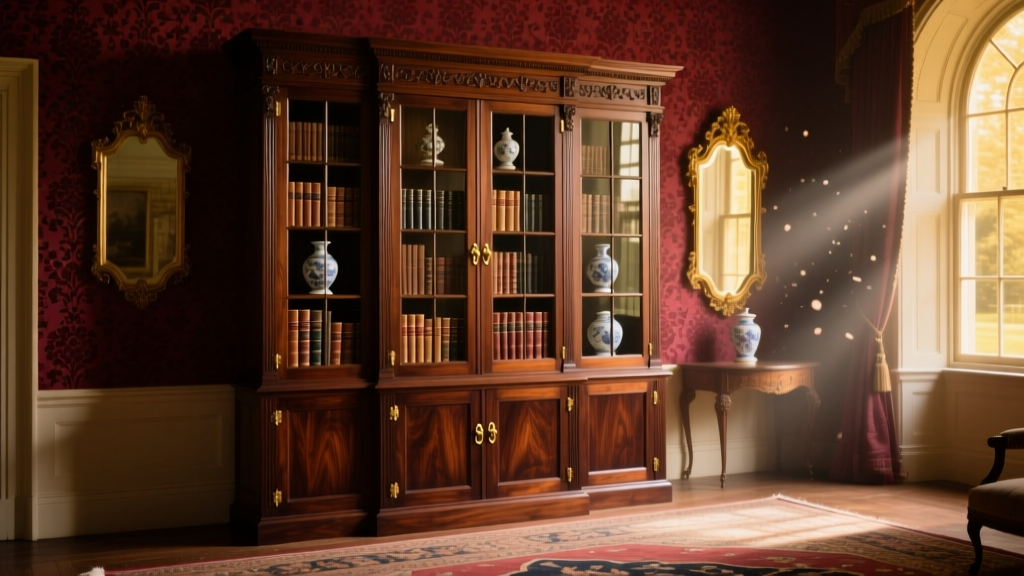
George III Mahogany Bookcase with Glazed Mullioned Doors: A Technical and Historical Appraisal of a 94¾-Inch Specimen
The 1137969: A Deep Structural and Historical Analysis of the 1948 Herman Miller Eames Lounge Chair & Ottoman (First Production Run)
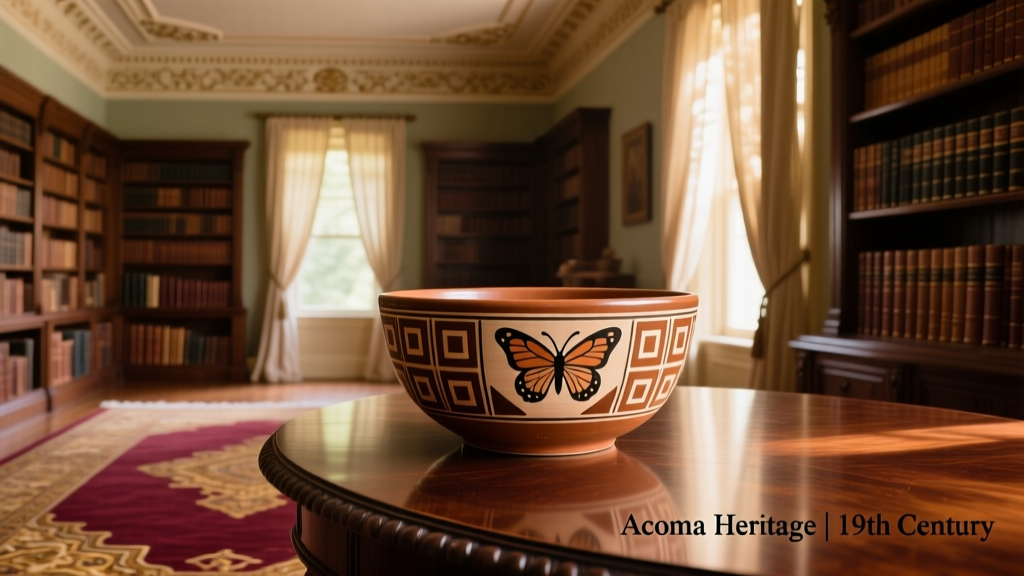
Acoma Pueblo Brownware Bowl: Decoding the Alternating Squares and Stylized Butterflies Motif (4.5 × 8 in, Circa 1940–1960)
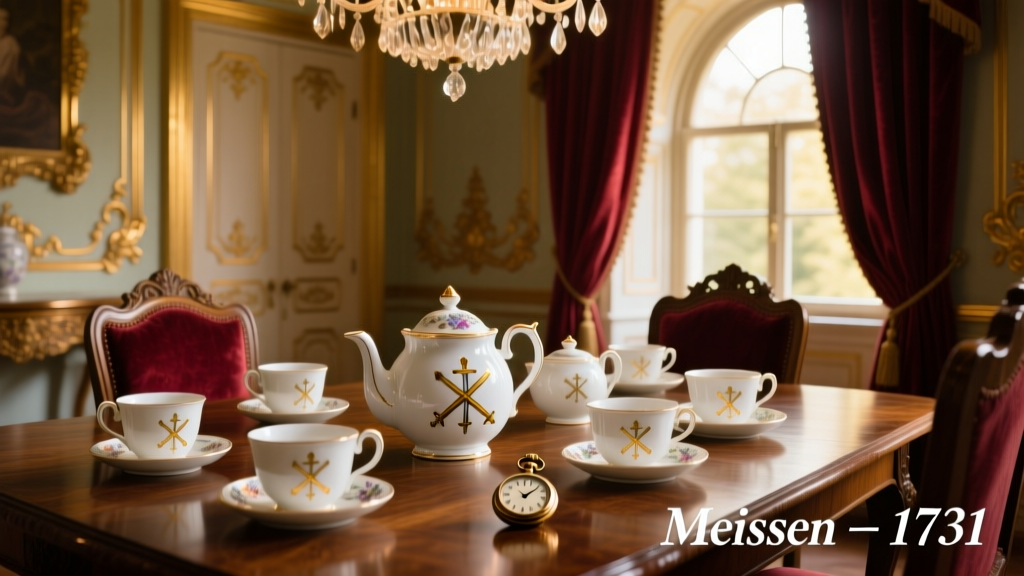
Meissen Tea Set: White Gold Crossed Swords – A Collector’s Guide to the 14-Piece Porcelain Service
Swords Fighting Foliage Form Grip Brass Hilt c. 1850 — A Technical & Historical Analysis of a 31-Inch Officer’s Sword
The 1139833: Decoding the History, Construction, and Restoration of a Rare 1920s Duncan Phyfe Revival Mahogany Sideboard
Silhouette Portraits of a Couple: Mid-19th Century Hollow-Cut Pair in Original Giltwood Frames