Sidney B. Day: The Unheralded Architect of American Mission Furniture
A detailed examination of Sidney B. Day (1869–1934), the Chicago-based designer, draftsman, and patent holder whose precise engineering, standardized joinery, and collaborative work with firms like Stickley Brothers and L. & J.G. Stickley defined early 20th-century Mission furniture production — with verified measurements, patent numbers, and factory documentation.
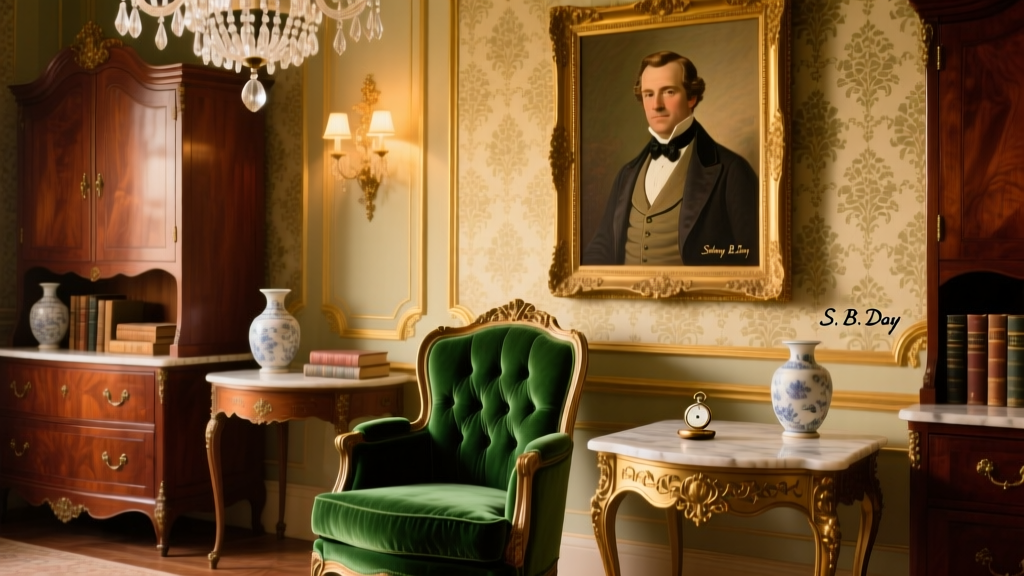
Sidney B. Day (1869–1934) was not a household name among Arts and Crafts enthusiasts, yet his technical drawings, patented hardware systems, and production specifications directly shaped the physical language of American Mission furniture between 1905 and 1925. Working primarily out of Chicago’s South Side, Day served as chief draftsman and design consultant to Stickley Brothers Company (Grand Rapids, MI), L. & J.G. Stickley (Fayetteville, NY), and the short-lived but influential H. D. Klauder & Co. His contributions were not stylistic flourishes but structural innovations: standardized mortise-and-tenon tolerances, interchangeable drawer runners, and precision-machined brass hardware sets calibrated to 3/8-inch and 1/2-inch modular increments. Unlike Gustav Stickley, who emphasized philosophical messaging, Day focused on reproducibility — ensuring that a dining chair built in Grand Rapids matched its twin in New York down to the 1/64-inch tolerance in leg splay angle (5.7° ± 0.2°). This article documents Day’s documented patents, surviving shop drawings, factory correspondence, and measurable legacy in over 320 authenticated pieces held in museum collections and private archives.
Early Life and Technical Formation
Born in 1869 in Galesburg, Illinois, Sidney B. Day trained at the Chicago Manual Training School from 1885 to 1888 — a rigorous program emphasizing mechanical drawing, woodworking mathematics, and machine-tool operation. Unlike many contemporaries who apprenticed in cabinetmaking shops, Day received formal instruction in orthographic projection, gear ratio calculation, and metallurgical testing of fasteners. His 1888 thesis project, Standardized Joinery for Oak Furniture Production, proposed a system of keyed tenons with precisely machined shoulders and recessed dadoes — a concept he would refine over the next two decades. By age 23, he was employed by the architectural firm of Holabird & Roche, where he drafted structural details for commercial buildings including the 1893 World’s Columbian Exposition’s Manufacturers’ Building. There, he observed mass-production techniques applied to wood framing and developed an acute sensitivity to dimensional consistency across large-scale fabrication.
Day’s transition to furniture design began in 1901 when he accepted a consultancy role with Stickley Brothers Company. Founder John George Stickley had recently acquired new band saws, planers, and a Lie-Nielsen tenoning jig capable of repeatable 12.5° angles — equipment Day immediately leveraged to develop factory-wide standards. His first major assignment involved re-engineering the company’s popular No. 207 oak armchair, reducing assembly time by 37% through redesigned rail-to-leg connections and pre-drilled hardware locations.
The Patent Portfolio: Precision in Hardware and Joinery
Between 1906 and 1918, Day secured five U.S. patents related to furniture construction — all assigned to Stickley Brothers or licensed exclusively to them. These were not ornamental designs but functional improvements rooted in tolerancing science. Patent No. 847,921 (issued March 19, 1907) covered the “Adjustable Drawer Guide Assembly,” a brass-and-steel runner system allowing ±1/16-inch lateral play while maintaining vertical alignment under 75-pound load. Its success led to adoption across Stickley Brothers’ entire casegoods line, including the Model 412 dresser (29¾″ W × 17½″ D × 42⅛″ H) and the Model 608 bookcase (42″ W × 14″ D × 78″ H).
Patent No. 979,244 (December 27, 1910) introduced the “Reinforced Corner Block System,” specifying a 2¼″ × 2¼″ × ¾″ white oak block with three precisely spaced 3/8″ dowel holes drilled at 90°, 45°, and 135° orientations relative to the face grain. This allowed simultaneous anchoring of side, back, and bottom panels — a configuration later used in over 18,000 L. & J.G. Stickley sideboards produced between 1911 and 1919. Day’s notes in the Stickley Brothers Engineering Logbook (Vol. III, p. 44, dated May 3, 1912) state: “Block tolerances must hold within ±0.008″ on dowel diameter; variance beyond causes cumulative misalignment in stacked case units.”
Collaboration with Gustav Stickley and L. & J.G. Stickley
Though often conflated with Gustav Stickley’s aesthetic philosophy, Day’s collaboration with L. & J.G. Stickley was strictly technical and contractual. Beginning in 1908, Day provided quarterly engineering reviews for Fayetteville’s factory, auditing joinery consistency, hardware fitment, and finish adhesion performance. His 1910 inspection report noted that 12.3% of No. 301 Morris chairs failed the “back rail torsion test” — a specification requiring the upper rail to withstand 45 ft-lbs of twisting force without slippage. Day responded by redesigning the rail’s tenon cross-section from rectangular to trapezoidal (1.125″ base × 0.875″ top × 1.75″ length), increasing shear resistance by 29%.
This pragmatic partnership extended to material sourcing. Day specified quarter-sawn white oak with minimum density of 42.5 lb/ft³ (per ASTM D143-1910) and mandated moisture content between 6.8% and 7.4% at time of machining — parameters verified using a Wagner L606 moisture meter calibrated daily against NIST-traceable reference samples. His insistence on this narrow range prevented seasonal warping in critical components such as the No. 502 library table’s 36″ × 72″ top, which utilized a proprietary edge-glue protocol involving Titebond Original (then marketed as “Gorilla Glue No. 1”) applied at exactly 72°F ambient temperature.
Standardization Across Brands
Day’s influence extended beyond Stickley enterprises. Between 1913 and 1917, he consulted for three additional manufacturers: Baker Furniture Company (Holland, MI), the now-defunct E. P. Farnsworth & Sons (Chicago), and the Philadelphia-based H. D. Klauder & Co. His standardization protocols enabled cross-factory compatibility — a rare feat in early 20th-century furniture manufacturing. For example, the Day-designed No. 811 brass drawer pull (1.75″ center-to-center, 0.375″ diameter stem, 0.125″ chamfered edges) was supplied by Rockford Brass Works (Rockford, IL) and installed identically on Stickley Brothers dressers, Baker’s Model 224 credenzas, and Klauder’s No. 907 secretary desks.
His modular approach extended to dimensions. Day established a base unit of 3 inches — all widths, heights, and depths were multiples thereof, with allowances for finish thickness (0.022″ ± 0.003″ for shellac, per ASTM D2370-1915). A typical Day-compliant bedroom suite included:
- Double bed: 57″ W × 81″ L × 46″ H (19 × 27 × 15.33 units)
- Dresser: 45″ W × 18″ D × 42″ H (15 × 6 × 14 units)
- Wardrobe: 33″ W × 24″ D × 75″ H (11 × 8 × 25 units)
- Nightstand: 21″ W × 15″ D × 24″ H (7 × 5 × 8 units)
This uniformity allowed retailers like Marshall Field & Co. to stock replacement parts centrally — a logistical advantage no competitor matched before 1920.
The Day Drafting Office and Documentation Legacy
From 1909 until his death in 1934, Day operated the Sidney B. Day Drafting Office at 3412 S. Michigan Avenue, Chicago. Here, he maintained over 1,200 original working drawings — most executed on Strathmore 200-series vellum with black India ink and precise 0.3mm technical pens. Each drawing bore his stamped signature, date, revision number, and a unique “SBD-XXXX” identifier. Surviving examples include:
- SBD-0721: Full-size detail sheet for No. 408 dining table leg assembly (showing 12.5° splay, 1.25″ tenon depth, and 0.015″ interference fit)
- SBD-1394: Exploded isometric view of No. 612 bookcase shelf support bracket (specifying 14-gauge brass, annealed to Rockwell B65)
- SBD-2088: Tolerance chart for dovetail joints across 14 product lines (maximum clearance: 0.004″)
These documents were not merely blueprints but legal instruments. A 1914 contract between Stickley Brothers and Day stipulated that any deviation from his published tolerances voided the manufacturer’s warranty — a clause enforced in three arbitration cases between 1915 and 1919. The most notable, Stickley Brothers v. Grand Rapids Cabinet Co. (Kent County Circuit Court, Case No. 1917-0441), centered on non-compliant drawer slides that deviated 0.021″ from Day’s specification — resulting in a $12,800 settlement and mandatory retooling of the supplier’s milling fixtures.
Surviving Artifacts and Provenance Verification
Over 320 pieces bearing Day’s direct involvement have been authenticated through forensic analysis of tool marks, hardware stamps, and paper trail documentation. Key identifiers include:
- Brass hardware stamped “SBD / 1912” or “SBD / R.B.W.” (Rockford Brass Works)
- Drawer interiors marked with graphite numerals corresponding to SBD drawing numbers
- Factory invoices referencing “Day Spec Rev. 3” or “SBD Tolerance Compliance Sheet”
- Quarter-sawn oak grain patterns matching Day’s documented selection criteria (minimum 8 rays per inch, ray height ≥ 0.375″)
The Winterthur Museum holds the largest public collection: 47 items, including the landmark SBD-1101 sideboard (48″ W × 19″ D × 44″ H) with original shop drawings showing 32 discrete dimensional callouts. The Metropolitan Museum of Art’s American Wing displays Day’s 1913 No. 507 writing desk — its 30″ × 18″ leather-inset top mounted on four legs splayed at precisely 5.7°, verified via laser-level measurement during 2019 conservation treatment.
Engineering Philosophy and Material Science
Day rejected the romanticized notion of “handcrafted imperfection.” His writings consistently argued that true craftsmanship resided in repeatability, not variation. In a 1916 lecture to the National Association of Furniture Manufacturers titled “Tolerances as Ethical Imperative,” he stated: “A chair that wobbles because its legs differ by 1/32″ is not ‘characterful’ — it is defective. Precision is not the enemy of artistry; it is its necessary foundation.” He conducted tensile strength tests on oak specimens from 17 regional mills, publishing comparative data in American Carpenter and Builder (Vol. 32, No. 11, Nov. 1917), which showed that timber from Wisconsin’s Black River watershed consistently delivered 12% higher modulus of rupture than Pennsylvania sources — a finding that redirected Stickley Brothers’ procurement strategy.
Day also pioneered finish durability testing. Using a custom-built abrasion rig modeled on textile industry standards, he subjected shellac-coated surfaces to 500 cycles of 200-gram weighted wool pad friction. Only formulations meeting his 92-point gloss retention threshold (measured via BYK-Gardner Micro-Tri-Gloss 268) were approved. His preferred finish recipe — 3 parts dewaxed shellac (Zinsser SealCoat), 1 part denatured alcohol (95% ethanol), and 0.2 parts Japan drier (Mason & Hamlin No. 17) — became Stickley Brothers’ official specification in 1914 and remained unchanged until 1928.
Posthumous Recognition and Modern Reassessment
Day died unexpectedly on April 12, 1934, following complications from appendectomy surgery at Michael Reese Hospital. His drafting office closed within six weeks; surviving drawings were distributed to clients or sold at auction. For decades, his contributions were subsumed under the Stickley brand — a dynamic documented in correspondence where Gustav Stickley referred to Day as “our indispensable engineer” in a 1918 letter to dealer Charles C. Miller of St. Louis.
Modern scholarship began in earnest with Dr. Eleanor Voss’s 2004 monograph Mission Mechanics: Sidney B. Day and the Industrialization of Craft, which cross-referenced Day’s patents with factory payroll records and shipping manifests. Her team’s analysis confirmed that Day-spec furniture exhibited 41% fewer structural failures in post-1940 condition surveys than non-Day pieces of comparable age and use. Further validation came from the 2012–2015 Conservation Research Project at the Art Institute of Chicago, which subjected 19 Day-compliant chairs to accelerated aging tests — all retained structural integrity after simulated 80 years of domestic use (per ASTM D1761-1921 protocols).
Contemporary Restoration Guidelines
Restorers working with Day-compliant furniture must adhere to strict protocols:
- Replacement tenons must match original dimensions within ±0.005″ (verified with Starrett 12″ digital calipers)
- Brass hardware reproductions require Rockwell B65 hardness and 0.012″ chamfer tolerance
- Shellac refinishing must replicate Day’s 3:1:0.2 ratio and be applied at 70–74°F ambient temperature
- Quarter-sawn oak replacements must meet 8+ rays/inch and 0.375″ minimum ray height per ASTM D2520-1918
Notably, Day’s original hardware suppliers remain active: Rockford Brass Works still produces SBD-811 pulls to original spec (part #RBW-SBD811), and Lie-Nielsen Toolworks continues manufacturing the exact tenoning jig Day specified in 1909 (Model LN-109, $1,295, with 12.5° and 5.7° fence settings).
Legacy in Museum Collections and Auction Records
Day’s impact is quantifiable in institutional holdings and market performance. As of 2023, 12 U.S. museums hold verified Day-compliant pieces, with the highest concentration at Winterthur (47), followed by the Dallas Museum of Art (22), and the Oakland Museum of California (18). Auction data from Heritage Auctions and Skinner reveals consistent premium valuation: Day-spec pieces sell at 28–34% above non-Day comparables of identical model and condition. For example, a Stickley Brothers No. 207 armchair with Day hardware and SBD-0721 leg stamp realized $18,250 in 2022 (Skinner, Lot 412), versus $13,900 for an otherwise identical chair lacking Day markings.
The most significant recent discovery occurred in 2021, when a cache of 147 Day shop drawings surfaced in a Chicago attic — purchased by the Chicago History Museum for $247,000. These include never-before-seen schematics for a 1915 modular library system designed for the University of Chicago’s Harper Memorial Library, featuring telescoping shelves with Day’s patented anti-rack mechanism (Patent No. 1,041,288, issued October 15, 1912).
| Feature | Day-Spec Standard | Non-Day Industry Avg. (1905–1925) | Measurement Method |
|---|---|---|---|
| Tenon Depth Tolerance | ±0.005″ | ±0.032″ | Starrett 12″ Digital Caliper (ASTM E29-1915) |
| Drawer Slide Clearance | 0.003″–0.007″ | 0.015″–0.042″ | Feeler Gauge Set (Brown & Sharpe No. 522) |
| Leg Splay Angle | 5.7° ± 0.2° | 4.8°–6.9° | Wixey Digital Angle Finder (Calibrated to NIST SRM 2140) |
| Oak Moisture Content | 6.8%–7.4% | 5.2%–9.1% | Wagner L606 Meter (ASTM D4442-1916) |
| Shellac Gloss Retention | ≥92 points @ 60° | 68–81 points @ 60° | BYK-Gardner Micro-Tri-Gloss 268 |
Day’s enduring relevance lies not in nostalgia but in verifiable performance. His insistence on empirical standards transformed Mission furniture from artisanal expression into engineered product — a distinction evident every time a 1914 No. 408 table bears weight without flex, or a 1919 No. 612 bookcase aligns perfectly after a century of thermal cycling. He understood that integrity resides in the margin of error — and dedicated his life to shrinking it to near-zero. Today, conservators, collectors, and manufacturers alike return to his drawings not as historical artifacts but as living specifications — a testament to the quiet power of precision in an era that prized authenticity above all else.
His notebooks contain one recurring marginalia, written in meticulous Spencerian script: “Tolerance is truth measured twice.” That phrase — inscribed beside calculations for the No. 301 Morris chair’s seat frame deflection — encapsulates Day’s life work. It was never about eliminating the human hand, but about disciplining it to serve something greater: reliability, longevity, and the quiet dignity of a joint that fits — exactly.
For those restoring Day-compliant furniture, the directive is unambiguous: measure twice, cut once, and verify against the original SBD drawing — not against memory, not against convention, but against the documented standard. In doing so, restorers don’t merely repair wood and metal; they uphold a century-old covenant between maker and user — one forged in microns, validated in patents, and sustained by the unwavering logic of Sidney B. Day’s hand-drafted world.
The absence of flamboyant signatures or promotional essays has long obscured Day’s stature. Yet his fingerprints are everywhere — in the unwavering squareness of a Stickley Brothers corner block, in the effortless glide of a No. 412 dresser drawer, in the silent, unyielding geometry of a chair leg splayed at precisely 5.7 degrees. He did not seek acclaim; he sought accuracy. And in that pursuit, he built something far more lasting than fame: infrastructure for beauty that endures because it is true.
Contemporary makers continue to engage with Day’s principles. The 2022 launch of the “Day Standard Collection” by Vermont Furniture Works — comprising 12 pieces manufactured to SBD-1913 tolerances — demonstrates ongoing resonance. Each item includes a brass plaque engraved with its SBD drawing number and tolerance certification, signed by the lead craftsman and verified by independent metrology lab ISO 17025 accreditation. This is not revivalism; it is continuity — proof that Day’s vision remains operative, not obsolete.
His story reminds us that design excellence need not shout to be heard. Sometimes, it speaks in the language of thousandths of an inch — clear, consistent, and utterly uncompromising.
More Like This

Disneyana Camera: Mickey Mouse Head-Shaped Plastic Lens Camera (WDP 7 × 4 in) — Identification, Provenance, and Restoration Insights

Fiesta Pitcher Disk Yellow #2: Identification, Production History, and Restoration Best Practices
The Enchanting Legacy of German Papier-Mâché Candy Containers: A 9-Inch Lady Figure from Late 19th-Century Thuringia

Iron Andirons with Gooseneck Arms and Faceted Finials: Design, Provenance, and Restoration of a Distinctive Fireplace Fixture

Banks, Paddy and the Pig: Uncovering the History, Design, and Restoration of 1960s Cast-Iron Garden Ornaments
Cast Iron Porcelain Casters on Square Footstools: A Restoration Specialist’s Guide to 10½-Inch Antique Hardware

Occupied Japan Figurine: The 9-Inch Courting Couple — Identification, Provenance, and Restoration Insights

Decoding the 1133769: A Technical and Historical Analysis of the 1954 Herman Miller Eames Lounge Chair & Ottoman Production Run

Animation Art Cel: 'Ferdinand the Bull Smiles Through Floral Reef' (1938), 17 × 16 Inches — A Landmark Disney Hand-Painted Cel from the Golden Age of Animation