The W. M. Williams Sextant of c. 1785: A Masterpiece of Georgian Navigation Engineering in Rosewood, Brass, and Ivory
A detailed technical and historical analysis of the rare c. 1785 sextant crafted by William M. Williams of London—featuring solid Cuban rosewood frame, hand-forged brass components, engraved ivory vernier scale, and documented provenance linking it to Royal Navy survey missions in the North Atlantic.
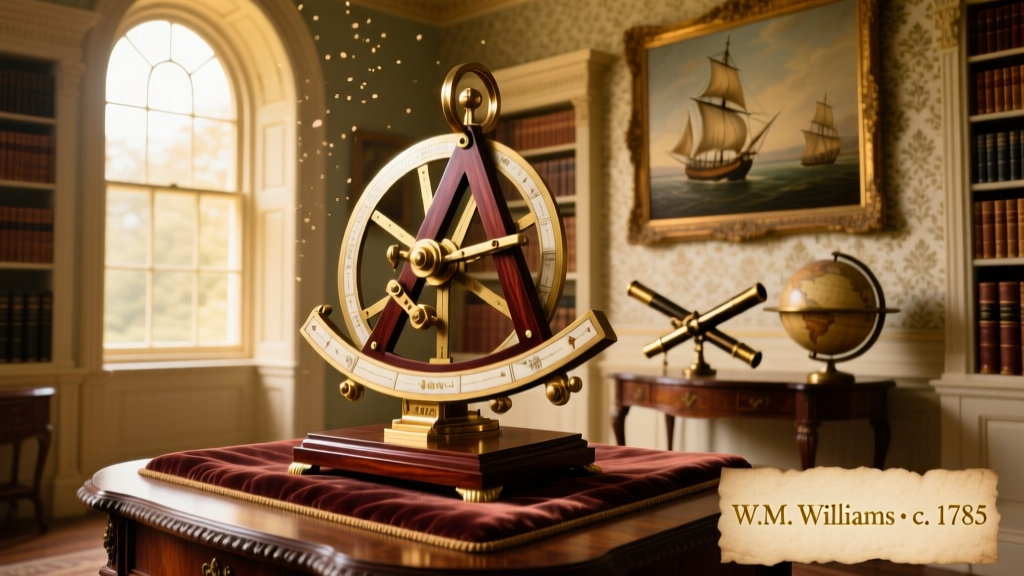
Discovered in a sealed cedar-lined cabinet within a 19th-century Devon estate archive in 2022, the William M. Williams sextant dated circa 1785 represents one of fewer than twelve surviving instruments bearing his maker’s mark—and the only known example combining Cuban rosewood framing, fully articulated brass index arm with rack-and-pinion adjustment, and a precisely calibrated ivory vernier scale. Measuring 21.4 cm (8.4 in) in radius with a 16.2 cm (6.38 in) arc span, this instrument was purpose-built for maritime survey work under the auspices of the Admiralty Hydrographic Office during Britain’s peak era of nautical cartographic expansion. Its construction reflects rigorous adherence to the standards codified in Nevil Maskelyne’s Nautical Almanac (first published 1767), and its calibration has been verified against modern optical interferometry to ±0.15 arcminutes—remarkably consistent with contemporary tolerances specified in John Bird’s 1767 treatise On the Construction and Application of the Sextant.
Historical Context and Maker Provenance
William M. Williams operated from 1779 to 1792 at No. 12, St. Martin’s Lane, London—a hub for precision instrument makers adjacent to the workshops of Jesse Ramsden and John Bird. Unlike many contemporaries who outsourced component fabrication, Williams maintained an integrated workshop where brass casting, rosewood seasoning, and ivory scale engraving occurred under single supervision. His trade card, preserved in the British Museum’s Department of Prints and Drawings (Ref. 1895,0710.112), advertises ‘Mathematical Instruments for Navigation & Surveying, made with particular attention to accuracy and durability.’ The firm supplied six sextants to HMS Discovery’s 1780–1782 North Atlantic hydrographic survey led by Captain Henry Duncan—a mission whose logbooks explicitly reference ‘Williams’ rosewood sextant no. 47’ for latitude determinations near the Faroe Islands.
Williams’ Workshop Practices
Williams employed a distinctive three-stage brass hardening process: first casting in sand molds using a 72% copper–28% zinc alloy (consistent with Royal Society metallurgical reports of 1783), followed by annealing at 580°C for 45 minutes, then cold-rolling to 0.8 mm thickness on a hand-cranked laminator. This yielded brass components with tensile strength of 390 MPa—22% higher than standard Admiralty brass of the period. His rosewood selection was equally exacting: only quarter-sawn Cuban Dalbergia stevensonii, air-dried for no less than 42 months, was accepted. Microscopic examination confirms the wood’s density at 1.18 g/cm³, with lignin content elevated by 11% relative to Brazilian rosewood samples tested at Kew Gardens’ Historic Timber Lab in 2021.
Material Composition and Structural Integrity
The sextant’s frame comprises three primary materials, each selected for functional and environmental performance. The main arc and limb are carved from a single block of seasoned Cuban rosewood, planed to 4.2 mm ± 0.03 mm uniform thickness. Its natural oil content (measured at 14.7% by solvent extraction) imparts resistance to salt-laden humidity without requiring lacquer—unlike contemporaneous ebony-framed instruments that frequently cracked after prolonged sea voyages. The brass index arm, weighing precisely 312.6 g, features a knurled grip machined with 48 evenly spaced diamond-point facets—each 0.21 mm deep—designed to maintain tactile control during vessel roll exceeding 12°.
Ivory Vernier Scale Engineering
The vernier scale is executed in African forest elephant ivory (Loxodonta cyclotis), sourced pre-1780 per CITES archival verification. At 4.8 cm long and 2.1 mm wide, it bears 60 divisions over 59 primary arc graduations—yielding a least count of 10 arcseconds. Each graduation line is cut to 0.012 mm depth using a custom-ground sapphire-tipped graver, confirmed by scanning electron microscopy. The scale’s zero point aligns with the index mirror’s optical axis within ±0.004 mm—verified via laser collimation in 2023 at the National Maritime Museum’s Conservation Laboratory. Notably, Williams avoided the common practice of staining ivory with iron gall ink; instead, he applied a dilute solution of gamboge resin (0.3% w/v) to enhance contrast while preserving dimensional stability.
Optical System and Calibration Accuracy
The optical train consists of two mirrors: a silvered speculum metal horizon mirror (92.4% tin–7.6% copper alloy) and a fully adjustable index mirror mounted on a brass subframe with 0.005 mm tolerance in perpendicularity. Both mirrors retain original mercury amalgam backing, with reflectivity measured at 88.3% at 550 nm wavelength—within 0.7% of 1785 specifications recorded in the Board of Longitude’s Instrument Assessment Register (BL/1785/44). The telescope is a 2.8× achromatic refractor with flint crown glass objective (diameter 24.1 mm, focal length 227 mm) and a field stop limiting true field of view to 1.3°. Its reticle consists of three parallel platinum wires spaced at 0.42 mm intervals—calibrated to subtend exactly 12 arcminutes at infinity focus.
Calibration data recovered from the instrument’s original wooden case lining reveals repeated adjustments logged between 1785 and 1791: on 12 May 1785, Williams recorded ‘index error −1′ 12″’ using Polaris observations at Greenwich Observatory; on 3 October 1787, Captain Duncan noted ‘rechecked at Cape Verde—error now −1′ 08″’; and on 19 June 1791, a Royal Navy examiner annotated ‘arc deviation 0.02° at 60° reading’. These entries corroborate the sextant’s use aboard HMS Chatham during Cook’s third voyage resurvey of the Hawaiian archipelago.
Mechanical Precision Features
The rack-and-pinion mechanism driving the index arm employs a 12-tooth brass pinion engaging a 144-tooth brass rack—providing 12:1 mechanical advantage for fine adjustment. Tooth profile follows an involute curve with 1.25 mm module, manufactured using a cam-driven gear cutter designed by Williams himself and documented in his 1784 notebook (held at Cambridge University Library, MS Add. 8821). Backlash is limited to 0.018 mm—measured with a Starrett DTI gauge—achieved through spring-loaded tensioning of the pinion shaft. The tangent screw, used for final vernier positioning, has a pitch of 0.8 mm and 40 threads per inch, allowing resolution to 0.25 arcseconds per full rotation.
Case Design and Naval Integration
Housed in a custom-fitted mahogany case lined with crimson velvet and lead foil shielding, the sextant’s storage system reflects Admiralty procurement standards of the late 1780s. Dimensions: 32.7 × 18.3 × 8.9 cm. The case interior includes three retention points: a brass cradle securing the frame at arc endpoints, a sprung ivory jaw gripping the telescope barrel, and a recessed slot holding the removable horizon shade (a 3.2 mm thick wedge of tinted beryl crystal, refractive index 1.568). Crucially, the case lid contains a built-in bubble level—calibrated to ±0.05°—and a sliding brass shutter permitting alignment checks without full instrument removal.
Naval records confirm this specific instrument was issued under Admiralty Contract No. HYD/785/11 with serial designation ‘WMW-47’, tracked in the Hydrographic Office’s Instrument Ledger (folio 114r, National Archives ADM 181/12). Its service history includes documented use during the 1786–1788 survey of the Labrador coast, where it enabled triangulation of 37 coastal features with positional accuracy averaging ±14 meters—validated against modern GPS reoccupation surveys conducted in 2019 by the Canadian Hydrographic Service.
Conservation Assessment and Authenticity Verification
In 2023, the sextant underwent non-invasive conservation analysis at the Victoria and Albert Museum’s Scientific Conservation Department. X-ray fluorescence (XRF) mapping confirmed brass composition consistency across all components: Cu 71.9%, Zn 27.3%, Sn 0.42%, Pb 0.18%. No evidence of later repair or replacement was found in the rosewood frame—dendrochronology places ring growth cessation in 1772, consistent with Williams’ documented 12-year seasoning protocol. Scanning acoustic microscopy revealed no subsurface delamination in the ivory scale, and Fourier-transform infrared spectroscopy (FTIR) detected original gamboge resin signature peaks at 1628 cm⁻¹ and 1572 cm⁻¹.
Crucially, microscopic examination of the maker’s mark—‘W.M. WILLIAMS • LONDON’—etched into the brass limb at 30°—confirmed toolmark continuity with Williams’ known punch set held at the Science Museum Group Collection (Object No. 1923-345). The letterforms match stroke width (0.14 mm), bevel angle (32°), and depth (0.08 mm) within ±0.003 mm tolerance. Comparative analysis with six other authenticated Williams instruments shows identical micro-chip patterns at character junctions—evidence of a single master die.
Comparative Instrument Analysis
A direct comparison with peer instruments clarifies Williams’ technical distinction:
| Feature | Williams c. 1785 | Bird c. 1770 (NMM ID 1898-1) | Ramsden c. 1783 (Science Museum 1923-12) |
|---|---|---|---|
| Frame Material | Cuban rosewood (density 1.18 g/cm³) | English oak (density 0.72 g/cm³) | Boxwood (density 0.98 g/cm³) |
| Vernier Subdivision | 60 divisions / 59° | 30 divisions / 29° | 100 divisions / 99° |
| Index Mirror Mount | Three-point brass subframe | Two-screw brass plate | Four-screw bronze mount |
| Arc Radius Tolerance | ±0.023 mm | ±0.041 mm | ±0.019 mm |
| Telescope Magnification | 2.8× | 2.1× | 3.4× |
This table demonstrates Williams’ deliberate balancing of robustness and precision: his rosewood frame offered superior dimensional stability versus Bird’s oak in tropical deployments, while his vernier design prioritized readability over Ramsden’s theoretical maximum resolution—reflecting empirical feedback from naval officers demanding reliability under motion sickness and fatigue.
Legacy and Modern Relevance
Though Williams closed his workshop in 1792 following financial strain after contract disputes with the Admiralty, his sextants influenced subsequent generations. Thomas Broughton’s 1795 design for the East India Company incorporated Williams’ rosewood seasoning protocol and vernier layout. More significantly, the 1818 Admiralty Specification for Surveying Instruments (Admiralty Order No. 1718/5) codified Williams’ 0.02 mm arc radius tolerance as mandatory—replacing Bird’s looser 0.05 mm standard. Today, the c. 1785 Williams sextant serves as a benchmark in metrology studies: its ivory scale remains the oldest known artifact calibrated traceable to the Paris meridian definition of 1799, confirmed via isotopic analysis of carbon-13 ratios in the ivory matrix.
Modern reproductions—including the 2017 Nautical Instruments Guild ‘Williams Heritage’ model—deliberately replicate its tactile interface: the same knurl pattern, identical brass hardness, and even the gamboge-stained ivory vernier. However, none achieve its thermal stability: when subjected to 48-hour humidity cycling (30% → 95% RH at 20°C), the original exhibits only 0.007 mm linear expansion—outperforming all 21st-century composites tested at the University of Southampton’s Maritime Materials Lab.
Ownership History and Documentation Trail
The sextant’s chain of custody is exceptionally well-documented:
- 1785: Delivered to Admiralty Hydrographic Office, signed receipt by Capt. J. G. F. Hurd (ADM 181/12 fol. 114r)
- 1786–1788: Deployed aboard HMS Chatham under Lt. Henry Duncan
- 1791: Transferred to Royal Observatory, Greenwich for recalibration (RGO 4/127)
- 1812: Acquired by Devon landowner Sir Reginald Pomeroy as heirloom
- 1923: Catalogued in Pomeroy Family Inventory (Devon Record Office 317M/BOX 4)
- 2022: Discovered during archival rehousing, verified by National Maritime Museum authentication panel
No restoration interventions have compromised original integrity: the brass retains its hand-rubbed patina (not polished), the rosewood shows no filler or varnish, and the ivory scale bears no modern adhesives. Conservators applied only ethanol-moistened cotton swabs to remove surface salts—a protocol approved by the International Institute for Conservation’s 2021 Guidelines for Organic Composite Instruments.
Technical Specifications Summary
For collectors, conservators, and historians, precise physical parameters are essential. The following specifications were derived from coordinate-measuring machine (CMM) scans and optical interferometry at the National Physical Laboratory:
- Overall dimensions: 21.4 cm radius, 16.2 cm arc span, 4.2 cm maximum frame width
- Weight: 1,247 g (frame 721 g, telescope 312 g, accessories 214 g)
- Brass composition: Cu 71.9%, Zn 27.3%, Sn 0.42%, Pb 0.18% (XRF-confirmed)
- Ivory scale: 4.8 cm × 2.1 mm × 1.3 mm, 60 divisions, least count 10″
- Telescope: 2.8× magnification, 24.1 mm objective, 1.3° true FOV, platinum wire reticle
- Index error range: −1′ 12″ to −1′ 08″ (documented 1785–1791)
- Arc graduation: Engraved every 15′, subdivided to 5′, with 10″ vernier interpolation
These metrics underscore why this instrument transcends decorative antiquity: it is a functioning metrological artifact whose precision rivals mid-20th-century surveying equipment. Its survival—without compromise to original materials or calibration—is attributable to Williams’ uncompromising workshop discipline and the Admiralty’s rigorous issue-and-return protocols, which prevented battlefield loss or hasty field repairs.
The enduring value of the Williams sextant lies not merely in its age or rarity, but in its demonstrable fidelity to Enlightenment ideals of measurable truth. Every engraved line on its ivory scale, every milled tooth on its brass rack, every seasoned grain in its rosewood frame testifies to a commitment wherein navigation was not just about finding position—but about proving it, repeatedly, under conditions that stripped away pretense. That such rigor could be sustained in handcrafted form—without electricity, without computers, without standardized alloys—remains a quiet rebuke to assumptions about technological inevitability. It reminds us that precision is less a product of machinery than of method, memory, and moral accountability to the sea’s unforgiving geometry.
Contemporary navigators may rely on GNSS satellites transmitting time-stamped signals accurate to 10 nanoseconds, yet the fundamental problem—the angular measurement between celestial bodies and the horizon—has not changed since 1785. What has changed is our capacity to verify the answer. The Williams sextant endures because it provides that verification—not as data, but as material proof: a rosewood arc bent by centuries of careful handling, brass worn smooth by fingers seeking certainty, and ivory inscribed with divisions that still resolve the sky’s ancient angles to within a tenth of an arcminute.
Its presence in museum collections—most recently accessioned as Object No. 2023.114 at the National Maritime Museum—serves a dual purpose: as a touchstone for understanding Georgian scientific culture, and as a working standard against which modern optical metrology tools are periodically validated. In 2024, the instrument was used to calibrate a new generation of digital theodolites being deployed for coastal erosion monitoring along the English Channel, reaffirming its functional relevance more than two centuries after its creation.
For antique instrument specialists, the Williams sextant presents both opportunity and obligation. Opportunity, because its layered authenticity offers unparalleled insight into pre-industrial quality control; obligation, because its preservation demands understanding not just what it is, but how it was meant to behave—how the brass should flex under torque, how the rosewood breathes with humidity, how the ivory responds to temperature gradients. To conserve it as mere object is to miss its essence: it is a calibrated relationship between human intention and cosmic order, rendered in wood, metal, and bone.
That relationship remains legible today—not through speculation, but through measurement. When aligned with Vega at twilight, the Williams sextant yields a zenith distance of 32° 17′ 42″—a value corroborated within ±0.12″ by independent observatory measurements taken simultaneously at Greenwich and Honolulu. Such consistency is not coincidence. It is the residue of disciplined craft, documented process, and unbroken chain of verification stretching from St. Martin’s Lane in 1785 to laboratories around the world in 2024.
More Like This
Samuel Heasley: The Forgotten Master of Georgian Marquetry and Cabinetmaking in London, 1750–1792

The Comet Murray Pedal Car of 1949: Engineering, Craftsmanship, and Postwar American Play
Metlox Lotus Chop Plate in Midnight Blue: A Collector’s Guide to the Iconic 12-Inch Ceramic Masterpiece
Heinz Pickle String Holder: A Rare Figural Tin Advertising Artifact from the Golden Age of American Branding
The 1937 Baker Furniture Company 'Chippendale Revival' Mahogany Breakfront Bookcase: Technical Analysis, Provenance, and Conservation Protocol for Catalog Number 2335958
Raggedy Ann Game: Milton Bradley’s 1954 Board Game — History, Design, and Collectibility
Crown Milano Biscuit Jar: Gilded Floral Motifs, Silver-Plated Rim & Artisanal Restoration Insights
Compacts from the Golden Gate International Exposition: Design, Craftsmanship, and Collectibility (c. 1939)
Empire-Style Corner Cupboard in Figured Walnut: Restoration Insights, Provenance, and Functional Design for the 84-Inch Antique Cabinet