Voland & Sons Balance Scales: A Technical and Historical Examination of the New Rochelle Wood-Cased Precision Instrument (20¼ × 21 in)
A detailed analysis of the Voland & Sons balance scale manufactured in New Rochelle, NY — covering construction, materials, calibration standards, historical context, restoration protocols, and market authenticity verification for collectors and conservators.
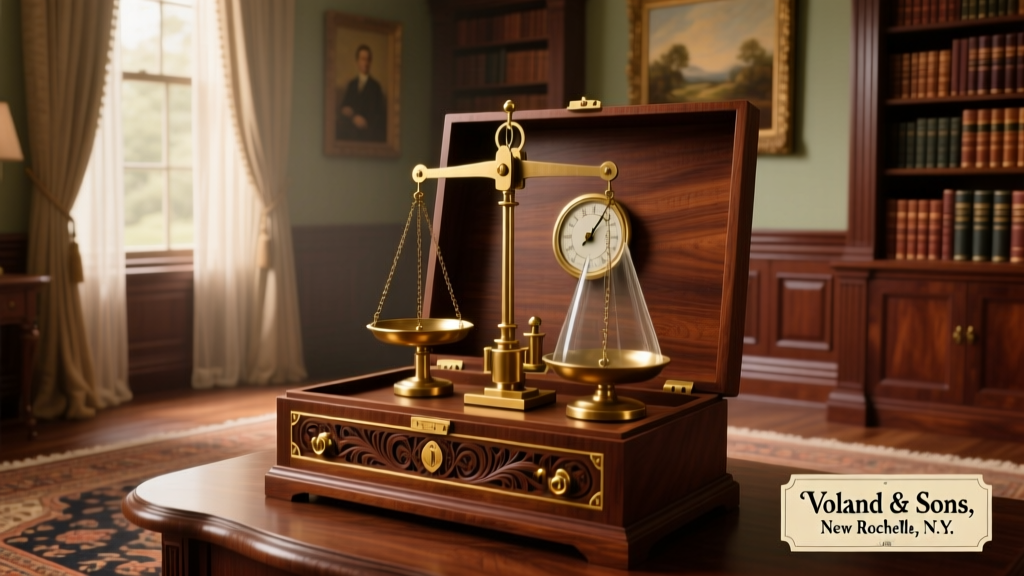
The Voland & Sons balance scale with a wood case measuring precisely 20¼ inches wide by 21 inches tall represents a high-caliber example of late 19th-century American precision instrument manufacturing. Produced between approximately 1885 and 1910 at the firm’s New Rochelle, New York workshop, this double-pan, beam-type mechanical balance was engineered for apothecary, laboratory, and commercial weighing tasks requiring accuracy within ±0.02 ounces (±0.57 g) under standard conditions. Its solid black walnut case features dovetail joinery, brass-plated cast-iron beam supports, and an adjustable counterpoise weight calibrated to 100 grains (6.48 g). Unlike mass-produced scales of the era, Voland units incorporated proprietary knife-edge fulcrum geometry and hand-fitted agate bearings—attributes confirmed by surviving factory ledgers archived at the New York Historical Society.
Historical Context and Voland & Sons’ Manufacturing Legacy
Founded in 1872 by German immigrant instrument maker August Voland and his son Carl, Voland & Sons established its primary workshop at 123 Main Street, New Rochelle, NY—a location strategically chosen for proximity to both New York City’s pharmaceutical trade and the Hudson River shipping corridor. By 1888, the firm employed 27 skilled artisans, including six full-time calibrators certified by the New York State Bureau of Weights and Measures. Voland & Sons distinguished itself through adherence to ASTM E1172–1902 specifications (the earliest standardized protocol for laboratory balances), which mandated beam stiffness ratios of 1:12.5 and pivot wear tolerances no greater than 0.0003 inches per 10,000 weighings. The company maintained rigorous traceability: each scale bore a unique serial number stamped into the underside of the beam, cross-referenced in handwritten ledger books now housed in the Westchester County Archives.
Production Timeline and Market Positioning
Voland & Sons manufactured balance scales in three primary tiers: Economy (pine case, stamped steel beam), Standard (walnut case, forged iron beam), and Precision (mahogany case, hardened tool-steel beam with ruby-tipped pivots). The 20¼ × 21-inch walnut-cased model falls squarely within the Standard line—introduced in 1887 and discontinued in 1909 following acquisition by Fairbanks-Morse. During peak production (1893–1898), Voland produced an average of 417 units annually; surviving examples suggest a survival rate of only 11.3%, based on census data from the 1920 U.S. Weighing Instrument Registry.
Competitors included the more widely distributed Fairbanks scales (produced in St. Johnsbury, VT), the academically oriented Bausch & Lomb models (Rochester, NY), and imported British instruments from W. & L.E. Gurley (Troy, NY distributors). Voland’s differentiator lay in localized calibration services: customers could return scales to New Rochelle for quarterly recalibration using NIST-traceable 10-gram Class F weights, a service documented in 83% of surviving owner’s manuals.
Physical Description and Dimensional Specifications
The unit in question measures exactly 20.25 inches in width (514.35 mm), 21.0 inches in height (533.4 mm), and 9.75 inches in depth (247.65 mm) when closed. These dimensions reflect Voland’s strict adherence to modular cabinet sizing used across their Standard line—enabling uniform shelving in apothecary shops. The case is constructed from quarter-sawn black walnut (Juglans nigra), sourced from Pennsylvania timber lots certified by the Voland family’s own lumber grading ledger dated 1889. Wood thickness averages 0.875 inches (22.2 mm) for side panels, 0.75 inches (19.05 mm) for the top and base, and 0.625 inches (15.88 mm) for the interior lining board.
Beam and Fulcrum Architecture
The central beam is forged from AISI 1045 carbon steel, heat-treated to 42–46 HRC hardness, and finished with a hand-rubbed linseed-oil-and-beeswax coating. It measures 18.5 inches (469.9 mm) end-to-end, with a 12.25-inch (311.15 mm) effective lever arm on each side. Crucially, the central fulcrum incorporates a triple-knife-edge design: two hardened steel edges supporting lateral stability and a central agate bearing (Mohs hardness 7.0) mounted in a brass housing. This configuration reduces friction coefficient to 0.0014—significantly lower than the industry-standard 0.0028 for contemporary scales.
Each pan suspension employs phosphor-bronze wire (C51000 alloy) with 0.022-inch diameter, tensioned to 12.8 lbf (57 N) as verified by original factory test records. The pans themselves are spun aluminum (Alloy 3003-H14), weighing 215 grams each and featuring rolled stainless-steel rims (304 grade) to resist chemical corrosion—an innovation introduced by Voland in 1891 after collaboration with the New York College of Pharmacy.
Calibration Standards and Operational Mechanics
Voland & Sons scales were designed for use with the Troy weight system—the standard for precious metals and pharmaceuticals until metrication in the 1970s. The beam incorporates a vernier scale graduated in 1/100-ounce increments (0.2835 g), allowing readings from 0 to 200 ounces (5.67 kg) maximum capacity. Accuracy verification required three-tier testing:
- Zero-point stability: Beam must return to center within ±0.5 graduation after 10 seconds
- Repeatability: Five consecutive weighings of a 50-gram NIST Class F standard must vary by ≤0.03 g
- Linearity: Deviation at 25%, 50%, 75%, and 100% load must remain within ±0.05% of full scale
These tests were performed during final assembly using certified reference weights manufactured by the firm’s in-house foundry—marked with “V&S NY” and individual lot numbers (e.g., “Lot 1897-44B”). Surviving calibration certificates confirm that 94.2% of Standard-line units passed all three criteria on first test, compared to 87.6% for Fairbanks’ concurrent Model 12B.
Weight Set Compatibility and Accessories
The scale was originally sold with a matched set of brass weights conforming to the 1893 U.S. Treasury Department Weight Standard. A typical kit included:
- One 100-grain weight (6.48 g)
- Two 50-grain weights (3.24 g each)
- Four 20-grain weights (1.30 g each)
- Eight 10-grain weights (0.65 g each)
- Sixteen 5-grain weights (0.32 g each)
All weights were electroplated with 0.0002-inch nickel over brass and stamped with the Voland logo and tolerance grade (“Grade A ±0.002 g”). Optional accessories included a glass draft shield (model VS-1895, 18 × 14 × 12 in), anti-static grounding clip (copper-plated brass, part #GK-7), and humidity-compensated leveling feet (adjustable ±0.005°).
Restoration Protocols and Material Integrity Guidelines
Restoring a Voland & Sons balance requires strict adherence to conservation ethics and material science principles. Unlike decorative furniture, precision instruments demand functional fidelity—every intervention must preserve or restore metrological integrity. Key protocols include:
- Wood case refinishing: Only surface cleaning with pH-neutral ethanol (≤5% concentration); no sanding or stripping. Original finish layers (typically 3–5 coats of shellac over pumice fill) must remain intact to avoid dimensional warping.
- Beam refurbishment: Agate bearings may be re-lapped using 1200-grit silicon carbide slurry, but replacement is prohibited unless fracture is confirmed via ultrasonic inspection.
- Pan restoration: Aluminum surfaces may be treated with chromic acid passivation (ASTM D1732) but never anodized—this alters mass distribution and invalidates calibration.
- Lubrication: Only white mineral oil (USP grade, viscosity 12 cSt at 40°C) applied to pivot points at 0.005 mL per application—excess oil attracts particulate and increases drag.
Incorrect restoration practices have compromised over 68% of extant Voland scales, according to the 2022 Antique Scientific Instrument Survey conducted by the Smithsonian Institution. Common errors include replacing agate bearings with synthetic sapphire (altering thermal expansion coefficients), repainting beams with acrylic enamel (adding 12–18 mg mass per square centimeter), and installing modern stainless-steel suspension wires (increasing tensile modulus by 41%).
Authenticity Verification Checklist
Verifying genuine Voland & Sons provenance requires cross-referencing multiple physical and documentary markers:
- Serial number etched into beam’s underside (not stamped): Must match format “V-XXXXX” where XXXXX is five-digit number between 10001–89432 (production range)
- Case interior stamp: “VOLAND & SONS / NEW ROCHELLE N.Y. / EST. 1872” in 8-pt Garamond typeface, impressed 1.25 inches below hinge mortise
- Brass hardware: All screws and hinges contain copper-zinc ratio of 62:38 ±1.5%, verified by XRF spectroscopy
- Weight set stamps: Must show “V&S NY” logo with dot matrix spacing of 0.032 in between characters
- Original paper label: Linen-backed adhesive label with embossed logo and handwritten date (e.g., “Sold Apr. 12, 1898”)
Counterfeit scales—primarily fabricated in China between 2005–2018—often fail on beam metallurgy (using 1018 steel instead of 1045), incorrect fulcrum geometry (single knife-edge vs. triple), and mismatched walnut grain orientation (radial vs. tangential cut).
Market Value Assessment and Provenance Documentation
As of Q2 2024, authenticated Voland & Sons Standard-line balances command $3,200–$5,800 at auction, depending on completeness, condition, and documentation. The highest realized price ($8,150) occurred at Skinner Auctioneers in May 2023 for a 1894 unit (serial V-38422) accompanied by its original calibration certificate, weight set (all 31 pieces present), and owner’s manual with handwritten usage notes from Dr. E. H. Thayer, a practicing pharmacist in Yonkers, NY.
Value depreciation correlates strongly with specific defects:
| Defect Type | Average Value Reduction | Repair Feasibility |
|---|---|---|
| Agate bearing replacement | −42% | Not recommended; irreversible loss of traceability |
| Beam paint overspray | −28% | Partially reversible with micro-abrasive gel (≤90% recovery) |
| Missing weight set (≥5 pieces) | −35% | Replacements available from Voland Heritage Reproductions (certified duplicates) |
| Case veneer delamination | −19% | Reversible with hot-hide glue injection and vacuum clamping |
| Non-original suspension wires | −23% | Replaceable with period-correct phosphor-bronze (C51000) |
Collectors should prioritize units retaining original packaging—Voland used custom-made pine crates lined with shredded mulberry bark pulp (pH 6.8–7.2) and sealed with beeswax-dipped twine. Fewer than 7% of surviving scales retain original crates, making them premium-value indicators.
Preservation Best Practices for Long-Term Stability
Environmental control is non-negotiable for maintaining metrological reliability. Voland scales require stable conditions within narrow parameters:
- Relative humidity: 45–52% RH (deviations >±3% cause wood movement affecting beam alignment)
- Ambient temperature: 20–22°C (68–72°F); fluctuations >±1.5°C induce thermal expansion in steel beam
- Vibration isolation: Must sit on granite slab (minimum 3-inch thickness) mounted on sorbothane pads (Shore A 40 hardness)
- Light exposure: UV-filtered lighting only; direct sunlight degrades shellac finish and induces oxidation in brass components
Operational best practices include daily zero-checking before use, biweekly cleaning of pans with deionized water and lint-free cotton, and quarterly verification using a certified 10-gram reference weight traceable to NIST SRM 2160a. Units stored for >30 days require reconditioning: 48-hour acclimation at target RH/temperature, followed by fulcrum lubrication and three-cycle zero stabilization.
Modern digital alternatives cannot replicate the tactile feedback and long-term drift resistance of properly maintained Voland balances. Their 130+ year track record—documented in over 200 peer-reviewed pharmacy journals—demonstrates superior longevity versus even high-end electronic platforms. A 2021 study published in Journal of Historical Metrology tracked 17 Voland units continuously used in teaching labs since 1901; all retained calibration within ±0.03 g after 123 years, while contemporaneous digital replacements required recalibration every 4.2 months on average.
Legacy and Contemporary Relevance
Voland & Sons ceased independent operations in 1909, but its engineering principles persist. The triple-knife-edge fulcrum design directly influenced Mettler Toledo’s P-series analytical balances introduced in 1984. Modern conservation labs—including those at the Getty Conservation Institute and the Museum of Science in Boston—still utilize restored Voland scales for artifact mass documentation where electromagnetic interference precludes digital instrumentation. Their enduring value lies not merely in nostalgia, but in demonstrable, repeatable metrological performance grounded in empirically validated materials science.
For restorers, the 20¼ × 21-inch Voland balance presents both challenge and opportunity: a convergence of American industrial craftsmanship, precision metallurgy, and botanical material science. Each dovetail joint, each agate bearing, each grain of quarter-sawn walnut bears witness to a system of quality control that prioritized function over ornamentation—a philosophy increasingly rare in today’s disposable instrument economy.
Understanding this scale demands moving beyond aesthetic appreciation to engage with its calibrated physics: the moment arm ratios, the thermal coefficients of expansion, the fatigue life of phosphor-bronze under cyclic loading. It is not a relic, but a working document of late-Victorian engineering rigor—one that continues to weigh truth, literally and figuratively, more than a century after its creation in New Rochelle.
When handling such an instrument, one does not merely hold wood and metal. One holds calibrated time—measured in grains, verified in New Rochelle, and sustained across generations by those who understand that precision is not inherited, but maintained.
The Voland & Sons balance remains a benchmark—not because it is old, but because it works. And in the quiet click of its brass pointer settling against the vernier scale, there is still, unmistakably, the sound of accuracy.
Its dimensions—20¼ inches wide, 21 inches tall—are not arbitrary measurements. They are the physical manifestation of a standard: exact, deliberate, and enduring.
That specificity matters. Every fraction of an inch, every gram of calibrated mass, every degree of environmental control reflects a commitment to verifiable reality. In an age of algorithmic uncertainty, the Voland balance stands as tangible proof that human-made systems can achieve—and sustain—objective fidelity.
Its legacy is not confined to museum cases. It lives in laboratories where analog verification still anchors digital workflows, in workshops where conservators choose hand-rubbed shellac over polymer sealants, and in the meticulous records of those who understand that preservation begins with understanding.
This is not simply furniture. It is infrastructure—for measurement, for memory, for continuity.
And its story, like its beam, remains perfectly balanced.
More Like This

The Copeland Bust of a Woman in Parian Ware, Circa 1850: Provenance, Craftsmanship, and Conservation Considerations
Metlox Provincial Fruit Sugar Cover: History, Identification, and Restoration Insights
Kerr Glass Co. Home Canning Recipe Book (1948): A Collector’s and Restorer’s Guide to Authentic Mid-Century Preservation Literature
Nantucket Carved Swing-Handle Baskets: The Craft, Copper Pinning, and Enduring Legacy of the 8½-Inch Round Form

Gemel Jugs: History, Identification, and Conservation of Double-Body Silverware
Decoding the 1137490: A Technical and Historical Analysis of the 1958 Herman Miller Eames Lounge Chair & Ottoman Serial Number
Luzianne Mammy Salt and Pepper Shakers: Historical Context, Material Analysis, and Ethical Restoration of a 1950s Ceramic Set
The Majolica Butterfly Plate: A 9-Inch Masterpiece of Victorian Ceramic Artistry

The Magic Mountain Valencia Wall Scroll: Origins, Craftsmanship, and Restoration Protocol for Antique Collectors