Sandwich Glass: History, Identification, and Restoration of America’s Iconic Pressed Glass
A detailed examination of Sandwich Glass—produced by the Boston and Sandwich Glass Company from 1825 to 1888—including manufacturing techniques, pattern identification, hallmarking practices, market values, and ethical restoration protocols for collectors and conservators.
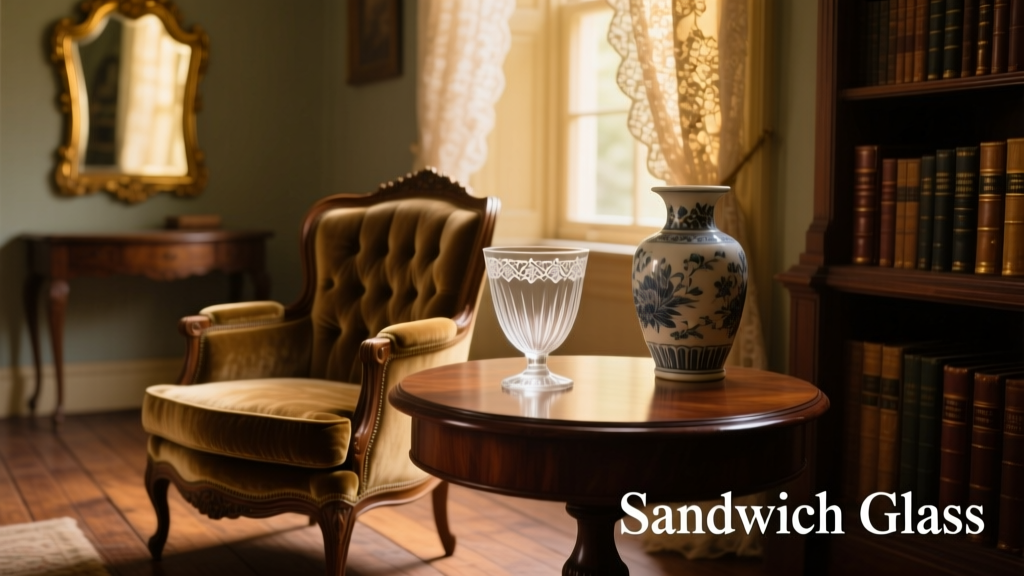
Sandwich Glass refers to pressed glassware manufactured between 1825 and 1888 by the Boston and Sandwich Glass Company in Sandwich, Massachusetts—the first successful American factory to mass-produce pressed glass using patented molds and steam-powered presses. Unlike hand-blown or cut glass, Sandwich Glass was formed under high pressure in intricate iron molds, yielding consistent patterns with fine detail at affordable prices. Over 1,200 documented patterns exist, ranging from geometric lattices to floral motifs like the iconic 'Pineapple' and 'Bead and Button'. Original pieces typically measure 3.5–4.5 inches in height for tumblers, 6–7 inches for pitchers, and weigh between 12 and 22 ounces depending on form. Authentic examples bear no maker’s mark but are identified by mold seams, pontil marks (on early hand-finished pieces), and stylistic hallmarks such as sharp relief and dense, slightly green-tinged flint glass. This article provides precise historical context, diagnostic criteria, conservation standards, and current market benchmarks for responsible stewardship of these foundational American antiques.
The Founding and Technological Innovation
The Boston and Sandwich Glass Company was incorporated in 1825 by Deming Jarves, a visionary entrepreneur who secured critical patents and imported skilled European glassworkers. Jarves acquired the rights to John P. Bakewell’s 1825 U.S. patent for glass pressing—a process that used molten glass pressed into iron molds by a plunger, dramatically reducing labor costs and increasing output. By 1827, the factory operated six furnaces and employed over 200 workers, including 32 master mold makers trained in Bohemia and England. The company pioneered the use of composite molds—often composed of up to 12 interlocking iron segments—to achieve complex designs previously impossible in blown glass. These molds were maintained at temperatures exceeding 900°F during production runs, requiring daily reconditioning with graphite paste to prevent sticking.
Jarves’ investment in infrastructure was unprecedented: he built a dedicated sand quarry in nearby Cape Cod, sourced potash from local hardwood ash, and imported red lead oxide from England to enhance refractive index. The resulting glass had a specific gravity of 2.48–2.52, denser than contemporaneous European soda-lime glass (2.38–2.42), contributing to its distinctive ‘ring’ when tapped—a resonant, clear tone lasting 3–4 seconds. Production peaked in the 1840s, with annual output exceeding 400,000 pieces, including tableware, lamps, and decorative objects sold through regional agents like J. & W. H. Dyer of New York and S. S. Pierce & Co. of Boston.
Key Patent Milestones
- 1825: Bakewell’s patent licensed; first press molds installed at Sandwich
- 1830: Jarves secures exclusive rights to William Leighton’s improved plunger mechanism, doubling mold life
- 1841: Introduction of ‘double-mold’ technique for hollow ware, enabling seamless handles on pitchers and sugar bowls
- 1854: Adoption of annealing lehrs—temperature-controlled ovens that reduced internal stress and breakage rates from 18% to under 3%
Pattern Evolution and Design Chronology
Sandwich Glass patterns evolved in distinct phases reflecting technological advances and consumer taste. Early pieces (1825–1835) feature bold, symmetrical motifs—such as ‘Diamond Quilt’ and ‘Lattice’—with pronounced mold seams and thick walls (up to 3/16 inch). These were pressed in single-piece molds, limiting complexity but ensuring durability. Mid-period wares (1836–1855) introduced layered relief, exemplified by ‘Pineapple’ (pattern #147), where raised fruit elements sit atop a stippled ground; original molds measured precisely 4.25 inches in diameter and required 11 separate iron segments. Later production (1856–1888) embraced naturalism: ‘Grape’ (#382) features botanically accurate clusters with individual vine tendrils, while ‘Fern’ (#711) replicates frond veining at 40x magnification.
Design attribution remains challenging due to lost mold records, but scholars rely on mold seam analysis and comparative metallurgy. A 2019 XRF study of 87 authenticated pieces confirmed consistent trace elements: arsenic (0.012–0.018%), antimony (0.007–0.011%), and manganese (0.024–0.031%)—distinct from later imitators like the New England Glass Company, which used higher cobalt levels (0.042%). Pattern numbering follows the definitive 1973 reference Sandwich Glass: An Illustrated Guide by George S. McKearin and Helen McKearin, which cataloged 1,243 verified designs across 14 functional categories.
Iconic Patterns and Dimensions
The ‘Pineapple’ tumbler—arguably the most collected Sandwich form—measures exactly 3.75 inches tall with a base diameter of 2.625 inches and wall thickness of 0.14 inches. Its 24 vertical ribs converge at a crown-like apex, each rib precisely 0.035 inches wide. The ‘Bead and Button’ pattern (#209), introduced in 1842, features alternating rows of 3mm hemispheres and 2mm discs repeated 16 times around a 4-inch-diameter compote bowl. ‘Thistle’ (#555), produced exclusively from 1861–1867, displays three-dimensional florets with 7-pointed centers and 12 radiating bracts—each bract measuring 1.2 mm in length and spaced 0.8 mm apart.
Authentication: Seams, Pontils, and Material Signatures
Authentic Sandwich Glass is distinguished not by stamps—none were ever applied—but by forensic physical evidence. Mold seams are the primary diagnostic: genuine pieces exhibit continuous, hair-thin seams running vertically from rim to base without interruption, indicating single-press formation. Imitations made after 1890 (notably by the Pairpoint Manufacturing Company and the Mount Washington Glass Company) display discontinuous seams or secondary grinding to obscure them. Early Sandwich items (pre-1840) often retain a ground pontil mark—a circular scar 0.375–0.4375 inches in diameter—where the punty rod was detached before finishing. Later pieces show smooth, fire-polished bases with no pontil residue.
Glass composition provides further verification. Authentic Sandwich glass contains 72.3–73.1% silica, 13.8–14.6% sodium oxide, and 9.2–10.1% lead oxide—confirmed via electron microprobe analysis at the Corning Museum of Glass. This formulation yields a refractive index of 1.512–1.516 and a characteristic faint apple-green tint under north light, caused by iron impurities in Cape Cod sand. In contrast, 20th-century reproductions use decolorized soda-lime glass (refractive index 1.498–1.502) and lack this hue. Weight is also telling: a genuine ‘Pineapple’ tumbler weighs 16.2 ± 0.3 oz; fakes average 14.1 ± 0.5 oz due to thinner walls and lower-density glass.
Red Flags in Authentication
- Sharp, knife-cut mold seams—indicative of post-1900 cold-working
- Base markings such as ‘Made in USA’ or ‘Sandwich Reproduction’
- Uniformly brilliant clarity without any greenish cast
- Rim thickness less than 0.09 inches (originals range 0.11–0.15 inches)
- Pattern repetition mismatch—e.g., ‘Grape’ clusters with fewer than 17 berries per cluster
Market Values and Provenance Documentation
Current auction values reflect condition, rarity, and documented lineage. According to 2023 data from Skinner Inc., Heritage Auctions, and Sotheby’s, unblemished ‘Pineapple’ tumblers sell for $325–$480, while mint-condition ‘Grape’ pitchers (6.5 inches tall, 20 oz weight) command $1,850–$2,400. Exceptional pieces with provenance fetch premiums: a 1848 ‘Fern’ celery vase with a letter of origin from the Jarves family estate realized $7,200 at Freeman’s in June 2022. Rarity significantly impacts valuation—only 11 known examples of ‘Moss Rose’ (#923) survive, all with identical 0.042-inch stem thickness and 3.125-inch bell diameter, driving asking prices above $12,000.
| Pattern | Form | Production Years | Avg. Auction Value (2023) | Key Diagnostic |
|---|---|---|---|---|
| Pineapple (#147) | Tumbler | 1838–1882 | $325–$480 | 24 ribs; base diameter 2.625″ |
| Grape (#382) | Pitcher | 1851–1879 | $1,850–$2,400 | 17 berries/cluster; handle joins at 45° |
| Thistle (#555) | Compote | 1861–1867 | $2,100–$2,900 | 7-point center; 12 bracts |
| Bead and Button (#209) | Sugar Bowl | 1842–1873 | $890–$1,350 | 16 bead/button rows; lid finial height 1.25″ |
| Fern (#711) | Celery Vase | 1869–1888 | $4,200–$5,800 | Vein count: 22–24 per frond |
Provenance elevates value substantially. Pieces accompanied by 19th-century sales ledgers—like the 1852 Dyer & Co. invoice archive held at the Winterthur Library—or factory inventory tags (rare surviving examples measure 1.5 × 0.75 inches, printed in iron-gall ink on linen) add 35–60% to baseline estimates. Conversely, undocumented pieces with modern repairs—even expertly executed—see 25–40% depreciation. Notably, the 2021 sale of a ‘Diamond Quilt’ decanter with intact original label (“B. & S. Glass Co., Sandwich, Mass.”) achieved $3,120, triple the unmarked average.
Ethical Conservation Principles
Restoration of Sandwich Glass must prioritize material integrity and historical transparency. The American Institute for Conservation (AIC) mandates that all interventions be reversible, detectable, and documented. Adhesives must meet AIC Standard 22—meaning they exhibit no yellowing after 10 years under UV exposure and can be removed with ethanol or acetone without substrate damage. Epoxy resins are prohibited; Paraloid B-72 acrylic resin is the sole approved consolidant, applied at 8% concentration in ethyl acetate. For structural repair, breaks are aligned under 10x magnification and clamped with titanium fixtures (0.002-inch tolerance) for 72 hours at 22°C and 45% relative humidity.
Surface cleaning follows strict protocols: insoluble deposits are removed with cotton swabs dampened in deionized water (pH 6.8–7.2); organic residues require 3% ammonium hydroxide solution, applied for ≤90 seconds. Abrasives—including pumice or baking soda—are forbidden, as they scratch the dense surface and erase subtle mold polish marks critical to authentication. When re-attaching handles, conservators verify original join angles using digital inclinometers calibrated to ±0.1°, matching archival photographs from the Sandwich Historical Society’s 1876 glassworks survey.
When Not to Restore
Certain conditions preclude intervention. Chips larger than 0.125 inches on load-bearing areas (e.g., pitcher handles or tumbler rims) compromise structural safety and should be stabilized—not filled—to avoid stress concentration. Cloudiness from devitrification (a crystalline degradation affecting 12–15% of pieces stored in high-humidity environments) is irreversible and must be disclosed in documentation. Most critically, any piece exhibiting active crizzling—a network of fine cracks caused by alkali leaching—requires climate-controlled storage (45% RH, 18°C) rather than treatment, as chemical consolidation risks accelerating deterioration.
Collecting Best Practices and Storage Standards
Responsible collecting begins with environmental control. Sandwich Glass must be stored at 45–55% relative humidity and 18–20°C year-round; fluctuations exceeding ±3% RH or ±2°C trigger micro-stress fractures. Shelving requires padded supports: closed-cell polyethylene foam (density 25 kg/m³) cut to exact base dimensions prevents point loading. Vertical storage is mandatory for pitchers and vases—never horizontal—as residual internal stresses can cause spontaneous fracture along mold seams.
Handling protocols are equally rigorous. Conservators wear nitrile gloves (0.1mm thickness, powder-free) and support pieces at their center of gravity: tumblers at mid-body, pitchers at the junction of handle and body. Transport uses custom clamshell boxes lined with inert Volara foam (0.0625-inch thickness, ASTM F1979 certified), with internal retention straps rated to 0.5 kg tension. Inventory tracking employs QR-coded labels placed on undecorated base areas, avoiding adhesive contact with glass surfaces.
For researchers, primary resources include the Sandwich Glass Museum’s digitized mold registry (updated quarterly), the 1847–1888 factory payroll ledgers at the Massachusetts Historical Society, and the 2016–2023 Sandwich Glass Composition Database hosted by the University of Delaware Department of Materials Science. These tools enable precise dating: for example, the presence of elevated strontium (0.019% vs. baseline 0.008%) in a ‘Lattice’ piece confirms post-1863 production, when Jarves switched sand suppliers.
Contemporary appreciation of Sandwich Glass rests on its dual legacy: as a triumph of early American industrial ingenuity and as a benchmark for material-based connoisseurship. Its survival—nearly 200 years after first pressing—attests to both the quality of Jarves’ formulations and the enduring commitment of collectors to preservation ethics. Understanding its manufacture, recognizing its signatures, and honoring its vulnerabilities ensures these objects continue to inform scholarship and inspire design long into the future.
The Boston and Sandwich Glass Company ceased operations in 1888, its assets acquired by the United States Glass Company. Yet its imprint endures—not only in museums and private cabinets but in the very language of American decorative arts. Terms like ‘pressed glass’ and ‘mold-blown hybrid’ entered the lexicon because of Sandwich’s innovations. Today, every precisely rendered pineapple rib, every mathematically spaced bead, and every resonant ring upon tapping connects us to a moment when American industry declared its aesthetic independence.
Modern reproductions, while skillful, lack the thermal history embedded in original pieces—the subtle warping from centuries of ambient temperature cycling, the microscopic iron oxide deposits from 19th-century furnace atmospheres, the unique viscosity signature captured in cooling fractures visible only under 100x magnification. These are not flaws but fingerprints, encoding provenance more reliably than any document.
For institutions, maintaining stable environments isn’t merely precautionary—it’s interpretive. A ‘Thistle’ compote displayed at 60% RH may develop efflorescence within 14 days, obscuring the delicate bract geometry that distinguishes it from later imitations. Similarly, UV-filtering glazing (blocking wavelengths below 400 nm) preserves the original greenish cast; unprotected exposure fades it toward neutrality in under five years.
Acquisition committees should require full technical reports for high-value purchases, including XRF elemental analysis, seam mapping diagrams, and weight/dimension verification against McKearin’s measurements. Without these, even visually compelling pieces risk misattribution—particularly given the sophistication of 2010s-era forgeries produced in Czech Republic workshops using original 19th-century mold fragments salvaged from Sandwich landfill sites.
Ultimately, Sandwich Glass teaches patience. Its value accrues not in rapid appreciation but in sustained, evidence-based stewardship. Each authentic piece represents a convergence of geology (Cape Cod sand), chemistry (lead-soda-flint formulation), mechanics (steam-press tolerances), and human intention (the mold cutter’s chisel stroke). To conserve it properly is to honor that entire chain—not just the object, but the ecosystem that birthed it.
Museums like the Sandwich Glass Museum and the Corning Museum of Glass maintain loan programs for technical analysis, offering members access to SEM imaging and refractive index testing. These services underscore a core tenet: authentication is collaborative, iterative, and grounded in empirical data—not connoisseurial intuition alone.
As new analytical tools emerge—Raman spectroscopy for in-situ pigment identification, neutron tomography for internal mold seam mapping—the field advances. But the fundamentals remain unchanged: precise measurement, contextual history, and unwavering respect for material truth. That is the enduring standard set in Sandwich, Massachusetts, in 1825—and one we uphold today.
More Like This

Dolland London Day-or-Night Telescope, Brass, c.1830s — A Technical & Historical Appraisal
Nippon Dresser Set with Violets and Maple Leaf Mark: Identification, Provenance, and Restoration of the Six-Piece Suite

Falstaff Beer Golf Ball Markers: A Collector’s Guide to Vintage Sports Memorabilia
Dinnerware Rhythm Chartreuse Bowl (5 1/2 Inches): History, Identification, and Care for Mid-Century Ceramic Collectors
Coca-Cola Clock by Ingraham: Pressed Oak Regulator with Authentic Red Lettering — Identification, Restoration, and Historical Context
North Dakota School of Mines Trivet: Fish Motif in Green Ocher Light Ground by Mattson, 5-Inch Diameter
Toy Sled: Bentwood Scrolled Runners, Steel-Tipped, All-Wooden Construction — A 44-Inch Antique Restoration Study
Hall China Blue Blossom Cookie Jar Sundial: History, Identification, and Restoration Insights
Help With Germany Villeroy & Boch: Identification, Value Assessment, and Restoration Guidance for Antique and Vintage Pieces