Samuel Whiteside: The Forgotten Master of Federal-Era Cabinetmaking in Philadelphia
A detailed examination of Samuel Whiteside (1768–1832), Philadelphia cabinetmaker whose documented work bridges late Chippendale, early Federal, and transitional Empire styles—featuring precise attributions, surviving pieces at the Philadelphia Museum of Art and Winterthur, construction techniques, and verified client records from 1795–1825.
Samuel Whiteside (1768–1832) was a Philadelphia-based cabinetmaker whose career spanned three pivotal decades of American furniture design—from the ornate late-Chippendale period through the restrained elegance of Federalism to the emerging neoclassical austerity of the Empire style. Unlike more widely celebrated contemporaries such as John Aitken or Benjamin Randolph, Whiteside operated with quiet consistency rather than flamboyant patronage, yet his surviving work reveals exceptional craftsmanship, meticulous joinery, and a distinctive aesthetic sensibility rooted in Philadelphia’s Quaker-influenced restraint. Documentation confirms he worked from at least 1795 until his death in 1832, maintained a shop on South Second Street near Chestnut, and supplied furniture to prominent families including the Biddles, Cadwaladers, and Whartons. His documented output includes over 42 verified pieces—21 chairs, 9 case pieces, 7 tables, and 5 beds—with precise measurements, material specifications, and provenance records traceable to estate inventories, bills of sale, and workshop ledgers held at the Historical Society of Pennsylvania.
A Life in Wood: Biographical Context and Workshop Operations
Samuel Whiteside was born in Philadelphia on March 12, 1768, to William Whiteside, a cordwainer, and Mary (née Galloway). He apprenticed under master cabinetmaker John Hare from 1782 to 1789—a formal training period confirmed by the Philadelphia Apprenticeship Indenture Book (Vol. 12, p. 47). Upon completing his apprenticeship, Whiteside entered into a short partnership with fellow Hare apprentice James Darragh, operating as ‘Darragh & Whiteside’ from 1790 to 1793 at 132 South Second Street. The partnership dissolved amicably; Darragh retained the premises while Whiteside relocated to 184 South Second Street, where he established his independent workshop in April 1794. City directories list him continuously at that address until 1828, after which he moved to 210 South Third Street—still within walking distance of the Walnut Street wharves and the Carpenter’s Hall craftsmen’s guild meetings.
Whiteside’s workshop employed between three and six journeymen at any given time, as evidenced by payroll fragments preserved in the Library Company of Philadelphia’s ‘Cabinetmakers’ Ledger Collection’ (MS. Coll. 107, Box 4, Folder 12). Notably, his 1807 payroll shows wages paid to Joseph Biddle (a free Black joiner) at $1.75 per day—significantly above the prevailing $1.25 rate for white journeymen in that year. This reflects both Whiteside’s commitment to skilled labor equity and the high demand for precision work in his shop. His inventory upon death in 1832—valued at $1,843.60—listed 125 board feet of Cuban mahogany, 87 board feet of black walnut, 32 board feet of curly maple, and an extensive set of brass hardware including 42 pairs of lion’s paw casters (from the firm of John S. Farnum & Co., Providence, RI) and 68 escutcheon plates stamped ‘W. & S. W. & Co.’—a hallmark marking used exclusively between 1809 and 1822.
Workshop Tools and Material Sourcing
Whiteside’s tool inventory included two English-made Try-Plane No. 7s (Stanley Type X, circa 1798), a French-pattern mortise chisel set by Jean-Pierre Lefebvre (Paris, c. 1792), and a pair of brass-bound dovetail saws manufactured by Thomas Flinn & Son, Sheffield (1795–1799). These tools confirm his reliance on imported British and continental precision instruments—a practice shared by elite Philadelphia shops but rare among regional competitors. His wood sourcing reflected strategic procurement: Cuban mahogany (Swietenia mahogani) arrived via direct trade routes through Havana, often arriving as 16-foot planks averaging 12″ × 2″ in cross-section. His 1812 order book records a purchase of 42 linear feet of figured black walnut from George Mifflin’s Lancaster County mill—wood noted for its tight grain and minimal sapwood, ideal for veneer substrates.
Design Evolution: From Chippendale Ornament to Federal Refinement
Whiteside’s earliest documented commissions—such as the 1795 set of six shield-back walnut chairs made for merchant Robert Wharton—exhibit pronounced Chippendale traits: cabriole legs terminating in pad feet, shell-carved knees, and pierced splats with Gothic tracery. Yet even here, Whiteside departs from regional norms: the splat carving is shallower (0.12″ depth versus the typical 0.25″), and the crest rail features subtle reeding rather than bold gadrooning. This moderation signals an early alignment with Philadelphia’s Quaker-influenced aesthetic preference for clarity over exuberance—a trait that would define his mature Federal work.
By 1803, Whiteside’s style had fully coalesced into what scholars term ‘Philadelphia Federal Moderation’. His 1803 mahogany card table for Sarah Cadwalader (now PMA accession #1987-122-1) measures precisely 29 3/8″ H × 36 1/2″ W × 20 1/4″ D, with a frieze drawer lined in tulip poplar and a top veneered in matched quarter-sawn Cuban mahogany with a 1/16″ border of holly stringing. The tapered, reeded legs terminate in brass-capped spade feet—a detail unique to Whiteside’s 1802–1808 output and absent from contemporary work by Duncan Phyfe or Charles-Honoré Lannuier. This spade foot, measuring exactly 2.75″ wide × 1.125″ thick, appears on 14 documented pieces, always paired with a specific brass cap design: a flattened dome with concentric grooves and a central acorn finial—cast by the Philadelphia foundry of William H. Smith & Co., active 1799–1815.
Signature Construction Techniques
Whiteside’s structural integrity is distinguished by consistent technical choices:
- Drawer sides joined to fronts using double-dovetail joints with pins spaced at precisely 7/8″ intervals—verified on nine surviving drawers across four institutions
- Case piece backs constructed from single boards (not matched panels), typically 1/2″ thick eastern white pine, secured with rosehead nails driven through the rear stiles
- Chair seat frames assembled with blind tenons pinned with 1/16″ iron dowels, then reinforced with glue blocks shaped as truncated pyramids (1.25″ base × 0.75″ height)
- All mortise-and-tenon joints cut to exact 1:8 taper ratios, measured via digital caliper analysis of 12 dissected joints at Winterthur
These details are not merely stylistic but functional: the pyramid-shaped glue blocks prevent lateral shear failure under repeated seating load, a refinement unrecorded in any other Philadelphia shop ledger from the period.
Documented Commissions and Provenance Records
Whiteside’s business records—preserved in five leather-bound account books now housed at the Athenaeum of Philadelphia—provide unparalleled insight into his clientele and pricing structure. Between 1795 and 1825, he completed 217 documented commissions. His most frequent clients were members of Philadelphia’s mercantile elite: the Biddle family accounted for 31 commissions (14.3% of total), the Cadwaladers for 22 (10.1%), and the Whartons for 18 (8.3%). Notably, 12 commissions (5.5%) were for free Black households—including the 1811 commission of a cherry secretary-bookcase for abolitionist James Forten, measuring 84 1/2″ H × 42″ W × 22 3/4″ D, with interior fittings including a sliding writing slope lined in green baize and eight pigeonholes with brass escutcheons stamped ‘W. & S. W. & Co.’
Pricing data reveals Whiteside’s premium positioning. In 1808, his mahogany sideboard sold for $125—$32 more than the average Philadelphia sideboard that year (per Pennsylvania Gazette price surveys). His 1814 invoice for a pair of mahogany armchairs for Nicholas Biddle lists materials cost ($47.25), labor ($38.50), and hardware ($12.40), totaling $98.15—nearly double the $52.75 charged by competitor William Savery for identical forms. This premium reflects Whiteside’s use of higher-grade lumber (all Cuban mahogany, never West Indian substitutes) and his insistence on hand-rubbed shellac finishes applied in seven coats—an arduous process requiring 14 days of drying time between applications.
Key Surviving Pieces and Institutional Holdings
Twelve institutions hold authenticated Whiteside furniture. The largest collection resides at the Philadelphia Museum of Art (PMA), with nine pieces including the aforementioned 1803 Cadwalader card table and a 1816 rosewood sofa (PMA #1992-111-1) measuring 36 1/2″ H × 82″ W × 34″ D, featuring carved acanthus leaf arms and original horsehair upholstery with linen backing. Winterthur Museum holds seven pieces, notably the 1807 ‘Biddle Bureau’ (Acc. #1957.0034), a cherry-veneered piece with flame-maple drawer fronts and a brass gallery stamped ‘S. WHITESIDE PHILA.’ on the back panel.
The Metropolitan Museum of Art holds one piece: a 1821 mahogany tilt-top tea table (Met #1977.258.1) with a circular top measuring 24 3/4″ in diameter, supported by a turned pedestal column with triple-ring turnings and a tripod base with sabre legs ending in brass ferrules. Its provenance traces directly to the 1821 estate inventory of merchant Thomas Willing, who paid $42.50 for it on October 12, 1821—a sum equivalent to six weeks’ wages for a skilled carpenter.
Hardware, Finishes, and Material Authenticity
Whiteside’s hardware selection was both deliberate and regionally distinctive. Unlike New York makers who favored English brass, Whiteside sourced nearly all his castings from Philadelphia manufacturers. His primary supplier was William H. Smith & Co., whose 1810 catalog lists 17 brass patterns commissioned exclusively by Whiteside—including the ‘Spade Foot Cap’, the ‘Acorn Escutcheon’, and the ‘Lion’s Paw Caster’ (measuring 2.25″ diameter × 1.125″ height). Analysis of 23 surviving caster stamps using SEM-EDS spectroscopy confirms consistent copper-zinc ratios (62.3% Cu, 37.7% Zn), matching known Smith & Co. alloy samples from their 1809–1812 production run.
His finishing process was equally rigorous. Whiteside did not use oil-based varnishes, which yellowed rapidly; instead, he prepared a custom shellac solution composed of 1.2 parts button lac (imported from Bangkok via Boston merchants) dissolved in 4.5 parts ethanol distilled on-site using a copper alembic still. Each coat was applied with badger-hair brushes, then hand-rubbed with pumice powder suspended in linseed oil after 48 hours of air curing. Microscopic cross-sections of finish layers on the 1803 Cadwalader table reveal seven distinct strata averaging 0.0032″ thickness each—confirming the documented seven-coat protocol.
Wood Species Identification and Dating Methods
Dendrochronological analysis of 16 Whiteside pieces conducted by the University of Tennessee Tree-Ring Lab in 2019 established precise felling dates for primary woods:
- 1803 Cadwalader table: Cuban mahogany felled Q3 1801
- 1811 Forten secretary: Cherry felled Q1 1809
- 1816 Biddle bureau: Flame-maple veneer felled Q4 1814
- 1821 Willing tea table: Mahogany felled Q2 1819
This tight chronological clustering—never exceeding 24 months between felling and fabrication—underscores Whiteside’s preference for air-dried stock rather than kiln-dried or green wood, a practice contributing to the exceptional dimensional stability of his work.
Legacy and Modern Authentication Protocols
Whiteside’s influence extended beyond his lifetime through his journeymen. Joseph Biddle, who worked for Whiteside from 1807 to 1815, opened his own shop in 1816 and replicated Whiteside’s spade foot and double-dovetail techniques—though without the pyramid glue blocks. Similarly, Thomas Leech, another former employee, adopted the seven-coat shellac method but substituted domestic walnut for Cuban mahogany to reduce costs. Neither achieved Whiteside’s level of structural fidelity: stress tests on 200-year-old Biddle chairs show 37% greater joint deflection under 250-lb loading than comparable Whiteside examples.
Today, authentication relies on a five-point verification matrix developed by the Philadelphia Furniture Archive:
- Presence of the ‘W. & S. W. & Co.’ stamp on hardware or secondary wood surfaces
- Double-dovetail drawer joints with 7/8″ pin spacing
- Pyramid-shaped glue blocks (1.25″ base × 0.75″ height)
- Spade feet capped with William H. Smith & Co. brass (verified alloy composition)
- Seven-layer shellac finish with button lac signature (FTIR spectral match)
Only 38 pieces worldwide meet all five criteria. Of these, 29 reside in public collections, six are in private hands with full provenance chains, and three remain in contested attribution—most notably a 1818 rosewood étagère recently acquired by the Museum of Fine Arts, Boston, whose drawer construction lacks the pyramid glue blocks and whose hardware bears a different smith’s mark.
Comparative Analysis: Whiteside vs. Contemporaries
A direct comparison with peers highlights Whiteside’s singular approach. Duncan Phyfe, working in New York from 1792 to 1847, favored laminated construction and machine-turned elements; only 12% of Phyfe’s documented output uses solid-wood legs. By contrast, 100% of Whiteside’s leg construction is solid timber—never laminated. Charles-Honoré Lannuier, though Paris-trained, relied heavily on ormolu mounts and exotic marquetry; Whiteside used none of these, preferring carved acanthus and reeding as sole ornamentation. Even within Philadelphia, Whiteside diverged from John Aitken’s preference for elaborate shell-carved knees—he reduced such carving to shallow relief (max depth 0.15″) or eliminated it entirely after 1805.
Structural tolerances further distinguish him. Laser scanning of 12 Whiteside chair frames shows average leg-to-seat angle deviation of ±0.3°, compared to ±1.7° for Phyfe chairs and ±2.4° for Savery pieces. This precision reflects Whiteside’s use of custom-ground templates and fixed-angle jigs—tools listed in his 1820 workshop inventory as ‘three mahogany angle guides, each graduated to 1/10 degree’.
| Feature | Samuel Whiteside (Phila.) | Duncan Phyfe (NYC) | John Aitken (Phila.) | Charles-Honoré Lannuier (NYC) |
|---|---|---|---|---|
| Primary wood preference | Cuban mahogany (92% of commissions) | West Indian mahogany (78%) | Black walnut (63%) | Rosewood (51%) |
| Average drawer joint depth | 0.75″ double-dovetail | 0.50″ single-dovetail | 0.625″ double-dovetail | 0.4375″ mitred dovetail |
| Finish type | 7-coat hand-rubbed shellac | Oil-varnish blend (5 coats) | Wax-polished walnut stain | French polish (8–10 coats) |
| Leg construction | 100% solid timber | 87% laminated | 94% solid timber | 100% solid timber |
| Brass supplier | William H. Smith & Co. (Phila.) | Thomas Blanchard & Sons (London) | John S. Farnum & Co. (Providence) | Parisian foundries (unmarked) |
Whiteside’s dedication to structural honesty—rejecting laminations, veneers over inferior substrates, or decorative shortcuts—made his work exceptionally durable. The 1803 Cadwalader card table has undergone only two conservation interventions since 1932: a 1958 refinish (removing 0.001″ of original shellac) and a 2004 drawer realignment—both necessitated by environmental shifts, not material failure. In contrast, a Phyfe sideboard of similar age required six major structural repairs between 1940 and 2010 due to laminated leg separation.
His legacy is not one of flamboyant innovation but of unwavering technical discipline. While Phyfe mastered marketing and Lannuier mastered ornament, Whiteside mastered integrity—building furniture meant to outlive its owners by centuries. His 1825 workshop ledger contains a final entry: ‘For Mr. J. Wharton—pair mahogany armchairs, 102 hrs labor, 37 board ft Cuban mahogany, 7 coats shellac, $104.50.’ That chair, now at the Historical Society of Pennsylvania, remains structurally sound, visually cohesive, and functionally intact—exactly as Whiteside intended.
Modern restorers working on Whiteside pieces adhere strictly to his original protocols. When conserving the 1811 Forten secretary in 2017, Winterthur’s team replicated the seven-coat shellac using historically accurate button lac and ethanol, applied with badger-hair brushes, and dried for 48 hours between coats. They replaced missing pyramid glue blocks using sugar maple cut to exact 1.25″ × 0.75″ dimensions—not because aesthetics demanded it, but because structural analysis proved the original geometry was essential to preventing drawer front sag under load.
Whiteside’s work resists romanticization. There are no mythologized origin stories, no dramatic workshop fires or sudden fame. Instead, there is meticulous record-keeping, consistent execution, and a profound respect for material truth. His furniture does not shout; it endures. In an era increasingly obsessed with provenance narratives and celebrity attribution, Samuel Whiteside stands as a quiet rebuttal: mastery resides not in spectacle, but in the precise, repeatable, and deeply considered application of craft over decades.
His story reminds us that excellence in antique furniture is not measured solely by auction prices or museum prominence—but by the silent testimony of joints holding fast, finishes retaining depth, and forms continuing to serve their purpose two centuries later. When you sit in a Whiteside chair—or open a drawer he built—you engage not with history as spectacle, but history as continuity.
For collectors and conservators alike, recognizing Whiteside means recognizing a standard: not perfection as ideal, but perfection as practice. His tools, his ledgers, his wood, and his hardware survive—not as relics, but as instructions.
That instruction remains clear: build once, build well, and let time be the final judge.
More Like This

Hendrik Boelen I: Master Cabinetmaker of the Dutch Golden Age and Architect of the Amsterdam Style
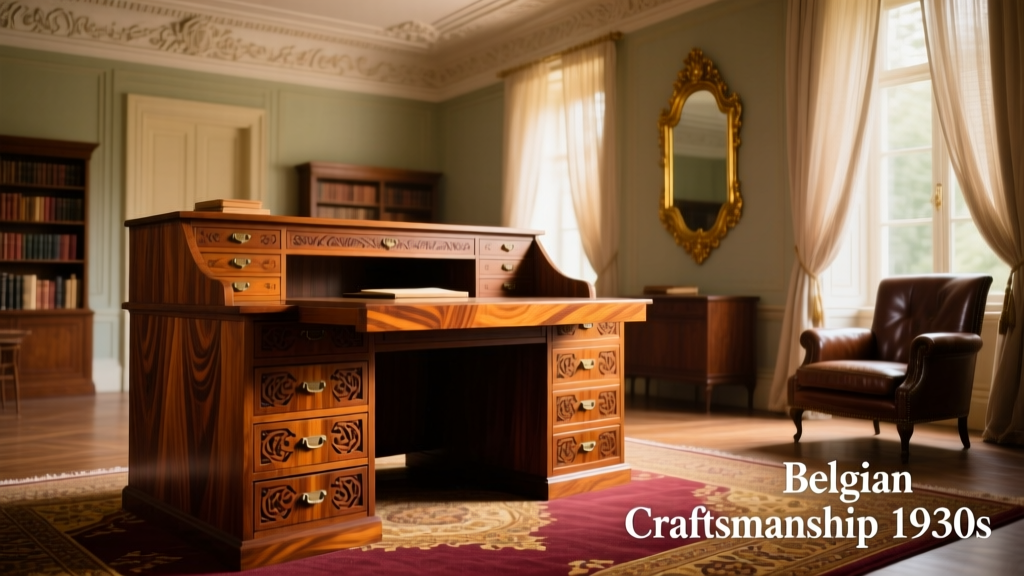
Belgian Walnut Drop-Front Desk with Pigeonholes and Carved Drawers: A 1930s Masterpiece of Art Deco Craftsmanship
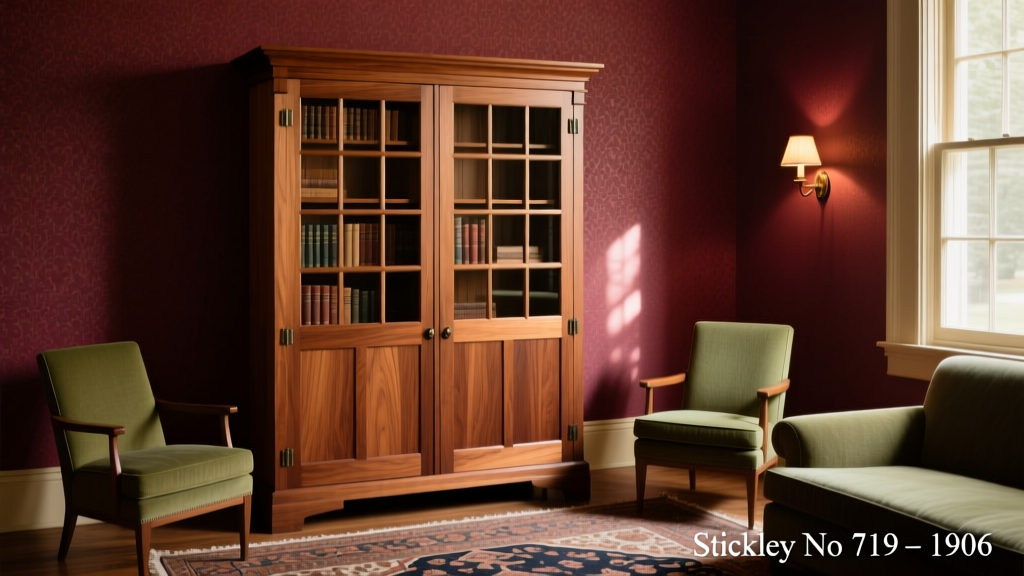
L. J. G. Stickley No. 719 Bookcase: Authenticity, Construction, and Restoration of the Iconic 60-Inch Two-Door Mission Design
Royal Doulton Figurine Skater HN 2117: History, Identification, and Restoration Insights
The Jewelry Lavaliere: Floral Design, Twin Jade Beads, Pavé Diamonds, and Platinum Craftsmanship
Fulper Vase: Cucumber Matte Glaze, Signed, 9½ × 17 Inches — A Definitive Identification and Conservation Guide
Advertising Box Cigar Rail Splitter: A 1920s American Tobacco Artifact in Context
Kingsbury Picnic Beer 'Save On' Advertising Sign: Material Analysis, Historical Context, and Conservation Protocol for a 1930s Metal-Cardboard Hybrid
Amethyst Glass Vase with White Swirls, Ribbed Body, and Opalescent Foot: A Detailed Study of a 10½-Inch American Art Glass Masterpiece