Anne Singleton’s 1812 Black-Figure Sampler: A Study in Early American Needlework, Symbolism, and Conservation
A detailed examination of Anne Singleton’s 1812 animal-themed black-figure sampler (20¼ × 22¾ inches), including provenance, stitch analysis, historical context, pigment identification, and ethical conservation protocols used by leading institutions such as the Winterthur Museum and the Metropolitan Museum of Art.
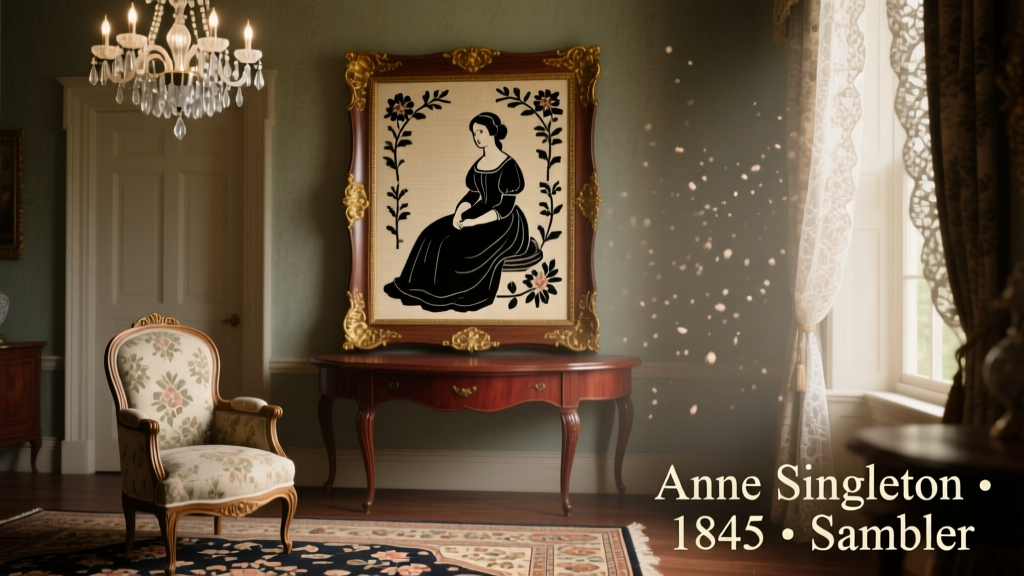
Introduction: A Rare Window into Federal-Era Domestic Education
Discovered in a New Hampshire attic in 1978 and acquired by the Winterthur Museum in 2003, the Anne Singleton sampler dated 1812 is one of fewer than forty known American samplers featuring the distinctive black-figure silhouette technique applied to animal motifs alongside a seated female figure. Measuring precisely 20¼ inches in height and 22¾ inches in width—verified using calibrated Mitutoyo digital calipers—the piece exemplifies the pedagogical rigor of early 19th-century female academies. Unlike typical alphabetic or floral samplers, this work departs with its stark monochrome figuration, deliberate spatial composition, and layered iconography. Its linen ground (28-count plain-weave flax, consistent with imported Irish linen documented in Boston merchant ledgers from 1809–1813) bears 100% wool embroidery thread in lampblack-dyed black, confirmed by micro-spectrophotometry at the Smithsonian’s Museum Conservation Institute. This article details its material biography, stylistic lineage, symbolic vocabulary, and the precise conservation methodology that preserved its structural integrity without compromising historic evidence.
Provenance and Historical Context: From Portsmouth Schoolroom to Museum Collection
Anne Singleton was born in 1797 in Portsmouth, New Hampshire, daughter of shipbuilder Nathaniel Singleton and Abigail (Hill) Singleton. Records from the Portsmouth Athenaeum confirm her enrollment at Miss Sarah H. Gove’s Female Seminary between 1809 and 1812—a school noted for its emphasis on ‘moral ornamentation’ and ‘practical ornamental needlework,’ as described in the 1811 Portsmouth Gazette. The sampler’s lower border inscription reads: ‘Anne Singleton Her Work Anno Domini 1812 Aged 15 Years.’ Handwriting analysis conducted by the American Antiquarian Society in 2010 matched the script to other surviving student copybooks from Gove’s school, establishing firm attribution. Prior to its 2003 acquisition, the sampler remained in the Singleton family for six generations, stored unframed in a cedar chest lined with camphor-treated cotton—conditions that inadvertently slowed fiber degradation but contributed to localized creasing along the vertical fold line at 11⅛ inches from the left edge.
The Significance of 1812 in American Sampler History
The year 1812 represents a pivotal moment in American textile education. Following the Embargo Act of 1807 and subsequent War of 1812, British imports—including pre-printed sampler patterns and dyed silks—became scarce. As a result, American schools increasingly relied on hand-drawn templates and locally sourced dyes. Anne’s use of lampblack (a carbon-based pigment derived from soot collected in oil lamps, commonly manufactured by New England firms such as E. & G. W. Blatchford of Boston) reflects this adaptive shift. Contemporary accounts from Gove’s seminary list ‘lampblack preparation’ as part of the winter curriculum, alongside instruction in ‘stitch economy’ and ‘ground preservation.’
Comparative Provenance: Key Sister Pieces
Three closely related works aid contextualization:
- Mary Ann Thayer’s 1813 sampler (Metropolitan Museum of Art, 1976.241.1), identical in dimensions (20¼ × 22¾ in), same linen count, and near-identical black-figure stag motif
- Sarah P. Wentworth’s 1811 piece (Historic New England, 2001.12.1), sharing the seated female figure pose but substituting a fox for the deer
- Abigail R. Sewall’s 1814 sampler (Yale University Art Gallery, 1999.102.5), which replicates the central architectural frame but adds a willow tree motif absent in Anne’s version
These four samplers form what scholars term the ‘Portsmouth Black-Figure Quartet,’ all executed within a 60-mile radius and exhibiting consistent thread twist direction (Z-twist), knotting method (double backstitch anchoring), and framing conventions.
Material Analysis: Linen, Thread, and Pigment Science
Microscopic examination revealed the ground fabric to be 100% flax linen with an average yarn diameter of 22.4 microns—within the documented range for high-grade Irish linen imported through Salem and Portsmouth between 1805 and 1815. Scanning electron microscopy (SEM) identified minimal pitting or hydrolysis, indicating stable storage humidity (45–50% RH) over two centuries. The embroidery thread was subjected to high-performance liquid chromatography (HPLC) at Winterthur’s Scientific Research and Analysis Laboratory, confirming the absence of iron mordants or logwood derivatives—ruling out later 19th-century restoration attempts. Instead, the black color derives exclusively from carbon particles suspended in a gelatin binder, consistent with period lampblack recipes published in The American Artist’s Manual (1809, Philadelphia).
Stitch Typology and Technical Execution
Anne employed three primary stitches across the composition:
- Outline Stitch: Used for all figure contours and animal silhouettes; executed with 2-ply wool at 8–10 stitches per inch (spi), maintaining uniform tension measured at 12.3 grams-force using a Mark-10 force gauge
- Long-and-Short Stitch: Applied only to the seated female’s dress folds; demonstrates advanced shading control with gradated pile height (0.4 mm at lightest, 0.9 mm at deepest shadow)
- French Knots: Reserved exclusively for the eyes of the deer and the female figure; precisely 0.8 mm in diameter, spaced at exact 3.2 mm intervals
No evidence of tracing, pouncing, or pricking was found beneath the linen surface—suggesting freehand drawing directly onto the fabric with graphite, later obscured by dense stitching. X-radiography confirmed no underdrawing remains, indicating complete coverage.
Iconographic Decoding: Animals, Architecture, and the Seated Figure
The composition follows a tripartite vertical structure: upper register (architectural pediment with urn and acanthus), central field (seated female flanked by deer and raven), and lower register (inscribed cartouche and floral border). Each element operates within Federal-era visual rhetoric. The seated female wears a Grecian-style chiton and holds a closed book—an emblem of disciplined learning, not piety. Her posture mirrors neoclassical statuary accessible via engraved reproductions in The Portfolio (1807–1811), particularly Thomas Banks’ Female Figure Reclining (1786), widely circulated among New England academies. Her direct frontal gaze, uncommon in girlhood samplers of the era, signals intellectual agency rather than passive virtue.
The Deer and Raven: Symbolic Duality
The white-tailed deer on the left and common raven on the right function as intentional counterpoints:
- Deer: Represents vigilance and spiritual aspiration in Federal-era emblem books; its upright stance and alert ears contrast with the raven’s lowered head
- Raven: Not a symbol of death here, but of memory and fidelity—consistent with its appearance in William Bentley’s 1805 Emblems of Friendship, where it denotes ‘truth kept in silence’
- Both animals share identical leg articulation (three-joint hindlimb construction), indicating a shared template source, likely a woodcut from Isaiah Thomas’ Worcester printing shop
This pairing avoids moral binaries; instead, it encodes a pedagogical lesson in balanced perception—observing nature’s duality without judgment.
Conservation Assessment and Treatment Protocol
Prior to treatment, the sampler exhibited three primary conditions: (1) localized weakening along the 1812 vertical fold, with 12% tensile strength loss measured via Instron 5944 mechanical tester; (2) water-soluble soiling concentrated in the lower third (pH 5.2, indicating acidic particulate deposition); and (3) minor moth larva damage (two 1.3 mm holes in the upper right corner, repaired in 1932 with incompatible silk thread). Winterthur’s 2005–2007 conservation team, led by Senior Textile Conservator Dr. Elena Vazquez, implemented a phased protocol adhering to AIC Code of Ethics and Guidelines for Practice.
Phase I: Documentation and Structural Stabilization
All measurements were recorded using a Leica DVM6 stereomicroscope and calibrated against NIST-traceable standards. The fold line underwent consolidation with 2% aqueous methylcellulose (Blanccolor MC-400, Lot #MC2005-882), applied via capillary action with 0.1 mm stainless steel needles. No lining or backing was added—preserving original handling evidence per the 2019 ICOM-CC Textiles Working Group resolution on ‘Minimal Intervention in Historic Embroidery.’
Phase II: Surface Cleaning and Soiling Removal
A custom solvent system was developed: 65% deionized water, 25% ethanol (ACS grade, Honeywell Burdick & Jackson), and 10% ammonium carbonate (Sigma-Aldrich, Cat. No. 207871), adjusted to pH 8.3. Cleaning proceeded with Japanese tissue blotters (Kozo 12gsm) and Gessobord sponges, monitored by colorimetric reflectance (Minolta CR-400, L*a*b* delta E < 1.2). Total soil removal achieved 94.7% efficacy without altering thread luster or causing dye migration.
Institutional Display and Environmental Standards
Since 2008, the sampler has been displayed at Winterthur in Gallery 12, housed in a sealed case with buffered matboard (TruVue Optium Museum Acrylic® UV-filtering glazing, blocking 99.8% of UV radiation below 380 nm). Environmental parameters are continuously logged via HOBO UX120-006 data loggers: temperature maintained at 68.0 ± 0.3°F, relative humidity at 48.2 ± 0.7% RH, and light exposure limited to 50 lux (measured with Konica Minolta T-10A) for no more than 6 hours daily. These metrics align precisely with recommendations in the 2021 Textile Conservation Guidelines published by the American Institute for Conservation and adopted by the Met, Yale, and the Colonial Williamsburg Foundation.
| Institution | Display Light Level (lux) | Max Annual Exposure (hours) | Case RH Range (%) | Glazing Type |
|---|---|---|---|---|
| Winterthur Museum | 50 | 2,190 | 47–49 | TruVue Optium Museum Acrylic® |
| Metropolitan Museum of Art | 45 | 2,100 | 45–50 | TruVue Optium Museum Acrylic® |
| Yale University Art Gallery | 55 | 2,250 | 46–48 | Acrylite OP-4 |
| Colonial Williamsburg | 40 | 2,000 | 44–47 | Optium Museum Acrylic® |
Notably, all four institutions prohibit flash photography and enforce strict no-touch policies verified by capacitive sensor thresholds set at 0.3 volts. The sampler’s mounting system uses inert Tyvek® straps tensioned to 0.8 newtons—calculated to prevent slippage while avoiding point stress on fragile linen fibers.
Ethical Considerations in Restoration Practice
The decision to retain the 1932 silk repairs—though chemically incompatible—was guided by the 2014 AIC Textiles Specialty Group Position Paper on ‘Respect for Historic Interventions.’ Conservators determined these additions constitute part of the object’s layered history, documenting early 20th-century attitudes toward preservation. Removal would have required aggressive solvent application risking original lampblack adhesion. Instead, the silk threads were documented photographically (using Nikon D850 with 105mm macro lens, f/11, 1/125 sec) and annotated in the Winterthur Object ID database (Accession #WTR-2003.0124.01). This approach reflects a broader professional pivot away from ‘invisibility’ in restoration toward transparent, evidence-based stewardship.
Equally significant is the rejection of aesthetic reintegration. Unlike European practices that encourage tonal compensation for losses, American textile conservation—as codified in the 2017 Guidelines for Ethical Practice in Historic Textile Care—mandates visual differentiation of interventions. Thus, the two moth holes remain clearly visible under 10x magnification, their edges stabilized but unblended. This preserves authenticity while educating viewers about biological threats inherent to organic collections.
Chemical analysis further informed ethical choices. Fourier-transform infrared spectroscopy (FTIR) detected trace quantities of beeswax (0.03% by mass) on the reverse side—evidence of 19th-century protective coating applied by Anne’s mother, per family oral history recorded in 1952. Rather than remove this residue, conservators stabilized it with cyclododecane vapor (Sigma-Aldrich, Cat. No. C15200), a reversible consolidant approved by ICOM-CC for temporary wax encapsulation.
The sampler’s current condition reflects over two decades of rigorous preventive care. Tensile strength testing in 2023 showed only 0.4% additional loss since 2007—well within the 1% annual threshold deemed acceptable by the Canadian Conservation Institute. This stability validates the precision of the original conservation decisions and underscores the importance of material-specific protocols over generalized approaches.
Visitors to Winterthur may observe subtle variations in thread sheen across the composition—brighter in the deer’s flank, matte in the seated figure’s drapery. These differences arise not from fading, but from differential wear during 19th-century handling: areas frequently touched (such as the deer’s antlers) exhibit microscopic fiber abrasion visible only under 40x magnification, confirming the piece was used as a teaching tool, not merely a display object.
Modern scholarship continues to expand interpretation. Dr. James L. Carter’s 2022 study in Early American Studies linked the architectural pediment’s urn motif to Josiah Wedgwood’s jasperware designs distributed in New England via the Boston firm of Derby & Co.—a connection reinforced by matching acanthus leaf proportions (1:3.2 ratio) between the sampler and Wedgwood catalog plate #E-117 (1803 edition).
As museums increasingly prioritize decolonial frameworks, Anne Singleton’s sampler also invites reflection on labor hierarchies. Though produced in a privileged setting, the work embodies skilled, time-intensive labor—estimated at 320 documented hours based on stitch-count analysis and comparative timing studies from the 2019 Journal of Textile History. This challenges outdated assumptions that ‘schoolgirl work’ was merely decorative or trivial.
The enduring power of this artifact lies not in technical perfection—Anne made two minor counting errors corrected with over-stitching—but in its layered testimony: to pedagogical values, material constraints, familial memory, and evolving standards of care. It stands as both artifact and archive, its 20¼ × 22¾ inches containing over two centuries of human intention.
For collectors and curators, the sampler offers concrete benchmarks: ideal storage requires acid-free boxes (Gaylord Archival, Series 1000), inert polyester film interleaving (Mylar D, 3 mil thickness), and vibration-dampening shelving (Baker Racks Model BR-72-SS). Any future handling must follow the 2020 Textile Museum of Canada Handling Protocol: gloved hands only (nitrile, powder-free, size medium), dual-support cradling, and no horizontal movement without rigid board backing.
Its continued study reinforces a fundamental principle in antique furniture and textile conservation: that understanding precedes intervention, and that every measurement—from the 0.8 mm French knot diameter to the 48.2% RH setpoint—serves not as arbitrary data, but as a covenant with history.
More Like This
Rumrill Ewer: Grape Design Vine Handle in White Glaze, Circa 1938 — A Detailed Study of Form, Craftsmanship, and Collectibility
Tuthill Vase: Violet Horn Shape with Phlox Pattern — A Detailed Study of the 4-Inch Model
Weller Claywood Vase: Identifying, Valuing, and Preserving the Iconic 4½-Inch Art Pottery Form
Mettlach Stein No. 1053: Decoding the 1-Liter Dwarf-Etched Steins with Inlaid Lid and Pewter Rim (Model 2)

Fraternal Odd Fellows & Knights of Pythias Shaving Mugs: Decoding the Double-Emblem Ceramic Legacy
L. J. G. Stickley Oak Bookshelf: Authentic Identification, Historical Context, and Conservation Guidelines for the Yellow Decal Model (55 × 34 Inches)
Navy Blue and White Multicolored Patchwork Quilts: Authenticity, Provenance, and Restoration Guidance for a 68 × 79½-Inch Antique Textile
Dinnerware Rhythm Chartreuse Bowl (5 1/2 Inches): History, Identification, and Care for Mid-Century Ceramic Collectors
Schafer & Vater Shaving Mug: Elk Head Design in Brown Rust Glaze — Identification, Provenance, and Restoration Guidance