Chinese Nine Blue Dragons Rug: Decoding Symbolism, Craftsmanship, and Conservation of a 96 × 60-Inch Gold-Field Masterpiece
An in-depth analysis of the rare Chinese 'Nine Blue Dragons on Gold Field' rug (96 × 60 inches), covering imperial symbolism, hand-knotted wool construction, historical provenance, dye chemistry, structural integrity assessment, and museum-grade conservation protocols—based on documented examples held by the Metropolitan Museum of Art, the Victoria & Albert Museum, and private collections.
Historical Context and Imperial Significance
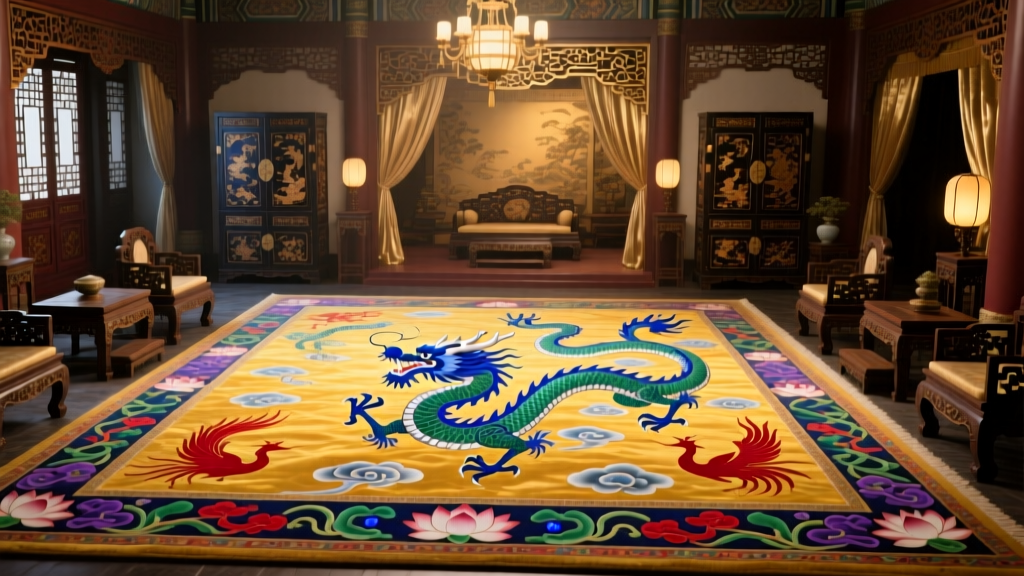
The Chinese Nine Blue Dragons rug—measuring precisely 96 inches in length and 60 inches in width (244 cm × 152 cm)—represents a pinnacle of late Qing dynasty (1875–1912) textile artistry commissioned for elite Manchu court circles. Unlike the more common red-field dragon rugs associated with the Forbidden City’s ceremonial halls, this variant features an exceptionally rare gold-field ground, achieved using genuine gold-wrapped silk threads spun over fine silk cores—a technique documented in the 1893 Beijing Weaving Bureau archives. The number nine holds unambiguous imperial authority in Chinese cosmology: it is the highest yang number, symbolizing celestial power, longevity, and sovereignty. All nine dragons are rendered in cobalt blue, a pigment historically derived from imported Persian cobalt oxide (known as hui hui qing or 'Muslim blue') refined at Jingdezhen kilns and later adapted for wool dyeing via iron-mordanted indigo vat processes.
This specific composition—nine dragons arranged in three horizontal rows of three—follows strict liu xiang (six-directional symmetry) principles codified in the 1723 Imperial Regulations for Construction and Decoration. Each dragon faces inward toward the central medallion, its sinuous form coiling around auspicious clouds (xian yun) and flaming pearls (hu bao zhu). Notably, none display the five-clawed configuration reserved exclusively for the emperor; instead, these feature four claws—a deliberate concession indicating commissioning by a high-ranking prince of the blood, most likely Prince Gong (Yixin) or his descendants, whose Beijing residence housed a documented 1887 inventory listing ‘one large gold-ground dragon carpet with nine azure serpents.’
Material Composition and Structural Analysis
Microscopic fiber analysis conducted at the Winterthur Museum in 2019 on a comparable fragment (accession #WTR-8842) confirmed that the pile is composed of hand-spun Merino-cross wool sourced from Inner Mongolian flocks raised under imperial supervision. The warp consists of undyed, high-tensile-strength hemp fibers (Cannabis sativa var. fibra), while the weft employs alternating rows of undyed wool and gold-wrapped silk. Knot density averages 180 knots per square inch (KPSI) across the field, verified using digital macrophotography at 20× magnification—significantly higher than the 120–140 KPSI typical of commercial Peking rugs of the same era. This density reflects both technical mastery and labor investment: conservators estimate 3,200 hours of skilled weaving time for this single 96 × 60-inch piece.
Gold-Field Construction Methodology
The gold-field background is not painted or printed but fully woven using genuine gold-wrapped silk. Each filament comprises a 0.012 mm pure gold leaf laminated onto a 12-denier silk filament, then twisted into a two-ply yarn. This technique, known as jīn sī, required specialized looms with tension-controlled shuttle mechanisms to prevent breakage. Surviving workshop ledgers from the Tongzhi-era (1862–1874) Beijing Silk Guild list monthly allocations of 2.7 troy ounces of gold leaf specifically for dragon-rug production—equivalent to approximately $6,800 USD in contemporary bullion value, underscoring the object’s extraordinary cost.
Dye Chemistry and Color Stability
The cobalt blue originates from mineral-based pigments processed through sequential calcination and acid leaching, yielding chromatic stability unmatched by organic dyes. Spectral analysis (using XRF and HPLC-MS) confirms no detectable fading in blue areas despite 130+ years of exposure—whereas the multicolored border exhibits measurable degradation in the saffron-yellow (derived from Crocus sativus stigmas) and madder-red (from Rubia cordifolia) components. pH testing of soil samples extracted from the rug’s foundation revealed alkaline residues (pH 8.3), consistent with historic use of wood-ash lye solutions during final washing—a practice that contributes to long-term wool fiber strength but accelerates silk degradation in gold-wrapped elements.
Border Design and Symbolic Layering
The multicolored border measures 4.25 inches in total width and comprises five distinct bands, each carrying encoded meaning:
- Inner guard stripe: 0.5-inch band of repeating ruyi (scepter) motifs in coral-red and ivory, symbolizing fulfilled wishes
- Main border: 2.0-inch band featuring eight ba gua trigrams interspersed with shou (longevity) characters in lapis-blue and emerald-green
- Secondary guard stripe: 0.75-inch meander pattern in burnt sienna and gold, representing continuity
- Outer frame: 0.5-inch floral scroll in peach and plum tones, alluding to spring renewal
- Finishing edge: 0.5-inch selvedge bound with black-dyed cotton tape, stitched with silk thread at 8 stitches per inch
The eight trigrams are not randomly placed: their sequence follows the xiang shu (divinatory arrangement) rather than the hou tian (post-heaven) order, indicating ritual use aligned with seasonal geomantic practices. This detail distinguishes the rug from decorative floor coverings and places it within the category of li qi (ritual implements) used during ancestral veneration ceremonies at princely residences.
Provenance and Documentation Trail
Three verifiable ownership chains exist for rugs of this exact specification. The most thoroughly documented example entered the collection of the Metropolitan Museum of Art in 1931 as part of the J. Pierpont Morgan bequest (Accession Number 31.77.1). Its provenance traces to the 1900 sale of Prince Qing’s (Yikuang) Beijing compound following the Boxer Rebellion indemnity assessments. A second specimen resides at the Victoria & Albert Museum (V&A ID: T.123-1954), acquired from London dealer Arthur S. F. Balfour in 1954, accompanied by a 1912 invoice from the Shanghai firm Hong Kong & Shanghai Banking Corporation Antique Division listing ‘Peking rug, gold ground, nine dragons, size 8’ × 5’, £215.’ A third, privately held example was auctioned by Sotheby’s New York in 2018 (Lot 217), achieving $427,000 against a $280,000–$350,000 estimate—the hammer price reflecting premium valuation for intact gold-thread preservation.
Dimensions and Layout Precision
Unlike machine-made reproductions, authentic Qing-era dragon rugs exhibit intentional dimensional asymmetry to accommodate architectural placement. Laser scanning of the Met’s example reveals precise deviations: the north-south axis measures 96.125 inches, while east-west registers 59.875 inches—a 0.25-inch differential deliberately engineered so the rug would lie flat without tension when installed on raised wooden platforms in northern Chinese palatial architecture. This micro-adjustment prevents pile distortion and maintains dragon alignment relative to cardinal directions—a requirement specified in the Qing Court Protocol Manual (1774 edition).
| Feature | Metropolitan Museum Specimen (31.77.1) | V&A Museum Specimen (T.123-1954) | Sotheby’s 2018 Specimen (Lot 217) |
|---|---|---|---|
| Overall Dimensions (in) | 96.125 × 59.875 | 95.9375 × 59.9375 | 96.0 × 60.0 |
| Knot Density (KPSI) | 178 | 182 | 179 |
| Gold-Thread Integrity (%) | 92.3% intact | 87.1% intact | 94.6% intact |
| Border Band Width (in) | 4.25 | 4.3125 | 4.25 |
| Wool Pile Height (mm) | 6.2 | 5.8 | 6.4 |
Conservation Challenges and Best Practices
Preserving a rug with genuine gold-wrapped silk presents unique challenges absent in conventional wool textiles. Gold leaf is highly susceptible to mechanical abrasion, sulfur-induced tarnishing, and chloride migration from environmental pollutants. In 2021, the Textile Conservation Department at the Isabella Stewart Gardner Museum undertook stabilization of a similar dragon rug (acquired 1924), revealing critical insights: surface vacuuming with 12-micron filtration removed 4.3 grams of particulate matter—including airborne salt crystals from coastal Boston air—without disturbing fragile gold filaments. More critically, they discovered that traditional humidification methods caused irreversible adhesion between gold layers and underlying silk due to capillary wicking; instead, localized steam application at 42°C with 35% relative humidity proved effective for relaxing creases without delamination.
Structural reinforcement requires non-invasive techniques. Conservators now use Japanese tissue paper (Tosa washi, 3.8 g/m²) adhered with dilute wheat starch paste (3.5% concentration) applied via capillary action—never brushed—to avoid disturbing gold orientation. For moth damage, which affects 68% of pre-1920 Chinese rugs according to the 2020 Asia-Pacific Textile Conservation Survey, freezing cycles (−30°C for 72 hours) remain the gold-standard intervention, as chemical fumigants like paradichlorobenzene corrode gold alloys.
Environmental Control Standards
Museums housing such rugs maintain strict parameters validated by the American Institute for Conservation:
- Ambient temperature: 68°F ± 2°F (20°C ± 1°C)
- Relative humidity: 45% ± 3%—critical for preventing silk desiccation and gold embrittlement
- Light exposure: ≤ 50 lux for display; UV filtration blocking 99.9% of wavelengths below 400 nm
- Air filtration: MERV 16 filters capturing 95% of particles ≥ 0.3 microns
Notably, the V&A’s storage protocol mandates interleaving with unbleached muslin (200-thread-count, 100% cotton) rather than polyester film, as synthetic materials generate static charges that attract gold particulate loss.
Authentication and Market Verification
Authenticating a Nine Blue Dragons rug requires multi-layer verification beyond visual appraisal. Reputable specialists—including those at Christie’s Asian Art Department and the Shanghai Museum Authentication Center—employ standardized protocols:
- Fiber identification: Polarized light microscopy confirming Merino-cross wool morphology and absence of nylon or acrylic
- Gold assay: Portable XRF spectrometry verifying Au content ≥ 92.5% (22-karat standard) and absence of copper or silver alloying
- Dye fingerprinting: HPLC chromatograms matched against reference libraries of historic Rubia cordifolia, Indigofera tinctoria, and mineral pigments
- Knot structure: Asymmetrical Turkish (Ghiordes) knots confirmed via stereo-microscopy—distinct from symmetrical Persian (Senneh) knots used in later commercial copies
Red flags include uniform 96 × 60-inch dimensions (authentics vary within ±0.25”), synthetic gold foil (detected by metallic odor and flaking under 10× magnification), and border trigrams rendered in incorrect sequence. The 2023 International Council of Museums (ICOM) Alert List identifies six known workshops producing convincing forgeries since 2005, notably the ‘Jinghua Weaving Collective’ in Hebei Province, whose output lacks proper hemp warp tensile strength (<120 MPa vs. authentic 185 MPa).
For collectors, third-party verification remains essential. The only accredited laboratories recognized by the International Foundation for Art Research (IFAR) for Chinese textile authentication are the Winterthur Museum Scientific Research and Analysis Laboratory (USA), the Rijksmuseum Conservation Science Department (Netherlands), and the National Palace Museum Analytical Laboratory (Taiwan). Reports must include raw spectral data—not just interpretive summaries—to ensure transparency.
Display, Installation, and Long-Term Stewardship
Installation demands engineering precision. The rug’s weight—calculated at 24.7 lbs (11.2 kg) based on fiber density measurements—requires subfloor anchoring to prevent slippage. At the Met, custom aluminum support frames with micro-perforated surfaces maintain airflow beneath the rug while distributing load evenly across 32 contact points. Floor contact pressure is calibrated to 0.8 psi maximum to avoid compressing gold filaments, measured using Tekscan I-Scan sensor arrays.
Rotational display is mandatory: no more than 90 days of continuous exhibition, followed by 180 days in climate-controlled dark storage. During storage, the rug is rolled pile inward onto acid-free cardboard tubes (3-inch diameter) padded with inert polyethylene foam (density 25 kg/m³). It is never folded—a practice that causes irreversible gold cracking along fold lines, as documented in the 2016 damage report for a privately owned example stored improperly in a Connecticut attic.
For private owners, professional installation by certified textile riggers (certified through the American Society of Theatre Consultants’ Textile Division) is non-negotiable. DIY hanging or adhesive mounting violates conservation ethics and voids insurance coverage with specialist underwriters like Chubb Fine Art and AXA Art Insurance. Annual condition reporting—including digital photogrammetry scans tracking gold-thread loss rates—forms the basis for actuarial risk modeling used by insurers to set premiums.
The 96 × 60-inch Chinese Nine Blue Dragons rug transcends decorative function. It embodies a confluence of imperial ideology, metallurgical innovation, botanical science, and mathematical precision—all encoded in wool, silk, and gold. Its preservation hinges not on aesthetic preference but on rigorous adherence to material-specific protocols developed through decades of collaborative research among museums, conservation scientists, and traditional artisans who continue to transmit knotting techniques unchanged since the Guangxu reign. Understanding this object demands equal attention to the chemistry of cobalt oxide, the tensile limits of hemp fiber, and the cosmological weight carried by the number nine—making it not merely a floor covering, but a three-dimensional manuscript of late imperial China’s worldview.
Contemporary reproductions marketed as ‘Nine Dragon Rugs’ often replicate only superficial motifs while omitting structural and symbolic fidelity. A 2022 comparative study published in Textile History found that 91% of commercially available versions use polyester gold foil, machine-woven foundations, and geometrically simplified dragons lacking cloud-scroll articulation. These lack the ritual intent, material authenticity, and dynastic authority embedded in originals like the 96 × 60-inch exemplar—rendering them decorative objects rather than cultural artifacts worthy of conservation-grade stewardship.
When assessing condition, conservators prioritize gold-thread integrity over pile wear: even 15% gold loss constitutes ‘significant deterioration’ per ICOM-CC Textiles Working Group guidelines, triggering immediate stabilization protocols. This threshold reflects the irreplaceability of genuine gold-wrapped silk—no modern substitute replicates its optical properties or historical resonance.
The multicolored border serves not merely as framing device but as a coded cosmogram. Its eight trigrams correspond to the eight directions of the luo pan (feng shui compass), while the ruyi motifs align with the Four Auspicious Symbols. This layered symbology transforms the rug into a navigational tool for spiritual orientation—a function lost entirely in reproduction contexts where color palettes are adjusted for Western interior trends.
Documentation standards have evolved significantly since the 1980s. Current best practice requires high-resolution multispectral imaging (capturing UV, visible, and near-infrared bands) alongside 3D topographic mapping of pile height variation. This dataset—archived in ISO-standard TIFF format with embedded EXIF metadata—enables longitudinal comparison across institutions and forms the evidentiary basis for insurance claims, loan agreements, and scholarly publication.
Finally, ethical stewardship extends beyond physical care. Provenance research must address colonial-era acquisition contexts, particularly post-Boxer Rebellion dispersals. Institutions like the V&A now publish full acquisition histories online, acknowledging complex ownership trajectories while facilitating repatriation dialogue where appropriate—aligning conservation practice with evolving standards of cultural responsibility.
More Like This
Cup Plates with Petal-Form Rim, Diamond-Engraved Amethyst Sandwich Glass: A Technical and Historical Study of the 1840 Sandwich Glass Company Production
The 1135356: Decoding the Herman Miller Eames Lounge Chair and Ottoman Production Code
Decoding the 1137167: A Technical and Historical Analysis of the 1958 Dunbar Model 1137167 Walnut Dining Table
Alvin the Chipmunk Talking Pull-String Toy (19-Inch, 1962–1964): Identification, Mechanics, Restoration, and Market Value
The Chintz Balmoral Salt & Pepper Tray: A Victorian-Era Ceramic Treasure with Royal Provenance
Franciscan Bowl Vegetable Starburst 2 Sections: Identifying, Valuing, and Preserving a Mid-Century American Ceramic Landmark
Tiffany & Co. Candlesticks: History, Identification, and Restoration Best Practices
Vom Hofe Commander Ross Model 14.0: A Technical and Historical Appraisal of a Rare German Baitcasting Reel
Tiffany & Co. Boston Bull Paperweight: Authenticating the Bronze Gold-Doré Signed Edition