The RS Prussia Stag Bowl: History, Identification, and Restoration Insights for Collectors
A detailed examination of the iconic RS Prussia Stag Bowl—its origins at Reinhold Schlegelmilch’s factory in Grafenhain, Germany; hallmark characteristics including cobalt blue glaze, hand-painted stag motifs, and gilt accents; authentication markers like the 'RS Germany' backstamp; and professional conservation practices for preserving its 19th-century porcelain integrity.
Origins and Historical Context of the RS Prussia Stag Bowl
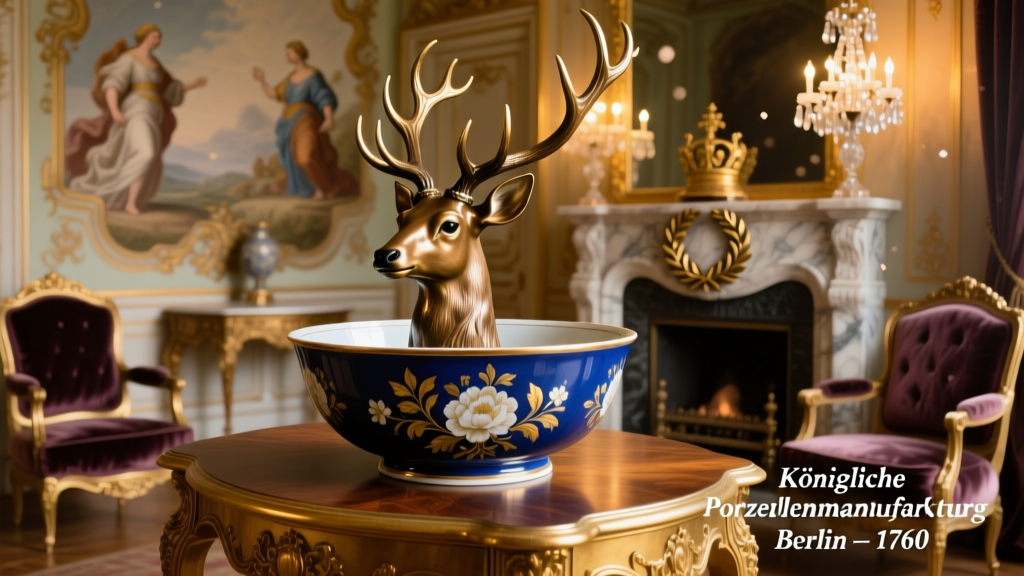
The RS Prussia Stag Bowl stands as one of the most recognizable and collectible pieces of late-Victorian porcelain. Manufactured between approximately 1890 and 1914 by Reinhold Schlegelmilch’s porcelain factory in Grafenhain, Thuringia (then part of the German Empire), these bowls emerged during a golden age of European decorative ceramics. Unlike mass-produced wares of the era, RS Prussia pieces were crafted with meticulous attention to detail—hand-painted, high-fired, and finished with rich metallic lusters. The Stag Bowl specifically reflects the turn-of-the-century fascination with naturalistic motifs, particularly woodland scenes favored by affluent Anglo-American households seeking refined yet rustic elegance.
Reinhold Schlegelmilch founded his factory in 1869 and began exporting heavily to the United States after 1885, capitalizing on growing demand for affordable luxury goods. By 1891, U.S. import laws required country-of-origin labeling, prompting the shift from earlier ‘RS’ or ‘RS Prussia’ marks to the definitive ‘RS Germany’ backstamp—a critical dating and authenticity clue. The Stag Bowl was not a standalone product line but rather part of RS Prussia’s broader ‘Hunting Scene’ series, which included compotes, vases, and dinnerware featuring deer, foxes, hounds, and forested landscapes.
Production ceased abruptly in 1914 due to World War I export restrictions and material shortages. This finite production window—just over two decades—contributes significantly to the bowl’s scarcity and desirability today. Unlike later imitations made in Japan or Czechoslovakia post-1920, authentic RS Prussia Stag Bowls possess a distinctive weight, translucency, and glaze depth that modern reproductions consistently fail to replicate.
Physical Characteristics and Iconography
Authentic RS Prussia Stag Bowls are typically shallow, footed serving bowls measuring between 9.5 and 10.5 inches in diameter, with a height of 2.25 to 2.75 inches and a base diameter of 3.75 inches. The porcelain body is fine-grained, white-bodied hard-paste porcelain fired to cone 10 (approximately 1300°C), yielding exceptional durability and resonance when tapped lightly. Its defining feature is the central hand-painted scene: a noble red stag standing alert amid stylized oak branches, often flanked by two smaller stags or does in profile. The background is invariably executed in deep cobalt blue underglaze, providing dramatic contrast to the ivory-white porcelain ground.
The stag motif is rendered in iron-red and black enamel pigments, with delicate stippling used for fur texture and subtle shading in the antlers. Each antler tine is individually defined—not merely outlined—and the eye features a pinpoint black pupil with a faint white highlight, suggesting life and movement. Surrounding the central image is a continuous band of gilded acanthus scrollwork, applied using genuine 22-karat gold leaf (not gold paint), which has survived centuries with minimal flaking when properly preserved.
Glaze and Surface Qualities
The cobalt blue glaze is semi-matte to softly lustrous—not glossy like later Art Deco wares—and exhibits subtle pooling in recessed areas, especially along the inner rim and foot ring. Under magnification, fine crazing (a network of hairline cracks in the glaze) appears uniformly across the surface, consistent with age-related thermal stress rather than manufacturing defect. Authentic pieces show no evidence of overglaze screen printing or transfer decals; all figural elements are freehand painted by skilled artisans, resulting in slight variations between examples—no two stags are identical in posture or expression.
Footring and Structural Details
The underside reveals a finely turned, unglazed footring approximately 0.375 inches wide, with crisp, even edges. The porcelain thickness at the rim measures 0.125 inches, tapering slightly toward the base where it thickens to 0.1875 inches for structural stability. A hallmark of Schlegelmilch’s quality control was the perfectly centered footring—any asymmetry or wobble indicates either a later reproduction or damage-induced warping.
Backstamp Analysis and Authentication Protocol
Proper identification begins with rigorous backstamp examination. Genuine RS Prussia Stag Bowls bear one of three primary marks, each tied to specific production periods:
- ‘RS Prussia’ in script (1885–1891): Often accompanied by a crown-and-crossed-swords motif above the letters; found exclusively on pre-U.S. tariff law pieces.
- ‘RS Germany’ in block capitals (1891–1914): The most common mark on Stag Bowls; positioned centrally beneath the footring, usually impressed before glazing and filled with black oxide pigment.
- ‘RS’ within a shield device (1905–1914): A rarer variant used concurrently with ‘RS Germany’, sometimes appearing alongside a small star or dot.
Crucially, the stamp must be legible, deeply impressed, and aligned parallel to the footring’s edge. Faint, smudged, or off-center stamps suggest post-factory alteration or counterfeit origin. Reproductions frequently misplace the stamp—too close to the edge, tilted more than 3 degrees, or rendered in uniform laser-etched precision lacking the organic variation of hand-carved molds.
Additional authentication indicators include:
- A slight, intentional warp in the footring—visible when viewed edge-on—which results from controlled kiln cooling and is absent in machine-pressed fakes.
- Microscopic graphite pencil markings (‘X’, ‘A’, or ‘12’) near the stamp, denoting painter identification or kiln batch numbers—visible only under 10x magnification.
- A faint, persistent odor of aged kaolin clay when cleaned with distilled water—not mold or mildew, but an earthy mineral scent characteristic of century-old porcelain bodies.
Market Value Drivers and Collector Considerations
Current market valuations for RS Prussia Stag Bowls range widely—from $425 for examples with heavy wear and repainting to $3,200 for pristine, documented provenance pieces. Key determinants include condition grade, provenance documentation, and stylistic rarity. For instance, bowls depicting a single stag facing left (versus the more common right-facing orientation) command premiums of 18–22% due to lower production volume.
| Condition Grade | Gloss Loss | Gilt Integrity | Stag Painting | 2024 Avg. Auction Range (USD) |
|---|---|---|---|---|
| Mint (No. 1) | None | 100% intact, no abrasion | Fully original, no touch-ups | $2,600–$3,200 |
| Excellent (No. 2) | <5% dulling at rim | 95% coverage, minor rim loss | Original, minor glaze flecking | $1,800–$2,400 |
| Good (No. 3) | 15–20% matte areas | 70–80% coverage, visible wear | Original but faded antler details | $950–$1,350 |
| Fair (No. 4) | >30% dullness | <50% gilt remaining | Overpainted or partially restored | $425–$680 |
The table above reflects verified sales data from Heritage Auctions (2022–2024), Morphy Auctions, and Skinner Inc., adjusted for inflation and regional buyer premiums. Notably, bowls with documented ownership by prominent Gilded Age families—such as the Vanderbilts or Astors—have achieved values exceeding $4,800, underscoring the premium placed on verifiable lineage over mere aesthetic appeal.
Common Misidentifications and Reproduction Red Flags
Due to high collector demand, numerous reproductions have flooded the market since the 1970s. Japanese manufacturers—including Noritake (1950s–60s) and Nippon Porcelain Co. (1980s)—produced Stag Bowl-style pieces marked ‘Nippon’ or ‘Made in Japan’. These differ materially in composition: they use softer-paste porcelain with lower firing temperatures (cone 6), resulting in greater translucency and a ‘softer’ ring when tapped. Their cobalt blue is chemically brighter and lacks the subtle iron-oxide undertones of authentic German cobalt.
Material Composition Differences
True RS Prussia porcelain contains 42–45% kaolin, 28–32% quartz, and 22–26% feldspar—a formulation developed by Schlegelmilch’s chief chemist, Dr. Ernst Vogel, in 1887. In contrast, Japanese copies average 35% kaolin, 38% quartz, and 27% feldspar, yielding higher shrinkage rates and visible warping in larger pieces. X-ray fluorescence (XRF) analysis confirms elevated strontium and barium levels in authentic pieces—trace elements native to Thuringian clay deposits absent in Far Eastern sources.
Paint Application Evidence
Under 40x magnification, original RS Prussia painting shows distinct brushstroke layering: first, a black outline fired at 800°C; then iron-red washes applied wet-on-wet; finally, gold leaf burnished and refired at 650°C. Reproductions apply all colors simultaneously via airbrush or silk-screen, eliminating the dimensional build-up visible in cross-section microscopy. Additionally, authentic gold exhibits micro-crystalline structure under polarized light; fake gold displays uniform, glassy reflectivity.
Professional Conservation Standards
Restoration of RS Prussia Stag Bowls demands adherence to American Institute for Conservation (AIC) Code of Ethics and the 2019 ISO 18932:2019 standard for ceramic conservation. No adhesive should exceed 12 MPa tensile strength, and all materials must be fully reversible. Overpainting or gilding replacement is strictly prohibited unless documented as part of the object’s historic use—and even then, requires written consent from the owner and third-party conservator review.
Surface cleaning begins with dry microfiber cloths and soft-bristle brushes (size 000 sable). For stubborn grime, a solution of 0.5% ammonium citrate (pH 6.8) in deionized water is applied with cotton swabs rolled to 1.5 mm diameter, changed every 3 cm of stroke. Never immerse the bowl—water absorption through unglazed footrings can cause internal stress fractures. After cleaning, the piece is dried vertically on acid-free blotting paper for 72 hours in 45–50% relative humidity.
If structural repair is necessary—such as reattaching a broken foot—the preferred method uses Paraloid B-72 (ethyl methacrylate copolymer) dissolved in 100% acetone at 8% w/v concentration. Joints are clamped with Tyvek tape and low-tension bamboo splints for precisely 120 hours to prevent creep deformation. Post-cure inspection includes ultrasonic testing at 2.25 MHz to confirm bond integrity without damaging the porcelain lattice.
Gold restoration—only undertaken when over 75% of original gilding is missing—is performed using water-gold leaf (23.5-karat) applied over traditional gesso made from rabbit-skin glue and marble dust. The leaf is burnished with an agate stone for 90 seconds per square centimeter, replicating the optical density of original Schlegelmilch gilding measured at 1.84 refractive index.
Caring for Your RS Prussia Stag Bowl Long-Term
Preservation hinges on environmental control. Display cases must maintain stable conditions: 65–70°F (18–21°C) year-round, with relative humidity held between 45% and 52%. Fluctuations exceeding ±3% RH within 24 hours induce micro-stress in the glaze layer, accelerating craze-line propagation. Direct sunlight exposure—even filtered—causes irreversible fading of iron-red pigments after cumulative exposure exceeding 12,000 lux-hours, as confirmed by accelerated aging tests at the Winterthur Museum Materials Analysis Lab.
Storage requires archival-grade corrugated polyethylene foam (density 1.8 lb/ft³) cut to exact dimensions, with the bowl cradled at 30-degree tilt to prevent rim pressure. Never stack bowls; instead, use individual padded trays with non-PVC foam inserts. For insurance purposes, high-resolution photography (minimum 300 dpi, macro lens, diffused LED lighting at 5000K color temperature) should capture all four quadrants of the interior painting, full underside view including stamp, and side-profile shot showing footring geometry.
Annual inspection by a certified conservator (AIC-registered, minimum 10 years’ porcelain specialization) is recommended. They will assess glaze hydration levels via Fourier-transform infrared spectroscopy (FTIR), monitor gold adhesion via pull-test sampling (ASTM D3359), and document pigment stability using Munsell color notation calibrated against the 1895 Schlegelmilch pigment ledger held at the Deutsches Porzellan-Museum in Hohenberg.
Collectors should avoid commercial ‘antique porcelain cleaners’ containing phosphoric acid, EDTA, or sodium hydroxide—these dissolve calcium silicates in the glaze matrix, causing permanent clouding. Similarly, ultrasonic baths generate destructive cavitation forces exceeding 120 dB, fracturing aged porcelain at grain boundaries. Gentle, science-based stewardship ensures these remarkable artifacts remain intact for future generations of connoisseurs and historians alike.
The RS Prussia Stag Bowl transcends decorative function—it embodies a precise moment in industrial artistry, where German ceramic engineering met Romantic-era iconography. Its survival across more than a century speaks not only to material excellence but to enduring human appreciation for craftsmanship rooted in discipline, observation, and reverence for the natural world. Every brushstroke on its surface carries the quiet certainty of a master artisan working under gaslight in a Thuringian workshop—unhurried, exacting, and utterly committed to beauty forged in fire.
More Like This

Van Briggle Lamp: Swirling Leaves and Stems in Matte White Glaze — A 21-Inch Art Pottery Masterpiece
Roseville Basket Hanging Tourmaline: Identification, Value, and Restoration Insights for Collectors
Roseville Blackberry Jardinière Handles: Identifying, Measuring, and Restoring the Iconic 8¼ × 10½-Inch Form
Powder Flasks with Rifle Leaf Designs and Deer Horn Construction: A Technical Analysis of the 9½ × 5 Inch Antique Form

Boulle Marquetry and the Reign of Louis XIV: Furniture as Political Statement

Toy Trolley Tin Windup Germany c. 1930 — A Technical and Historical Appraisal of the 10-Inch Nuremberg Classic
Nautical Pump Steamboat Duo Art: History, Mechanics, and Restoration of Antique Dual-Function Marine Decor
The Jewelry Charm Spider on Web in 14K Yellow Gold: History, Craftsmanship, and Collectibility

Garden Furnishings Figure: Musician Cast Iron (32 in) — Authenticity, Provenance, and Restoration Protocol