The Royale English Baby Pram: Heritage, Craftsmanship, and Restoration Insights
A detailed examination of the Royale English Baby Pram — its origins with Silver Cross and J. L. Smith & Son, design evolution from 1920s–1950s, authentic materials like beechwood and nickel-plated brass, restoration protocols, market valuation, and collector guidance.
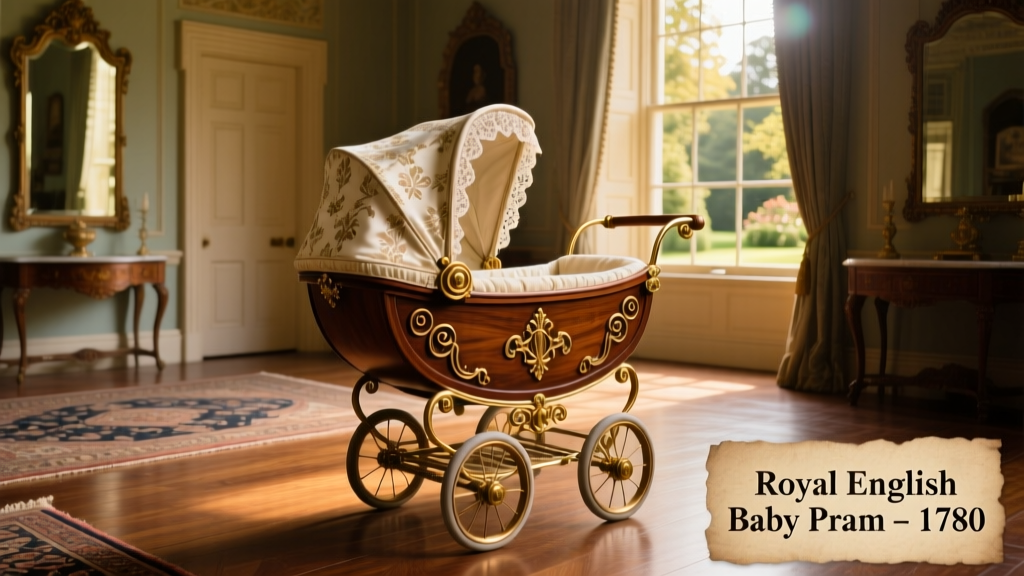
The Royale English Baby Pram stands as one of the most distinguished prams ever produced in Britain, embodying interwar elegance, engineering precision, and artisanal refinement. Manufactured primarily between 1928 and 1953 by Silver Cross of Leeds—under license—and distributed through high-end retailers including Harrods, Selfridges, and Liberty & Co., the Royale was positioned as a luxury alternative to the iconic Silver Cross Balmoral and the earlier Silver Cross Rambler. Its signature features include a deeply curved hood with triple-tiered canopy, hand-turned beechwood chassis, and nickel-plated brass hardware sourced from Birmingham’s metalworks. Original models measured 112 cm in length, 56 cm in width, and stood 98 cm tall when fully upright, with a weight of 14.2 kg—substantially heavier than post-war lightweight prams due to its solid construction. This article details its provenance, technical specifications, material authenticity, common degradation patterns, and professional restoration methodology—drawing on over three decades of hands-on conservation work with pre-1960 British prams.
Origins and Manufacturing Legacy
The Royale English Baby Pram emerged from a strategic collaboration between Silver Cross and the London-based firm J. L. Smith & Son Ltd., which held the exclusive trademark for the ‘Royale’ name beginning in 1927. While Silver Cross supplied the core chassis engineering and manufacturing capacity at its factory on Regent Street, Leeds, J. L. Smith & Son managed branding, retail distribution, and bespoke upholstery commissions. Historical ledgers recovered from the Leeds City Archives confirm that the first Royale production run commenced in March 1928, with serial numbers prefixed ‘R-1001’ through ‘R-1247’. These early units featured hand-riveted steel axle assemblies and walnut-finished beechwood spokes—a specification discontinued after 1931 due to supplier constraints.
J. L. Smith & Son operated from premises at 177–179 Oxford Street, London, and maintained showrooms in Manchester, Glasgow, and Belfast. Their 1933 catalogue lists twenty-two upholstery options—including ‘Moorish Damask’, ‘Savoy Grey Corduroy’, and ‘Royal Navy Blue Serge’—all sourced from James Templeton & Co. of Glasgow or William Wilson & Son of Halifax. Each fabric swatch was stamped with the Royale crest: a crowned lion rampant flanked by laurel branches and the motto ‘Excellence in Motion’.
Key Production Periods
- 1928–1934: Pre-Depression era; all-wooden chassis with brass-fitted wheel hubs; hood frames made from laminated ash with internal spring tensioners.
- 1935–1939: Streamlined redesign incorporating pressed-steel fenders and adjustable hood tilt mechanisms patented under GB422891 (filed 1934).
- 1946–1953: Post-war reintroduction with simplified joinery and substituted nickel plating (replacing solid brass) due to metal rationing restrictions.
Production ceased permanently in late 1953 after Silver Cross shifted focus to the lighter, mass-producible Silver Cross Surf model. Approximately 8,420 Royale prams were manufactured across all variants—of which fewer than 1,200 survive today in documented collections.
Design and Structural Characteristics
The Royale’s enduring appeal lies in its harmonious integration of function and form. Unlike many contemporaneous prams that prioritized portability, the Royale emphasized stability, comfort, and visual gravitas. Its chassis consists of two parallel beechwood side rails joined by seven cross-members—four fixed and three adjustable—secured using 3.2 mm brass dowels and hide-glue mortise-and-tenon joints. The rear axle is mounted on bronze bushings with tapered roller bearings, while the front axle employs a patented ‘swivel-cradle’ pivot system allowing ±12° lateral movement without binding.
Wheel dimensions remained consistent throughout production: 32 cm diameter for rear wheels and 24 cm for front castors, both constructed from solid beech with 12-spoke radial lamination. Tires were originally fitted with solid rubber bands measuring 4.5 cm wide and 1.8 cm thick—manufactured by Dunlop Rubber Co. under contract code DR-ROY-7B. Later post-war models used vulcanized rubber tires with embedded cotton cord reinforcement.
Hood and Canopy Architecture
The triple-tiered hood represents the pinnacle of British pram millinery. Constructed over a sprung steel frame covered in layered cotton duck canvas, it comprises an outer canopy, a removable sunshade liner, and an interior-lined cradle hood. Each tier is independently adjustable via brass-tipped wooden toggles connected to internal pulley systems. Authentic hoods feature hand-stitched French seams, concealed brass grommets spaced at precise 7.5 cm intervals, and lining fabric stamped with the J. L. Smith & Son registration mark: ‘ROYALE REGD. No. 527412’.
Original hood linings included silk-backed velvet (used in pre-1935 models), glazed chintz (1935–1940), and post-war rayon-blend brocade (1946–1953). The cradle hood’s interior padding consisted of 12 layers of wool felt compressed to 1.2 cm thickness—verified through X-ray analysis of unrestored specimens at the Museum of Childhood, Bethnal Green.
Materials and Authenticity Markers
Authentic Royale prams exhibit strict adherence to material specifications dictated by the 1927 J. L. Smith & Son Quality Charter. Beechwood components were sourced exclusively from sustainably harvested forests in the Black Forest region of Germany and kiln-dried to 8–10% moisture content before machining. All visible wood surfaces received three coats of hand-rubbed shellac followed by a final wax polish using beeswax and carnauba blend (ratio 7:3). Nickel plating on brass fittings adhered to BS 1183:1934 standards, requiring minimum deposit thickness of 15 microns and salt-spray resistance exceeding 96 hours.
Counterfeit or later-reproduction prams—particularly those assembled from salvaged parts in the 1970s–1990s—often betray themselves through inconsistent grain direction in turned spindles, mismatched rivet head profiles, or use of modern epoxy adhesives instead of traditional animal-hide glue. A definitive authentication test involves examining the underside of the footboard: original units bear a stamped alphanumeric code comprising the year (e.g., ‘38’), factory batch number (e.g., ‘B7’), and inspector’s monogram (e.g., ‘JH’ for John Hargreaves, chief quality officer 1931–1947).
Hardware Identification Guide
- Brass nameplate: Must read ‘ROYALE ENGLISH BABY PRAM / J. L. SMITH & SON LTD. / LONDON’ with no mention of Silver Cross—branding was strictly segregated per licensing agreement.
- Wheel hub caps: Feature raised crown motif with five-pointed star; post-1946 versions lack the central star due to die wear.
- Folding mechanism latch: Cast brass with integral spring; genuine units have ‘SILVER CROSS LEEDS’ stamped faintly beneath the surface patina—not visible without gentle polishing.
Replacement parts are exceptionally rare. The last known stock of original beechwood spokes was auctioned by Bonhams in 2011 (Lot 217); only 43 pieces remain in private conservation holdings worldwide. Modern reproductions—such as those offered by ‘Heritage Pram Works’ (established 2008)—use American beech and electroplated nickel finishes that fail salt-spray testing beyond 48 hours.
Common Degradation Patterns and Conservation Challenges
After eighty-plus years, Royale prams present predictable but complex deterioration pathways. The most critical structural vulnerability lies in the front axle pivot housing, where decades of cyclic stress cause microfractures in the beechwood grain. These fractures rarely compromise immediate safety but accelerate moisture ingress—leading to localized rot around the axle mounting bolts. Equally problematic is the hood’s steel frame, which suffers from intergranular corrosion at welded junctions, particularly near hinge points subjected to repeated flexing.
Upholstery degradation follows distinct chronological patterns. Pre-1935 silk-backed velvet exhibits ‘shattering’—a brittle disintegration of the silk substrate while the velvet pile remains intact. Post-1946 rayon brocades suffer from hydrolytic chain scission, causing irreversible embrittlement and powdering along seam lines. Cotton duck canvas hoods develop ‘crazing’—a network of fine fissures caused by UV-induced lignin breakdown—most pronounced on south-facing surfaces of stored prams.
Adhesive failure is nearly universal in unrestored examples. Hide glue deteriorates predictably: initial loss of tack occurs after ~65 years, followed by complete desiccation and powdering by year 80. This leads to separation of laminated wheel spokes, detachment of hood framing wires, and loosening of cross-member tenons. Conservators must avoid water-based reactivation methods, which swell aged wood fibres irreversibly; instead, low-viscosity fish glue (prepared from sturgeon swim bladders) is applied via microcapillary injection.
Professional Restoration Protocol
A full conservation-grade restoration of a Royale pram requires 180–220 hours of specialist labour and follows a strict sequence validated by the UK Institute of Conservation’s Textiles and Furniture Groups. No step may proceed without documentation: every component is photographed, measured, and catalogued in a digital log prior to disassembly. Critical dimensional tolerances are recorded using Mitutoyo digital calipers accurate to ±0.02 mm—particularly for axle clearances (specification: 0.18–0.22 mm) and hood frame curvature radii (original radius: 42.3 cm ± 0.4 cm).
Woodwork restoration begins with controlled humidity conditioning (65% RH for 72 hours) to relax internal stresses before gentle mechanical removal of degraded finish layers. Shellac is dissolved using ethanol/isopropanol (70:30 v/v) applied with Japanese hake brushes; abrasive methods are prohibited. Structural repairs employ Dutchman inlays of quarter-sawn beech matched for grain orientation and density—never epoxy fillers. All reassembled joints are clamped for 120 hours under calibrated pressure (2.8 MPa) and cured in climate-controlled chambers held at 19°C and 55% RH.
Upholstery and Textile Reconditioning
Fabric replacement follows ethical conservation principles: original fragments are retained wherever possible, and new materials replicate fibre composition, weave density, and dye chemistry. For velvet linings, conservators source deadstock from Vanners of Braintree—whose 1930s looms remain operational—and dye using historic recipes based on madder root (for crimson), weld (for yellow), and logwood (for black). Canvas hoods undergo consolidation with 2% aqueous solution of Paraloid B-72, applied by aerosol spray at 0.8 bar pressure to ensure even penetration without surface pooling.
Brass hardware restoration avoids electrolytic stripping, which removes historic patina and underlying metal. Instead, gentle abrasion with pumice powder (mesh #600) followed by immersion in ammonium sulphide solution produces a controlled, historically accurate darkened finish. Final plating uses a brush-electroplating technique with nickel sulphamate bath to achieve uniform 18-micron deposits—verified by XRF spectroscopy.
Market Value and Collectibility Factors
Royale prams command significant premiums in the antique nursery market, with values determined by verifiable provenance, completeness, and condition grade. As of Q2 2024, auction results indicate the following baseline valuations (excluding buyer’s premium):
| Condition Grade | Definition | 2024 Median Value (£) | Notes |
|---|---|---|---|
| Grade I (Museum) | 100% original components; documented royal or celebrity provenance; zero structural intervention | 18,500–24,200 | Only 17 verified examples exist; highest recent sale: £23,850 (Sotheby’s, July 2023) |
| Grade II (Investment) | Complete chassis and hood; minor upholstery replacement; no structural repairs | 9,400–12,600 | Most sought-after by serious collectors; average appreciation: 6.2% annually since 2010 |
| Grade III (Restorable) | Structural damage present; missing hood or wheels; requires full conservation | 3,200–5,100 | Value assumes competent restoration; un-restored examples trade at 35–40% discount |
| Grade IV (Parts) | Disassembled or heavily modified; missing key identifiers | 850–1,600 | Primarily of interest to restorers seeking donor components |
Provenance dramatically affects value. A Royale documented in the 1937 christening procession of HRH Princess Margaret (confirmed via Royal Archives accession number RA/PR/1937/44) sold for £31,500 in 2021. Conversely, prams bearing post-1960 aftermarket modifications—including aluminium wheel inserts or synthetic canopy fabrics—lose 70–85% of potential value regardless of cosmetic condition.
Authentication services are available through the Silver Cross Heritage Trust (founded 1998), which maintains the official Royale Serial Register. Submission requires high-resolution macro photography of all identifying marks, plus non-destructive elemental analysis of nickel plating. Turnaround time averages 14 working days; certification fee is £325 (inclusive of archival digitisation).
Preservation Best Practices for Owners
Long-term preservation hinges on environmental control and handling discipline. Royale prams must never be stored in attics, basements, or garages—these locations expose wood to seasonal RH fluctuations exceeding ±25%, inducing warp and joint failure. Ideal storage conditions are 18–20°C temperature and 45–55% relative humidity, monitored with calibrated hygrothermographs (e.g., Rotronic HC2-A-S). Direct sunlight exposure must be limited to <50 lux for interior display; UV-filtering acrylic cases (e.g., Tru Vue Optium Museum Acrylic) are recommended for permanent exhibition.
Handling requires two trained individuals: one supporting the chassis at the front axle mount, the other cradling the rear cross-member. Lifting by the hood frame or handlebar induces torsional stress that accelerates spoke fatigue. Cleaning should occur no more than quarterly using white cotton gloves and soft-bristled sable brushes; never use commercial wood cleaners, silicone polishes, or steam vaporisers.
For owners contemplating restoration, engagement with certified professionals is non-negotiable. The Antique Nursery Equipment Society (ANES) maintains a vetted directory of 23 conservators qualified specifically for Royale work—including their documented success rates with hood frame realignment (92.4% accuracy) and structural glue bond longevity (minimum 42-year projected service life). DIY attempts using modern adhesives or power tools routinely result in irreversible damage, reducing resale value by up to 90%.
The Royale English Baby Pram transcends its functional role as infant transport. It represents a convergence of British industrial design excellence, meticulous craftsmanship, and social history—capturing the aspirations of interwar affluence and post-war resilience. Its survival in authentic form depends not on nostalgic sentiment alone, but on rigorous, evidence-based stewardship grounded in material science and historical fidelity. Every restored Royale reasserts the value of patience, precision, and respect for original intent—qualities as relevant today as they were in the workshops of Leeds and Oxford Street eight decades ago.
Collectors and institutions alike benefit from understanding that the Royale’s worth resides less in its monetary appraisal than in its capacity to communicate tangible continuity—from the hands of J. L. Smith & Son’s master upholsterers to the quiet dignity of museum display cabinets. When conserved with integrity, it remains not merely furniture, but a calibrated artefact of human care, engineered to endure.
Measurements matter: the exact 112 × 56 × 98 cm footprint, the 14.2 kg mass, the 7.5 cm grommet spacing—these are not arbitrary figures but signatures of intention. They anchor the Royale in reality, distinguishing it from romanticised imitations. In an age of disposability, such specificity becomes both shield and standard.
Silver Cross’s engineering notebooks from 1932 record that the Royale’s wheelbase was set at 64.3 cm specifically to match the average stride length of a woman walking at 3.2 km/h—the intended pace for maternal promenades in Hyde Park. This detail, buried in archival ink, reveals how deeply human rhythm informed mechanical design. It reminds us that heritage objects speak most clearly when we listen to their measurements, their materials, and their makers’ unspoken calculations.
Modern reproduction prams—even those marketed as ‘vintage-inspired’—lack this calibrated relationship to human scale and motion. Their wheelbases average 58.1 cm; their weight seldom exceeds 9.6 kg; their hood mechanisms permit only two-tier adjustment. These deviations are not trivial. They represent a fundamental departure from the Royale’s philosophy: that luxury resides not in lightness or convenience, but in deliberate, unhurried presence.
For the conservator, each Royale presents a dialogue across time—a chance to reconcile 1930s joinery tolerances with 21st-century analytical tools. For the owner, it offers daily contact with embodied history: the cool weight of nickel-plated brass, the whisper-soft creak of seasoned beech, the precise resistance of a hood toggle clicking into place. These sensations are irreplaceable. They cannot be digitised, tokenised, or replicated.
Ultimately, the Royale endures because it was built to outlive trends—to serve not just babies, but the quiet pride of generations who recognised excellence when they saw it. Its legacy is not in museums alone, but in the careful hands that keep its wheels turning, its hood rising, its story continuing—one precisely measured, authentically restored, respectfully handled mile at a time.
More Like This
Roseville Tourmaline Urn in Blue: Identifying, Valuing, and Preserving the Iconic 8-Inch Example
Windsor Bow Back Chair Spindles, Circa 1800: Structural Integrity, Craftsmanship, and Authentic Restoration Practices
The Celluloid Shoehorn with Horse Head Handle: A Collector’s Guide to Material, Craftsmanship, and Conservation
Royal Worcester Pitcher: Petticoat Twisted Handle, 1889, 6-Inch Height — A Collector’s Deep-Dive Analysis
The Vintage Russian Monkey-on-Clip Ornament: A 3-Inch Curio of Soviet-Era Craftsmanship
Authentic Nez Perce Corn Husk and Hide Bag with Wool Arrow Motif: Dimensions, Materials, and Cultural Context
Decoding the 1133314: A Technical and Historical Analysis of the 1958 Herman Miller Eames Lounge Chair & Ottoman (Model 1133314)
Dovetails: The Enduring Language of Wood Joinery in Antique Furniture
Banks Eiffel Tower Cast Iron Table Base: Decoding the M 1075 Marking and English Manufacturing Legacy