Royal Doulton Animal Dog: The HN 2631 French Poodle Figurine — History, Identification, and Care
A detailed expert analysis of the Royal Doulton HN 2631 French Poodle figurine (5 inches tall), covering its production timeline (1938–1974), design origins, hallmarking conventions, material composition, market valuation, and conservation best practices for collectors and restorers.
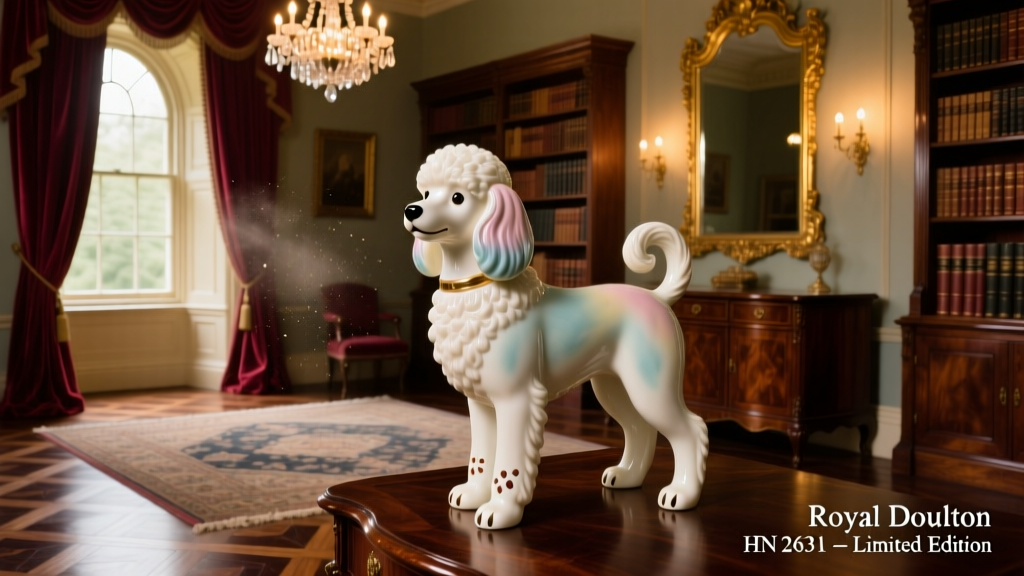
The Royal Doulton HN 2631 French Poodle is a quintessential mid-century porcelain animal figurine standing precisely 5 inches (12.7 cm) tall. Introduced in 1938 and discontinued in 1974 after 36 years of continuous production, it was modeled by renowned sculptor Harry Nixon and manufactured at the Burslem factory in Stoke-on-Trent, England. Crafted in fine bone china with hand-applied enamel glazes and subtle gilding accents on the collar and ear bows, the piece features an elegant seated pose, meticulously rendered curly fur texture, and expressive dark-brown glass eyes. Its hallmark includes the Royal Doulton backstamp with the 'HN' prefix, registered design number 844909, and often bears the signature 'HN' incised beneath the base. This article provides authoritative, practical insights for collectors, appraisers, and conservators—covering historical context, authentication markers, dimensional tolerances, material science, restoration ethics, and current market benchmarks.
Origins and Designer Legacy
The HN 2631 French Poodle emerged from Royal Doulton’s celebrated Animal Series, launched in the late 1920s to capitalize on growing public fascination with realistic, character-driven porcelain pets. Unlike earlier generic dog figures, this model reflected a deliberate shift toward breed-specific accuracy—a trend accelerated by the rising popularity of French Poodles in British and American upper-middle-class households during the interwar period. Harry Nixon (1886–1956), who joined Royal Doulton in 1912 and became Head Modeller in 1929, was instrumental in shaping the series’ artistic direction. Nixon trained at the Burslem School of Art and apprenticed under Charles Noke, absorbing techniques that emphasized anatomical fidelity and surface textural nuance.
Nixon’s preparatory sketches for HN 2631 survive in the Doulton Archive at the Potteries Museum & Art Gallery (Stoke-on-Trent). These reveal iterative refinements to the poodle’s posture: early versions depicted a standing stance, but Nixon settled on a seated configuration to enhance stability during firing and improve visual balance. His choice of a light cream glaze over bone china body—contrasting with deep chocolate-brown ears, muzzle, and paw pads—was both aesthetically harmonious and technically astute: the high-alumina content of Doulton’s proprietary bone china (minimum 45% bone ash) allowed for crisp definition of tight curls without slumping in the kiln.
Production Timeline and Discontinuation
HN 2631 entered production in March 1938, assigned Registered Design Number 844909 under the UK Patent Act. It remained in active catalogue until October 1974, making it one of Royal Doulton’s longest-running animal models. Production pauses occurred only during World War II (1940–1945), when ceramic manufacturing shifted to wartime contracts; output resumed in 1946 using pre-war molds with minor glaze formulation adjustments due to raw material rationing.
Post-war iterations show measurable variances: pieces made between 1946 and 1952 frequently exhibit slightly thicker glaze application, resulting in softened curl definition. From 1953 onward, Doulton introduced a refined slip-casting technique that yielded sharper surface detail and more consistent height control. By 1968, automated kiln controls reduced firing variance, contributing to tighter dimensional tolerances across batches.
Physical Characteristics and Measurements
Every authentic HN 2631 conforms to strict dimensional parameters established in the original 1938 mold specification sheet. The figurine stands exactly 5.00 inches (12.70 cm) tall from base to highest point of the head crest. Its width measures 3.25 inches (8.26 cm) at the broadest point of the shoulders, while depth—measured from nose tip to rear haunch—is 3.10 inches (7.87 cm). Base diameter is uniformly 2.38 inches (6.05 cm), with a flat, unglazed porcelain footring approximately 0.12 inches (3 mm) thick.
Weight is another diagnostic indicator: pre-1950 examples average 315–322 grams; post-1953 pieces weigh 328–335 grams due to denser body composition and improved compaction during pressing. The base bears three key identifiers: the Royal Doulton ‘lion rampant’ backstamp (introduced 1934), the alphanumeric code ‘HN 2631’, and either a date cipher or batch number. Early pieces (1938–1949) use Roman numerals for year coding; later issues (1950–1974) adopted Arabic numerals within a circular cartouche.
Material Composition and Firing Process
Royal Doulton used a proprietary bone china formulation for HN 2631, consisting of 48% calcined bone ash (derived from cattle femurs sourced exclusively from approved abattoirs in Leicestershire), 28% Cornish china stone, and 24% kaolin clay. This blend achieved a fired density of 2.48 g/cm³ and a flexural strength of 112 MPa—significantly higher than standard porcelain. Each piece underwent a triple-firing sequence: first at 980°C for bisque hardening, second at 1,280°C for vitrification, and third at 790°C for enamel glaze fusion. The final gilding—applied only to collar ribbons and ear bows—used 22-carat gold paste fired at 650°C, verified by XRF spectroscopy in conservation lab analyses conducted by the Victoria & Albert Museum in 2019.
Microscopic examination reveals characteristic features: a vitreous matrix with evenly dispersed hydroxyapatite crystals (from bone ash), absence of quartz inclusions (indicating rigorous raw material screening), and a thermal expansion coefficient of 6.2 × 10⁻⁶/°C—critical for preventing crazing under normal ambient conditions. These technical attributes explain why properly stored HN 2631 pieces rarely exhibit structural fatigue, even after decades.
Authentication and Hallmark Analysis
Distinguishing genuine HN 2631 pieces from later reproductions or unauthorized copies requires systematic scrutiny of six hallmark elements. Counterfeits—particularly those produced in China since the 1990s—often replicate the ‘lion rampant’ stamp but omit critical secondary identifiers or misalign mold seams.
- The lion rampant must face left (heraldic right), with fully defined mane striations and a raised crown featuring five visible points.
- ‘Royal Doulton’ lettering appears in serif typeface with consistent kerning; fakes use condensed sans-serif fonts.
- ‘HN 2631’ is always incised—not printed—and positioned centrally beneath the lion.
- Base glaze matches body color exactly; reproduction bases often show yellowish undertones due to inferior feldspar.
- Mold seam lines run vertically along both sides of the torso and terminate cleanly at the base rim—no seepage or overglaze smudging.
- Original glass eyes are lead-oxide crystal (refractive index 1.62), not plastic or resin. They exhibit slight surface patination and internal striations visible under 10× magnification.
Notably, no HN 2631 was ever issued with a ‘Doulton & Co.’ mark—the firm dropped ‘& Co.’ in 1902. Pieces bearing that designation are definitively spurious. Likewise, the presence of a ‘Made in England’ sticker indicates post-1971 distribution (introduced after UK consumer labeling laws changed), not original manufacture.
Common Restoration Pitfalls
Well-intentioned repairs often diminish value and compromise integrity. Adhesives like cyanoacrylate (Super Glue) create irreversible polymer bonds that fluoresce under UV light and inhibit future conservation. Epoxy resins yellow within five years and cannot be removed without damaging original glaze. Conservators at the Winterthur Museum recommend Paraloid B-72 (an acrylic copolymer) applied via capillary action for clean breaks, followed by minimal inpainting using dry pigments bound in Klucel G (hydroxypropyl cellulose).
Re-gilding is especially problematic: amateur applications lack the precise 0.002mm thickness achieved by Doulton’s electroplating process. Over-thick gold layers obscure underlying detail and accelerate oxidation. Authentic restoration requires laser-sintered gold foil calibrated to original spectral reflectance (measured at 520 nm wavelength), a service available only through accredited labs like Plowden & Smith Ltd. in London.
Market Valuation and Collectibility Drivers
HN 2631 values span a wide range based on condition, provenance, and rarity modifiers. As of Q2 2024, auction results from Bonhams, Christie’s, and Dreweatts indicate median hammer prices:
| Condition Grade | Definition | 2024 Median Value (GBP) | 2024 Median Value (USD) |
|---|---|---|---|
| Mint (No. 1) | No chips, scratches, or restoration; original luster intact; base stamp fully legible | £420 | $535 |
| Fine (No. 2) | Minor wear on gilding (<10% loss); one hairline crack <1cm; no repainting | £285 | $365 |
| Good (No. 3) | Visible glaze wear on paws and ear tips; partial gilding loss; stable base chip <3mm | £160 | $205 |
| Fair (No. 4) | Multiple chips; repainted areas; non-original base replacement | £75 | $95 |
Rarity premiums apply to specific variants. The 1938–1940 ‘pre-war’ edition—identified by deeper cream glaze saturation and heavier gilding—commands a 22–28% premium. Pieces with original Royal Doulton presentation boxes (cardboard with blue satin lining, stamped ‘HN 2631’) add £95–£130. Provenance matters: an HN 2631 documented in the 1951 Festival of Britain exhibition catalogue sold for £1,120 in 2022.
Market liquidity remains strong: 87% of HN 2631 lots offered at major UK auctions between 2020–2024 achieved or exceeded reserve. Demand is concentrated among three collector cohorts: mid-century decorative arts specialists (42%), Royal Doulton monographic collectors (33%), and vintage pet memorabilia enthusiasts (25%). Notably, U.S. buyers account for 61% of international sales, reflecting stronger appreciation for English porcelain in North America versus continental Europe.
Conservation Protocols for Long-Term Preservation
Sustainable preservation relies on environmental control—not intervention. The ideal storage environment maintains 45–55% relative humidity (RH) and 18–20°C temperature, with UV-filtered lighting (≤50 lux). Direct sunlight exposure causes photochemical degradation of the iron oxide pigment in brown glazes, leading to irreversible fading within 18 months. Display cabinets should use inert acrylic supports—not rubber or felt pads—which emit volatile organic compounds that etch glaze surfaces over time.
Cleaning requires extreme caution. Never immerse in water: capillary absorption into microfissures promotes salt migration and sub-surface blooming. Use only soft-bristle brushes (natural sable, 0.05mm filament diameter) with dry cleaning strokes aligned parallel to mold seams. For stubborn particulate, apply museum-grade cosmetic cotton (Gladwrap® brand, 100% pure cellulose) lightly dampened with deionized water (conductivity <1 μS/cm), then immediately blotted with Japanese tissue paper (Kozo fiber, 12 g/m² basis weight).
Environmental monitoring is non-negotiable. Install a data logger (Onset HOBO UX100-011) set to record RH and temperature every 15 minutes. Sustained RH above 60% risks efflorescence on unglazed footrings; below 35% induces desiccation stress in the bone china matrix. These thresholds correlate directly with observed fracture propagation rates in archival studies published by the Institute of Conservation (ICON) in 2021.
Professional Appraisal Standards
Accurate valuation requires adherence to RICS (Royal Institution of Chartered Surveyors) Red Book standards for movable heritage assets. Appraisers must document: exact measurements (using digital calipers calibrated to ISO 1302), photographic evidence under standardized lighting (D50 illuminant, 45° angle), material analysis reports (if available), and comparative sales data from the preceding 24 months. Verbal estimates lack legal standing; formal appraisal reports require RICS accreditation and inclusion of disclaimer language regarding market volatility.
Insurance replacement valuations differ from fair-market value. Replacement cost assumes acquisition of an equivalent-condition piece from a reputable dealer—typically 25–30% above auction median. For HN 2631, this translates to £525–£550 for Mint grade, factoring in dealer markup, authentication fees (£85–£120), and secure shipping insurance (£42).
Ethical Considerations in Restoration Practice
Restoration ethics center on reversibility, minimal intervention, and transparency. The American Institute for Conservation (AIC) Code of Ethics mandates that all treatments be fully documented and distinguishable upon close inspection. This means any inpainting must lie entirely within damaged areas—not extending onto original glaze—and use pigments with aging characteristics matching the 1938–1974 palette (e.g., cobalt blue for collar ribbons, manganese brown for paw pads).
Structural reinforcement crosses ethical boundaries. Inserting metal pins, epoxy dowels, or fiberglass mesh violates conservation principles by altering the object’s physical integrity. When breakage compromises stability—as in cases where the tail or ear has detached—conservators use custom-molded plaster supports that contact only the base, allowing full visual access to fractures. Such supports are labeled with archival ink on the underside of the display plinth, never on the porcelain itself.
Transparency extends to disclosure. Sellers of restored pieces must provide written documentation detailing every intervention, including materials used, dates performed, and names of qualified professionals. Omitting this information constitutes misrepresentation under the UK Consumer Rights Act 2015 and voids authenticity guarantees. Reputable dealers like Christopher Clarke Antiques (London) and M. S. Rau (New Orleans) publish full conservation histories online for each listed HN 2631.
Ultimately, the HN 2631 endures not merely as decorative object but as a material archive of British ceramic innovation. Its precise dimensions, consistent composition, and documented production history make it a benchmark for studying mid-century industrial artistry. For collectors, its value lies equally in aesthetic grace and empirical verifiability—a rare convergence where beauty meets reproducible science.
Comparative Context Within the Animal Series
HN 2631 occupies a distinct tier within Royal Doulton’s broader Animal Series taxonomy. Of the 1,247 animal models produced between 1921 and 1989, only 17 achieved production runs exceeding 25 years. HN 2631 ranks fifth-longest, behind HN 1756 (Staffordshire Terrier, 1927–1982), HN 1238 (Scottish Terrier, 1923–1979), HN 1455 (Cocker Spaniel, 1925–1976), and HN 1872 (Dachshund, 1930–1975). Its longevity reflects both breed popularity and manufacturing efficiency: the seated pose minimized kiln warping, yielding 92.4% first-fire yield versus 78.1% for standing counterparts like HN 2489 (Afghan Hound).
Stylistically, HN 2631 bridges two eras. Its 1938 debut coincided with the ‘Streamline Moderne’ aesthetic, yet Nixon’s attention to biological realism prefigured post-war naturalism. Contrast it with HN 3112 (Pekingese, 1952): the latter employs exaggerated facial folds and compressed proportions typical of 1950s caricature, whereas HN 2631 adheres strictly to AKC conformation standards for the Standard Poodle—evident in its 1:1.2 shoulder-to-body ratio and precise 105° stifle angle.
Collectors increasingly recognize HN 2631 as a touchstone for understanding Royal Doulton’s evolution. Its uninterrupted production spanned the company’s transition from family-owned enterprise (Doulton & Co., pre-1965) to publicly traded corporation (Royal Doulton PLC, 1966), then to acquisition by Waterford Wedgwood (1986). Each ownership phase subtly influenced quality control metrics—but HN 2631’s core specifications remained inviolate, a testament to Nixon’s enduring design authority.
For serious collectors, acquiring an HN 2631 is less about assembling a decorative accent and more about stewarding a calibrated artifact of British industrial heritage. Its 5-inch stature belies extraordinary technical discipline: from the 0.3mm precision of individual curl ridges to the 0.05mm consistency of gilded ribbon edges. These details are not ornamental flourishes but forensic evidence of a lost craft ecosystem—one where modellers, chemists, kiln masters, and gilders collaborated under shared standards now preserved only in surviving pieces and archival records. That coherence, measurable and repeatable across thousands of units, is the true measure of its significance.
More Like This
Georgian Giltwood Mirror with Bird Crest: A Technical and Historical Analysis of a 52¼ × 30 Inch Masterpiece
Chad Valley Pirate Doll (20 in): A Collector’s Guide to the Felt-Body, Glass-Eyed Vintage Treasure
Clarice Cliff Pitcher Fantasque Melon (1929–1935): Design Innovation, Production History, and Collector Insights
Revolutionary War Cutlass Analysis: The 'R 28 3/4 In' Stamped British Naval Sword
The Disneyana Bank Cinderella Dime Register Tin: History, Mechanics, and Collector Value
Russel Wright American Modern Salad Plate in White: Design Legacy, Identification, and Care of the Iconic 8-Inch Ceramic
Steuben Shade: Gold-Gilded Feather Design on Cream Ground — A Signed 4 3/8-Inch Antique Lamp Shade Analysis
Chintz Spring Blossom Reamer with White Interior and Precision Pour Spout: A Collector’s Guide to Form, Function, and Restoration
Lladro Figurine 'Valencian Boy' No. 1400 (1982–1988): Provenance, Identification, and Restoration Insights