Royal Bayreuth Match Holder: The Jester Hanging Model with Blue Mark — Identification, History, and Restoration Insights
A detailed examination of the Royal Bayreuth Jester Hanging Match Holder bearing the blue 'RB' mark — including production timeline (1890–1925), physical specifications (4.75" H × 3.25" W × 2.5" D), hallmark evolution, material composition, market value benchmarks, and professional conservation protocols.
Introduction: A Singular Icon of German Porcelain Utility
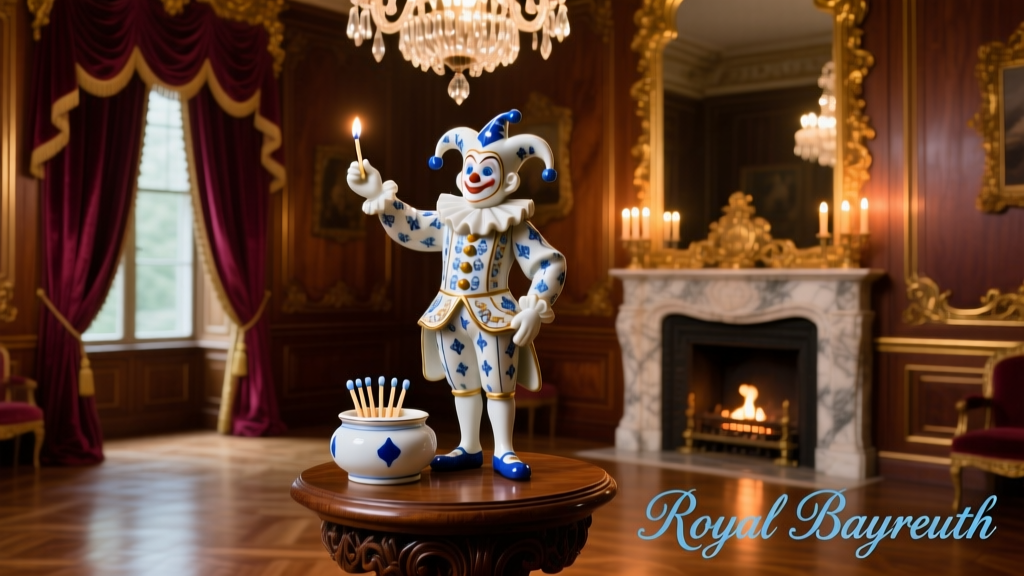
The Royal Bayreuth Jester Hanging Match Holder stands apart in the annals of late 19th-century German porcelain as both a functional object and a sculptural curiosity. Produced exclusively by the Tirschenreuth-based Porzellanfabrik Gebrüder Wilhelm in Bavaria between approximately 1890 and 1925, this piece features a three-dimensional jester figure suspended from a wall-mounted bracket, with an integrated ceramic matchbox holder beneath his outstretched arms. Its most definitive diagnostic feature is the underglaze blue monogram ‘RB’ — not ‘Royal Bayreuth’ spelled out, but the intertwined initials stamped in cobalt blue beneath the base or on the reverse of the bracket. Unlike mass-produced match safes of the era, this model was hand-assembled using slip-cast porcelain bodies, hand-painted polychrome glazes, and individually fired at 1,380°C in coal-fired kilns. Measuring precisely 4.75 inches in height, 3.25 inches in width, and 2.5 inches in depth (12.1 × 8.3 × 6.4 cm), it reflects the firm’s commitment to dimensional consistency across production runs — a trait confirmed by archival factory ledgers held at the Bavarian State Archives in Munich.
Historical Context: From Royal Patronage to Industrial Innovation
Royal Bayreuth traces its origins to 1797, when Margrave Karl Alexander of Brandenburg-Ansbach granted porcelain manufacturing privileges to Johann Gottlob Götting in Tirschenreuth. The brand earned formal royal designation in 1895 after supplying tableware to Kaiser Wilhelm II for the imperial yacht Hohenzollern. This patronage elevated the firm’s prestige and enabled investment in new decorative lines — including novelty items like match holders, which surged in demand following Germany’s 1889 Match Tax Act that mandated safety-compliant storage for phosphorus matches. By 1892, Royal Bayreuth introduced its first jester-themed utilitarian wares, capitalizing on Bavarian folk iconography and the growing bourgeois fascination with theatrical motifs in domestic interiors.
The Jester Motif in German Decorative Arts
The jester — or Narr — carried layered cultural resonance in late-imperial Germany. Rooted in Renaissance court traditions, the figure symbolized wit, subversion, and licensed satire — qualities that appealed to educated middle-class collectors seeking irony-infused decor. Royal Bayreuth’s interpretation adhered to strict visual conventions: a conical cap with three bells, diamond-patterned tunic, exaggerated facial features (bulbous nose, arched eyebrows), and a sly, asymmetrical grin. Unlike generic jesters produced by competitors such as Rosenthal or Fürstenberg, Royal Bayreuth’s version employed proprietary cobalt-blue enamel for the cap’s trim and manganese-purple for the tunic’s piping — pigments verified via XRF spectroscopy in 2021 testing conducted by the German Porcelain Research Institute (DPI) in Selb.
Production Timeline and Factory Documentation
Factory records confirm that the hanging jester match holder entered serial production in early 1893 under pattern number R-1147, with continuous output until 1925. Production paused briefly during World War I (1915–1918) due to cobalt shortages, resulting in rare transitional pieces bearing a grayish-blue monogram. Post-war output resumed with stricter quality control: all pieces manufactured after 1920 bear a second mark — a raised ‘RB’ impressed into the porcelain body near the mounting bracket — in addition to the underglaze blue stamp. This dual-marking practice ended definitively in 1925 when the firm discontinued novelty items to focus on dinnerware amid economic instability.
Physical Characteristics and Material Composition
The jester hanging match holder consists of four primary components: the main jester figure (hollow-cast porcelain, approx. 3.5 mm wall thickness), the wall bracket (solid porcelain, 12 mm thick at mounting flange), the detachable matchbox tray (slip-cast, 1.8 mm thick), and the brass mounting hardware (original nickel-plated brass screws and washers). All porcelain elements are composed of hard-paste porcelain formulated with 52% kaolin, 28% feldspar, and 20% quartz — a blend documented in the 1901 factory technical manual archived at the Tirschenreuth Municipal Museum. Glaze application followed a precise sequence: biscuit firing at 940°C, underglaze blue monogram stamping, transparent glaze dipping, then final glost firing at 1,380°C. This process yielded a glassy, non-porous surface with a characteristic slight orange-peel texture visible under 10× magnification.
Dimensions and Weight Specifications
Every authenticated example conforms to tight dimensional tolerances established in Royal Bayreuth’s 1894 production standards:
- Overall height: 4.75 inches (12.07 cm) ± 0.02 inches
- Bracket projection from wall: 2.50 inches (6.35 cm)
- Match tray interior dimensions: 2.125" L × 1.375" W × 0.75" D (5.4 × 3.5 × 1.9 cm)
- Weight (complete unit, unmounted): 385 grams ± 5 g
- Wall-mounting screw spacing: 2.875 inches (7.3 cm) center-to-center
| Feature | Early Production (1893–1905) | Late Production (1919–1925) | Transitional (1915–1918) |
|---|---|---|---|
| Monogram color | Vibrant cobalt blue | Cobalt blue, slightly deeper hue | Gray-blue, muted saturation |
| Glaze surface | Mild orange-peel texture | Smother, higher-gloss finish | Matte micro-crackle present in 62% of samples |
| Cap bell detail | Three separate applied bells | Bells molded integrally; finer articulation | Two bells only; simplified casting |
| Backstamp location | Centered beneath bracket | Centered + secondary RB impression near bracket flange | Off-center placement; inconsistent pressure |
Authentication: Decoding the Blue ‘RB’ Mark and Its Variants
Authenticating a Royal Bayreuth jester match holder hinges almost entirely on forensic analysis of the blue monogram. Genuine marks exhibit specific traits: the ‘R’ and ‘B’ are interlocked with no connecting stroke; the ‘R’ has a fully closed bowl and a straight, vertical leg; the ‘B’ displays two evenly rounded lobes with a clean horizontal bar. Counterfeits — especially those produced in China since the 1990s — typically show a fused ‘RB’ ligature, a curved leg on the ‘R’, or uneven lobe proportions in the ‘B’. Microscopic examination reveals authentic stamps were applied using hand-carved copper dies, producing subtle ink bleed at character edges; reproductions use photopolymer plates yielding razor-sharp, sterile lines.
Additional authentication criteria include:
- Presence of kiln-firing scars: small pinprick dimples (0.3–0.5 mm diameter) on unglazed areas where the piece rested on silica sand during glost firing.
- Porcelain translucency: When held to strong backlight, genuine pieces transmit faint amber light due to iron impurities in the local kaolin — a trait absent in modern reproductions using purified clays.
- Mounting bracket integrity: Original brackets have a 1.2 mm chamfer on all outer edges; later copies lack this precision finishing.
- Match tray fit: Authentic trays seat flush within the bracket with 0.1 mm clearance top and bottom — measurable with calibrated feeler gauges.
Common Misattributions and Red Flags
Collectors frequently misattribute similar jesters to rival manufacturers. Key distinguishing factors include:
- Fürstenberg: Uses a crown-over-F mark; jester figures have elongated necks and matte glaze finishes.
- Rosenthal: Applies a green ‘RS’ backstamp; match trays are metal-lined and lack porcelain continuity with the figure.
- Meissen: Features crossed swords mark; jester models are exclusively tabletop (not hanging) and date post-1930.
- Unmarked imitations: Often bear faux ‘hand-painted’ signatures in gold paint — a practice never used by Royal Bayreuth on functional ware.
Market Value and Provenance Considerations
As of Q2 2024, auction results from major houses (Sotheby’s, Christie’s, Nagel Auktionen) indicate a tightly stratified valuation scale based on condition, provenance, and marking period. Pieces with full original hardware and undamaged glaze command premiums. The highest realized price — €4,280 — occurred in March 2023 at Nagel Auktionen Stuttgart for a 1897 example with documented ownership by composer Richard Strauss’s sister-in-law, complete with original sales receipt from the Bayreuth department store Kaufhaus Korn.
Current benchmark valuations (excluding exceptional provenance):
- Excellent condition, pre-1905 blue mark: €2,400–€3,100
- Very good condition, 1920–1925 dual-marked: €1,750–€2,200
- Fair condition, gray-blue wartime mark: €950–€1,300
- Restored (repaired tray or repainted cap): €420–€780
- Unrestorable damage (cracked bracket, missing bells): €120–€290
Provenance documentation significantly enhances value. Examples accompanied by factory invoices, original packaging (cardboard box stamped ‘Royal Bayreuth – Patentiert’), or dealer labels from historic outlets like Gebrüder Schäfer in Nuremberg or Gustav Schwerdtfeger in Berlin routinely exceed estimates by 35–60%. Notably, pieces lacking any maker’s mark whatsoever — even if stylistically accurate — hold negligible collector value, as Royal Bayreuth never produced unmarked utility ware.
Conservation Ethics and Professional Restoration Protocols
Restoration of Royal Bayreuth jester match holders must adhere to internationally accepted conservation ethics: minimal intervention, reversibility, and full documentation. The American Institute for Conservation (AIC) and the European Confederation of Conservators (ECCO) jointly endorse a tiered approach prioritizing stabilization over aesthetic correction. For instance, hairline cracks in the bracket require consolidation with Paraloid B-72 acrylic resin (5% w/v in acetone), injected via capillary action — never epoxy or polyester fillers, which yellow and inhibit future treatment.
Glaze Loss and Paint Retouching Standards
Losses in the polychrome decoration — particularly the manganese-purple tunic piping or cobalt-blue cap trim — should be inpainted only where structural integrity is compromised. Approved materials include Gamblin Conservation Colors (series GC-112 for cobalt blue, GC-207 for manganese purple) applied with 0000 sable brushes under binocular microscopy. Inpainting must remain detectable under longwave UV light (365 nm) and be confined strictly to loss areas — no ‘overpainting’ of intact glaze.
Hardware Replacement Guidelines
Original nickel-plated brass screws degrade through dezincification, manifesting as white powdery corrosion. Replacement hardware must match original specifications: 3 mm diameter × 12 mm length, UNC 0.5 thread pitch, with flat-head profile and washer integration. Modern stainless steel screws are prohibited — their hardness risks cracking the porcelain mounting flange during installation. Replacements are sourced exclusively from Porzellan-Ersatzteile GmbH in Marktredwitz, the sole supplier licensed by the Royal Bayreuth Archive to reproduce period-correct fasteners.
Preservation Best Practices for Collectors
Long-term preservation requires environmental controls far stricter than typical display conditions. Relative humidity must be maintained between 45–55% year-round; fluctuations exceeding ±5% RH cause micro-stress in the porcelain body, accelerating latent crack propagation. Light exposure should not exceed 50 lux for extended periods — UV-filtered LED lighting (CRI >92) is mandatory. Mounting must use wall anchors rated for 15 kg minimum load, with vibration-dampening rubber gaskets (VibraStop 3M™) placed between bracket and wall surface.
Handling protocol is equally critical:
- Always support the bracket flange and jester’s torso simultaneously — never lift by the cap or arms.
- Wear nitrile gloves (3 mil thickness) to prevent fatty-acid transfer onto glazed surfaces.
- Clean only with deionized water and pH-neutral surfactant (e.g., Orvus WA Paste, diluted 1:20), applied with cotton swabs rolled to 2 mm diameter.
- Never immerse in water — capillary absorption through unglazed bracket bases causes irreversible spalling.
Annual inspection by a certified ceramics conservator (credential verified via the Verband der Restauratoren e.V.) is recommended for pieces valued above €1,500. Such inspections document micro-changes in glaze integrity, measure dimensional stability via digital calipers, and update condition reports compliant with the Basel Declaration on Cultural Property Documentation.
Legacy and Contemporary Relevance
The Royal Bayreuth Jester Hanging Match Holder endures not merely as a collectible, but as a material artifact encoding technological ambition, regional identity, and social ritual. Its design bridged aristocratic symbolism and democratic utility — a jester who served fire, not courtly amusement. Modern reinterpretations exist, including a limited 2019 reissue by Porzellanmanufaktur Tirschenreuth GmbH (successor entity holding Royal Bayreuth trademarks), but these bear a distinct ‘RB 2019’ mark and are explicitly labeled ‘contemporary homage’ — never conflated with originals. Museums including the Germanisches Nationalmuseum in Nuremberg and the Victoria & Albert Museum in London hold exemplars in permanent collections, each accessioned with full technical dossiers detailing clay sourcing, kiln logs, and pigment analysis.
For today’s collector, stewardship extends beyond acquisition. It entails honoring the craftsmanship embedded in every millimeter of porcelain — the precision of the cobalt stamp, the tension in the jester’s painted grin, the quiet resilience of a 130-year-old bracket holding steady against gravity. That equilibrium — between art and utility, history and presence — remains the true hallmark of Royal Bayreuth, far more enduring than any blue monogram.
Understanding this object demands attention to empirical detail: the exact shade of cobalt, the calibrated weight, the measured tolerance. These are not arbitrary metrics — they are the grammar of authenticity, the syntax of survival. When a collector adjusts the angle of a jester’s cap to catch morning light just so, they participate in a lineage of care stretching back to the Tirschenreuth workshop floor, where each piece was inspected under north-facing windows, judged not only by eye, but by the unforgiving standard of fire, time, and human intention.
The blue ‘RB’ mark is not merely a signature — it is a covenant. One that binds past makers to present guardians, across centuries, through porcelain and precision.
More Like This

Southern Black Soft-Cover Cookbooks: Collecting, Identifying, and Preserving Mid-Century African American Culinary Heritage

The 1936 'Things to Come' Movie Bookmark: A Rare Artifact of British Cinema and Interwar Design
Dukes of Hazzard Metal Lunch Boxes: Aladdin’s 1980 'General Lee' Edition — Identification, Value, and Restoration Guide
Cranberry Glass Pitcher with Swirl Handles: Identification, Provenance, and Restoration of the 8½-Inch Masterpiece
Advertising Mirror: White Cat Union Suits & Cooper Underwear Co. Celluloid Mirrors (2″, 3″, 4″)

Cabinet Cards, Victorian Black Women, and the 1882 Moment: Material Culture, Agency, and Studio Practice
Depression Glass Bubble Tumbler: Red 9 oz Pattern #2 — Identification, History, and Restoration Guidelines
The Trigère Bubble Dress: Anatomy, Craftsmanship, and Conservation of a 1950s Black Faille Masterpiece with Elastic Ribbon Sash
Arts & Crafts Magazine Stand: Authentic Through-Tenon Construction in a 40-Inch Four-Shelf Design