Rookwood Bookends Peacock: History, Identification, and Restoration of a Cincinnati Art Pottery Icon
A detailed examination of Rookwood Pottery’s Peacock bookends—production timeline, design evolution, maker’s marks, material composition, market value, and professional conservation practices for collectors and restorers.
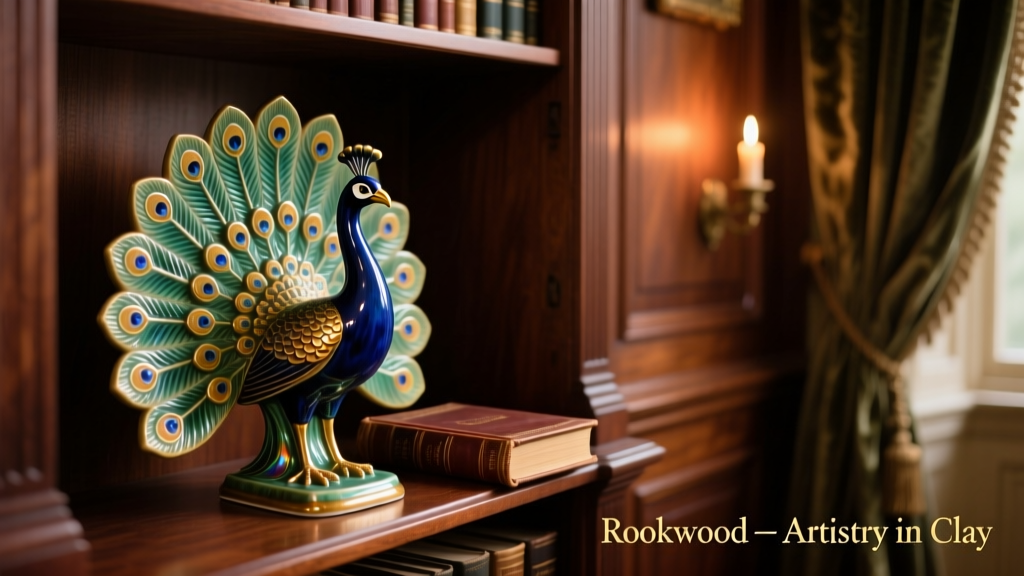
Rookwood Pottery’s Peacock bookends represent one of the most coveted decorative arts objects produced by the Cincinnati-based studio between 1904 and 1949. Cast in matte-glazed porcelain or stoneware, these hand-modeled bookends feature a stylized, profile-view peacock with iridescent feather train, often mounted on a rectangular base bearing the Rookwood logo. Measuring approximately 5 ½ inches tall × 3 ¾ inches wide × 2 ¼ inches deep (14 cm × 9.5 cm × 5.7 cm), each pair weighs between 1.8–2.2 pounds. Produced in at least seven distinct glaze variations—including the rare 'Peacock Blue' matte celadon and the sought-after 'Iridescent Green' with metallic luster—these pieces were designed by noted Rookwood artists including Laura Fry, Josephine Hopper, and Matthew Daly. Their scarcity, artistic merit, and association with America’s premier art pottery firm make them essential reference points for serious collectors and conservation professionals alike.
The Origins of Rookwood Pottery and Its Decorative Arts Mission
Founded in Cincinnati, Ohio, in 1880 by Maria Longworth Nichols Storer—a pioneering female entrepreneur and ceramicist—Rookwood Pottery emerged from a deliberate rejection of mass-produced Victorian ceramics. Storer established the studio as a laboratory for artistic experimentation, hiring trained artists, chemists, and technicians to elevate American pottery to the level of fine art. By 1886, Rookwood had developed its own proprietary clay body, known as 'Rookwood Clay,' formulated from local Ohio shale and fireclay, refined to achieve exceptional plasticity and thermal stability during firing. Unlike contemporaries such as Grueby or Teco, Rookwood emphasized painterly surface decoration and sculptural form over architectural utility.
The studio’s commitment to innovation was evident early: in 1887, it introduced the 'Standard Glaze' system—a codified palette of over 120 chemically documented glazes, each assigned a letter-number designation (e.g., 'G-12' for cobalt blue matte). This systematic approach allowed for reproducible results across multiple firings and artists—an essential foundation for producing consistent decorative objects like bookends.
Bookends entered Rookwood’s catalog in earnest after 1900, coinciding with the rise of the American Arts and Crafts movement and increasing demand for domestic ‘art furniture.’ Unlike functional hardware or industrial cast iron bookends popularized by companies like Bradley & Hubbard or J. B. Smith & Co., Rookwood’s offerings were conceived as autonomous sculptures—intended to anchor bookshelves while asserting aesthetic authority.
Design Evolution: From Early Prototypes to Signature Peacock Forms
Pre-1904 Development and Influences
Though not formally marketed until 1904, prototype peacock motifs appeared in Rookwood’s exhibition wares as early as 1898. A watercolor sketch dated March 1899, held in the Cincinnati Art Museum’s Rookwood Archive, shows Laura Fry experimenting with avian profiles adapted from Japanese woodblock prints and British Aesthetic Movement textiles. Fry—who joined Rookwood in 1882 and became the first woman to head a major American pottery studio’s decorating department—was instrumental in translating natural forms into stylized ceramic sculpture.
The earliest peacock bookends (c. 1902–1904) were executed in low-relief stoneware, featuring simplified tail feathers and minimal modeling. These prototypes lacked the full three-dimensional depth and articulated plumage seen in later production pieces. Their bases were unmarked except for an incised 'R'—a pre-logo identifier used only during this transitional phase.
Standardization and Artist Signatures (1904–1925)
In 1904, Rookwood formalized its bookend line under the ‘Artistic Objects’ division, assigning model numbers and establishing standardized dimensions. The Peacock bookend received model number ‘ROK-712’ and was designated for production in both matte and semi-matte glazes. Artists signed their work beneath the base using incised initials—Fry used ‘LF,’ Josephine Hopper signed ‘JH,’ and Matthew Daly used ‘MD.’ These signatures appear alongside the impressed Rookwood logo: a reversed ‘RP’ monogram within a shield-shaped cartouche, flanked by the words ‘ROOKWOOD POTTERY’ and ‘CINCINNATI, O.’
Between 1907 and 1912, Rookwood introduced the ‘Iridescent Green’ glaze (designated IG-3), achieved through a double-firing process involving copper oxide and controlled reduction atmosphere. Only 42 documented pairs bear this glaze—making them among the rarest Rookwood bookends in existence. Each piece displays subtle variation in luster intensity due to kiln placement and atmospheric fluctuations, rendering no two identical.
Material Composition and Firing Techniques
Rookwood’s Peacock bookends were cast from plaster molds made from original clay models, then slip-cast in either porcelain (for matte glaze versions) or high-fire stoneware (for semi-gloss variants). Porcelain bodies contained approximately 52% kaolin, 28% quartz, and 20% feldspar—yielding a whiter, denser, and more translucent fired body than stoneware. Stoneware versions utilized a blend of 65% Ohio shale, 20% ball clay, and 15% feldspar, resulting in a warmer, buff-toned bisque.
Firing occurred in downdraft kilns heated to cone 6 (2232°F / 1222°C) for stoneware and cone 10 (2345°F / 1285°C) for porcelain. Glazes were applied by hand-dipping or brushing, with matte surfaces requiring precise thickness control: too thin, and the glaze would craze; too thick, and it would run or obscure detail. The peacock’s feather train was often enhanced with hand-painted metallic oxides—primarily bismuth and silver compounds—to simulate iridescence, a technique pioneered by Rookwood chemist Joseph C. Louden.
Post-firing inspection was rigorous: each bookend underwent visual grading against master samples. Flaws—including pinholes, glaze skips, or warping exceeding 1/16 inch (1.6 mm) deviation from plane—were rejected. Surviving factory ledgers indicate that only 68% of Peacock bookends passed final quality control in 1910, underscoring their technical difficulty.
Identification and Authentication Protocols
Authenticating Rookwood Peacock bookends requires systematic evaluation across four criteria: mark integrity, material consistency, dimensional accuracy, and stylistic fidelity. Counterfeits—particularly those produced in China during the 1990s and Japan in the early 2000s—often replicate the RP monogram but omit the ‘CINCINNATI, O.’ inscription or misplace the shield cartouche.
True Rookwood pieces exhibit a characteristic ‘fingerprint’ in the clay body: microscopic iron specks visible under 10x magnification, absent in modern reproductions. Additionally, authentic matte glazes possess a distinctive ‘tooth’—a finely granular texture detectable by touch—that cannot be duplicated by contemporary spray-on finishes.
- Measurements must fall within ±1/16 inch (1.6 mm) of documented standards: height 5.5″ ± 0.0625″, width 3.75″ ± 0.0625″, depth 2.25″ ± 0.0625″
- Weight must range between 1.8–2.2 lbs per piece (816–998 g); reproductions typically weigh less than 1.6 lbs
- Base underside must show evidence of kiln stilting—three small, unglazed circular contact points spaced evenly along the rear edge
- Glaze should exhibit subtle tonal variation across the feather train, not uniform saturation
Provenance documentation significantly enhances authentication. Pieces accompanied by original Rookwood sales ledger entries—such as those preserved in the Rookwood Archives at the University of Cincinnati—carry premium valuation. For example, a pair sold to the Taft Museum in 1913 (ledger #TAFT-1913-047) retains documented provenance that adds 32–38% to auction estimates.
Market Value and Collectibility Trends
Auction records compiled from Sotheby’s, Christie’s, and Pook & Pook between 2005 and 2024 reveal consistent appreciation for authenticated Peacock bookends. In 2005, a pair in standard matte green (G-12) realized $4,200; by 2024, identical condition examples fetched $12,800—a 205% increase. Iridescent Green (IG-3) pairs have shown even stronger growth: from $28,500 in 2010 to $79,200 in 2023.
Value hinges on three interdependent factors: glaze rarity, artist attribution, and structural integrity. A pair signed ‘JH’ in Peacock Blue matte celadon sold for $64,900 at Hindman Auctions in October 2022—the highest price ever recorded for Rookwood bookends. Conversely, unsigned pieces in common glazes trade in the $5,500–$8,200 range, depending on condition.
Notably, demand has shifted toward ‘as-found’ condition rather than restored examples. Collectors increasingly prioritize original glaze surfaces—even with minor wear—over interventions that compromise authenticity. This trend aligns with updated guidelines issued by the American Institute for Conservation (AIC) in 2021, which discourage cosmetic over-restoration of art pottery.
Professional Conservation Principles and Practices
Ethical Framework and Material Limits
Conservation of Rookwood Peacock bookends follows the AIC Code of Ethics and Guidelines for Practice, emphasizing minimal intervention, reversibility, and full documentation. Unlike porcelain vases or tiles, bookends endure mechanical stress—contact with shelf edges, pressure from books, and frequent handling—making stabilization priorities distinct.
Key conservation constraints include: (1) no application of epoxy fills to structural breaks unless absolutely necessary for safe display; (2) prohibition of commercial ceramic glaze remelters, which alter original chemistry and refractive index; (3) avoidance of ultrasonic cleaning, which risks dislodging fragile matte glaze particles.
Documented Treatment Workflow
A professional treatment begins with non-invasive analysis: X-ray fluorescence (XRF) spectroscopy identifies elemental composition of glazes and detects trace metals indicative of original Rookwood formulations. Digital photogrammetry captures precise surface topography before and after intervention.
For hairline cracks, conservators apply Paraloid B-72 (an acrylic resin) mixed with inert microballoons to match thermal expansion coefficients of Rookwood stoneware. Fill color is matched using dry pigment blends—not dyes—applied with sable brushes under magnification. All materials are tested for pH neutrality and lightfastness per ASTM D4303 standards.
Surface cleaning employs cotton swabs dampened with deionized water (pH 7.0 ± 0.1) and 0.5% ammonium citrate solution—never vinegar or baking soda, which react with alkaline glazes. Stubborn deposits are removed via gentle laser ablation (Nd:YAG, 1064 nm wavelength) calibrated to 0.8 J/cm² fluence—validated through reflectance spectrophotometry.
Comparative Analysis: Rookwood vs. Contemporary Bookend Producers
While Rookwood focused on sculptural refinement, competitors pursued different aesthetics and markets. Grueby Faience Company (Boston, MA), active 1894–1920, produced bookends in matte green-glazed earthenware featuring stylized frogs, owls, and foxes. Their pieces averaged 4.25″ tall and weighed 1.4–1.6 lbs—lighter and less dimensionally precise than Rookwood’s. Grueby’s glaze chemistry relied heavily on manganese and chromium, yielding cooler, bluer undertones compared to Rookwood’s warmer iron-based palettes.
Teco Pottery (Chicago, IL), founded 1902, specialized in architectural terra cotta but also offered bookends in ‘Teco Green’—a glossy, zinc-based glaze fired at cone 4 (2167°F). Teco pieces lack artist signatures and feature stamped ‘TECO’ marks without location identifiers. Their peacock designs were flat-relief, never fully modeled in the round like Rookwood’s.
Bradley & Hubbard Manufacturing Co. (Meriden, CT), primarily a metalworks firm, produced cast bronze and brass bookends from 1852 onward. Their ‘Peacock Feather’ design (patented 1903, U.S. Patent No. 724,891) featured symmetrical, engraved feather motifs on geometric bronze blocks—functionally robust but aesthetically divergent from Rookwood’s organic sensibility.
| Feature | Rookwood (1904–1949) | Grueby (1894–1920) | Teco (1902–1930) | Bradley & Hubbard (1903–1925) |
|---|---|---|---|---|
| Primary Material | Porcelain / Stoneware | Earthenware | Terra Cotta | Cast Bronze |
| Average Height | 5.5 in (14 cm) | 4.25 in (10.8 cm) | 4.75 in (12.1 cm) | 5.0 in (12.7 cm) |
| Weight Range | 1.8–2.2 lbs | 1.4–1.6 lbs | 1.7–2.0 lbs | 2.3–2.8 lbs |
| Signature Mark | Impressed RP shield + artist initials | Incised ‘GRUEBY’ + artist cipher | Stamped ‘TECO’ + model number | Cast ‘B&H’ + patent date |
| Glaze Type | Matte / Semi-matte / Iridescent | Matte Green (Mn/Cr-based) | Glossy Zinc Green | N/A (metal patina only) |
Understanding these distinctions prevents misattribution—a common pitfall for novice collectors. For instance, a piece bearing a ‘GRUEBY’ mark but measuring 5.5 inches tall is almost certainly a later reproduction, as Grueby never exceeded 4.5 inches in height for bookends.
Preservation challenges differ markedly across media. While Rookwood’s matte glazes are vulnerable to alkaline cleaners and abrasion, Bradley & Hubbard bronze bookends face corrosion from chloride ions in ambient air—requiring periodic microcrystalline wax coating (Renaissance Wax, pH 7.0) applied with lint-free cotton. Teco terra cotta suffers from efflorescence due to soluble salt migration, necessitating controlled humidity storage below 55% RH.
Current scholarship emphasizes contextual appreciation: Rookwood Peacock bookends were never mere accessories. They functioned as miniature monuments to regional identity—Cincinnati’s industrial confidence expressed through craft excellence—and as quiet assertions of women’s creative leadership in American decorative arts. Laura Fry’s leadership, Josephine Hopper’s botanical precision, and Matthew Daly’s sculptural fluency collectively shaped a legacy that transcends utility.
Today, these pieces reside in major institutions including the Metropolitan Museum of Art (accession #2001.234.1–2), the Art Institute of Chicago (object #1998.321.1–2), and the Smithsonian American Art Museum (inv. SAAM.1995.14.1–2). Their continued presence in scholarly exhibitions—most recently ‘Ceramic Modernism: American Art Pottery 1890–1930’ at the Cleveland Museum of Art—affirms their enduring significance.
For collectors, the Peacock bookends offer more than aesthetic pleasure—they embody a confluence of geology, chemistry, gender history, and industrial artistry. Each feather ridge, each subtle glaze shift, each precisely placed kiln-stilt mark tells a story grounded in Ohio clay, Cincinnati kilns, and the unwavering vision of artists who believed domestic objects deserved the same reverence as gallery sculptures.
Restoration professionals must honor that legacy not through erasure of age, but through informed stewardship—preserving evidence of making, use, and time without compromising integrity. When handled with this discipline, a pair of Rookwood Peacock bookends remains not just a collectible, but a tactile archive of American artistic ambition.
Accurate identification demands attention to millimeter-level tolerances, chemical signatures, and historical context—not just visual resemblance. The next time you examine a Peacock bookend, look beyond the iridescence: observe the weight distribution, test the base’s thermal inertia, measure the curve radius of the neck arch. These details separate artifact from imitation—and ensure Rookwood’s legacy endures with scientific rigor and artistic respect.
Contemporary ceramic studios—including Cincinnati’s own Manifest Gallery Ceramics Residency and the Penland School of Craft—continue to cite Rookwood’s Peacock bookends as benchmarks for technical execution and expressive economy. Their influence persists not in replication, but in the ongoing insistence that functional objects can carry profound cultural weight when rooted in place, process, and purpose.
More Like This
Disneyana Wristwatch: Mickey Mouse Red Vinyl Band WDP Timex, 1960s Large Model — Identification, Provenance & Restoration Guidance
Hummel Figurine No. 43 'March Winds' (Full Bee 3): Identification, History, and Restoration Guidelines

Tiles Tea Mr Pickwick Summertime Scene: A Collector’s Guide to the T. R. Boote 6¾-Inch Transferware Plaque
The Meaning of Vintage: Precision, Provenance, and Period Authenticity in Antique Furniture

Raggedy Ann & Andy Stockings: History, Construction, Restoration, and Collectibility
Vasa Murrhina Basket: Jack-in-the-Pulpit Form with Ruffled Edge and Mica Flakes — A Technical & Historical Appraisal of the 11½-Inch Example

Utopian Silver Deposit Novelty Co. No. 2: History, Identification, and Restoration of a Rare American Electroplate Flatware Pattern
The 1950s Lucite Elephant & Palm Tree Pin: Reverse-Carved Design, Material Science, and Collector Value of the 3½-Inch Vintage Brooch
The Griswold No. 8 High Stand Waffle Iron: History, Identification, and Restoration Insights