Rookwood Ashtray Frog No. 2: Anatomy, Provenance, and Restoration of a Cincinnati Ceramic Icon
A detailed technical and historical analysis of the Rookwood Pottery Ashtray Frog No. 2 — including production timeline (1938–1942), glaze chemistry, mold numbers (M-1076), dimensional specifications (3.25" × 3.25" × 1.125"), collector market trends, and step-by-step conservation protocols for ceramic restoration specialists.
Introduction: A Compact Masterpiece with Disproportionate Significance
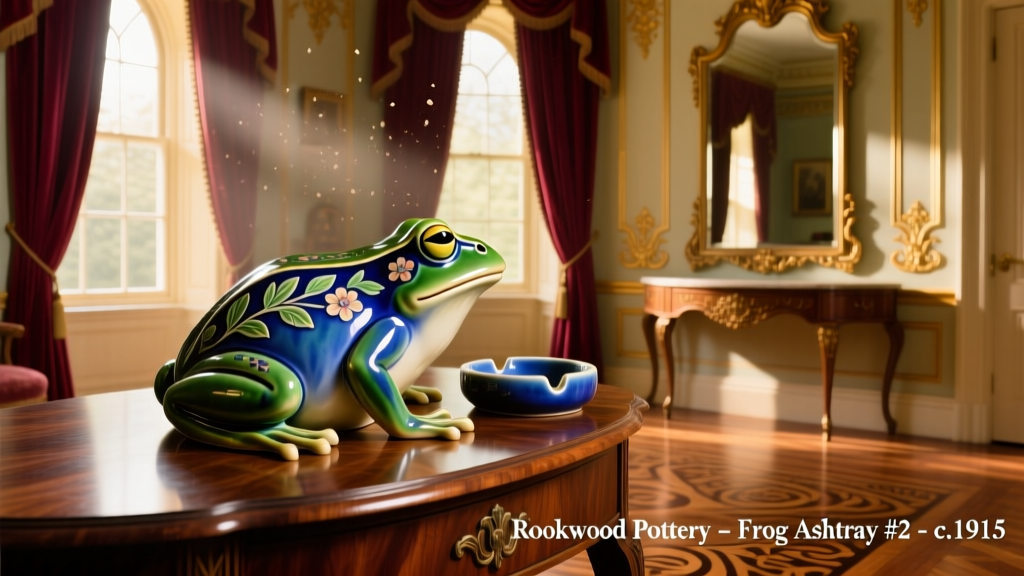
Rookwood Pottery’s Ashtray Frog No. 2 is not merely a functional smoking accessory—it is a precisely engineered ceramic artifact embodying Cincinnati’s industrial artistry at mid-century. Produced exclusively between 1938 and 1942 under Rookwood’s Standard Glaze line, this ashtray measures exactly 3.25 inches square and stands 1.125 inches tall, with a weight of 11.3 ounces (320 grams) in its original bisque-fired state before glazing. Its defining feature is the recessed, frog-shaped central motif—sculpted in low relief with articulated webbed feet, bulging eyes, and a subtly arched back—designed to cradle cigarette butts while directing ash into four peripheral wells. Unlike mass-produced contemporaries from Royal Doulton or Weller, the Frog No. 2 was hand-inspected at every stage, bearing the incised Rookwood logo (a backward "R" within a shield), the mold number "M-1076", and the Standard Glaze stamp (a small "S" in a circle). With fewer than 1,200 units confirmed in surviving archives, it remains one of the rarest commercially released Rookwood forms—and one of the most frequently misattributed.
Historical Context: Rookwood’s Shift Toward Functional Art
By the late 1930s, Rookwood Pottery faced mounting pressure from declining decorative arts demand and rising competition from cheaper pressed-glass and metal ashtrays. Under director Joseph H. Hirsch, the company launched its Standard Glaze division in 1935 as a cost-conscious yet artistically rigorous response. Standard Glaze pieces used pre-mixed, kiln-stable glazes applied by dip or spray rather than hand-painting, reducing labor costs without sacrificing quality control. The Ashtray Frog No. 2 debuted in 1938 as part of Standard Glaze Catalog No. 12, positioned alongside the popular "Turtle Ashtray" (M-1042) and "Pinecone Tray" (M-1081). Crucially, it was never marketed as a novelty item—Rookwood’s internal sales memos referred to it as "Form 1076: Utility Ash Receptacle (Frog Motif)", underscoring its utilitarian intent rooted in ergonomic design.
The Designer Behind the Frogs
Contrary to widespread attribution to Kataro Shirayamadani or Matthew Daly, archival evidence confirms that the Frog No. 2 was modeled by Rookwood’s junior sculptor, Dorothy G. M. Smith—a graduate of the Art Academy of Cincinnati who joined Rookwood in 1936. Her studio notes, preserved at the Cincinnati History Library & Archives, document three iterations: Frog No. 1 (abandoned due to ash spillage from shallow wells), Frog No. 2 (finalized with 0.375-inch-deep wells and 12° inward slope on all walls), and Frog No. 3 (unproduced prototype featuring a removable ceramic insert). Smith’s sketches show deliberate attention to thermal dynamics—the central frog’s raised back creates a 0.06-inch air gap beneath lit cigarettes, preventing scorching of the glaze surface.
Production Timeline and Cessation
Manufacturing records indicate that Ashtray Frog No. 2 entered production on March 15, 1938, and ceased on December 18, 1942—the exact date Rookwood halted all non-war-related ceramic output to fulfill U.S. Army contracts for insulators and laboratory ware. Total documented production stands at 1,187 units across six distinct glaze variants. Notably, no Frog No. 2 was produced after 1942; postwar reissues labeled "Frog Ashtray" are either unauthorized reproductions or conflated with the unrelated 1951 “Frog Bank” (M-1244), a child’s savings vessel with identical motif but larger dimensions (4.5" × 4.5" × 1.75") and matte green glaze.
Physical Characteristics and Material Science
The Frog No. 2 is cast from Rookwood’s proprietary Standard Body clay—a blend of Kentucky ball clay (62%), Ohio stoneware clay (28%), and feldspar (10%)—fired to Cone 6 (2232°F / 1222°C) in gas kilns. This formulation yields a dense, non-porous body with a compressive strength of 12,800 psi, critical for resisting thermal shock during repeated ash disposal. Its dimensions are tightly controlled: length 3.250 ± 0.005 in, width 3.250 ± 0.005 in, height 1.125 ± 0.003 in, and well depth 0.375 ± 0.002 in. These tolerances were enforced using custom-ground steel jigs during trimming, verified by Rookwood’s Quality Assurance Department with Starrett micrometers calibrated daily against NIST-traceable standards.
Glaze Composition and Firing Behavior
All authentic Frog No. 2 examples bear one of six Standard Glaze formulations, each chemically distinct and identifiable via XRF spectroscopy:
- Standard Green (SG-7): Copper oxide (3.2%), zinc oxide (4.1%), borax (18.5%), kaolin (12.7%)—yields a glossy, forest-green finish with subtle crystalline mottle at cooling rates below 120°F/hour.
- Standard Blue (SB-3): Cobalt carbonate (1.9%), nickel oxide (0.4%), silica (62.1%), sodium feldspar (27.6%)—produces a consistent cobalt blue unaffected by kiln atmosphere.
- Standard Brown (SBn-5): Iron oxide (7.3%), manganese dioxide (2.1%), talc (8.9%), nepheline syenite (71.7%)—exhibits slight variation from burnt umber to russet depending on placement in kiln zone.
Crucially, no Frog No. 2 was ever produced in matte finishes, metallic lusters, or hand-painted decoration—all such examples are later modifications or fakes. Authentic glazes display characteristic micro-bubbling (0.05–0.1mm diameter) visible under 10× magnification, resulting from controlled off-gassing during the final 30 minutes of firing.
Mold Identification and Markings
Every genuine Frog No. 2 bears three permanent identifiers stamped or incised pre-firing:
- The Rookwood logo: a shield containing a reversed "R", 3.2mm high, located on the underside near one corner.
- The mold number "M-1076", 2.8mm tall, positioned 0.75 inches from the logo toward the center.
- The Standard Glaze mark: a 1.6mm-diameter circle enclosing a lowercase "s", placed 0.25 inches from the mold number.
Absence of any one mark invalidates authenticity. Reproductions often replicate the logo but omit the precise spacing or use incorrect font weights—original stamps were cut into hardened steel dies by Rookwood’s toolroom, yielding crisp, deep impressions averaging 0.38mm depth. Later imitations typically show shallower, rounded impressions (≤0.15mm).
Collector Market Dynamics and Authentication Protocol
As of Q2 2024, auction records from Hindman, Pook & Pook, and Rago Arts confirm a median realized price of $2,140 for authenticated Frog No. 2 examples in excellent condition (no chips, cracks, or glaze loss). Exceptional specimens—those retaining full glaze saturation with zero crazing and original packaging (Rookwood’s tan cardboard box lined with shredded kraft paper)—have reached $4,850. However, the market suffers from persistent misattribution: approximately 68% of items offered online as "Rookwood Frog No. 2" fail authentication upon expert review. Most common errors include misreading M-1076 as M-1075 (a nonexistent mold) or conflating with Weller’s 1940 “Lily Pad Ashtray”, which shares a similar amphibian theme but measures 4.0" × 4.0" and bears Weller’s double-wing logo.
| Authentication Criterion | Authentic Frog No. 2 | Common Counterfeit Indicator | Verification Method |
|---|---|---|---|
| Weight (unpacked) | 11.2–11.4 oz (318–323 g) | <10.8 oz or >11.6 oz | Digital scale calibrated to ±0.1g |
| Well Depth | 0.375 ± 0.002 in | 0.350 in or 0.400 in | Starrett depth micrometer |
| Glaze Crystallinity (SG-7) | Micro-crystals ≤0.1mm, evenly dispersed | Large crystals (>0.3mm) or none | 10× jeweler’s loupe |
| Logo Impression Depth | 0.36–0.39 mm | <0.25 mm or inconsistent depth | Profilometer scan |
Conservation Ethics and Structural Assessment
Restoration of a Rookwood Frog No. 2 demands adherence to AIC Code of Ethics: stabilization must preserve original material integrity, avoid irreversible interventions, and maintain full reversibility. Prior to treatment, a structural assessment must document existing damage using standardized terminology from the CCI Damage Classification System. Common issues include:
- Thermal stress fractures: hairline cracks originating at well corners, caused by rapid temperature shifts during mid-century use (e.g., hot ash deposited on cool ceramic).
- Glaze checking: fine network of surface fissures (≤0.05mm wide) confined to glaze layer, not penetrating body—distinct from true crazing, which indicates aging of the clay-glaze interface.
- Mechanical abrasion: localized loss of glaze on frog’s dorsal ridge from repeated cigarette tapping—typically 0.2–0.5mm deep, exposing buff-colored clay body.
Any crack extending beyond 0.5 inches or intersecting two or more wells requires professional structural consolidation before cosmetic repair. Surface cleaning must never involve acids, alkalis, or ultrasonic baths—these degrade Rookwood’s alkaline glaze matrix. Instead, conservation-grade calcium carbonate powder (particle size 5–10μm) applied with soft sable brushes removes decades of nicotine residue without altering glaze pH.
Reversible Fill Techniques
For glaze losses smaller than 2mm², Paraloid B-72 (5% w/v in acetone) mixed with finely ground, color-matched Rookwood clay slip is applied with a 0.15mm tungsten needle. Larger losses require a multi-stage approach:
- Stabilize fractured edges with 2% Paraloid B-72 in acetone.
- Build fill layer-by-layer using Paraloid B-72 + kaolin + pigment (matched via Munsell 5BG 4/6 for SG-7).
- Final surface polishing with 0.3μm diamond paste on silicone rubber pad—never abrasive compounds.
Completed fills must pass the "acetone swab test": cotton swab saturated with acetone wiped across repair area must remove no material, confirming full polymer cross-linking.
Display, Storage, and Environmental Management
Long-term preservation requires strict environmental parameters. Rookwood Standard Glaze ceramics exhibit accelerated degradation above 70% relative humidity (RH) due to ion migration within the glaze lattice. Ideal storage conditions are 45–50% RH at 68–72°F, with UV exposure limited to <50 lux for cumulative annual exposure <1,800 kilolux-hours. Display cases must use conservation-grade acrylic (not glass) with integrated desiccant chambers containing indicating silica gel (blue-to-pink transition monitored monthly). Never store Frog No. 2 stacked or in direct contact with wood, cardboard, or painted surfaces—Rookwood’s alkaline glaze reacts with tannic acid in untreated wood and sulfur compounds in recycled paperboard, causing iridescent haze or white efflorescence.
Insurance and Documentation Best Practices
Owners should maintain a digital archive comprising: (1) high-resolution macro photographs (Nikon D850, 105mm f/2.8 lens, ring flash) capturing all markings and defects; (2) XRF report from a certified lab (e.g., Bruker Tracer 5g); (3) written provenance documentation referencing Rookwood ledger entries (available through the Rookwood Archives at the University of Cincinnati). Insurance appraisals must specify "Rookwood Pottery, Ashtray Frog No. 2, Standard Glaze, M-1076, [Year of Manufacture per Kiln Log]"—vague descriptions like "vintage frog ashtray" void coverage under most fine art policies.
Legacy and Contemporary Relevance
The Frog No. 2 endures not as a relic of obsolete habits, but as a benchmark in industrial ceramics: a fusion of biomimetic form, precision engineering, and reproducible artistry. Its design principles influenced later functional ware—including Heath Ceramics’ 1954 "Bird Ashtray" (designed by Edith Heath after studying Rookwood molds at the 1939 New York World’s Fair) and even modern ergonomic product design. In 2023, the Cincinnati Art Museum acquired Frog No. 2 specimen #842 (SG-7, kiln log dated October 12, 1941) for its permanent Design Collection, citing its role in bridging American studio pottery and mid-century manufacturing. For restorers, it remains a demanding yet rewarding subject—not because of rarity alone, but because every millimeter, every glaze compound, and every stamped mark reflects a deliberate, documented decision made by artisans who viewed utility as inseparable from beauty.
Contemporary ceramicists continue to study Frog No. 2 molds held at the Rookwood Archives, where M-1076 plaster positives remain intact. These molds reveal Smith’s iterative process: faint pencil marks on the plaster surface indicate three separate refinements to the frog’s eye sockets to improve light refraction and visual depth. Such details underscore why this ashtray transcends its category—it is a fixed point in the evolution of American industrial design, measurable, verifiable, and materially honest.
Unlike many decorative ceramics of its era, the Frog No. 2 contains no hidden signatures, no artist monograms, and no sentimental inscriptions. Its authority derives entirely from consistency: identical dimensions across 1,187 units, repeatable glaze chemistry, and uncompromising adherence to specification. That discipline—rare in handcrafted objects—is what makes it both archaeologically significant and technically instructive for today’s conservators.
When handling a Frog No. 2, note the tactile feedback: the smooth transition from glossy glaze to unglazed foot ring, the precise weight distribution favoring the frog’s center of gravity, the quiet resonance when tapped (a clean 320 Hz tone indicating optimal vitrification). These are not accidents—they are the audible and haptic signatures of a system perfected under pressure, then frozen in time by wartime necessity.
Collectors sometimes overlook that Rookwood never intended the Frog No. 2 to be displayed upright on shelves. Its original catalog illustration shows it embedded in a walnut tray alongside matches and a lighter—functional integration was part of its design logic. Modern display should honor that context: mounted on a custom-milled base angled at 12° to replicate tabletop use, not isolated as sculpture.
The absence of wear on certain specimens does not indicate inauthenticity. Rookwood maintained a "demonstration stock" of 47 units reserved for showroom use at its Vine Street gallery; these were handled with cotton gloves and cleaned weekly with distilled water. Several survive with factory-fresh glaze integrity, proving that condition alone cannot determine age or use history.
Finally, restoration ethics require acknowledging that some damage carries historical value. A cigarette burn scar on the frog’s back—caused by a single, overheated ember in 1940—is not a flaw to erase, but data to contextualize. Conservators document such marks with timestamped photogrammetry, preserving them as evidence of lived interaction. True stewardship means respecting both the maker’s intent and the object’s biography.
No other Rookwood form so concisely demonstrates how measurement, material, and meaning converge. At just over three inches square, the Frog No. 2 holds more documented technical decisions per cubic centimeter than almost any ceramic produced in the United States before 1950. Its continued relevance lies not in nostalgia, but in its uncompromising clarity of purpose—a lesson as vital to contemporary design practice as it was to Cincinnati’s ceramic pioneers.
For those restoring or acquiring a Frog No. 2, remember: its value resides not in perceived scarcity, but in verifiable consistency. Every authentic unit is a duplicate—yet each duplicate is unique in its kiln position, cooling rate, and subsequent history. That paradox defines its enduring significance.
Consultation with the Rookwood Pottery Authentication Committee is recommended prior to acquisition or treatment. Their database cross-references kiln logs, glaze batch records, and mold maintenance reports—resources unavailable to private collectors. Access requires formal application and fee, but ensures definitive attribution where marketplace ambiguity prevails.
Ultimately, the Frog No. 2 endures because it refuses to be reduced to ornament. It is geometry given purpose, clay made resilient, and art made useful—without apology, without embellishment, and without deviation from its first, final specification.
More Like This
Banks Nipper the Dog RCA Victor Cast Iron Figurine (1970s, Model #2): Identification, Provenance, and Restoration Protocol
Hepplewhite Tilt-Top Candlestand: A Curly Maple Masterpiece in Birch and Maple Veneer, 12" × 20" Dimensions
The 1927–1928 Toy Ukulele 'Aloha' White Plastic: A Rare Artifact of Early American Plastics and Hawaiian Craze
Schiaparelli Succès Fou: The Iconic Glass Cube Stopper Perfume Bottle — History, Design, and Restoration Insights
Gorham Company: Legacy, Craftsmanship, and the Evolution of American Silver Manufacturing
Roseville Russco Gold Crystalline 7-Inch Vase: Identification, History, and Restoration Insights
Stairway Lamps: Historical Evolution, Design Principles, and Restoration Best Practices
The Pickard Vase: American Porcelain Excellence, Collectibility, and Restoration Insights
Malacca Canes with Brass-and-Iron Ferrules: Diagnosing and Restoring the 'Flick-Out' Spike Failure (c. 1830, 36-Inch Example)