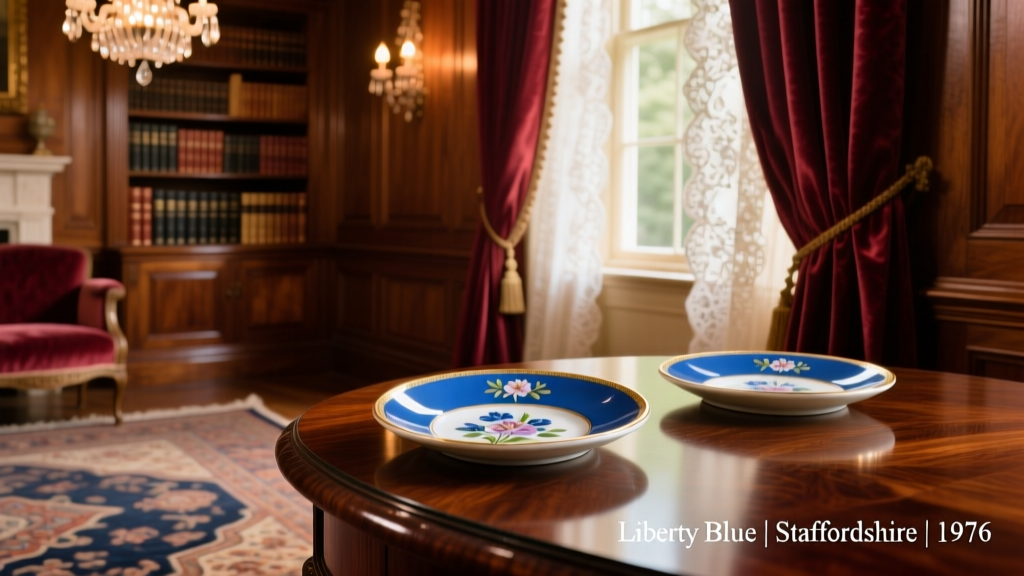
Ridgway Platter Danish Lace Blue 16 In: History, Marks, and Care
Learn about the Ridgway Danish Lace blue 16-inch platter, including pattern features, Staffordshire transferware context, marks, condition checks, cleaning, repair, and display advice.
Ridgway Platter Danish Lace Blue 16 In: Quick Summary
The Ridgway Platter Danish Lace Blue 16 In is a large Staffordshire transferware serving platter in a blue pattern commonly associated with Ridgway of Stoke-on-Trent. A 16-inch platter measures about 40.6 cm across, usually oval, with a broad rim decorated with lacework, flowers, scrolls, and a cobalt-to-mid blue printed border. The well often carries a matching central motif, sometimes faded or softened from age, washing, or stacking. For collectors, the main attractions are its practical size, blue transferware color, and Ridgway attribution, which can place it within the Victorian dining and tea-room repertoire. Condition matters more than a simple pattern name: rim chips, hairlines, glaze crazing, printing wear, and restoration history all affect value. For a furniture and decorative arts consultant, this platter is best treated as a fragile ceramic object, not as a piece to scrub, wire, or stack carelessly. It can make an excellent wall display, table centerpiece, or period dining accent when the body, glaze, and printed design are stable.
What Makes the Danish Lace Pattern Distinctive
The name Danish Lace refers to a delicate, openwork border that imitates lace, ribbon, or pierced fabric under a blue transfer print. In Ridgway examples, the design usually combines floral sprigs, small leaves, curving tendrils, and a scalloped edge that gives the platter a lighter visual effect than heavier chinoiserie or landscape scenes. The pattern is often read as a domestic, highly decorative style, which made it popular for serving fish, fruit, bread, and dessert in the Victorian era. The blue itself may range from a soft slate or cornflower tone to a deeper cobalt, depending on the kiln atmosphere, printing technique, and how much light the piece has received. In a 16-inch format, the pattern has room to repeat around the rim while still leaving a generous central well for food or display. This makes it one of the more practical large platters to collect, because the visual complexity does not overwhelm a dining table, yet the scale is enough to anchor a display shelf.
Typical visual features
- A scalloped or lobed rim with a lace-like border.
- Small floral clusters and foliage repeated at regular intervals.
- Blue transfer print that may be strongest at the edge and lighter toward the center.
- A central motif, often a wreath, basket, medallion, or open floral arrangement.
- A smooth glazed surface with visible printing lines when examined under raking light.
When identifying the pattern, look for continuity of the printed border. True transferware shows fine lines that follow the curve of the rim, with some natural variation from piece to piece. If the decoration appears painted on with thick brush strokes, it may be a later hand-painted interpretation or a reproduction. Also check the color: original blue transfer prints often show slight tonal unevenness, tiny printing gaps, or minor fading in raised areas. These are not necessarily faults; they can support age and authentic production methods.
Ridgway and Staffordshire Transferware Context
Ridgway belongs to the family of English pottery makers whose names appear frequently in antique tableware. Staffordshire, and specifically Stoke-on-Trent, became the center of transferware production because of its clay, coal, water transport, and skilled labor. Ridgway worked in that environment, producing dinnerware, tea sets, platters, and ornamental pieces for domestic use and export. The firm's pieces often have a refined printed surface and a well-controlled form, which appeals to collectors who prefer quieter blue patterns over the more crowded scenes associated with some Spode, Minton, or Wedgwood designs. In a platter this large, the Ridgway name matters because it suggests a maker capable of producing stable, well-glazed serving ware for formal dining. It also helps with authentication, because pattern books, auction records, and old dealer references often link similar Danish Lace designs to Ridgway or related Staffordshire firms.
For a decorative arts specialist, Ridgway pieces fit easily into a period room, a Victorian kitchen display, a country house pantry, or a modern interior that uses blue and white as a neutral. Unlike furniture, the platter cannot be sanded, re-stained, or re-polished to hide wear. Its value is tied to the integrity of the glaze, the crispness of the printed design, and the absence of significant damage. This is why condition assessment is more important than the attractive pattern name alone.
Size, Shape, and Practical Measurements
A 16-inch platter is a substantial piece of tableware. The length of 16 inches equals 40.6 cm, and a typical oval example may be about 11.5 to 13 inches wide, or 29 to 33 cm across the short dimension. The height is usually modest, around 1.5 to 2 inches, with a shallow well and a raised rim. These proportions make the platter ideal for fish, cold cuts, fruit, or bread, but they also mean the rim is vulnerable to knocks. The edge of a large oval platter is often the first point of contact when the piece is moved, stacked, or leaned against a wall. If the piece has handles or pierced handles, they can be especially fragile. If it does not, the broad rim can still act as a lever, and any hairline at the rim can become a break under thermal stress.
| Feature | Typical Detail | Why It Matters |
|---|---|---|
| Length | 16 inches / 40.6 cm | Large enough for serving, but requires careful handling and storage. |
| Shape | Usually oval, sometimes lobed | Oval forms can roll if placed on uneven shelves. |
| Width | About 11.5 to 13 inches / 29 to 33 cm | Helps determine whether the piece fits in a display case or stack. |
| Height | About 1.5 to 2 inches / 4 to 5 cm | Shallow wells are attractive but can trap moisture in cracks. |
| Decoration | Blue Danish Lace transfer print | Printing wear reduces value more than minor crazing. |
| Use | Serving, wall display, table accent | Food use should be avoided if the piece has cracks or old repairs. |
Reading Marks and Dating the Platter
Many Ridgway pieces carry an impressed mark, a paper label, or a combination of both. On a platter of this size, the mark may be underglaze on the back, impressed into the foot ring, or printed on a label that was once attached. Look carefully at the foot rim and center of the underside. The mark may say Ridgway, Ridgways, or Ridgway and Company, depending on the period and product line. Some pieces have no readable mark because of wear, glaze coverage, or a removed label. If the mark is absent, attribution may rely on pattern, body, shape, glaze color, and comparison with catalog references.
Dating clues
Blue transferware in this style is generally Victorian, with many pieces produced between the 1840s and the 1880s. A platter with a soft cream body, a clear glaze, and a delicate lace border often fits the mid-Victorian range. Later reproductions may look too clean, have overly uniform blue color, or show machine-perfect edges. A genuine piece may have a slightly irregular foot rim, tiny glaze pooling, faint printing lines, and wear in expected places such as the rim edge or raised pattern areas. The best dating evidence comes from a combination of mark, pattern reference, body, and condition, not from a single clue.
Condition Checks Before Buying or Restoring
Before considering restoration, inspect the platter under bright, angled light. Hold it against a white background and look for hairlines, rim chips, cracks, and areas where the printed pattern has rubbed through. Tap the platter gently with a fingertip or a soft wooden stick; a clear ring is a good sign, while a dull sound can indicate a crack. Check the foot ring for grinding marks, old adhesive, or filler. Examine the underside for stains that may be water damage or simply old tea and food residue. If there is crazing, determine whether it is surface glaze cracking or a structural line. Crazing alone is common on old glazes and may be acceptable, but deep cracks that penetrate the body are more serious.
Restoration history is equally important. Old repairs may use animal glue, shellac, epoxy, or cellulose acetate. Some are stable but discolored; others can fail and damage the ceramic further. A visible crack line with cloudy adhesive may need professional review. Missing rim fragments can be filled and toned, but this should be done only by a conservator or experienced ceramic restorer. For a 16-inch platter, any repair near the rim is under stress every time the piece is moved. If you are buying for display, a small stable chip may be acceptable. If you are buying for dining use, even a tiny hairline can be unsafe.
Red flags to document
- Long cracks crossing the well or rim.
- Chips on both the front and back of the edge.
- Glaze flaking around a repair.
- Discolored adhesive showing through the pattern.
- A foot ring that has been ground down.
- A paper-thin area under a crack.
Cleaning, Handling, and Display
Cleaning an antique Ridgway platter should be gentle. Use lukewarm water and a small amount of pH-neutral dish soap. A soft nylon brush can remove residue from the lace pattern, but never scrub aggressively. Avoid soaking, because water can enter cracks and loosen old repairs. Do not use abrasive powders, steel wool, bleach, ammonia, dishwasher detergent, or ultrasonic cleaners. If the piece has crazing or a crack, water can become trapped and leave a stain. For display dust, a soft makeup brush or microfiber cloth is safer. Always support the platter with two hands, one under the center and one near the rim, and never lift by the edge.
For wall display, use a padded platter hanger or a shelf with a non-slip pad. Do not wire directly through a chip or crack. If the platter is on a table, avoid placing it where it can be bumped. Keep it out of direct sunlight for long periods, because blue transfers can fade. Also avoid rapid temperature changes, such as moving from a cold car into a warm room, or placing a cold platter near a heater. If the piece is on display in a historic room, keep food and drinks away unless you are certain the body, glaze, and repairs are stable.
Safe handling checklist
- Clear the surface and use a padded table.
- Remove jewelry and rings that can scratch glaze.
- Wash hands or wear clean cotton gloves for polished surfaces.
- Support the center with both hands.
- Do not stack other plates on top of the platter.
- Store it vertically in a padded rack, not flat under heavy objects.
Repair, Conservation, and Collecting Value
Minor chips can be cleaned, filled with conservation-grade fillers, and carefully retouched. The goal is not to make the repair invisible under magnification, but to stabilize the edge and restore the appearance from a normal viewing distance. Hairline cracks are more challenging. A conservator may use Paraloid B-72, a reversible acrylic resin used in museum work, for some ceramic repairs. This adhesive is preferred when stability and reversibility matter. For larger breaks, epoxy may be used by experienced restorers, but it is harder to reverse and can yellow over time. If the platter has been badly repaired, professional removal may be necessary before new treatment.
Replacement of missing rim pieces is possible in some cases, but it should be limited to stable fills that do not hide the original form. Over-restoration can destroy value, especially if the restorer repaints the Danish Lace pattern too boldly. The printed design should be matched only in areas where the original is missing. It is better to leave a small honest chip than to create a heavy fill that changes the profile. If the platter will be used for food, any repair must be non-toxic and fully sealed, but the safer recommendation is to keep an antique platter decorative.
The value of a Ridgway Platter Danish Lace Blue 16 In depends on pattern rarity, condition, maker mark, and market demand. A clean, unmarked piece may be modest, while a fully marked, crisply printed, no-damage example can command a higher price. Collectors often pay more for platters with strong pattern detail and minimal restoration. However, a large platter is harder to store and display, so condition flaws near the rim can reduce desirability. Ask the seller for high-resolution photos of the front, back, foot rim, and any suspect areas. Request measurements in inches and centimeters. Ask whether the piece has been tested with UV light for old repairs. Ask if the mark is present and whether it has been photographed under raking light.
For a decorative arts buyer, this platter is an excellent alternative to more expensive blue transferware patterns. It offers scale, color, and a recognizable Staffordshire maker connection without requiring a formal dining set. For a restorer, it is a project that should be assessed before repair: is the printed design still strong, is the body stable, and will treatment improve or harm it? When the answers are positive, a 16-inch Ridgway Danish Lace platter can remain a practical and attractive object for decades.
More Like This
Hepplewhite Mahogany Serpentine Front Sideboard: Authenticity, Provenance, and Restoration Standards for a 42-Inch Antique

Popeye Colorforms: The 1957 Launch, Design Innovation, and Collectibility of America’s First Reusable Vinyl Toy System
Satsuma Ewer with Black Dragon Motif, Floral Texture, and Smoke Swirls: A 13 × 10-Inch Meiji-Era Masterpiece
Jonas Joseph Schindler: The Forgotten Master of 19th-Century American Cabinetmaking
Imperial Glass Beaded Block Vase in Cobalt Blue: A Collector’s Guide to the Footed 5¼-Inch Example

Brooks Robinson Signed Baseball Photograph: Authentication, Framing, and Collectible Value of the 11×14 Matted Glass Display

National Cash Register Model 333-2: Engineering, Operation, and Restoration of a Mid-Century Mechanical Landmark

Jacob R. Esterle: The Forgotten Master of American Colonial Revival Furniture

Lladro Figurine 'Mancha Nobleman' No. 1269 (1974): Provenance, Craftsmanship, and Collectibility Assessment