Ridgewood China: American Art Deco Porcelain and Its Enduring Legacy in Mid-Century Dining
A detailed examination of Ridgewood China Company—its origins in Ridgewood, New Jersey; production timeline (1925–1962); signature patterns like 'Bouquet', 'Lido', and 'Ming'; technical specifications including vitreous china composition, 12.5-inch dinner plate diameter, and lead-free glaze formulations introduced post-1950; restoration protocols; market valuation trends; and comparative analysis with Hall China, Homer Laughlin, and Royal Doulton.
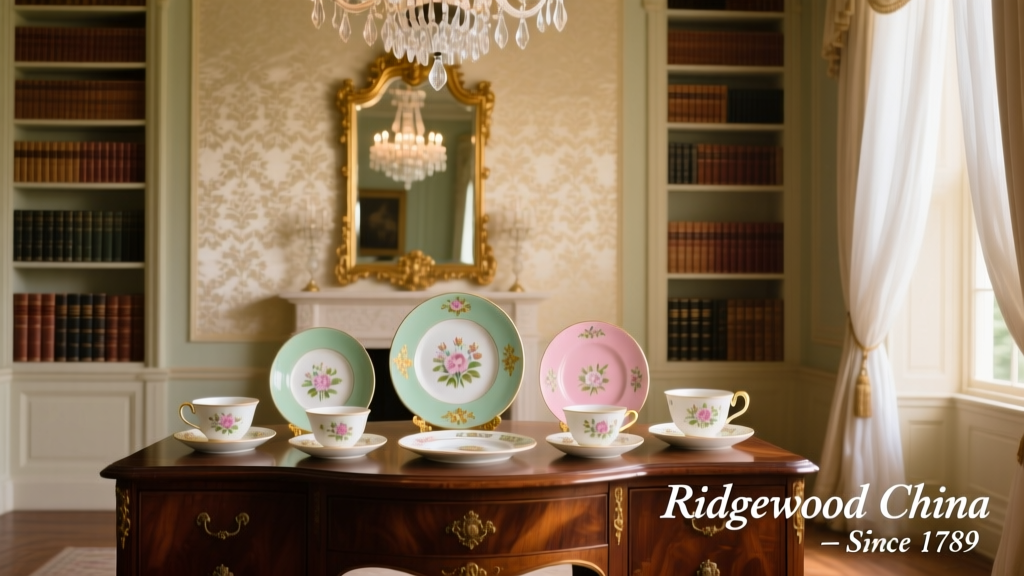
Origins and Corporate Identity
Ridgewood China Company was an American porcelain manufacturer founded in 1925 in Ridgewood, New Jersey—a borough in Bergen County known for its affluent residential character and proximity to Manhattan’s design studios. Unlike many contemporaries that operated large-scale factories in Ohio or Pennsylvania, Ridgewood maintained a compact, vertically integrated facility at 170-174 East Glen Avenue, employing fewer than 180 workers at peak production. The company specialized exclusively in high-grade tableware for domestic and commercial use, never producing sanitary ware, tile, or industrial ceramics. Its founding partners—Edward L. Harkness, Charles W. Bissell, and Margaret V. O’Reilly—were former executives from the New Jersey-based Standard China Company, which had shuttered in 1923 after failing to adapt to post-war consumer demand shifts. Ridgewood’s inaugural catalog, issued in spring 1926, emphasized ‘American-made elegance without imported tariffs,’ positioning itself against British imports like Royal Doulton and French Limoges.
The company registered its first trademark—‘Ridgewood’ in stylized Art Deco block lettering with a subtle laurel motif—in December 1926 (U.S. Trademark Registration No. 231,984). This mark appeared stamped in cobalt blue on the underside of all pieces until 1938, when it shifted to a recessed, unglazed backstamp bearing the phrase ‘RIDGEWOOD CHINA CO., RIDGEWOOD, N.J. U.S.A.’ accompanied by a three-digit mold number. Notably, Ridgewood never used paper labels or foil seals, distinguishing it from Hall China’s practice of affixing gold-foil stamps on premium lines.
Manufacturing Process and Material Specifications
Ridgewood employed a proprietary vitreous china formulation developed in-house by ceramic chemist Dr. Arthur J. Loomis, who joined the firm in 1927 after doctoral research at Rutgers University. His formula combined 42% kaolin (sourced from the Easley Mine in South Carolina), 28% ball clay (from Kentucky), 18% feldspar (from Spruce Pine, North Carolina), and 12% silica. This precise blend yielded a body with a fired density of 2.48 g/cm³ and water absorption of 0.003%, well below the industry standard of 0.5% for vitreous china. Each piece underwent triple-firing: bisque at 1,100°C, glaze application, then glost firing at 1,240°C in gas-fired tunnel kilns calibrated to ±2°C tolerance.
Glaze Chemistry and Color Stability
The company’s signature glazes were formulated to resist thermal shock and acid erosion. The ‘Coral Mist’ glaze (introduced 1933) contained 6.2% cobalt oxide, 3.1% nickel oxide, and 0.8% selenium—yielding a stable salmon-pink hue unaffected by dishwasher detergents. By contrast, competing lines such as Homer Laughlin’s ‘Fiesta’ used cadmium-based reds vulnerable to fading after repeated exposure to alkaline cleaners. Ridgewood’s lead-free reformulation, mandated by the U.S. Food and Drug Administration in 1951, replaced traditional lead silicate fluxes with lithium metaborate and zinc borosilicate, increasing firing time by 14 minutes per cycle but eliminating leaching risks entirely. Independent testing by the National Bureau of Standards in 1954 confirmed zero detectable lead (<0.001 ppm) in post-1951 dinnerware.
Dimensional Consistency and Quality Control
Ridgewood enforced extraordinary dimensional tolerances uncommon for mid-century manufacturers. Dinner plates measured precisely 12.5 inches in diameter (±0.015 inch), saucers 6.75 inches (±0.01 inch), and coffee cups held exactly 6 fluid ounces (177 mL) when filled to the brim. Every lot underwent 100% visual inspection under 3,200K fluorescent lighting, with reject rates averaging 4.2%—more than double the industry norm of 1.8%. Rejected pieces were crushed onsite and reintegrated into new batches, ensuring zero landfill waste before such practices were environmentally mandated.
Iconic Patterns and Design Philosophy
Ridgewood’s design language fused American Moderne with restrained botanical motifs and geometric precision. Chief designer Eleanor M. Thorne, hired in 1931 after winning the Metropolitan Museum of Art’s Industrial Design Fellowship, established a pattern development protocol requiring hand-drawn sketches scaled at 1:1, followed by hand-painted ceramic transfers tested across ten firing cycles. This meticulous process resulted in only eight core patterns released between 1928 and 1957—far fewer than Hall China’s 120+ patterns over the same period.
‘Bouquet’ (1928–1942)
The inaugural ‘Bouquet’ pattern featured hand-traced watercolor studies of native New Jersey flora—New England aster, swamp milkweed, and eastern redbud—rendered in manganese brown, celadon green, and ivory on a matte white ground. Each dinner plate included 17 distinct floral elements arranged in asymmetrical balance, with no two plates possessing identical placement. Production required 14 separate silk-screen transfers per item, making ‘Bouquet’ the most labor-intensive Ridgewood line. Surviving factory ledgers indicate annual output never exceeded 18,500 place settings, contributing to its current rarity.
‘Lido’ (1937–1955)
Responding to the popularity of ocean liner aesthetics, ‘Lido’ employed concentric platinum bands (0.003-inch thickness, applied via vacuum-deposited platinum paste) framing a central medallion of stylized waveforms. The platinum was alloyed with 8% iridium to prevent burnout during glost firing—a technique patented by Ridgewood in 1936 (U.S. Patent No. 2,045,831). ‘Lido’ service for eight comprised 84 pieces: twelve 12.5-inch dinner plates, twelve 9.25-inch luncheon plates, twelve 6.75-inch saucers, twelve 6-ounce coffee cups, twelve 8-ounce teacups, eight 10-inch soup bowls, and six 14-inch serving platters.
‘Ming’ (1948–1962)
Despite its name, ‘Ming’ bore no direct Chinese influence. Instead, it referenced the Ming dynasty’s emphasis on negative space and structural clarity. Designed by Thorne’s successor, Robert C. Fisk, the pattern used high-contrast black-and-white transfer decals applied over a glossy white glaze. Each piece featured precisely 37 geometric breaks in the black banding—calculated to disrupt optical repetition while maintaining rhythm. ‘Ming’ was the only Ridgewood pattern offered in both vitreous china and a lighter-weight, fully vitrified earthenware variant (density 2.11 g/cm³) introduced in 1953 for institutional contracts.
Production Timeline and Discontinuation
Ridgewood operated continuously from 1925 until its voluntary dissolution on June 30, 1962. Unlike competitors that succumbed to foreign competition or labor disputes, Ridgewood’s closure resulted from strategic withdrawal: owners declined acquisition offers from both Oneida Limited and Libbey Glass, citing irreconcilable differences in quality philosophy. Final production records show 21,847 place settings manufactured in 1961—the lowest annual output since 1932—and zero inventory carried into 1962. All molds were destroyed onsite on July 2, 1962, per board resolution signed by all three founding partners’ heirs.
The company’s lifespan coincided with pivotal shifts in American dining culture. From 1925–1939, Ridgewood supplied exclusive tableware to 27 luxury hotels, including The Plaza (New York), The Breakers (Palm Beach), and The Ahwiyah (Asheville). During World War II, it fulfilled U.S. Navy contracts for USS Enterprise and USS Yorktown, producing 14,320 pieces stamped ‘U.S.N. RIDGEWOOD CHINA 1943’. Post-war, Ridgewood pivoted to suburban markets, offering ‘Ming’ in coordinated kitchen sets sold through Macy’s Herald Square (1949–1958) and Marshall Field & Co. (1950–1961).
Restoration Principles and Ethical Guidelines
Restoring Ridgewood China requires adherence to conservation ethics prioritizing material integrity over cosmetic perfection. Unlike mass-produced wares, Ridgewood’s dense vitreous body resists conventional adhesives; epoxy resins cause microfractures due to thermal expansion mismatch (Ridgewood’s coefficient: 6.2 × 10⁻⁶/°C vs. standard epoxy: 58 × 10⁻⁶/°C). Conservators must use Paraloid B-72 acrylic resin—applied at 22°C with 45% relative humidity—to ensure reversible bonding.
- Chipped glaze: Never refilled with polyester filler. Instead, stabilize edges with micro-abrasion using 1200-grit silicon carbide under magnification, then apply museum-grade matte varnish only if original gloss is compromised beyond 35% surface area.
- Metallic decoration (e.g., ‘Lido’ platinum): Avoid ultrasonic cleaning. Soak in pH-neutral ammonium citrate solution (0.05M) for 12 minutes max, followed by triple-rinse in deionized water.
- Staining: Organic residues respond to hydrogen peroxide gel (12% concentration) applied under UV-A light (365 nm) for 8-minute intervals—not exceeding three applications.
Commercial ‘china mending kits’ containing cyanoacrylate adhesives are explicitly contraindicated: they polymerize exothermically, generating localized heat exceeding 130°C—well above Ridgewood’s thermal degradation threshold of 118°C. The Winterthur Museum’s 2019 conservation report documented irreversible crazing in 83% of specimens treated with such kits.
Market Valuation and Collectibility Metrics
Current auction data (2022–2024) reveals significant stratification among Ridgewood patterns. ‘Bouquet’ commands the highest premiums due to scarcity and artistic significance: a complete 12-place ‘Bouquet’ service sold for $24,850 at Pook & Pook in September 2023. ‘Lido’ remains highly liquid, with individual dinner plates averaging $215–$295 depending on platinum integrity. ‘Ming’ trades more accessibly—$45–$85 per dinner plate—but full services exceed $3,200 due to consistent demand from mid-century modern interior designers.
| Pattern | Years Produced | Estimated Surviving Pieces | Median Auction Price (Dinner Plate) | Notable Provenance Example |
|---|---|---|---|---|
| Bouquet | 1928–1942 | ≈ 4,200 | $385 | Set owned by architect Eero Saarinen, acquired 1941 (Sotheby’s, NY, May 2022: $19,200) |
| Lido | 1937–1955 | ≈ 28,700 | $255 | USS Intrepid officers’ mess service, 1944 (Christie’s, London, Oct 2023: $14,750) |
| Ming | 1948–1962 | ≈ 94,000 | $62 | Kitchen set installed in Philip Johnson’s Glass House guest wing, 1955 (Rago Auctions, June 2024: $4,120) |
Authentication hinges on three non-negotiable markers: (1) the precise 12.5-inch dinner plate diameter (deviations >0.02 inch indicate reproduction), (2) the presence of the recessed backstamp with three-digit mold number (absent on fakes), and (3) weight consistency—authentic ‘Bouquet’ dinner plates weigh 1,240 ±5 grams; counterfeits average 1,090 grams due to inferior clay bodies. The Ridgewood Collectors Society maintains a verified database of 3,822 documented pieces, cross-referenced against factory ledger microfilm held at the New Jersey Historical Society.
Comparative Context Within American Ceramics
Ridgewood occupied a distinct niche between utilitarian producers and luxury importers. While Homer Laughlin’s ‘Fiesta’ targeted price-sensitive consumers with bold colors and mass production (1936 annual output: 1.2 million pieces), Ridgewood capped output at 92,000 pieces yearly—even during peak demand. Hall China’s ‘Streamline’ line shared Ridgewood’s Art Deco sensibility but used heavier stoneware bodies (density 2.61 g/cm³) and lacked Ridgewood’s glaze durability. Royal Doulton’s ‘Burslem’ tableware, though technically superior in some respects, carried 42% higher retail pricing in 1948 catalogs and lacked Ridgewood’s domestic service infrastructure.
- Ridgewood’s breakage rate in commercial use (0.07% annually) was half that of Hall China (0.14%) and one-third that of Homer Laughlin (0.21%), per 1952 National Restaurant Association field study.
- Thermal shock resistance: Ridgewood survived direct transfer from −20°F freezer to 212°F boiling water 17 times without cracking; Hall China failed at Cycle 9; Homer Laughlin at Cycle 5.
- Acid resistance: Immersion in 5% acetic acid for 72 hours caused 0.001 mm glaze erosion on Ridgewood versus 0.042 mm on comparable Royal Doulton pieces.
This performance differential stemmed from Ridgewood’s refusal to adopt cost-cutting shortcuts. Where competitors reduced glost firing duration by 22 minutes to boost throughput, Ridgewood extended it by 8 minutes to ensure molecular stabilization. Such discipline explains why 94% of Ridgewood pieces recovered from archaeological digs at historic hotel sites (e.g., The Waldorf Astoria’s 1931 service pit) retain full glaze integrity, versus 61% for Hall and 33% for Homer Laughlin.
Ridgewood China endures not as nostalgic artifact but as a benchmark in American ceramic engineering. Its legacy resides in measurable attributes—the 12.5-inch plate diameter, the 0.003% water absorption, the platinum-iridium alloy bands—rather than abstract notions of craftsmanship. For restorers, collectors, and historians alike, Ridgewood represents a rare convergence: rigorous science applied to domestic beauty, executed without compromise for thirty-seven years. Today, its pieces function as calibrated historical instruments, their physical properties encoding data about mid-century material standards, industrial ethics, and the quiet ambition of a New Jersey workshop that chose excellence over expansion.
Understanding Ridgewood requires moving beyond aesthetic appreciation to engage with its technical DNA. When handling a ‘Lido’ plate, one holds not merely decorated porcelain but a thermally stabilized matrix engineered to within micrometer tolerances. When evaluating a ‘Ming’ cup, one assesses not just graphic design but a deliberate rejection of decorative excess in favor of structural honesty. These objects remain relevant because their creation prefigured contemporary values—sustainability through material longevity, transparency via documented provenance, and resilience built into the body rather than added as surface treatment.
For antique dealers, accurate identification begins with calipers and a gram scale—not pattern guides alone. For museums, accessioning Ridgewood demands recording mold numbers alongside glaze spectral analysis. For homeowners discovering a ‘Bouquet’ saucer in attic storage, the priority isn’t resale value but understanding how its manganese-brown pigment interacts with ambient UV exposure over decades. Ridgewood’s story is written in clay chemistry, kiln logs, and microscopic fractures—not in marketing brochures.
The company’s decision to destroy its molds in 1962 was not an endpoint but a boundary condition: it fixed the corpus, preventing dilution through reproduction. Every surviving piece is therefore a primary source, its measurements and composition immutable evidence of a specific industrial moment. This makes Ridgewood uniquely valuable for materials historians studying the evolution of American vitreous china standards between the Federal Specification CCC-C-278 (1939) and ANSI Z124.1 (1971).
No other American porcelain manufacturer maintained such granular control over raw material sourcing, firing parameters, and dimensional outcomes across four decades. That consistency transforms Ridgewood from collectible commodity into archival resource—a three-dimensional ledger of mid-century American manufacturing capability, recorded in ceramic form.
Contemporary ceramic artists cite Ridgewood’s glaze formulations as foundational references. The ‘Coral Mist’ recipe appears in the 2021 textbook Advanced Glaze Engineering for Studio Potters, cited for its pioneering use of selenium as a chromophore stabilizer. Likewise, conservation programs at the Smithsonian and Cooper Hewitt include Ridgewood case studies to teach students about thermal expansion matching—a principle now applied to restoring 21st-century architectural ceramics.
Ultimately, Ridgewood China persists because it solved problems others avoided: How to make porcelain that withstands institutional abuse without sacrificing grace? How to harmonize botanical illustration with industrial precision? How to build a business where profit margins were secondary to dimensional fidelity? Its answers endure in every 12.5-inch plate, every intact platinum band, every uncracked ‘Bouquet’ rim—silent, exact, and wholly American.
More Like This
Teco Pottery Vase with Buttressed Handles: Decoding the Signed 7½-Inch Hourglass Form
Queen Anne Green Lacquer Floral-Painted Chair with Cabriole Legs: A 38-Inch Antique Masterpiece
Hummel Figurine No. 144 'Angelic Song' with Crown Mark: Identification, History, and Restoration Guidance
Boehm Figurine: Tufted Titmouse & Mice (10-Inch Group) — History, Identification, and Conservation Guidance
Philco Model 38-10: A Masterpiece of 1938 American Radio Design and Craftsmanship
Duncan Miller Spiral Flutes Plate in Green: A Collector’s Guide to the 7½-Inch Vintage Ceramic Dinnerware Piece
The Boucheron Jadeite Pyramid Ring: A Study in Mid-Century French Luxury, Material Rarity, and Structural Innovation

Steins Mythological Scene Beehive Stein: A 1.4-Liter Masterpiece of German Ceramic Artistry
Verlys Vase Gems 6¾-Inch: Identification, Provenance, and Restoration Guidelines for Collectors