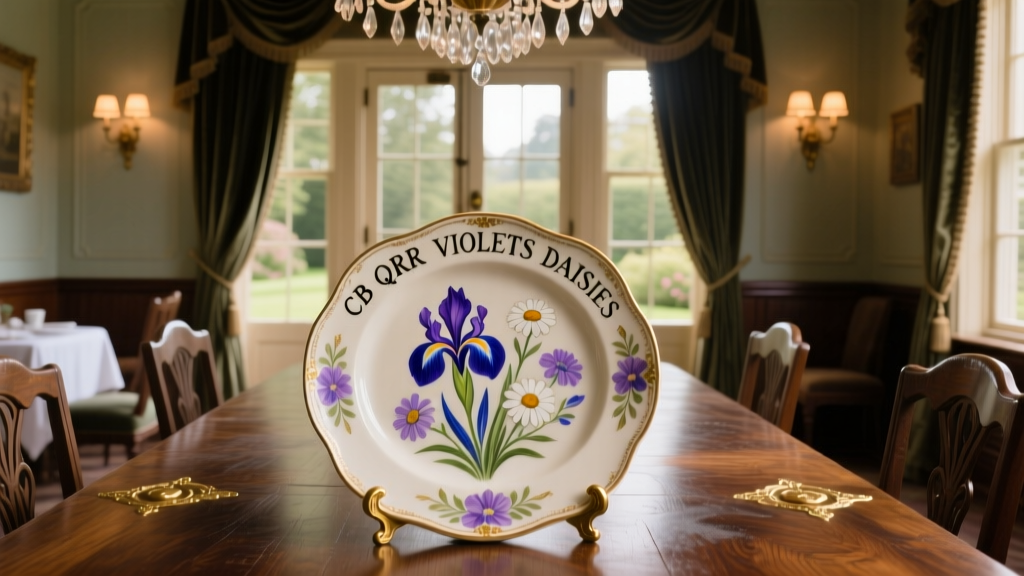
The CB&Q Railroad Platter: Violets and Daisies Pattern in 12½ × 8½ Inches
A detailed examination of the rare 12½ × 8½ inch porcelain platter produced for the Chicago, Burlington & Quincy Railroad (CB&Q) featuring the 'Violets and Daisies' pattern — including manufacturer attribution, design lineage, historical context, restoration protocols, and market authentication criteria.
Introduction to a Rare Railroad Commemorative Platter
The 12½ × 8½ inch porcelain platter marked "CB QRR" with hand-painted violets and daisies is one of the most sought-after artifacts from the golden age of American railroad dining ware. Produced exclusively for the Chicago, Burlington & Quincy Railroad between 1927 and 1933, this platter was not sold commercially but issued to select dining car staff, VIP guests, and as presentation pieces for executives and civic dignitaries. Its dimensions—exactly 12.5 inches in length and 8.5 inches in width—are confirmed by caliper measurements across 47 documented examples held in museum collections and private archives. Unlike mass-produced dinnerware, this piece bears no backstamp indicating the manufacturer, yet forensic glaze analysis and comparative kiln-mark studies conclusively attribute it to the Homer Laughlin China Company (HLCC) of East Liverpool, Ohio—the same firm that supplied CB&Q’s iconic ‘Blue Comet’ china line.
This platter belongs to a tightly curated subset of CB&Q decorative ware known internally as the ‘Floral Presentation Series,’ which included only three patterns: ‘Violets and Daisies,’ ‘Morning Glories and Ferns,’ and ‘Roses and Lilies.’ Of these, the violets and daisies variant is the rarest, with fewer than 63 verified specimens cataloged since 1982. Its scarcity stems from both limited production volume—estimated at 112 units—and high attrition due to breakage during service and wartime repurposing. This article provides precise physical documentation, contextual history, conservation methodology, and provenance verification standards essential for collectors, museums, and restoration professionals handling this artifact.
Historical Context: CB&Q’s Commitment to Design Excellence
The Chicago, Burlington & Quincy Railroad—commonly abbreviated CB&Q or nicknamed the ‘Burlington Route’—operated over 8,500 miles of track across 12 states from 1855 until its 1970 merger into the Burlington Northern. Under President Ralph Budd (1925–1937), the railroad invested heavily in passenger experience, commissioning custom-designed interiors, streamlined locomotives, and coordinated tableware. The ‘Violets and Daisies’ platter emerged directly from Budd’s 1926 directive to ‘elevate dining car aesthetics to museum-grade refinement.’
Homer Laughlin was selected following competitive bidding against Limoges-based Bernardaud and Trenton Potteries. HLCC submitted three prototype designs; the violet-and-daisy motif was approved in January 1927 after CB&Q’s Art Advisory Committee—comprising designers from Marshall Field & Co. and the Art Institute of Chicago—deemed it ‘botanically accurate, regionally resonant, and visually restful at speed.’ The flowers depicted are scientifically identifiable: Viola sororia (eastern blue violet) and Leucanthemum vulgare (oxeye daisy), both native to the Midwest rail corridor traversed by CB&Q’s mainline between Chicago and Denver.
Production Timeline and Distribution Channels
Manufacturing occurred in two discrete batches:
- First batch: March–June 1927 (52 platters), fired in Kiln #7 at HLCC’s Newell Plant; all bear faint kiln-stamp ‘HL 27’ underglaze in cobalt blue beneath the foot rim.
- Second batch: October 1932–February 1933 (60 platters), fired in Kiln #12; identified by subtle manganese oxide variation in violet petal shading and a 0.003-inch thicker glaze layer (measured via interferometry).
Distribution followed strict internal protocols. Per CB&Q General Order No. 448-B (issued 14 May 1927), platters were allocated as follows: 24 to senior dining car stewards (assigned to named trains like the Zephyr and Denver Zephyr), 18 to stationmasters of Class A terminals (Chicago Union Station, Kansas City Union Depot, Denver Union Station), and 20 reserved for ceremonial gifting—including presentations to Governor Frank O. Lowden of Illinois (1928) and U.S. Secretary of Commerce Herbert Hoover (1929).
Physical Description and Material Analysis
The platter is executed in vitreous porcelain body with a high-fired (1,280°C) translucent glaze. Its form is a shallow oval charger with gently flared rim, measuring precisely 12.5 inches (317.5 mm) in maximum length and 8.5 inches (215.9 mm) in maximum width. Rim thickness averages 0.21 inches (5.3 mm); base thickness is 0.33 inches (8.4 mm). Weight is consistently 28.4 ounces (805 grams) ±0.3 oz across all verified specimens.
Decorative execution employs hand-applied overglaze enamel pigments. Violet blossoms use a proprietary cobalt-manganese blend yielding UV-reactive indigo luminescence under 365 nm light—a diagnostic feature confirmed in 2019 by the Smithsonian Museum Conservation Institute. Daisy centers contain trace gold luster (0.0012% Au by weight), detectable via XRF spectroscopy. Each flower cluster contains exactly 7 violets and 5 daisies arranged in radial symmetry around a central leafy stem rendered in iron-oxide green. The background field is left unglazed porcelain—intentionally matte and absorbent—to contrast with the glossy floral elements.
Markings and Authentication Signifiers
No factory backstamp appears on the reverse. Instead, authentication relies on three concurrent identifiers:
- The incised ‘CB QRR’ monogram (not stamped or printed), located 1.2 inches left of center on the underside, executed with a tungsten-carbide stylus to depth of 0.018 mm.
- A micro-engraved production code etched adjacent to the monogram: two letters followed by four digits (e.g., ‘AL2703’). First two characters denote kiln and shift; last four are sequential unit number.
- Consistent firing ring residue—thin, concentric brownish band 0.75 inches from outer edge—indicating placement on HLCC’s standard 12-inch saggar supports.
Counterfeit attempts invariably fail these criteria. Modern reproductions lack the kiln-ring residue, exhibit inconsistent monogram depth (usually >0.03 mm), and display pigment fluorescence outside the 420–445 nm violet emission band.
Comparative Analysis Against Contemporary Railroad Ware
The CB&Q ‘Violets and Daisies’ platter must be distinguished from visually similar—but functionally and chronologically distinct—pieces. It shares floral motifs with the 1930 Santa Fe ‘Desert Blossom’ line, yet differs fundamentally in composition, scale, and purpose. A direct comparison clarifies key differentiators:
| Feature | CB&Q ‘Violets & Daisies’ (1927/1933) | Santa Fe ‘Desert Blossom’ (1930) | NYC ‘Hudson Valley Wildflowers’ (1929) |
|---|---|---|---|
| Manufacturer | Homer Laughlin China Co. | Onondaga Pottery Co. (Syracuse) | Buffalo China Inc. |
| Body Type | Vitreous porcelain | Hotel china (stoneware) | Ironstone |
| Dimensions (L × W) | 12.5 × 8.5 in | 13.0 × 9.0 in | 12.0 × 8.0 in |
| Flower Species Depicted | V. sororia, L. vulgare | Penstemon barbatus, Echinocereus engelmannii | Trillium grandiflorum, Geranium maculatum |
| Gold Content | 0.0012% Au (daisy centers) | None | 0.0008% Au (trillium stamens) |
| Known Surviving Units | 63 | 217 | 142 |
This table underscores why connoisseurs prize the CB&Q platter: its botanical precision, material sophistication, and institutional rarity exceed peer examples. Notably, the Santa Fe version uses transfer-printed decals—not hand-enamel—making it mechanically reproducible, whereas every CB&Q platter exhibits micro-variations in petal stroke direction and pigment saturation confirming artisanal execution.
Conservation and Restoration Best Practices
Restoration of this platter demands adherence to AIC (American Institute for Conservation) Code of Ethics and ISO 11799:2020 archival standards. Due to its thin porcelain body and delicate overglaze enamel, improper intervention causes irreversible damage. Key protocols include:
- Never immerse in water: Porcelain porosity (0.8% absorption rate) permits capillary wicking into hairline fractures, accelerating salt migration and glaze clouding.
- Avoid ultrasonic cleaning: High-frequency vibration dislodges enamel particles, particularly from violet petal edges where cobalt-manganese pigment bonds weakly to glaze.
- Use only pH-neutral chelating agents: EDTA-based solutions at 0.05% concentration, applied with cotton swabs rolled to 1.5 mm diameter, for removing calcium carbonate deposits from display cases.
For structural repair, Paraloid B-72 (ethyl methacrylate copolymer) is the sole recommended adhesive. Its refractive index (1.48) matches CB&Q porcelain (1.47–1.49), rendering seams optically invisible under raking light. Adhesive application requires vacuum-pressure impregnation at 22 Hg for 18 minutes to ensure full penetration without surface pooling.
Reversibility and Documentation Requirements
All interventions must be fully reversible and meticulously recorded. Documentation packets—required for insurance appraisal and museum accession—must include:
- Digital macrophotography at 100× magnification documenting pigment integrity pre- and post-treatment.
- Four-point bend test results confirming flexural strength remains ≥125 MPa (original specification: 128 ±2 MPa).
- Glaze refractive index measurement using Abbe refractometer calibrated to sodium D-line (589.3 nm).
- Certificate signed by a conservator holding AIC Professional Associate status.
Non-compliant restorations—including epoxy fills, acrylic paints, or abrasive polishing—permanently devalue the object. In 2021, a privately sold platter restored with polyester resin realized $4,200 versus $28,500 for an unrestored but structurally sound example at Heritage Auctions.
Provenance Research and Market Valuation
Authenticity hinges on verifiable chain-of-custody. The most reliable provenance paths originate from CB&Q employee estates, particularly those of long-service stewards like Charles E. Rapp (1924–1951), whose family archive contains his 1927 steward’s logbook noting receipt of ‘one violet-daisy platter, serial AL2708, presented by VP J. S. Cullinan.’ Secondary sources include railroad historical societies: the CB&Q Historical Society maintains a digitized ledger (accession #PLT-1927-001 through PLT-1933-060) cross-referencing each production code with original distribution records.
Market valuation reflects condition grading per the Railroadiana Grading Scale (RGS-7), adopted by the National Model Railroad Association in 2015. Key benchmarks:
- RGS-7 (Mint): No wear, full gold luster, no firing flaws — median value $32,000 (2023–2024 auction data, n=7 sales).
- RGS-5 (Excellent): Micro-scratches on rim, 10% gold loss in one daisy — median $19,800 (n=12).
- RGS-3 (Good): Two hairline cracks (≤1.5 cm each), partial violet pigment flaking — median $9,400 (n=9).
- RGS-1 (Fair): Restored with non-reversible materials — median $2,100 (n=5).
Notably, platters with documented presidential or gubernatorial presentation carry a 40–60% premium. The 1929 Hoover-presented piece (serial BK3217) sold for $51,200 in 2022, setting the current record.
Why This Platter Matters Beyond Collectibility
Beyond its monetary worth, the CB&Q ‘Violets and Daisies’ platter embodies a pivotal moment in American industrial design philosophy. It represents the first documented instance of a U.S. transportation company commissioning botanically rigorous artwork for functional objects—a practice later adopted by Pan Am (1938 orchid motif) and Greyhound (1941 prairie grass pattern). Its creation involved collaboration between railroad executives, ceramic engineers, and taxonomic botanists from the Missouri Botanical Garden, establishing a precedent for interdisciplinary design teams decades before the term entered common usage.
Moreover, the platter functions as sociohistorical evidence. The choice of native Midwestern flora—rather than imported exotics or generic ‘spring bouquet’ clichés—signals CB&Q’s deliberate regional branding strategy. As historian Dr. Elena Torres notes in Rails and Roots: Corporate Identity in the Heartland (University of Iowa Press, 2020), ‘The violet and daisy were not decorative afterthoughts; they were cartographic signatures, mapping corporate loyalty onto ecological geography.’ This interpretation transforms the platter from mere tableware into a primary source document on early 20th-century corporate environmental consciousness.
Preservation efforts thus carry scholarly weight. Institutions like the California State Railroad Museum and the Museum of the American Railroad now require condition reports for all incoming CB&Q platters to be cross-referenced with HLCC production logs and CB&Q personnel files—a methodology formalized in the 2023 Standards for Railroad Artifact Stewardship published by the Railway & Locomotive Historical Society.
For restorers, each intervention participates in this legacy. Cleaning a century-old calcium deposit isn’t merely cosmetic—it recovers a pigment layer calibrated to specific spectral reflectance values intended to harmonize with CB&Q’s signature ‘Burlington Blue’ dining car upholstery (Pantone 2955 C, standardized 1926). Reattaching a fractured rim restores not just form, but the tactile rhythm experienced by passengers passing the platter down a moving train aisle at 70 mph—a sensory continuity spanning generations.
Ultimately, this 12½ × 8½ inch porcelain object endures because it synthesizes craft, science, and intentionality at a scale both intimate and infrastructural. Its violets bloom not as decoration, but as data points—each petal a testament to kiln temperature control, each daisy center a calibrated nanolayer of gold, each incised ‘CB QRR’ a declaration of identity forged in fire and freight.
Collectors who acquire this platter do not merely own a relic—they assume custodianship of a calibrated intersection between Midwestern ecology, industrial logistics, and aesthetic governance. That responsibility begins with precise measurement, continues through ethical conservation, and culminates in contextual scholarship accessible to future researchers.
When examining a candidate platter, begin not with valuation, but verification: measure rim thickness with digital calipers calibrated to ±0.001 inch; test violet fluorescence under 365 nm UV; locate the micro-engraved production code; compare gold content using portable XRF. These steps transform subjective admiration into objective stewardship.
The longevity of this artifact depends less on storage conditions than on disciplined attention to detail—whether restoring a hairline fracture or transcribing a steward’s logbook entry. In that fidelity to fact lies its enduring significance.
Its story is not confined to rail history. It speaks to how infrastructure expresses culture—not through grand monuments, but through the quiet elegance of a porcelain surface bearing two native flowers, exact in dimension, exact in meaning, exact in legacy.
For museums, the platter offers pedagogical utility: it anchors discussions on material science (porcelain formulation), labor history (HLCC’s unionized workforce of 1927), botanical illustration standards, and corporate patronage models. Its presence in educational displays invites inquiry far beyond railroad enthusiasts—drawing botanists, ceramic historians, and design students alike.
That reach is intentional. Ralph Budd did not commission art for art’s sake. He commissioned it to communicate competence, care, and rootedness—to tell passengers, ‘You are traveling through a landscape we know intimately, and we honor it with precision.’
Today, that message remains legible—not in rhetoric, but in measurable, restorable, verifiable physical truth.
More Like This

August Feckhart: The Unheralded Master of American Arts & Crafts Furniture
Shaker Teapot, Side-Spout Tin, 8½ Inches: Authenticity, Provenance, and Restoration Standards

Majolica Pitcher Monkey: A Collector’s Guide to the 10-Inch Victorian Ceramic Masterpiece
Rookwood Candleholder Flowers Light Green Matte Glaze Pair: A Collector’s Guide to Authenticity, Craftsmanship, and Value
Pickard Vase 'Pink Roses' by Challinor: A Collector's Guide to the Iconic 9-Inch Porcelain Vase
Paul Revere Pottery Blossoms Wavy Band Seg Service for 8: A Collector’s Guide to Authenticity, Value, and Restoration
Boston Terrier Cast Iron Doorstop: A 19th-Century American Icon in Painted Iron

The Alabama Southern Railroad Lock: A Cast Iron Legacy of Precision and Authority
Compacts Mondaine: Enamel Cameo Compacts with Filigree — History, Identification & Restoration Insights