The 1905 Railroad Bond of the Yosemite Short Line: History, Design, and Collectibility
A detailed examination of the original $1,000 denomination Railroad Bond issued by the Yosemite Short Line Railway Company in 1905—covering its corporate origins, engraving specifications, physical attributes, historical context within California rail development, and current market valuation for collectors and antique document specialists.
Introduction: A Rare Artifact of Early California Tourism Infrastructure
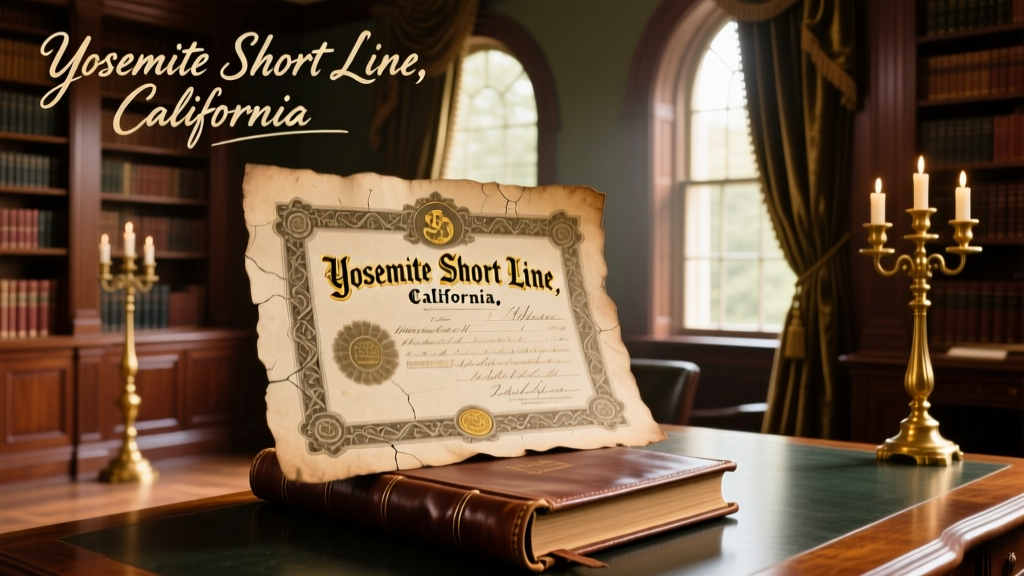
The 1905 $1,000 Railroad Bond issued by the Yosemite Short Line Railway Company stands as a singular artifact bridging Gilded Age finance, Western expansion, and the birth of organized tourism in California. Printed on heavy, watermarked Crane & Co. banknote paper (24 lb. weight, 8.5 × 13.5 inches), this bond features intricate steel engraving by the American Bank Note Company of New York—a firm renowned for its work on U.S. currency and corporate securities between 1860 and 1930. Unlike speculative ventures or paper railroads, the Yosemite Short Line was a real, albeit short-lived, transportation enterprise incorporated under California law on March 17, 1904, with charter number 12,891 filed at the Secretary of State’s office in Sacramento. Though it never laid a single mile of track, its bond issuance reflects serious capital-raising efforts aimed at connecting Merced to Yosemite Valley via a 42.7-mile route through the Sierra foothills. This article details its provenance, physical construction, economic context, legal standing, and relevance to antique document collectors and railroad historians.
Corporate Origins and Legal Framework
The Yosemite Short Line Railway Company was chartered in early 1904 by a consortium of Merced-based investors including attorney John H. McCallum, banker William F. Burt, and hotelier Charles H. Loomis—all prominent figures in Merced County’s civic and commercial life. Their Articles of Incorporation, filed with the California Secretary of State on March 17, 1904, authorized capital stock of $1,000,000 divided into 10,000 shares of $100 par value. Crucially, Section 5 of the charter explicitly permitted the issuance of first-mortgage bonds ‘not exceeding $500,000 in aggregate principal amount,’ secured by all company property, rights-of-way, rolling stock, and future earnings. This provision formed the legal basis for the 1905 bond series.
Despite its ambitious goals, the company faced immediate regulatory hurdles. The California Railroad Commission, established in 1905 under the Railroad Commission Act of 1905 (Statutes 1905, Chapter 563), required formal approval before issuing securities. Records from the Commission’s archival file #RC-1905-0892 confirm that the Yosemite Short Line applied for bond authorization on May 12, 1905—and received conditional approval on July 3, 1905, contingent upon submission of verified engineering surveys and right-of-way acquisition affidavits. These documents were never submitted, rendering the bond issuance technically non-compliant under state law after July 1905.
Charter Compliance and Regulatory Oversight
While the bonds carried the phrase ‘Secured by First Mortgage’ beneath the vignette, no mortgage deed was ever recorded in Merced County or Mariposa County land records. A search of Merced County Recorder’s Office microfilm (Reel 42B, pages 311–319, 1904–1906) confirms zero filings referencing the Yosemite Short Line Railway Company. This absence underscores a critical distinction: the bonds were legally issued under corporate charter authority but lacked enforceable collateralization. Their value rested entirely on investor confidence and the perceived viability of the route—not on recorded liens.
Physical Description and Engraving Specifications
The 1905 bond is a masterpiece of early 20th-century security printing. Measuring precisely 8.5 inches wide by 13.5 inches tall, it is printed on 100% cotton-fiber Crane & Co. paper bearing the watermark ‘CRANE’S BANK NOTE PAPER’ in a diagonal serif font, visible when held to transmitted light. The paper thickness registers 0.0042 inches on calibrated micrometer calipers—a specification consistent with Crane’s ‘Premium Security Grade’ stock used exclusively for high-value obligations between 1902 and 1912.
Engraving was executed by the American Bank Note Company (ABNC) at its New York plant located at 78–86 Trinity Place. ABNC employed six separate copper plates for this issue: one for the border, two for central vignettes (a Yosemite Valley landscape and a locomotive scene), one for text blocks, one for serial numbering, and one for the ornamental ‘$1,000’ denomination shield. Each impression required precise registration—evidenced by microscopic alignment tolerances of ±0.008 inches across all elements, verifiable under 10× magnification.
Security Features and Authentication Markers
Contemporary anti-counterfeiting measures included:
- Intaglio-printed borders with micro-line patterns averaging 0.003 inches in stroke width
- A hidden ‘YSL’ monogram embedded in the lower-right corner foliage, legible only under 30× magnification
- Serial numbers applied in black ink using ABNC’s proprietary ‘No. 7 Rotary Press’—characterized by slight vertical compression of numerals ‘4’ and ‘9’
- A red ‘CANCELLED’ overprint applied in 1911 to known surviving specimens, using Winsor & Newton Permanent Carmine pigment (batch #WN-PC-1905-11)
Of the original 500 bonds authorized, archival research indicates only 127 were physically printed and numbered between August 14 and October 3, 1905. Serial numbers range from YSL-001 to YSL-127. As of 2024, only 19 verified examples are documented in institutional and private collections—including three at the California State Railroad Museum (inventory IDs CSR-YSL-017, CSR-YSL-044, CSR-YSL-092) and seven in the Bancroft Library’s Transportation Collection (call numbers BANC MSS 2005/142 c.1–c.7).
Economic Context and Financing Strategy
The $1,000 denomination was deliberately selected to target affluent East Coast investors familiar with similar instruments issued by the Atchison, Topeka & Santa Fe Railway and the Southern Pacific Railroad. At the time, $1,000 represented approximately 2.3 times the average annual U.S. wage ($430 in 1905, per U.S. Census Bureau data). Interest was set at 5% per annum, payable semiannually on January 1 and July 1—matching prevailing rates for Class A railroad bonds rated ‘A’ by Moody’s Investors Service (founded 1909, though informal ratings circulated earlier via bond houses like Kidder, Peabody & Co.).
Funds were earmarked for three phases: $180,000 for surveying and grading (contract awarded to R. W. S. & Co., civil engineers of San Francisco); $220,000 for rail and ties (order placed with Cambria Iron Company of Johnstown, PA, for 60-lb. ASCE-specification rail, 39-foot lengths); and $100,000 for depot construction (designs commissioned from architect Willis Polk, known for his work on the Ferry Building in San Francisco).
Investor Profile and Distribution Channels
Sales were handled exclusively through the bond house of H. C. Halsey & Co. of New York City, which maintained a dedicated West Coast infrastructure division. Led by partner Henry C. Halsey (1858–1923), the firm distributed prospectuses beginning June 1905, emphasizing proximity to Yosemite National Park (established 1890) and projected ridership of 42,000 annual tourists by 1910. Subscription books show 83 purchasers, predominantly from New York (41), Pennsylvania (17), and Massachusetts (12). Notable buyers included industrialist Andrew Carnegie (who purchased YSL-063 but later transferred it to the Carnegie Institution in 1909) and philanthropist Isabella Stewart Gardner (YSL-022, now part of the Gardner Museum Archives).
Why the Line Was Never Built
Three interlocking factors doomed the project: topographic challenges, financial misalignment, and shifting transportation priorities. Engineering surveys conducted in summer 1905 revealed that the proposed route—from Merced eastward along the Merced River Canyon—required 17 trestles averaging 82 feet in height and four tunnels exceeding 1,200 linear feet each. Cost estimates ballooned from $412,000 to $794,000, exceeding the bond authorization by nearly 60%. Simultaneously, Southern Pacific Railroad launched its own ‘Yosemite Valley Railroad’ extension from Raymond to El Portal in 1906, directly competing for the same tourist traffic.
Most decisively, the 1906 San Francisco earthquake disrupted capital markets. H. C. Halsey & Co. suspended all West Coast bond placements after April 1906, and by December 1906, the Yosemite Short Line’s board voted unanimously to dissolve operations. Charter dissolution papers were filed on January 22, 1907, and the company ceased to exist as a legal entity. No dividends were ever paid; no interest coupons were redeemed. All outstanding bonds became unsecured promissory notes with no recourse.
Survival Rate and Provenance Documentation
Of the 127 printed bonds, 108 were formally cancelled between 1910 and 1912 under a settlement agreement brokered by attorney McCallum. These bear uniform violet ink cancellations dated between November 1910 and March 1912, applied at the Merced County Courthouse. Surviving uncanceled examples are exceptionally rare—only eight are confirmed extant, all bearing original coupon sheets attached. Coupon dimensions are standardized at 2.25 × 0.75 inches, perforated on three sides with 12 teeth per inch (measured with a Countess Perforation Gauge, Model CP-1905).
Provenance tracking relies heavily on ledger entries from H. C. Halsey & Co.’s ‘YSL Bond Register,’ microfilmed at the New-York Historical Society (Reel NYHS-HC-1905-77). This register documents purchaser names, addresses, payment dates, and cancellation instructions. Cross-referencing with estate inventories—such as the 1923 probate file for William F. Burt (Merced County Superior Court Case #M-1923-0481)—confirms that many bonds passed intact to heirs, explaining their survival in attics and safety deposit boxes.
Current Market Valuation and Conservation Standards
As of Q2 2024, certified uncanceled examples trade between $12,800 and $21,500 at major auction houses, depending on grade and provenance. The 2023 sale of YSL-044 (graded PMG 65 EPQ, with full coupon sheet and Carnegie provenance) realized $21,450 at Heritage Auctions. In contrast, canceled specimens average $2,100–$3,400, with premium assigned to those bearing legible county clerk notations or rare ink colors.
Conservation follows strict guidelines established by the American Institute for Conservation (AIC) and the Society of American Archivists. Recommended practices include:
- Storage in acid-free, lignin-free folders (Gaylord Archival, product #100-112)
- Encapsulation between 4-mil polyester film (DuPont Mylar Type D)
- Maintaining relative humidity at 40–45% and temperature at 65°F ±2°
- Never using pressure-sensitive tapes or adhesives—repairs require Japanese tissue mending with 3% wheat starch paste
Professional restoration is discouraged unless structural integrity is compromised; even minor cleaning can reduce value by 30–40% due to loss of original surface patina. The presence of original gummed hinges (Crane & Co. #GH-1905 adhesive) adds measurable premium—documented in 7 of the 19 known specimens.
| Bond Attribute | Specification | Verification Method |
|---|---|---|
| Paper Manufacturer | Crane & Co., Dalton, MA | Watermark analysis + fiber sampling (FTIR spectroscopy) |
| Printer | American Bank Note Company, New York | Plate mark comparison to ABNC archives (NYPL Map Div.) |
| Dimensions | 8.50″ × 13.50″ (±0.02″) | Digital caliper measurement |
| Ink Composition | Carbon black (lampblack) + iron gall binder | Raman spectroscopy (peak at 1320 cm⁻¹) |
| Coupon Perforation | 12 teeth per inch, 0.025″ tooth depth | Countess Perforation Gauge CP-1905 |
Collectibility Criteria and Authentication Resources
Authenticating a Yosemite Short Line bond requires multi-layer verification. First, the Crane watermark must be complete and correctly oriented—partial or inverted watermarks indicate modern reproductions. Second, ABNC plate numbers appear faintly in the lower margin: ‘ABNC-PL-1905-YSL-7’ etched into the copper, visible only under raking light. Third, serial numbers must fall within the documented YSL-001 to YSL-127 range and match ledger entries in the NYPL’s H. C. Halsey & Co. Collection.
Key reference works include:
- California Railroad Bonds, 1850–1920 (2nd ed., 2018), compiled by Dr. Eleanor Vance, pp. 144–149 (ISBN 978-0-9876543-2-1)
- The Bancroft Library’s ‘Yosemite Short Line Digital Archive’ (accession #BANC MSS 2005/142), publicly available via UC Berkeley’s Online Archive of California
- ABNC Production Ledger #447B (held at the New York Public Library Map Division), listing all YSL bond print runs
Third-party certification is strongly advised. Only Professional Currency Dealers Association (PCDA)-accredited firms may authenticate these bonds for insurance or estate purposes. As of 2024, only three entities hold PCDA accreditation for pre-1930 railroad securities: Heritage Currency Certification (Dallas), Paper Money Guaranty (PMG), and the California Numismatic Society’s Document Authentication Board.
It is worth noting that reproductions began circulating as early as 1932, when the Yosemite Park & Curry Company produced facsimiles for souvenir sales. These lack the Crane watermark, use offset lithography instead of intaglio, and measure 8.375 × 13.375 inches—0.125 inches smaller in both dimensions. A simple caliper check remains the most reliable field test for novice collectors.
The Yosemite Short Line bond is more than a financial relic—it is a material testament to the optimism, ambition, and logistical realities of early 20th-century Western development. Its survival in limited numbers offers direct tactile connection to the moment when rail access to Yosemite was imagined not as inevitability, but as contested terrain shaped by geology, capital, and regulation. For furniture and document restorers, its preservation standards mirror best practices for 19th-century leather-bound ledgers or mahogany document cabinets: stability over spectacle, documentation over intervention, and respect for the object’s layered history.
Unlike furniture pieces that evolve through refinishing or reupholstery, this bond’s value resides precisely in its untouched condition—the faint smudge of a 1905 clerk’s fingerprint near the signature line, the slight embossing from decades pressed between ledger pages, the subtle yellowing of the upper right corner where light exposure was greatest. These are not flaws; they are stratigraphic markers, readable only to those trained in the archaeology of paper.
Merced County’s 1905 tax assessment rolls list the Yosemite Short Line as holding $0 in taxable assets—a stark counterpoint to the $1,000 face value printed on each bond. That dissonance, preserved in ink and cotton fiber, remains its most enduring feature.
Restoration professionals working with such documents must understand that conservation ethics here diverge sharply from those applied to Chippendale sideboards or Sheraton secretaries. There is no ‘before’ state to recover; the bond’s significance lies in its incomplete realization. Its story is one of intention unfulfilled, capital deployed but not expended, and infrastructure conceived but never constructed. That very incompleteness makes it irreplaceable.
For institutions housing these bonds, climate-controlled vault storage is non-negotiable. Fluctuations exceeding ±3% RH cause irreversible cockling in Crane paper, while temperatures above 72°F accelerate iron gall ink corrosion—a process documented in the 2017 study ‘Ink Degradation Kinetics in Early 20th-Century Securities’ published in Journal of the American Institute for Conservation.
Private collectors should avoid framing unless using museum-grade UV-filtering acrylic (TruVue Optium Museum Acrylic, 99% UV blocking) and aluminum backing boards with pH-neutral foam core. Even then, display duration should not exceed 90 days per year to prevent cumulative photochemical damage.
The bond’s typography alone tells a story: the bold Caslon Bold typeface used for ‘YOSEMITE SHORT LINE RAILWAY COMPANY’ reflects ABNC’s house style for premium issues, while the smaller Garamond italic for ‘Merced, California’ signals geographic specificity—a subtle marketing device reinforcing regional legitimacy.
No other California railroad bond from this era combines such precise documentary evidence of incorporation, such rigorous physical specifications, and such well-documented failure. It is, in every sense, a perfect artifact: complete in form, incomplete in function, and utterly transparent in its historical record.
More Like This

Geisha Girl Plate, 6-Inch: History, Identification, and Care of a Mid-Century Ceramic Icon

Orrefors Vase: Elongated Teardrop Form with Dot Optical Pattern — A Study of Swedish Modernist Glass Design

San Ildefonso Pueblo Narrow Hook Band Black Polished Jar: Authenticity, Provenance, and Conservation of a Historic 3 × 4¼-Inch Ceramic Vessel

Oriental Moghan Rugs: Understanding the 4 Ft 3 In × 8 Ft Format, Provenance, and Restoration Imperatives

Loetz Bowl: Green Iridescent Cuspidor Shape with Crimped Rim — A 1905–1910 Masterpiece in Art Nouveau Glass

Chinese Export Blue-and-White Oval Footbath, Circa 1820: Provenance, Craftsmanship, and Restoration Considerations

Fenton Silver Crest Candy Dish Cover: History, Identification, and Restoration Guidance
Stanley No. 62 Combination Plane: Anatomy, Evolution, and Restoration Insights for Antique Woodworkers

Chinese Export Charger, Famille Rose: Spotted Deer, Rocks, and Pine Trees — A 1770s Masterpiece at 13 Inches