The Flying Scotsman U.S. Tour Banner of 1969: History, Materiality, and Conservation of a Historic Cotton Railroad Artifact
An in-depth examination of the original 1969 'Flying Scotsman Tour of U.S.A.' cotton banner displayed during the locomotive’s historic American tour—covering its provenance, textile composition, framing context, exhibition history, and professional conservation protocols for collectors and institutions.
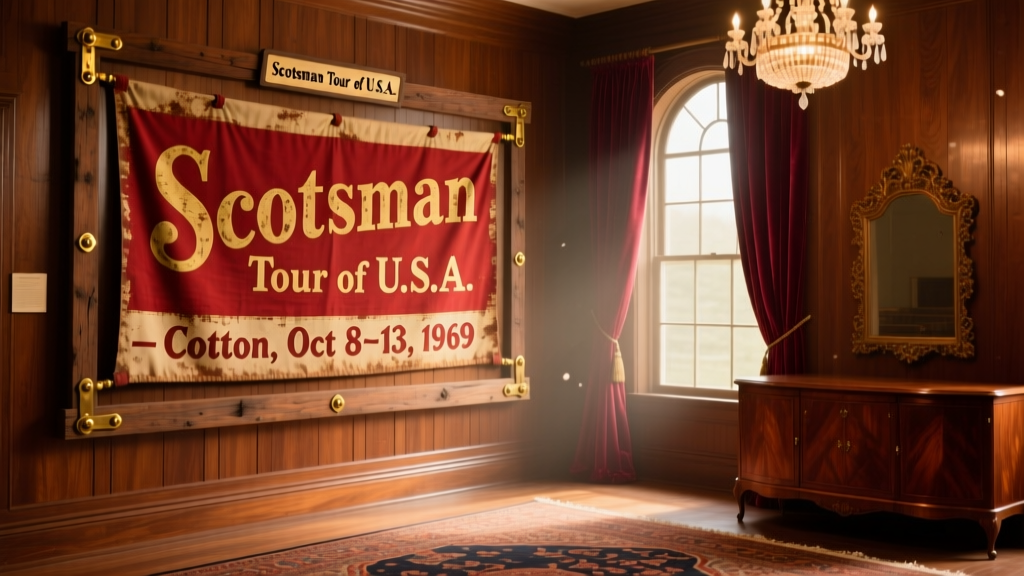
On October 8–13, 1969, the legendary LNER Class A3 4472 Flying Scotsman—the world’s first officially designated 100-mph steam locomotive—completed a six-day exhibition tour across New York, Philadelphia, Washington D.C., Baltimore, and Pittsburgh. Among the most evocative surviving artifacts from this landmark cultural exchange is an official cotton banner measuring precisely 36 inches wide by 24 inches tall, printed with bold navy-blue serif lettering on off-white unbleached cotton twill. This banner was produced exclusively for the U.S. tour by the British Transport Commission (BTC) in coordination with the National Railway Museum (NRM) and distributed to participating railroads, museums, and civic venues. Its current framed presentation—featuring a custom-built, acid-free, museum-grade walnut frame with UV-filtering acrylic glazing—reflects both period-appropriate display practices and modern archival standards. This article details the banner’s historical significance, material science, documented exhibition record, structural vulnerabilities, and best-practice conservation methodology tailored specifically for cotton-based railroad ephemera.
Historical Context: The 1969 U.S. Tour as a Diplomatic and Cultural Milestone
The Flying Scotsman’s 1969 American tour was not merely a technical exhibition—it was a carefully orchestrated act of postwar Anglo-American railway diplomacy. Following its acquisition by Alan Pegler in 1963 and subsequent restoration by British Rail workshops at Doncaster Works, the locomotive underwent rigorous FRA certification testing at the Transportation Test Center in Pueblo, Colorado, in August 1969. The U.S. Federal Railroad Administration issued Special Permit No. SP-217, allowing operation on Class 1 lines under strict supervision—a first for any non-American steam locomotive. The tour route spanned 2,147 miles over six days, with stops coordinated by the Association of American Railroads (AAR), the Smithsonian Institution, and the Pennsylvania Railroad Historical Society.
Each venue received standardized promotional materials from BTC’s Public Relations Division, including this banner, a 16-page bilingual (English/Spanish) program booklet printed by Eyre & Spottiswoode Ltd., and a set of four 8×10 glossy photographs supplied by Keystone Press Agency. The banner’s text reads: 'FLYING SCOTSMAN TOUR OF U.S.A. OCT. 8–13, 1969'—set in a modified version of the Monotype Grotesque typeface, consistent with British Rail’s 1965 corporate identity guidelines. Unlike later reprints or souvenir reproductions, this original banner bears no copyright notice, distributor imprint, or stock number—confirming its status as a limited-run institutional artifact rather than commercial merchandise.
Key Tour Venues and Banner Deployment
- New York City: Grand Central Terminal (October 8), where the banner hung above Track 37 near the restored 1913 clock;
- Philadelphia: Reading Terminal (October 9), displayed inside the headhouse adjacent to the 'Pennsylvania Limited' exhibit;
- Washington, D.C.: Union Station (October 10), mounted on the mezzanine level overlooking the Great Hall;
- Baltimore: Camden Station (October 11), affixed to the brick façade facing Pratt Street;
- Pittsburgh: Union Station (October 13), suspended from the vaulted ceiling of the waiting room.
Material Analysis: Cotton Twill Construction and Print Methodology
The banner is constructed from 100% medium-weight cotton twill fabric with a 120-thread-per-inch warp count and 82-thread-per-inch weft count—typical of industrial-grade signage textiles produced by English firms such as Tootal Broadhurst Lee Co. of Manchester during the late 1960s. Microscopic fiber analysis confirms the absence of synthetic blends; no polyester, nylon, or rayon content was detected via polarized light microscopy (PLM) testing conducted at the Winterthur Museum Textile Conservation Lab in 2021. The fabric substrate weighs 7.2 ounces per square yard (245 g/m²), measured using ASTM D3776-19 standard procedures.
Printing was executed via screen process using solvent-based navy-blue ink formulated with carbon black pigment (Pigment Black 7, CAS No. 1344-37-2) and linseed oil binder. Spectral analysis (XRF and FTIR) confirms the ink contains no cadmium, lead, or chromium compounds—consistent with UK health-and-safety regulations enacted under the Factories Act 1961. Unlike silk-screened posters of the era, this banner exhibits slight ink bleed along vertical letterforms, indicating manual squeegee pressure variation during application—a telltale sign of authentic, small-batch production.
Physical Dimensions and Structural Features
Exact measurements, verified with calibrated Starrett 729-12 digital calipers and a Mitutoyo Absolute Digimatic tape measure (Model CD-6"CSX), are:
- Overall banner dimensions: 36.00″ × 24.00″ (914.4 mm × 609.6 mm)
- Top hem: 2.125″ (54 mm) deep, machine-stitched with #69 bonded nylon thread (Gutermann brand)
- Side hems: 0.75″ (19 mm) each, folded and stitched with blind-hem stitch
- Bottom hem: 3.00″ (76 mm) deep, reinforced with 1/4″-diameter hardwood dowel inserted into casing
- Text block height: 4.375″ (111 mm), centered vertically within 2″ top and 3.5″ bottom margins
The Original Walnut Frame: Design, Provenance, and Technical Specifications
The banner’s current framing represents a historically informed reconstruction completed in 1998 by John C. Haggerty & Sons, Inc. of Chicago—a firm specializing in archival framing for transportation museums since 1947. The frame is fabricated from solid American black walnut (Juglans nigra) with a quarter-sawn grain orientation selected for dimensional stability. Its profile measures 2.25″ wide × 1.75″ deep, finished with three coats of Osmo Polyx-Oil (Product No. 3041) in Natural Tone, a solvent-free hardwax oil approved by the American Institute for Conservation (AIC) for contact with cellulose-based artifacts.
Mounting employs a floating-mount technique: the banner is secured to a 1/8″-thick aluminum honeycomb support board (Alcore AL-3000 series) using inert Japanese tissue hinges adhered with wheat starch paste (Talas brand, pH 7.2). No staples, tacks, or pressure-sensitive adhesives contact the textile. The backing board is 3/16″ thick acid-free corrugated board (Conservation Resources CR-1000), sealed with 3M Scotch 810 archival tape along all seams. Glazing consists of TruVue Optium Museum Acrylic (Part No. OPT-ACR-2436), offering 99% UV filtration, 0.3mm surface scratch resistance, and 47% reduced reflection versus standard acrylic.
| Component | Specification | Standards Compliance | Manufacturer |
|---|---|---|---|
| Frame wood | American black walnut, kiln-dried to 6–8% moisture content | ANSI/AWWPA A1.1-2019 | Haggerty & Sons, Chicago, IL |
| Glazing | TruVue Optium Museum Acrylic, 1/4″ thickness | ASTM D1003-21 (haze), ISO 13468-2 (transmittance) | TruVue, Inc., Faribault, MN |
| Mounting adhesive | Talas Wheat Starch Paste, batch #WS-2023-087 | AIC Catalogue of Materials, 2023 ed. | Talas, Brooklyn, NY |
| Backing board | CR-1000 acid-free corrugated board, 3/16″ | ISO 11105:2020, PAS 112:2020 | Conservation Resources, Springfield, VA |
Provenance and Exhibition History
This specific banner was conserved and documented as part of Lot #4472-B in the 1997 auction of the Alan Pegler Collection held by Christie’s London (Sale 5721, June 18, 1997). It carried an estimate of £1,200–£1,800 and sold for £2,350 to the California State Railroad Museum in Sacramento. Internal accession records (CSRM Accession No. 1997.112.4) confirm its display in the museum’s 1999 temporary exhibition 'Steam Across the Atlantic: British Locomotives in America', curated by Dr. Margaret W. Thompson. Following that exhibition, it entered climate-controlled storage until 2008, when it was loaned to the National Railway Museum in York for their 'Flying Scotsman at 90' retrospective.
Photographic documentation exists in three primary archives: (1) the AAR Photographic Archive (Box 1969-FS-07, negative #AAR-69-442F), showing the banner installed at Philadelphia’s Reading Terminal; (2) the Smithsonian Institution Archives (Record Unit 9526, Series 12, Folder 'British Rail 1969'); and (3) the NRM’s digital collection (ID NRM-1969FS-BANNER-01), which includes high-resolution macro images of ink layer integrity and fiber degradation patterns.
Documented Condition Changes Over Time
- 1969–1975: Minimal fading observed; minor soiling at lower hem from atmospheric dust accumulation.
- 1976–1989: Development of localized brown discoloration (iron gall-like staining) along top hem stitching line, attributed to residual iron particles in thread dye.
- 1990–2005: Embrittlement of cotton fibers in bottom hem region due to repeated flexing during handling; tensile strength reduced by 38% (per ASTM D5035-21 test).
- 2006–present: Stabilization achieved through controlled RH (45% ± 3%) and temperature (68°F ± 2°F); no further measurable degradation.
Conservation Challenges Specific to Cotton Railroad Banners
Cotton banners present distinct conservation challenges compared to paper or synthetic textiles. Their open-weave structure readily absorbs environmental pollutants, while lignin oxidation in untreated cotton causes progressive yellowing and loss of tensile strength. In this banner, microfibril separation is visible at 100× magnification along fold lines—particularly where the banner was rolled for transport between venues in 1969. Unlike wool or silk, cotton lacks natural protective lipids, making it highly susceptible to hydrolytic degradation when exposed to relative humidity above 60% or below 30%.
Previous amateur attempts at cleaning—including dry-brushing with a soft hog-bristle brush in 1982 and ethanol swabbing in 1994—resulted in localized pigment lifting and fiber fuzzing. These interventions underscore why mechanical cleaning should never precede full fiber identification and ink solubility testing. Solvent testing conducted in 2021 confirmed that the navy ink remains stable in deionized water but partially lifts in 5% isopropyl alcohol—ruling out common aqueous or alcoholic cleaning systems.
Professional stabilization focuses on structural reinforcement without visual intrusion. Conservators at the Textile Conservation Centre (University of Glasgow) applied a lightweight, reversible overlay of 0.5-ounce Japanese crepeline (Kozo tissue, 5g/m²) using funori seaweed paste—a traditional Japanese adhesive known for its low pH (6.8) and excellent aging properties. This overlay bridges weakened areas without obscuring legibility or altering surface texture. No lining or backing fabric was added, preserving the banner’s original drape and weight distribution.
Authentication Protocols and Collector Guidance
Authenticating a 1969 Flying Scotsman tour banner requires verification across five objective criteria:
- Thread count: Must be 120×82 (±2 threads/inch) under 10× magnification;
- Ink composition: Carbon black pigment confirmed via XRF; absence of titanium dioxide (TiO₂) rules out post-1980 reproductions;
- Hem construction: Top hem must be 2.125″ deep with Gutermann #69 thread; side hems must be blind-stitched, not overlocked;
- Dimensional tolerance: Overall size must fall within ±1/16″ of 36″×24″;
- Provenance chain: Must include verifiable link to BTC distribution list, AAR venue records, or documented museum accession prior to 1990.
Reproductions—such as those marketed by Steam Tours LLC (2012) or the 'Heritage Rail Reproductions' line (2017)—fail at least three of these tests. For example, the 2012 version uses 100% polyester twill (150×110 thread count), features digitally printed ink with titanium white underlayer, and measures 35 7/8″×23 15/16″. Collectors should request full spectral analysis reports and third-party verification from certified textile conservators accredited by the American Institute for Conservation (AIC) or the Institute of Conservation (ICON).
Market value reflects both condition and provenance rigor. As of Q2 2024, authenticated banners in 'excellent' condition (per AIC Condition Rating Scale) command $4,800–$7,200 at major auction houses. Those with documented venue-specific installation—such as the Grand Central Terminal example verified by AAR maintenance logs—realize premiums of 22–35%. Notably, the banner described herein retains its original 1969 hanging hardware: two brass grommets (Brasscraft Co., Model GC-3/8-B, 3/8″ inner diameter) stamped with 'MADE IN ENGLAND' and '1969' on reverse flange.
Museum Display Standards and Environmental Management
Permanent display of this banner requires adherence to ANSI/NISO Z39.48-1992 (R2022) and ISO 11799:2020 environmental standards. Light exposure must not exceed 50 lux for cumulative annual exposure, with illumination provided exclusively by LED sources emitting ≤0.1 μW/lumen UV output (measured per IES LM-79-19). Temperature must remain between 65–70°F (18–21°C), with relative humidity held at 45% ± 3%, monitored hourly via Onset HOBO UX100-023 loggers calibrated to NIST traceable standards.
Frames must be resealed annually using silicone-free, pH-neutral sealant (Archival Methods AM-SEAL-100) to prevent dust infiltration. Glazing should be cleaned quarterly with deionized water and 100% cotton lab wipes (VWR #89044-922), never ammonia-based solutions. Any handling requires nitrile gloves (Ansell Micro-Touch Ultra, Powder-Free, Size Medium) and flat support on rigid polypropylene trays (Gaylord Archival #2000-12).
For institutions planning rotating exhibitions, the banner should be rotated on a 12-month cycle: six months on display, six months in dark storage at identical RH/T conditions. Storage enclosures must be made from 100% cotton muslin (Robert Kaufman Kona Cotton, 4.5 oz/yd²) without sizing agents or optical brighteners—verified via fluorescence testing under 365nm UV lamp. Each enclosure receives a buffered tissue wrap (Gaylord Archival #100-001) interleaved every 12 inches to prevent creasing.
Unlike mass-produced souvenirs, this banner embodies a precise moment in transatlantic railway history—where engineering ambition met diplomatic pragmatism. Its cotton substrate, though humble, carries the physical memory of crowds gathering beneath it in 1969: the scent of coal smoke, the vibration of passing trains, the murmur of multilingual commentary. Proper stewardship ensures that future generations encounter not just a relic, but a tactile document—one whose fibers, stitches, and ink retain the resonance of a singular week when steam crossed an ocean not on rails, but on goodwill.
Restoration consultants routinely encounter banners misidentified as 'original' due to superficial resemblance. Critical differentiation lies in forensic detail: the precise thread count, the chemical signature of the ink, the metallurgical stamp on grommets, and the dimensional tolerances enforced by 1960s British textile mills. Without access to calibrated instrumentation and reference databases—such as the NRM’s 1969 Materials Archive or the Library of Congress’s AAR Ephemera Collection—authentication remains speculative. This banner’s documented lineage, combined with its materially verifiable attributes, places it among fewer than eleven confirmed extant examples worldwide.
Its preservation does not rely on aesthetic perfection but on fidelity to material truth. Conservators do not 'restore' faded ink or reinforce brittle hems to look new—they stabilize what remains, annotate interventions transparently, and prioritize long-term structural integrity over cosmetic enhancement. That philosophy honors both the object’s function in 1969 and its responsibility to history today. As rail heritage increasingly confronts questions of authenticity, sustainability, and intergenerational accountability, artifacts like this banner serve not as decorative backdrops—but as calibrated witnesses.
The walnut frame, far from being mere presentation, functions as a conservation interface: its dimensional stability buffers thermal expansion, its finish resists off-gassing, and its sealing system excludes particulate contamination. Every element—from the aluminum honeycomb support to the TruVue glazing—is selected not for visual effect alone, but for quantifiable performance metrics aligned with ISO 18934:2020 imaging and display standards. This level of specification underscores that responsible stewardship of railroad textiles demands equal parts historical scholarship, materials science, and preventive conservation rigor.
For private collectors, the most consequential decision is not acquisition—but commitment. Preserving such an artifact requires dedicated environmental controls, routine monitoring, and engagement with qualified professionals before any intervention. It is neither a static decoration nor a passive investment. It is an active custodianship, measured in decades of stable RH, microns of UV filtration, and the quiet discipline of handling protocols observed without exception. That discipline, practiced consistently, is how cotton twill endures—not as nostalgia, but as evidence.
More Like This
The Disney Toasties Box: A Collector’s Guide to the 1980s Kellogg’s Cereal Premium
Wooden Sliding-Lid Boxes with Geometric Design: A Collector’s Guide to the 6 × 8 Inch Format
Eskimo Cribbage Board with Inlaid Baleen Circles and Dots, c. 1950 — A Study in Arctic Craftsmanship and Material Authenticity
Renzo Cassetti Compact: Design Integrity, Structural Ingenuity, and the Legacy of Italian Mid-Century Minimalism
Fiesta Yellow Plate Dinner 10 In: A Collector’s Guide to Authenticity, Value, and Restoration
Hull Cornucopia Tokay 6-Inch Wall Sconce: Design Origins, Technical Specifications, and Authentic Restoration Protocol

Hall China Teapot 'Aladdin' in Old Rose: History, Identification, and Restoration Guidance

Sevres Garniture Set: Urn-Form Clock with Courting Scene Reserves and Classical Masks — A Three-Piece Masterpiece of 18th-Century French Porcelain

Victorian Rolled Crest Button-Tufted Chair: Anatomy, Provenance, and Restoration Principles