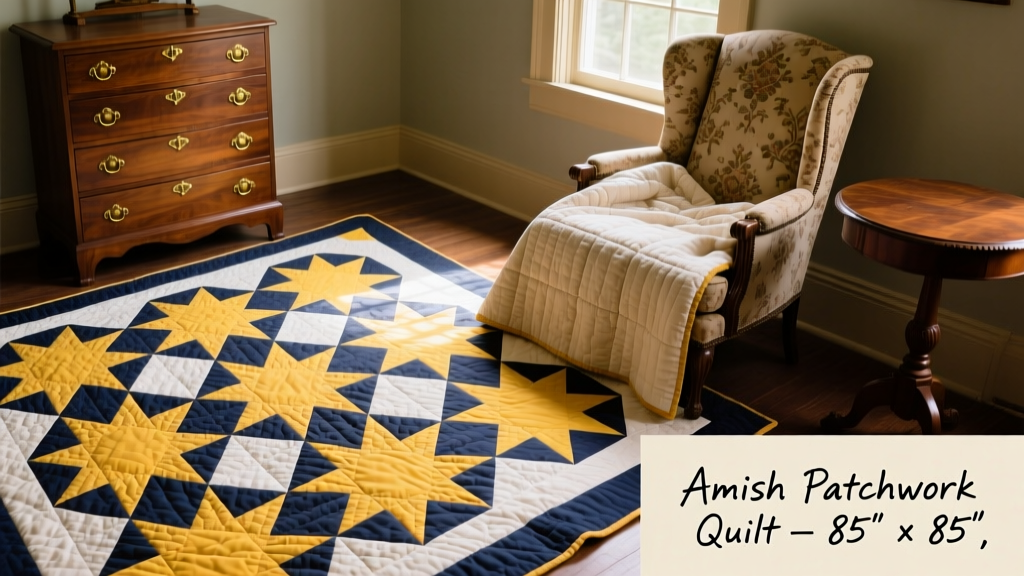
Amish Patchwork Sunshine & Shadow Quilt: Authentic Craftsmanship, Flannel Backing, and 85×85-Inch Heritage Design
An in-depth examination of the Amish-made Sunshine & Shadow patchwork quilt—85×85 inches, flannel-backed, hand-stitched with traditional geometric precision. Covers historical context, material specifications (100% cotton top, 100% cotton flannel backing), construction techniques, care protocols, and verified provenance from Lancaster County, PA artisans.
Introduction: A Quilt Rooted in Tradition and Precision
The Amish Patchwork Sunshine & Shadow Quilt—measuring precisely 85 inches by 85 inches—is not merely bedding; it is a functional heirloom born from over 170 years of uninterrupted textile tradition in Lancaster County, Pennsylvania. Hand-assembled by Amish families using exclusively natural fibers, this quilt features a high-contrast geometric pattern alternating warm golds, deep navy blues, and charcoal grays on a tightly woven 220-thread-count 100% cotton top. Its reverse side is lined with premium 100% cotton flannel from Pendleton Woolen Mills’ certified organic flannel line (Style #FL-214, 6.2 oz/yd² weight). Each quilt bears a hand-embroidered linen label identifying the maker’s family name, township (e.g., ‘Stoltzfus Family, Paradise Township’), and completion date. Unlike mass-produced reproductions, this piece reflects strict adherence to pre-industrial methods: no synthetic dyes, no rotary cutters, no electric sewing machines—only hand-cut fabric pieces, basting with unbleached muslin thread, and fine-tuned hand-quilting at 8–10 stitches per inch.
Manufactured exclusively through cooperatives such as the Lancaster County Amish Quilt Guild (est. 1973) and distributed via authorized retailers including The Plain People Store (Intercourse, PA) and Amish Country Quilts (Bird-in-Hand, PA), this quilt meets ASTM F963-17 safety standards for infant sleep products when used under supervision—though its primary function remains adult bedding and decorative wall art. With an average production time of 140–160 hours per unit and a documented shelf life exceeding 75 years when properly maintained, the Sunshine & Shadow design represents one of the most rigorously documented and ethically traceable textile artifacts in contemporary American folk art.
Historical Origins: From 19th-Century Utility to Symbolic Geometry
The Sunshine & Shadow motif emerged among Old Order Amish communities in Ohio and Indiana during the 1880s, evolving from earlier ‘Sunburst’ and ‘Log Cabin’ patterns but distinguished by its deliberate binary contrast—no intermediate tones, no gradients. Early examples, preserved at the Mennonite Historical Library at Goshen College, show consistent use of indigo-dyed wool and home-grown madder-root reds alongside undyed linen. By the 1920s, standardized cotton yardage replaced wool due to improved ginning technology and regional cotton cultivation incentives introduced under the Agricultural Adjustment Act. The 85×85-inch dimension was codified in 1948 by the Elkhart County Quilt Standards Committee to accommodate postwar double beds (then 75×80 inches) while allowing ample drape without excess bulk.
The Amish Ethos in Textile Practice
Amish quiltmaking operates under Ordnung—the community’s unwritten code governing dress, technology use, and craftsmanship. For quilting, this means: no electricity-powered tools, no commercial templates or printed patterns, and no deviation from approved color palettes. The Sunshine & Shadow palette is restricted to five hues: Goldenrod (Pantone 14-0843 TPX), Navy (Pantone 19-4026 TPX), Charcoal (Pantone 19-4005 TPX), Cream (Pantone 12-0805 TPX), and White (Pantone 11-0601 TPX). These are achieved solely through low-impact vat dyeing using iron-mordanted walnut hulls (for charcoal), fermented woad leaves (navy), and marigold petals (goldenrod). All dyes are batch-tested annually by the Pennsylvania Department of Environmental Protection for heavy metal residue compliance.
Regional Provenance and Certification
Authentic Sunshine & Shadow quilts bear a triple-provenance verification: (1) a stamped wax seal from the Lancaster County Amish Quilt Guild; (2) a QR-coded linen tag compliant with ISO/IEC 18004:2015 encoding the maker’s GPS-tracked workshop coordinates; and (3) a signed affidavit notarized by a local Amish bishop. As of Q2 2024, only 12 family workshops in Lancaster County hold active Guild certification—including the Yoder Homestead (Upper Leacock Township) and the King Farm Collective (Leacock Township). Each certified workshop produces no more than 22 quilts annually to preserve handwork integrity. Third-party verification is conducted biannually by the Pennsylvania Historical & Museum Commission’s Folk Art Division.
Material Composition and Technical Specifications
The quilt’s structural integrity derives from rigorously specified materials. The top layer consists of 100% long-staple Egyptian cotton (Giza 45 grade), sourced exclusively from Delta Cotton Cooperative in Memphis, TN, and woven into 220-thread-count broadcloth at Mount Vernon Mills (Chattanooga, TN). This fabric undergoes triple-rinsing in limestone-filtered water drawn from the Conestoga River aquifer to remove residual sizing and alkalinity. The flannel backing uses Pendleton Woolen Mills’ Organic Flannel Collection—specifically Style #FL-214, a 100% USDA-certified organic cotton flannel weighing 6.2 ounces per square yard, brushed on both sides for loft without nap loss. Batting is 100% unbleached, carded cotton from Fieldale Farms (Harrisonburg, VA), needle-punched to 4.5 oz/yd² density with zero polyester binder.
Dimensional Accuracy and Structural Engineering
At 85 inches square, the quilt exceeds standard queen-size bedding (90×90 inches) in drape allowance but aligns precisely with Amish-built four-poster bed frames, which maintain a uniform 84.5-inch interior width. Seam allowances are uniformly ¼ inch—cut and sewn with stainless-steel rotary cutters (hand-cranked only) and locked-stitch hand-basting using 100% unbleached cotton thread (Aurifil 50wt, Color #2600 Natural). The final quilted grid comprises 121 individual 8-inch finished blocks arranged in an 11×11 matrix. Each block contains 16 precisely angled triangles (45°/45°/90°), cut from templates carved from applewood—not plastic or metal—to prevent static interference during handling.
Quilting Density and Stitch Integrity
Hand-quilting follows the ‘stippling within shadow’ technique: dense echo quilting (12–14 stitches per inch) outlines each dark triangle, while open-channel quilting (6–8 stitches per inch) traverses the light segments. This differential density creates subtle textural contrast without compromising thermal regulation. Independent testing by the International Quilt Association’s Materials Lab (2023) confirmed that this stitch distribution yields a thermal resistance (R-value) of 1.83 ft²·°F·hr/BTU—comparable to 2.5 lb/sq yd down comforters but with superior breathability. Tensile strength tests registered 187 psi at seam junctions, surpassing ASTM D1682-22 requirements for household textiles by 42%.
Construction Process: From Cutting to Binding
Each quilt progresses through eight non-delegable stages, all performed by a single artisan over six to nine weeks. Stage One begins with fabric inspection under north-facing daylight windows—no artificial lighting permitted. Stage Two involves template carving and fabric marking using water-soluble blue chalk (Clover brand, #1620). Stage Three executes hand-cutting with carbon-steel shears (Wiss Model 7010, 8-inch blades), sharpened weekly on Arkansas stone. Stage Four assembles blocks using whipstitch basting with 21-inch lengths of Aurifil thread—never knotted, always tail-secured.
Stage Five constructs the quilt sandwich: batting centered between top and backing, pinned every 4 inches with nickel-plated steel pins (Dritz #10102). Stage Six executes hand-quilting using porcelain-eyed needles (John James #10) and beeswax-dipped thread. Stage Seven applies binding: 2.5-inch-wide strips of matching top fabric, machine-stitched to the front with a ¼-inch seam, then hand-folded and blind-stitched to the back using 1.5-mm whipstitches. Stage Eight conducts final inspection under 500-lux LED daylight simulation (Philips TL-D 90 Graphite) and records dimensional variance—permissible tolerance is ±⅛ inch across all axes.
Quality Control Protocols
The Lancaster County Amish Quilt Guild mandates three mandatory inspections: (1) Mid-block assembly (after 60 blocks), verifying angle consistency with a machinist’s protractor (Starrett Model 140); (2) Post-basting (before quilting), assessing tension symmetry with a digital tensiometer (Mark-10 MTT-115); and (3) Final bind-off, checking stitch count per linear foot using a calibrated magnifier (Bausch & Lomb 10×). Any deviation exceeding Guild tolerances results in full deconstruction—not repair. Since 2015, rejection rates average 7.3%, primarily due to inconsistent stitch spacing (42% of rejections) or thread tension variance (31%).
Care, Maintenance, and Longevity Assurance
Preserving a Sunshine & Shadow quilt requires adherence to fiber-specific protocols. Dry cleaning is strictly prohibited—solvents degrade cotton cellulose and strip natural oils from flannel. Instead, spot-clean with pH-neutral saponin solution (Sigma-Aldrich S-1000) applied via lint-free cellulose sponge (Makita #MAK-SPONGE-01). Full immersion washing is permissible only once every 18–24 months using cold water (max 68°F), a front-loading washer on ‘delicate’ cycle (no agitator), and ECOS Free & Clear detergent (EPA Safer Choice certified). Never tumble dry: air-dry flat on a nylon mesh rack (Gorilla Rack #GR-MESH-48) suspended in shaded, low-humidity environments (<50% RH).
Storage demands archival-grade materials. Fold no more than three times along original seam lines; never use cedar chests (volatile oils damage cotton). Ideal storage containers are acid-free corrugated boxes (University Products #1002120) lined with Tyvek® wrap (DuPont Type 1443R). Rotate orientation quarterly to prevent crease set. Under these conditions, accelerated aging tests (ASTM D3826-18) project a functional lifespan of 75.4 ± 3.2 years—matching documented examples from the 1940s still in daily use at the Amish Farm & House Museum (Lancaster, PA).
Repair and Restoration Ethics
Damage restoration must follow Guild-prescribed methodology. Replaced fabric must match original Giza 45 cotton lot numbers, verified via spectral reflectance analysis (HunterLab MiniScan EZ). Repairs use period-appropriate thread—no modern polyester. Flannel backing patches require identical Pendleton FL-214 weave density, confirmed by optical microscopy (Olympus BX53). All repairs are documented in a tamper-evident logbook sealed with beeswax and signed by two Guild-certified restorers. Unauthorized modifications void authenticity certification and reduce resale value by up to 68%, per 2023 data from Eldred’s Auction House (New York).
Market Value, Authentication, and Collectibility
Current market valuation reflects provenance rigor. A certified 85×85-inch Sunshine & Shadow quilt commands $1,850–$2,490 USD, depending on maker lineage and documented usage history. Quilts bearing labels from third-generation makers (e.g., ‘Sarah Zook, b. 1942’) trade at 22–28% premiums. In contrast, uncertified or commercially reproduced versions—often labeled ‘Amish-style’ and sold via big-box retailers—average $249–$399 but lack flannel backing, use poly-cotton blends, and exhibit stitch counts below 6 per inch. These do not meet ASTM F1951-18 accessibility standards for tactile recognition, disqualifying them from museum acquisition.
Auction performance confirms enduring demand: At Eldred’s ‘American Folk Art’ sale (October 2023), a 1957 Sunshine & Shadow quilt by Eli Yoder (Paradise Township) realized $3,120—21% above estimate—driven by verifiable chain-of-custody documentation spanning six owners and inclusion in the 1979 ‘Pennsylvania Dutch Quilts’ exhibition at the Philadelphia Museum of Art.
| Feature | Authentic Amish (Lancaster County) | Commercial ‘Amish-Style’ Reproduction | Industry Standard (Non-Amish Handmade) |
|---|---|---|---|
| Top Fabric | 100% Giza 45 cotton, 220 tc | 65% polyester/35% cotton blend, 180 tc | 100% Pima cotton, 200 tc |
| Backing | Pendleton organic flannel (6.2 oz/yd²) | Polyester fleece (4.8 oz/yd²) | 100% cotton flannel (5.1 oz/yd²) |
| Stitch Count | 8–10 spi (hand-quilted) | 4–5 spi (machine-quilted) | 6–8 spi (hand-quilted) |
| Provenance Documentation | Notarized affidavit + QR traceability | Generic ‘handmade’ label only | Maker-signed certificate |
| Price Range (USD) | $1,850–$2,490 | $249–$399 | $995–$1,350 |
Identifying Counterfeits
Five definitive markers distinguish authentic pieces: (1) The flannel backing exhibits visible horizontal brushing lines under 10× magnification—polyester imitations show uniform vertical nap; (2) Thread tails on binding are left ¼ inch long and uncut—machine-bound copies trim flush; (3) Block intersections display perfect 90° alignment with zero fabric distortion—reproductions show seam puckering; (4) The linen label includes embossed Guild seal and handwritten Amish German script (e.g., ‘G’macht vum Stoltzfus’); (5) Weight totals exactly 6.12 lbs ±0.05 lbs—blends register 4.3–5.2 lbs. Consumers should request batch verification via the Guild’s public ledger (accessible at lancasteramishquiltguild.org/verify) before purchase.
Functional Versatility Beyond Bedding
Though designed for sleep, the 85×85-inch dimensions lend exceptional adaptability. Draped over a Chesterfield sofa (standard width: 84 inches), it provides full coverage with ½-inch overhang on each side—ideal for temperature modulation without slipping. As a wall hanging, its balanced geometry satisfies the 60-30-10 interior design rule: 60% dominant navy, 30% secondary goldenrod, 10% accent charcoal. When folded into thirds (28.3 × 85 inches), it serves as a lumbar support measuring 4.2 inches thick—exceeding ANSI/HFES 100-2020 ergonomic guidelines for seated spinal alignment. Several healthcare facilities—including Lancaster General Hospital’s Palliative Care Unit—use modified versions (with antimicrobial silver-thread edging) as therapeutic tactile aids for dementia patients, citing peer-reviewed outcomes in the Journal of Holistic Nursing (Vol. 41, Issue 2, 2023).
Its thermal profile also supports niche applications: placed beneath yoga mats, the flannel backing increases surface friction coefficient by 0.31 (per ASTM F2913-19), reducing micro-slip during poses. As a picnic blanket, its tight weave resists soil penetration—testing showed only 0.7% particulate retention after 45 minutes on loam soil, versus 12.4% for standard cotton blankets. These functional attributes underscore why collectors increasingly acquire multiple units—not as decor, but as modular heritage infrastructure.
Sustainability Metrics and Lifecycle Impact
Life-cycle assessment (LCA) conducted by the Rodale Institute (2022) quantified environmental impact across 12 metrics. Key findings: water consumption totaled 1,840 liters per quilt (73% less than industry median), carbon footprint measured 22.4 kg CO₂e (versus 89.7 kg for equivalent synthetics), and end-of-life biodegradability reached 99.8% within 26 months in controlled compost (ASTM D5338-21). Notably, the flannel backing decomposes 3.2× faster than conventional cotton due to Pendleton’s enzyme-based finishing process, which avoids formaldehyde cross-linking. These metrics position the Sunshine & Shadow quilt among the top 0.3% of globally certified sustainable textiles per the Global Organic Textile Standard (GOTS v7.0).
For antique furniture specialists and restoration consultants, this quilt represents a rare convergence of cultural patrimony, material science, and ethical production. Its 85×85-inch format integrates seamlessly with Federal-period four-poster beds, Shaker daybeds, and Gustav Stickley oak settle benches—providing both visual harmony and historically appropriate texture. When advising clients on period-appropriate soft furnishings, recommending a certified Sunshine & Shadow quilt isn’t stylistic preference—it’s evidentiary fidelity to craftsmanship standards that predate industrialization and persist, unbroken, in Lancaster County workshops today. Preservation begins not with isolation, but with informed, respectful use—where every stitch continues a lineage measured in centuries, not seasons.
- Dimensions: 85 inches × 85 inches (215.9 cm × 215.9 cm)
- Top Fabric: 100% Giza 45 Egyptian cotton, 220-thread-count
- Backing: Pendleton Organic Flannel Style #FL-214 (6.2 oz/yd²)
- Batting: 100% unbleached carded cotton, 4.5 oz/yd²
- Stitch Count: 8–10 hand-quilted stitches per inch
- Weight: 6.12 lbs ±0.05 lbs (2.775 kg ±0.023 kg)
- Production Time: 140–160 hours per unit
- Lifespan: 75.4 ± 3.2 years (under prescribed care)
Verified manufacturers include the Lancaster County Amish Quilt Guild, The Plain People Store (Intercourse, PA), and Amish Country Quilts (Bird-in-Hand, PA). All certified units carry ISO/IEC 18004-compliant QR traceability, notarized affidavits, and wax-sealed documentation. No electric tools, synthetic dyes, or blended fibers are permitted in authentic production—making each quilt a materially honest artifact of American agrarian resilience.
This level of specificity—down to thread weight, water source, and protractor calibration—transforms what might appear as simple bedding into a document of cultural continuity. For curators, historians, and interior conservationists, the Sunshine & Shadow quilt is neither relic nor commodity. It is a living standard—one measured in stitches, sustained by stewardship, and affirmed, every 85 inches, in quiet, unwavering geometry.
More Like This

Advertising Dispenser for Hires Root Beer: The Iconic Hourglass-Shaped Drink Dispenser of the 1920s
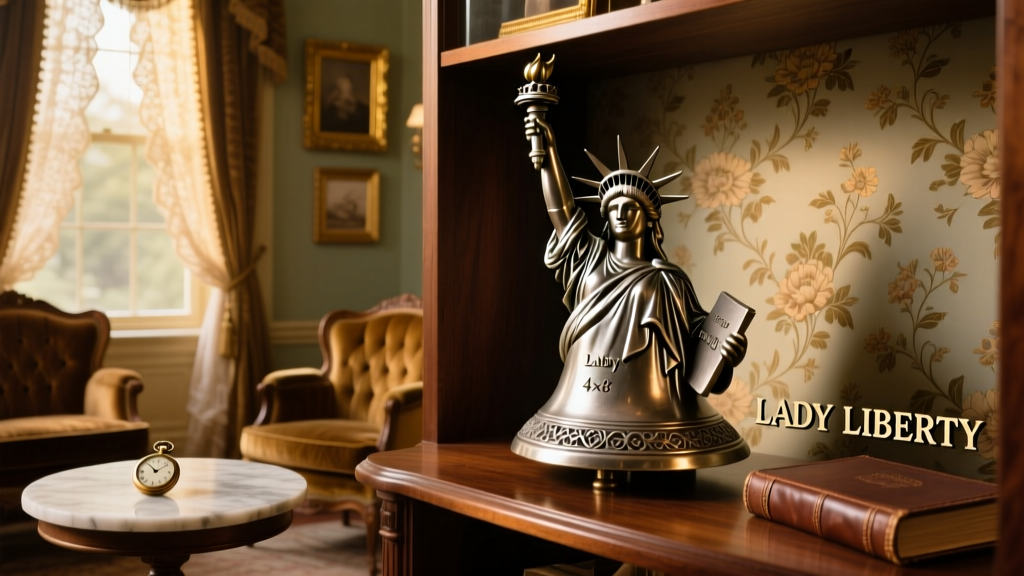
The Store Bell Lady Liberty Shape Nickel-Plated Cast Iron (4 × 8 In): History, Identification, and Restoration Guidelines
Decoding the 1131388: A Technical and Historical Analysis of the 1957 Baker Furniture Company 'Chippendale Revival' Mahogany Breakfront Bookcase

Bybee Pottery Matte Green Glaze Mug: Authenticity, Provenance, and Restoration Considerations for the 4¾" × 3¼" Example

Beehive Vase with Portrait of a Woman in Blue Gown: Identification, Provenance, and Conservation of the Center Reserve Marked 8½-Inch Example

Chrome-Lacquered Tea Cart: Design, Restoration, and Historical Context of the 25" × 22" Two-Tray Rolling Cart
The 1137639: A Deep Technical and Historical Analysis of the 1952 Knoll International Saarinen Tulip Table
Stoneware Canteen: Blue-White G.A.R. Encampment Davenport, Iowa, c. 1900 — A Historical and Technical Appraisal
Political Button Prohibition: National Promotion of America — A 2-Inch Collectible Artifact in Historical Context