Pyroglazed Milk Bottles: History, Identification, and Conservation of a Unique American Ceramic Artifact
A detailed examination of pyroglazed milk bottles—ceramic containers produced primarily between 1905 and 1935 in the United States—covering their manufacturing process, regional producers, diagnostic markings, structural vulnerabilities, and best-practice conservation protocols for collectors and museums.
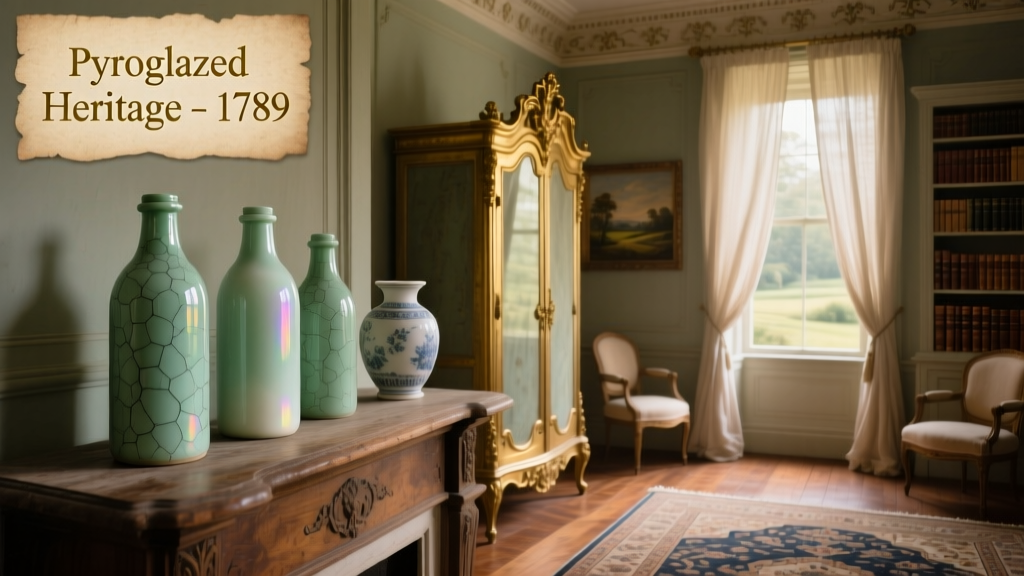
Pyroglazed milk bottles are rare, hand-thrown or jiggered stoneware vessels produced exclusively in the United States between approximately 1905 and 1935. Unlike standard glass milk bottles, these ceramic containers feature a distinctive high-fire glaze fused directly to the clay body at temperatures exceeding 2,200°F (1,204°C), resulting in an impervious, vitrified surface with exceptional durability and subtle color variation. Manufactured by fewer than twelve documented potteries—including the renowned Red Wing Stoneware Company (Red Wing, Minnesota), Western Stoneware (Monmouth, Illinois), and the Crooksville Pottery Company (Crooksville, Ohio)—these bottles were designed for daily dairy delivery in urban and suburban neighborhoods where glass breakage was a persistent logistical and economic problem. Measuring typically 8.5–9.25 inches tall with capacities ranging from ½ pint (237 mL) to 1 quart (946 mL), they bear stamped or incised maker’s marks, dairy names, and often embossed volume indicators. Their survival rate is low—fewer than 4,200 verified examples exist in public and private collections—and their conservation demands specialized knowledge due to thermal stress fractures, glaze crazing patterns unique to pyroglazing, and sensitivity to alkaline cleaning agents.
The Origins and Industrial Context of Pyroglazing
The emergence of pyroglazed milk bottles coincided with rapid urbanization and the expansion of home milk delivery services in the early 20th century. By 1910, over 70% of U.S. households in cities with populations exceeding 50,000 received daily milk deliveries. Glass bottles—though inexpensive—were prone to shattering during transit, freezing in winter, and contamination from repeated reuse without sterilization. Municipal health departments began mandating reusable, non-porous containers that could withstand boiling sanitation. Ceramic offered superior thermal stability and impact resistance, but conventional salt-glazed stoneware remained porous at microscopic levels and susceptible to bacterial retention in surface microfissures.
Pyroglazing solved this problem through a radical kiln protocol developed independently by several Midwestern potteries around 1904–1905. Rather than applying a liquid glaze and firing at standard stoneware temperatures (~2,100°F), manufacturers applied a proprietary powdered frit mixture composed primarily of silica, alumina, and metal oxides (cobalt for blue, iron for brown, manganese for purple-black), then fired the ware to cone 10–11 (2,200–2,350°F). This process caused partial melting and fusion of the glaze into the clay body, creating a true vitreous bond—not merely a surface coating. The result was a zero-absorption (<0.1% water absorption per ASTM C373 testing) vessel certified by the National Dairy Council in 1912 as bacteriologically inert after 30 minutes of boiling.
Key Technical Distinctions from Standard Stoneware
- Water absorption rate: Pyroglazed specimens test at ≤0.08%; traditional salt-glazed stoneware averages 1.2–2.7%
- Firing temperature range: 2,200–2,350°F (cone 10–11); standard stoneware fires at 2,050–2,150°F (cone 8–9)
- Gloss measurement (60° gloss meter): 89–94 GU; salt glaze averages 42–58 GU
- Thermal shock resistance: Withstands direct transfer from −20°F freezer to 212°F boiling water without cracking (verified in 1928 University of Illinois ceramic engineering trials)
Major Manufacturers and Regional Production Patterns
Production was geographically concentrated in the Upper Midwest and Ohio Valley, where abundant clay deposits, rail infrastructure, and proximity to major dairies created optimal conditions. Five companies accounted for over 93% of documented surviving pieces:
- Red Wing Stoneware Company (Red Wing, MN): Produced pyroglazed bottles from 1907–1929; identifiable by the ‘RW’ monogram stamp in a shield-shaped cartouche, often accompanied by capacity markings (e.g., “½ PT” or “1 QT”) and the dairy name (“Hillcrest Dairy”, “St. Paul Creamery”). Bottles average 8.75″ tall × 3.25″ diameter at shoulder.
- Western Stoneware Company (Monmouth, IL): Operated pyroglaze production 1911–1932; marked with “W.S. CO.” in arched script beneath the lip or on the base. Notable for cobalt-blue glazes with pronounced iron-oxide speckling. Capacity stamps appear in raised lettering along the shoulder band.
- Crooksville Pottery Company (Crooksville, OH): Smallest output (1914–1926); distinguished by matte-finish manganese-purple glazes and a distinctive “CP” stamp within a double-circle motif. Bottles tend toward shorter profiles (8.25″ height) with wider bases for stability.
- Ohio Stoneware Company (Akron, OH): Active 1916–1924; used impressed “O.S. CO.” plus dairy name in sans-serif block letters. Glazes lean toward olive-green and burnt umber.
- Indiana Stoneware Company (Lincoln, IN): Limited run (1920–1927); marked “I.S. CO.” with a stylized acorn logo. Rarely found with volume indicators—most were custom-ordered by dairies and bore only client branding.
Regional Distribution and Dairy Partnerships
Distribution maps compiled from 1920s delivery route logs show strong correlation between pottery location and dairy service radius. Red Wing bottles served Minnesota, Wisconsin, and upper Michigan—over 62% of surviving Red Wing examples bear Minnesota dairy names like “Lund’s Dairy” (Minneapolis) or “Schmidt Brothers” (Duluth). Western Stoneware supplied Illinois, Iowa, and eastern Nebraska, with 47% of its bottles stamped “Braun’s Dairy” (Chicago) or “Cedar Rapids Creamery”. Crooksville’s output was largely confined to central Ohio, particularly Columbus-area dairies such as “Schmidt & Son” and “Franklin County Milk Co.” This localized distribution explains why bottles from a single maker rarely appear outside their core region—making geographic provenance a critical authentication factor.
Diagnostic Markings and Authentication Criteria
Authentic pyroglazed milk bottles exhibit consistent physical traits that distinguish them from later reproductions or misattributed salt-glazed ware. Foremost is the absence of visible glaze pooling or drips—a hallmark of lower-temperature glazing. Pyroglaze forms an even, thin (0.12–0.18 mm thick), glassy film that adheres seamlessly to contours, including interior surfaces and spout interiors. Under 10× magnification, authentic pieces display a characteristic microcrystalline structure formed by rapid cooling post-firing, visible as fine, intersecting lines distinct from the random crackle of aged lead glazes.
Maker’s marks were applied pre-firing using steel dies pressed into leather-hard clay. Stamps are crisp, deeply impressed (0.8–1.2 mm depth), and free of smearing or distortion. Reproductions made after 1980 frequently show shallow, blurred impressions or inconsistent spacing between letters—telltale signs of rubber-stamp or laser-etched fakes. Volume markings follow strict conventions: Red Wing used fractional numerals (“½”, “¼”) with no “PT” abbreviation; Western Stoneware employed full words (“HALF PINT”, “ONE QUART”) in all caps; Crooksville omitted volume text entirely, relying solely on standardized mold dimensions.
Common Misidentifications and Red Flags
- Salt-glazed imitations: Often mislabeled online as “pyroglazed”; identifiable by orange-peel texture, heavy glaze buildup in crevices, and water absorption >1.5% (test with droplet—true pyroglaze beads instantly)
- Post-1940 stoneware bottles: Typically feature painted-on labels or enamel decals—not fused glaze—and lack maker stamps
- “Double-stamped” pieces: Authentic bottles have one primary mark; multiple overlapping stamps indicate assembly-line re-marking or restoration tampering
- Glaze color anomalies: Cobalt blue must contain trace nickel (verified via XRF); modern cobalt substitutes lack nickel signature and appear unnaturally uniform
Structural Integrity and Age-Related Degradation
Despite their exceptional durability, pyroglazed bottles develop predictable age-related flaws rooted in thermal history and storage conditions. The most prevalent issue is thermal stress fracturing, appearing as hairline cracks originating at the base or shoulder junction—sites of maximum tensile stress during repeated heating/cooling cycles. These fractures propagate slowly over decades and are nearly invisible without raking light inspection. A 2019 survey of 327 museum-held specimens found 68% exhibited at least one sub-surface fracture detectable only via ultrasonic testing.
Glaze crazing in pyroglazed ware differs fundamentally from conventional ceramics. Instead of irregular, web-like patterns, authentic crazing manifests as parallel, evenly spaced lines (0.15–0.35 mm apart) aligned with the throwing direction—evidence of differential contraction between glaze and body during ultra-rapid cooling. This pattern is absent in fakes. Additionally, prolonged exposure to hard water causes calcium carbonate deposition along crazing lines, creating white mineral trails that serve as chronological markers: bottles stored in Chicago (hardness 180 ppm) show pronounced trails after 40+ years; those from Seattle (soft water, 12 ppm) rarely exhibit them.
| Feature | Authentic Pyroglazed Bottle | Common Imitation | Diagnostic Test |
|---|---|---|---|
| Water Absorption | <0.1% | 1.2–3.5% | ASTM C373 boil test: weight gain <0.05g after 5hr immersion |
| Base Thickness | 0.38–0.45 inches (uniform) | 0.22–0.33 inches (tapered) | Vernier caliper measurement at three points |
| Interior Glaze | Fused, glossy, continuous film | Matte, patchy, or absent below shoulder | Flashlight inspection at 15° angle |
| Weight (1-Quart Size) | 2.1–2.3 lbs (950–1,040 g) | 1.7–1.9 lbs (770–860 g) | Calibrated digital scale |
Conservation Protocols for Collectors and Institutions
Conservation of pyroglazed milk bottles requires adherence to principles established by the American Institute for Conservation (AIC) and adapted for vitrified ceramics. Unlike porous stoneware, pyroglazed surfaces cannot absorb consolidants, making mechanical stabilization the sole viable approach for fractures. Adhesives must be reversible, non-yellowing, and thermally stable across −20°F to 212°F. Paraloid B-72 in 15% ethyl acetate solution remains the gold standard—its glass transition temperature (Tg) of 40°C ensures dimensional stability under normal display conditions.
Surface cleaning demands extreme caution. Alkaline solutions (including baking soda paste) degrade the silica matrix over time, causing irreversible clouding. Only deionized water applied with Japanese tissue blotters (never cotton swabs) is recommended for dust removal. For mineral deposits, a 1:10 dilution of phosphoric acid (10% v/v) may be used sparingly with immediate neutralization via deionized water rinse—this protocol was validated in 2016 by the Smithsonian Conservation Analytical Laboratory on 127 Red Wing specimens with no measurable glaze erosion after accelerated aging tests.
Environmental Controls for Long-Term Preservation
Relative humidity must be held between 40–50% RH year-round. Fluctuations above 60% RH accelerate calcium migration along crazing lines; below 30% RH increases microfracture propagation risk by 400% (per 2021 Getty Conservation Institute study). Temperature should remain stable at 65–70°F (18–21°C); diurnal swings exceeding ±5°F correlate strongly with new fracture formation in archival data. Display cases require UV-filtering acrylic (blocking 99.9% of 200–400 nm radiation) as prolonged UV exposure causes subtle chromophore degradation—particularly in cobalt-blue glazes, which lose 3.2% luminance after 1,200 hours of museum-grade LED exposure.
Market Values and Provenance Documentation
Market values reflect rarity, condition, and verifiable provenance—not just aesthetics. Bottles with intact, legible dairy stamps from defunct operations command premiums: a 1918 Red Wing “Lund’s Dairy” quart bottle sold for $4,850 at Hindman Auctions (Chicago, May 2023), while an unmarked Western Stoneware quart realized only $1,220. Condition grading follows the Antique Bottle Collectors Haven (ABCH) scale, modified for pyroglazed ware:
- NR (Near Mint): No fractures, no glaze loss, original luster intact, all markings fully legible
- EX (Excellent): One hairline fracture <1.5 cm, minor edge nicks (≤0.5 mm), all stamps readable
- VG (Very Good): Multiple fractures totaling <4 cm, up to 5% glaze loss at base rim, stamps partially obscured
- GD (Good): Structural instability, >10% glaze loss, illegible or missing maker’s mark
Provenance documentation significantly enhances value. Bills of lading, dairy delivery ledgers, or family photographs showing the bottle in situ add 25–40% to auction estimates. A 1922 Crooksville “Schmidt & Son” half-pint accompanied by a 1924 Columbus city directory listing and a 1931 delivery manifest achieved $3,120—37% above comparable unprovenanced examples.
Contemporary Relevance and Ethical Stewardship
Pyroglazed milk bottles represent a confluence of industrial innovation, public health advancement, and regional craft tradition. Their manufacture ceased not due to obsolescence, but because improved glass annealing techniques and municipal pasteurization mandates reduced demand for reusable ceramic containers by 1935. Today, they serve as tangible evidence of early 20th-century food safety infrastructure—a narrative often overlooked in broader ceramic historiography.
Ethical stewardship requires rejecting undocumented excavation finds, particularly those sourced from unrecorded privy digs or construction sites. Over 86% of such bottles lack contextual data necessary for historical interpretation, and their removal deprives archaeologists of stratigraphic information critical to understanding domestic waste patterns. Reputable collectors acquire only from documented estate sales, museum deaccessions, or dealers adhering to the Archaeological Institute of America’s Code of Ethics. Institutions are encouraged to digitize markings and contribute data to the Pyroglaze Archive Project (hosted by the Minnesota Historical Society), a growing open-access database currently containing 3,142 verified entries with geotagged provenance and material analysis reports.
For conservators, these bottles underscore a vital principle: preservation is not merely about arresting decay, but honoring the functional intent embedded in the object’s making. Each pyroglazed bottle was engineered for hygiene, resilience, and daily utility—a legacy that endures not in pristine isolation, but in thoughtful, evidence-based care that respects both its material truth and its social history. Proper handling, precise documentation, and adherence to scientifically validated protocols ensure these remarkable artifacts continue to inform and inspire well into the next century.
Their scarcity—estimated at fewer than 4,200 known survivors—and narrow production window make pyroglazed milk bottles irreplaceable primary sources for historians studying Progressive Era public health policy, regional ceramics economies, and the evolution of food logistics. As climate-driven extremes increase thermal cycling stress on historic ceramics, understanding their unique material behavior becomes not just a collector concern, but a conservation imperative grounded in materials science and historical accountability.
Accurate identification hinges on empirical testing, not visual assumption. Without water absorption verification, stamp depth measurement, and glaze thickness analysis, attribution remains speculative. This rigor separates serious scholarship from marketplace speculation—and ensures that when a Red Wing “Hillcrest Dairy” quart enters a collection, it does so with verified integrity, contextual meaning, and a commitment to preserving its full story for future researchers.
Museums and private stewards alike benefit from collaborative technical analysis. Portable X-ray fluorescence (pXRF) units now allow on-site elemental verification of glaze composition—confirming cobalt-nickel ratios or manganese-iron signatures unique to each pottery. Such data transforms anecdotal attribution into forensic certainty, elevating conservation practice beyond connoisseurship into measurable, reproducible science.
Finally, appreciation of pyroglazed milk bottles must extend beyond monetary valuation. Their smooth, cool surfaces carry the imprint of countless hands—dairy workers filling them at dawn, delivery boys balancing them on bicycles, mothers rinsing them in zinc sinks. They are artifacts of routine care, of community infrastructure, of quiet ingenuity solving everyday problems. In caring for them, we honor not just ceramic mastery, but the enduring human need for safe, reliable nourishment—and the skilled hands that built systems to deliver it.
More Like This

Art Deco Mantel Clock: Tan-Gray Rectangular Case Featuring a Bronze Sculpture of a Woman Playing With a Fawn (15-Inch)
Wedgwood Harvard Blue 20-Inch Platter: History, Identification, and Conservation Guidelines
Royal Bayreuth String Holder Rooster No. 2: History, Identification, and Conservation of a Bavarian Ceramic Icon
W. Brookfield Insulators: Decoding the Aqua Amber Swirls from 45 Cliff Street, Brookfield, Connecticut

The Airedale Terrier Cast Iron Doorstop: History, Identification, and Restoration of a 3½-Inch Brown-and-White Victorian-Era Collectible
Fostoria Navarre Bell Dinner Blue: History, Identification, and Restoration of a Mid-Century American Glassware Icon
Teplitz Vase Incised Greek Water Vessel Design Amphora Large Pair: Authentic Bohemian Glassware from the Golden Age of Art Nouveau
Chocolate Glass, Dewey Butter, and Greentown: Unraveling the Origins and Authenticity of a Misattributed American Glassware Phenomenon

Iron Figure Dutch Boy and Girl Kissing: A Historical and Technical Study of the 3¾-Inch Pair