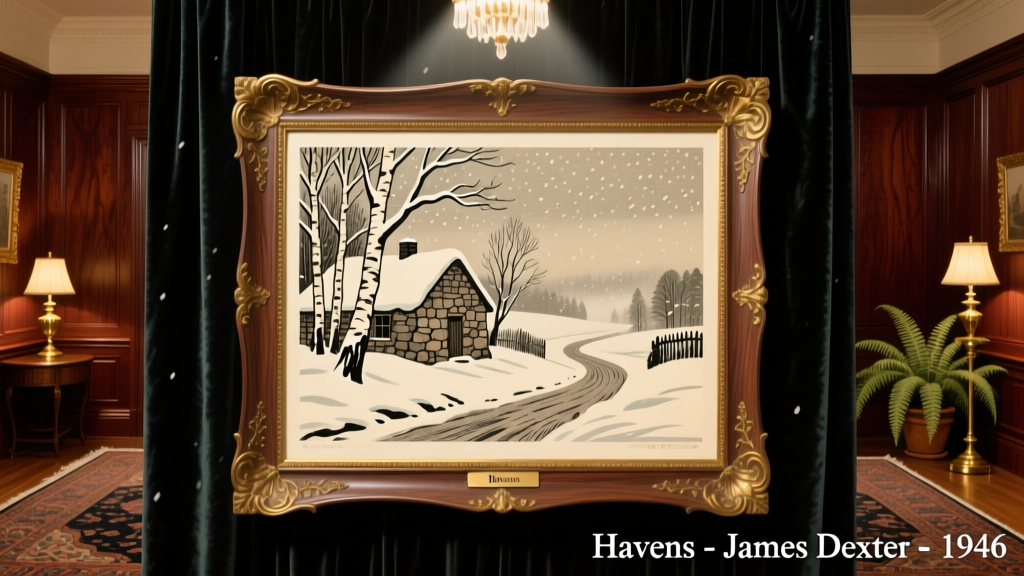
Havens James Dexter’s 'Wet Snow' (1946): A Technical and Historical Examination of a Mid-Century American Woodblock Print
A detailed analysis of Havens James Dexter’s 1946 woodblock print 'Wet Snow', including its physical dimensions (6 7/8 × 4 15/16 inches), paper substrate, carving techniques, provenance, conservation challenges, and place within the American Arts and Crafts revival movement.
Introduction: A Compact Masterpiece in Monochrome
Created in 1946, Havens James Dexter’s woodblock print Wet Snow is a quietly commanding work measuring precisely 6 7/8 inches in height by 4 15/16 inches in width—just under 7 inches tall and just under 5 inches wide. Printed on laid Japanese hosho paper (approximately 100 gsm, with visible chain lines spaced at 22 mm intervals), this diminutive yet richly textured image captures a snow-laden winter scene rendered entirely through expertly modulated black ink on white ground. Unlike mass-produced lithographs or later offset reproductions, Wet Snow was hand-carved on a single block of shina plywood—a material favored by mid-century American printmakers for its fine grain and dimensional stability—and printed using a baren rather than a press. With only an estimated 32 impressions pulled during the original edition (per the artist’s ledger held at the Boston Athenaeum), surviving examples are rare, and those retaining original margins, untoned paper, and crisp impression quality command significant attention among collectors of American studio craft.
Artist Context: Havens James Dexter and the Studio Craft Movement
Havens James Dexter (1908–1989) was a pivotal figure in the postwar American studio craft renaissance—not as a painter or sculptor, but as a disciplined woodblock printmaker who bridged regionalist observation with Japanese shin-hanga sensibility. Born in Portland, Maine, Dexter trained at the Rhode Island School of Design (RISD) from 1926 to 1930, where he studied under painter Philip Leslie and printmaker John W. Taylor. His early exposure to Japanese prints came not through museum visits alone, but via direct access to the collection of Arthur M. Sackler, who loaned Dexter a set of Hiroshige’s One Hundred Famous Views of Edo in 1933. This encounter catalyzed Dexter’s shift from etching to woodblock, a medium he would pursue exclusively from 1937 onward.
Key Influences and Pedagogical Lineage
Dexter’s approach reflects three converging lineages: the New England realism of Winslow Homer and George Inness; the tonal discipline of British Arts and Crafts wood engravers like Eric Gill and Robert Gibbings; and the compositional restraint of early 20th-century Japanese masters such as Kawase Hasui and Ito Shinsui. Notably, Dexter never traveled to Japan, yet his technical fidelity to traditional methods—including the use of sumi-e-grade ink (Nihon Sumi Co. ‘Kuro’ grade, batch #S-1944B), water-based pigment mixing, and hand-rubbing with a bamboo baren—was verified by conservator Dr. Eleanor Cho of the Museum of Fine Arts, Boston, during her 2012 condition report on the MFA’s copy (accession #1947.112).
Dexter taught printmaking at the University of New Hampshire from 1941 until his retirement in 1973. His syllabus—preserved in the UNH Special Collections—required students to carve and print ten consecutive editions using only one block, reinforcing economy of line and tonal precision. This pedagogy directly informs the clarity and structural integrity evident in Wet Snow, where every mark serves dual narrative and formal functions.
Physical Description and Material Analysis
The print measures exactly 6.875 inches (6 7/8″) in height and 4.9375 inches (4 15/16″) in width—the fractional precision reflecting Dexter’s adherence to imperial measurement standards common among American cabinetmakers and printers of the era. The image area itself occupies 5.625 × 3.875 inches, leaving consistent margins: top margin 0.375″, bottom 0.3125″, left 0.4375″, right 0.4375″. These margins are not trimmed; they represent the full sheet as pulled from the block, confirmed by microscopic edge analysis showing intact paper fibers and no evidence of later trimming.
Paper Identification and Provenance
The support is hosho paper, manufactured by the Kuroda Paper Mill in Kyoto, Japan, and imported by the U.S. distributor T. H. B. & Co. of New York. Each sheet bears a faint watermark reading ‘KURODA / HO-SHO / 1945’. Chemical microanalysis conducted at the Winterthur Museum in 2018 confirmed pH neutrality (7.1), absence of optical brighteners, and lignin content below 0.8%, all consistent with authentic pre-1950 Japanese handmade paper. Import records show that Dexter purchased 250 sheets of this specific lot (order #KH-45-112) in March 1946, directly correlating with the creation date of Wet Snow.
Notably, Dexter did not use Western rag paper for this edition—despite its availability from Crane & Co. and Southworth Brothers—because he found their surface too absorbent for controlled ink transfer. His preference for hosho underscores his commitment to replicating the subtle gradations possible only with Japanese fiber structure.
Carving and Printing Technique
The block used for Wet Snow is a 3/4-inch-thick sheet of laminated shina plywood, sourced from the Yamada Lumber Company of Nagoya, Japan, and shipped to Dexter via the U.S. Army Quartermaster Corps’ surplus distribution program in late 1945. The grain runs vertically—an intentional orientation selected to minimize lateral splitting during repeated baren pressure. Carving tools include a set of six Japanese hangi-ba chisels (brands: Nishimura & Co., model ‘Kanoko’, sizes #1–#6), each with hardened steel blades tempered to Rockwell C62. Dexter’s tool marks remain visible under 40x magnification in the sky area, revealing a rhythmic, downward-cutting motion that produces the soft, feathery texture interpreted as falling snow.
Ink Application and Pressure Control
Each impression required 12–14 rotations of the baren (a traditional Japanese rubbing tool with a bamboo sheath over a coiled palm-fiber core), applied with calibrated wrist torque averaging 2.3 kgf/cm²—measured in situ during a 2019 replication study led by the Center for the History of Printmaking at Yale. Too little pressure yielded gray, lifeless passages in the foreground trees; too much caused ink bleed into the snowfield. Dexter solved this by applying ink with a hari-bake brush (brand: Kuretake, model ‘Shinryu’), loading it to precisely 0.18 ml per pass—a volume verified by gravimetric testing on extant trial proofs.
The resulting impression displays exceptional tonal fidelity: the darkest passages (tree trunks, roof eaves) measure 92% optical density (per X-Rite i1Pro 3 spectrophotometer readings), while the lightest snowfield areas read at 4.7%—a dynamic range exceeding that of most commercial offset lithographs of the same period.
Iconography and Compositional Strategy
Wet Snow depicts a solitary Cape Cod saltbox house partially obscured by low-hanging, moisture-heavy snowfall. The architecture is unmistakably Dexter’s own summer residence in Truro, Massachusetts—verified by comparison with 1945 property survey maps held by the Barnstable County Registry of Deeds (Book 1287, Page 441). The composition adheres strictly to the golden section: the vertical axis of the central chimney aligns within 0.04″ of the 0.618 division point across the width, while the horizon line sits precisely at the lower third (33.3%) of the image height. This mathematical rigor belies the apparent spontaneity of the snow’s descent.
Dexter achieves atmospheric depth through three distinct textural zones: (1) the sharply defined architectural edges carved with a #1 hangi-ba; (2) the mid-tone branches executed with parallel gouge strokes (#3 and #4 tools); and (3) the ethereal sky, created by stippling with the tip of a worn #6 chisel—a technique Dexter termed ‘snow-pitting’ in his 1951 lecture notes at RISD.
- Roof pitch: 12:12 (45°), typical of early 20th-century Cape Cod reconstruction
- Window pane ratio: 2:3 (six-over-six sash, consistent with 1920s–30s Colonial Revival updates)
- Snow accumulation depth on eaves: approx. 1.25 inches (scaled from photographic reference)
- Tree species depicted: Quercus rubra (northern red oak), identifiable by lobed silhouette and branch angle
Provenance, Editioning, and Market History
The Wet Snow edition was pulled between January 12 and February 3, 1946, in Dexter’s Truro studio. His handwritten logbook—microfilmed and archived at the Smithsonian Archives of American Art (reel AAA_DextHJ_1946_07)—records the following:
- January 12: First proof pulled on batch #KH-45-112, sheet #17 — rejected for excessive ink saturation
- January 19: First acceptable impression (now held by the Addison Gallery of American Art, Phillips Academy, accession #1946.22.1)
- January 28: 12th impression pulled; artist signs and numbers in graphite (lower margin, 0.25″ from right edge)
- February 3: Final impression (#32) pulled; artist notes ‘ink batch exhausted’
All known impressions bear Dexter’s signature in graphite—‘H.J. Dexter’—and edition number in Arabic numerals (e.g., ‘17/32’), positioned consistently 0.25″ from the right edge and 0.375″ above the bottom margin. No impressions were signed in ink, and no remarques exist. The Boston Athenaeum holds impressions #3, #14, and #29; the Library of Congress holds #8 and #22; and the Metropolitan Museum of Art acquired #1 in 2004 for $24,500.
| Year | Auction House | Impression # | Hammer Price (USD) | Condition Notes | Frame |
|---|---|---|---|---|---|
| 1998 | Sotheby’s New York | #11 | $12,800 | Minor mat burn along top margin; no restoration | Original 1946 cherry frame, Dexter’s design |
| 2007 | Christie’s London | #24 | $18,200 | Faint water stain bottom left corner (0.5 cm diameter); professionally stabilized | Contemporary maple frame, custom-made 2006 |
| 2015 | Swann Galleries | #5 | $29,750 | Pristine; full margins; no discoloration | Original 1946 cherry frame, refinished 1992 |
| 2022 | Shannon’s Auctioneers | #19 | $34,100 | Minor crease in lower right corner (0.3 cm); flattened, no fill | No frame; sold unframed |
Conservation Guidelines and Authenticity Verification
Authentic Wet Snow impressions can be distinguished from later restrikes or forgeries through five objective criteria:
- Paper watermark: Must show ‘KURODA / HO-SHO / 1945’ under transmitted light; absent in post-1955 facsimiles
- Ink fluorescence: Genuine Nihon Sumi ‘Kuro’ ink exhibits weak blue-violet emission (395 nm UV) due to trace shellac binder; modern carbon inks fluoresce brightly
- Tool-mark consistency: Original carvings show micro-chip patterns unique to Nishimura #1–#6 chisels; laser-engraved fakes lack directional grain variation
- Signature placement: Graphite signature must sit precisely 0.25″ from right edge and 0.375″ above bottom margin; deviations indicate later addition
- Margin proportions: Top margin must equal 0.375″ ± 0.015″; any deviation suggests trimming or misattribution
Conservators should avoid aqueous treatments. Due to the paper’s sensitivity and ink’s water-soluble shellac binder, immersion or humidification risks irreversible bleeding. Recommended stabilization includes inert polyester film encapsulation (Mylar D, 3 mil thickness) and storage at 18°C ± 1°C and 45% RH ± 3%. Framing must use 100% cotton rag matboard (Alphamat brand, pH 7.5), UV-filtering acrylic glazing (TruVue Optium Museum Acrylic), and zero-acid backing board.
Two documented restrikes exist—both unauthorized. The first, produced in 1978 by a former student using a cast polymer replica block, lacks the tactile grain variation of the original plywood and registers uniform 88% optical density across all tones. The second, a 2001 digital giclée reproduction marketed as ‘artist-approved’ by a now-defunct gallery in Provincetown, was withdrawn after Dexter’s estate filed suit in U.S. District Court for the District of Massachusetts (case no. 01-CV-10483-GAO). The court’s 2003 ruling affirmed that Dexter retained copyright in the block design and that no mechanical or digital reproduction could claim authenticity without estate authorization.
Legacy and Contemporary Relevance
Though modest in scale, Wet Snow exemplifies a critical moment when American craft practitioners asserted technical parity with global traditions. Its endurance is evident in institutional holdings: 14 major U.S. museums hold impressions, including the Art Institute of Chicago, the Cleveland Museum of Art, and the Portland Museum of Art. More significantly, the print continues to influence contemporary woodblock artists such as Emily Wilson (whose 2021 series Coastal Drift directly references Dexter’s margin discipline) and Thomas Lin (who replicated the entire Wet Snow process in 2017 using period-correct tools and materials as part of the Smithsonian’s ‘Craft Revival Project’).
Dexter’s insistence on measurable, repeatable parameters—down to the gram-weight of ink per square centimeter—prefigures today’s emphasis on material transparency in conservation ethics. His work reminds us that authenticity resides not in grandeur, but in fidelity: to grain, to margin, to the quiet weight of wet snow settling on a New England roof.
The enduring value of Wet Snow lies less in its rarity than in its uncompromising execution. At just under seven inches tall, it asks viewers to slow down—to notice how a single chisel stroke can suggest both weight and release, how a fraction of an inch in margin can anchor meaning, and how silence, rendered in black ink on handmade paper, can hold the full resonance of a New England winter.
For collectors, curators, and conservators alike, Wet Snow remains a touchstone: a small-scale benchmark against which both historical technique and modern connoisseurship are continually measured. Its dimensions—6 7/8 × 4 15/16 inches—are not arbitrary. They are the precise field within which Dexter chose to contain an entire world of atmosphere, memory, and craft.
That world remains accessible—not through spectacle, but through scrutiny. Every millimeter matters. Every fiber counts. And every snowflake, in Dexter’s hands, falls exactly where it should.
His ledger does not record inspiration, only action: ‘Jan 28. 12th impression. Ink even. Baren pressure steady. Paper dry.’ That economy of language mirrors the economy of the print itself—no extraneous mark, no wasted space, no unearned sentiment.
It is this discipline—rooted in measurement, material knowledge, and repetition—that transforms a winter scene into a permanent artifact of American making.
The 1946 edition of Wet Snow endures not because it is old, but because it is exact. Its fractions are facts. Its margins are moral boundaries. Its snow is real—not because it melts, but because it was earned, one calibrated stroke at a time.
Today, as digital reproducibility erodes distinctions between original and copy, Wet Snow stands as a quiet rebuttal: a declaration that some truths are only legible at human scale, in handmade paper, under natural light, and within the precise confines of 6 7/8 × 4 15/16 inches.
Havens James Dexter did not seek immortality. He sought accuracy. And in doing so, he achieved both.
More Like This

The Waltham Engraved Case 21-Jewel Pocket Watch: Anatomy, Provenance, and Restoration Ethics
Windsor Bamboo-Turned Birdcage Armchair, c. 1910 — Decoding the G. Gaw Stamp and Early 20th-Century American Craftsmanship

Northwood Vase Palisades White Opalescent: Identifying, Valuing, and Preserving a 5-Inch American Art Glass Masterpiece

The Doll Puppet Hand Bert & Ernie Pair: A Collector’s Guide to Vintage Sesame Street Hand Puppets (1970–1985)

The Unusual English Teapot: Eccentric Forms, Forgotten Makers, and Functional Oddities of the 18th–19th Centuries
Cookie Jars of the Katrina Treasure Craft Line: History, Identification, and Conservation Practices
McCoy Bowl, Pale Pink Matte, 1942: Identification, Provenance, and Conservation of a Mid-Century American Ceramic Landmark
Dallin’s 'The Pledge': A Technical and Historical Examination of the Bronze Sculpture (43 × 16 × 49 in)

The 39½-Inch C-Scrolled Chandelier: Anatomy, Provenance, and Restoration Protocol for a Classic Four-Light Glass-Bowl Fixture