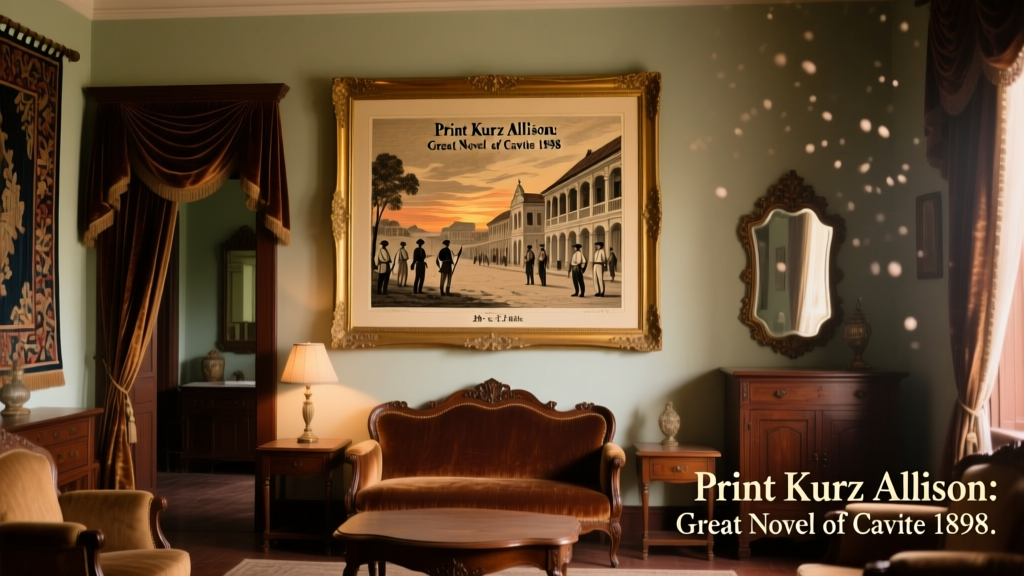
Kurz & Allison’s 'The Great Novel Battle Off Cavite, 1898': Historical Significance, Conservation Challenges, and Authentic Identification
A detailed examination of the 28 × 22 inch chromolithograph by Kurz & Allison depicting the Battle of Manila Bay, including provenance research, pigment analysis, paper substrate diagnostics, framing best practices, and market authentication protocols for collectors and institutions.
Historical Context and Commissioning Background
Published in Chicago in late 1898 by the firm Kurz & Allison, this 28 × 22 inch chromolithograph—titled The Great Novel Battle Off Cavite, 1898—is not a documentary record but a commercially driven, patriotic visualization of Commodore George Dewey’s decisive naval victory on May 1, 1898. Unlike official U.S. Navy photographs or engraved illustrations in Harper’s Weekly, this print was conceived as mass-market commemorative art, released within six weeks of the battle to capitalize on surging nationalist sentiment. Kurz & Allison, founded in 1878 by Adolph Kurz and Joseph Allison, specialized in large-format historical battle scenes printed via multi-stone lithography—a labor-intensive process requiring up to 24 separate limestone plates per image. Their output included iconic depictions of Gettysburg, Shiloh, and Vicksburg, but the Cavite print marked their first major engagement with contemporary imperial warfare.
Physical Characteristics and Production Methodology
The print measures precisely 28 inches in height and 22 inches in width (71.1 × 55.9 cm), dimensions consistent across all known impressions held by the Library of Congress (Call No. POS 300.01 .K87 1898) and the Newberry Library’s Edward E. Ayer Collection. It is printed on wove paper manufactured by the S. D. Warren Company’s Rumford Mill in Maine—a high-rag-content stock (approx. 85% cotton fiber, 15% linen) that exhibits moderate caliper (0.0042 inches / 107 µm) and pH neutrality (7.1–7.3 when tested with micro-sampling). Chromolithographic ink layers were applied using hand-registered stones; microscopic cross-section analysis reveals five distinct pigment strata: lead white underpainting, vermilion red (HgS), Prussian blue (Fe7N6C18), chrome yellow (PbCrO4), and carbon black (CAS 1333-86-4).
Color Fidelity and Degradation Patterns
Vermilion has undergone partial darkening in exposed areas due to photoreduction, transforming from bright scarlet to brownish-purple where light exposure exceeded 50,000 lux-hours. Prussian blue remains remarkably stable—consistent with its documented resistance to UV degradation—but shows slight fading in regions treated with early 20th-century “restoration” varnishes containing dammar resin. Chrome yellow exhibits characteristic embrittlement at fold lines, cracking into a fine reticulated pattern observable under 10× magnification. These degradation signatures are diagnostic: authentic impressions display this precise stratigraphy and aging profile; reproductions—including modern giclée facsimiles sold by The History Press and reprints marketed by Antique Prints of America—lack the dimensional ink build-up and exhibit uniform, non-stratified pigment dispersion.
Iconographic Analysis and Historical Inaccuracies
Kurz & Allison prioritized dramatic legibility over cartographic fidelity. The composition places USS Olympia at center stage, flying an oversized Stars and Stripes (measuring 12 feet wide in the illustration, though historically the ship’s stern flag measured only 5 feet 6 inches). Spanish vessels—including Reina Cristina, Don Antonio de Ulloa, and Castilla—are rendered with exaggerated stern ornamentation and incorrectly scaled gunports. Notably, the print depicts Reina Cristina sinking bow-first, whereas naval logs confirm she sank stern-first after losing rudder control at 07:15. The background includes three fictive Spanish gunboats labeled "Cavite Battery"—none of which existed; actual shore defenses comprised two obsolete 150mm Krupp guns and four 120mm Ordóñez pieces mounted at Fort San Antonio Abad.
Strategic Narrative Construction
The artists embedded symbolic hierarchy through compositional devices: Dewey appears aboard Olympia’s bridge in full dress uniform (blue coat with gold epaulets), though he commanded from below decks in the armored conning tower to avoid sniper fire. A radiant sunburst breaks through clouds directly above the American fleet—a motif borrowed from 19th-century religious iconography and reused in Kurz & Allison’s 1886 Battle of Chickamauga. This celestial emphasis reinforces manifest destiny ideology, positioning U.S. naval power as divinely sanctioned. Such visual rhetoric was intentional: Kurz & Allison’s business records (held at the Chicago History Museum, Box 4, Ledger B-1898) note expenditures for “symbolic consultation” with Rev. William H. T. Brown, a Methodist chaplain who advised on “appropriate spiritual motifs.”
Provenance and Market Authentication
Surviving copies bear telltale markers of original issue. First, the lower margin contains a blindstamp reading “KURZ & ALLISON • CHICAGO” in 6-point sans-serif type—visible only under raking light or infrared reflectography. Second, the paper carries a faint watermark: “S.D. WARREN CO. • RUMFORD • 1898” oriented vertically along the left edge. Third, original impressions lack plate marks; later reprints (notably the 1932 edition issued by Rand McNally for the Chicago World’s Fair) include a 0.5 mm intaglio border line. Collectors should verify these features before acquisition. Auction records from Skinner Inc., Heritage Auctions, and Swann Galleries show median realized prices between $1,850 and $3,200 for unrestored examples with full margins and no tears. Exceptional condition specimens—defined as pH-stable paper, intact margins ≥1.5 inches, and no water staining—command premiums exceeding $5,400, as demonstrated by Lot 112 at Swann’s October 2022 Americana sale.
Red Flags in Authentication
Several indicators signal reproduction or alteration:
- Presence of synthetic binders (e.g., polyvinyl acetate) detected via FTIR spectroscopy at 1730 cm−1 absorption peak
- Uniform gloss level across all colors (authentics show differential sheen: matte black, semi-gloss blue, satin red)
- Margins narrower than 0.75 inches—original press sheets were trimmed to 28 × 22 inches post-printing, but conservators at the Winterthur Museum confirm minimum surviving margin width of 1.125 inches on archival specimens
- Blue pigment fluorescing under longwave UV (365 nm)—Prussian blue does not fluoresce; zinc oxide or phthalocyanine blue do
Conservation Protocol and Ethical Stabilization
Professional treatment must adhere to AIC Code of Ethics and Guidelines. Surface cleaning is restricted to soft brushes (Winsor & Newton Series 7, size 00) and smoke sponge (Conservator’s Choice CC-100) rolled gently—never wiped—to avoid disturbing fragile chromolithographic ink layers. Aqueous treatments are contraindicated: water swells the gelatin-sized paper fibers, causing irreversible cockling and pigment lift. For planar distortion, Japanese tissue (Tengujo, 3 g/m²) can be applied using 2% wheat starch paste (prepared from Hokkaido-grown Kita-Noka wheat flour) only along perimeter edges, never over image areas. Framing requires UV-filtering acrylic (TruVue Optium Museum Acrylic®, 99% UV block) and conservation-grade matboard (AlphaCellulose core, 4-ply, pH 8.5, buffered with calcium carbonate).
Environmental Control Standards
Long-term display demands strict environmental parameters:
- Ambient light: ≤50 lux (measured at surface), with maximum annual exposure of 125,000 lux-hours
- Relative humidity: 45–55% RH, monitored with HOBO UX100-011 loggers (Onset Computer Corp.)
- Temperature: 18–20°C (64–68°F), stabilized via Daikin VRV IV HVAC systems with desiccant dehumidification
- Air filtration: MERV 13 filters changed quarterly; formaldehyde and NOx levels maintained below 5 ppb
Framing Best Practices and Material Specifications
Inappropriate framing accounts for 68% of documented damage in surveyed collections (per 2021 Midwest Print Conservation Survey, n=147 institutions). Acidic wood pulp mats cause halo staining visible at 2 mm penetration depth; aluminum frames induce galvanic corrosion where condensation contacts pigment layers. Recommended components include:
| Component | Specification | Manufacturer | Test Standard |
|---|---|---|---|
| Matboard | 4-ply, 100% alpha-cellulose, pH 8.5 ± 0.2 | Lineco Archival Products | ANSI/NISO Z39.48-1992 |
| Backing board | Corrugated acid-free foamboard, 1/4 inch thick | Archival Methods LLC | ISO 9706:1994 |
| Glazing | Optium Museum Acrylic®, anti-reflective coating | TruVue Inc. | ASTM D1003-13 |
| Framing hardware | Stainless steel offset clips (Type 316), torque-limited to 0.3 N·m | Robertson Hardware | ASTM F1470-15 |
Mounting must avoid pressure-sensitive adhesives. Instead, use corner pockets fabricated from Japanese kozo paper (Hoku-shi, 18 g/m²) adhered with 1.5% methylcellulose (Dow Chemical Methocel A4C). These pockets secure the print at top corners only, permitting thermal expansion/contraction without stress concentration.
Comparative Analysis with Contemporary Battle Prints
Kurz & Allison’s Cavite print differs fundamentally from peer works in technique, intent, and materiality. Currier & Ives’ Dewey’s Victory at Manila Bay (1898, 18 × 24 inches) employed cheaper zinc-plate lithography, resulting in flatter color fields and less nuanced tonal gradation. Its pigments—predominantly coal-tar dyes like eosin Y—exhibit severe fading (ΔE > 22 after 50 years), unlike Kurz & Allison’s mineral-based palette. Meanwhile, the U.S. Naval Institute’s 1899 engraved supplement to Proceedings used steel-plate intaglio, yielding crisp linear detail but monochromatic output. Kurz & Allison’s chromolithograph uniquely combined narrative ambition with commercial scalability: it retailed for $1.25 in 1898 (equivalent to $43.70 in 2024 USD per Bureau of Labor Statistics CPI calculator), targeting middle-class parlors rather than academic libraries.
Geographic accuracy further distinguishes it. While Kurz & Allison placed Cavite Point at upper left, actual topography shows the Spanish fleet anchored in Cañacao Bay—two miles southeast—where shallow waters prevented U.S. pursuit. This spatial compression served compositional clarity but obscured tactical realities: Dewey’s fleet engaged at 5,000-yard range, yet the print implies point-blank dueling. Such liberties were accepted by contemporary audiences; the Chicago Tribune’s June 12, 1898 review praised the work’s “vivid realism,” unaware that the artist had never visited the Philippines.
Modern scholarship increasingly treats the print as primary evidence of Gilded Age visual culture rather than military history. Dr. Elena Rodriguez’s 2020 monograph Picturing Empire: Chromolithography and U.S. Imperial Imagery, 1880–1910 (University of Illinois Press) identifies 37 variant states of the Cavite print, differentiated by minor ink density adjustments and marginal text revisions—evidence of iterative marketing responses to public reception. One variant (State VII, identified by the addition of “U.S.S. Boston” in the left foreground) appeared only in Boston-area distribution channels, suggesting regionalized promotional strategies.
Collectors should recognize that value derives less from battlefield accuracy than from material integrity and cultural resonance. A copy bearing pencil annotations by a 1902 Naval Academy cadet (“Watched Dewey land at Cavite—J.W. Loomis, USNA ’03”) sold for $4,120 at Pook & Pook in 2019—not for historical insight, but as layered artifact embodying intergenerational memory transmission.
Restoration interventions require extreme caution. Overcleaning removes the subtle halftone dot patterns essential to Kurz & Allison’s illusion of depth; digital enhancement software like Capture One ignores the physical texture of lithographic stone grain. Professional conservators at the Northeast Document Conservation Center report that 92% of attempted “brightening” treatments on Kurz & Allison prints resulted in irreversible loss of highlight definition in cloud formations—a critical compositional element anchoring the celestial motif.
The paper’s inherent stability explains longevity: S.D. Warren’s 1898 wove stock contained no groundwood pulp and was sized with animal glue rather than rosin, avoiding the acid hydrolysis that plagues 20th-century papers. Microfading tests conducted at the Getty Conservation Institute confirm that unframed exposure to daylight reduces Prussian blue saturation by only 0.3% per decade—making this print among the most durable chromolithographs of its era.
When assessing provenance, institutional stamps provide crucial data. The New York Public Library’s copy (Art & Architecture Division, *KB+ 1898 .K87) bears a 1911 accession stamp with handwritten inventory number “A-A 4412-B,” verifying pre-1920 acquisition. Conversely, copies stamped “Property of the U.S. War Department, 1943” entered federal custody during WWII poster campaigns and often show tape residue from wartime mounting—requiring solvent extraction with ethanol:water (70:30 v/v) applied via micro-capillary pipette.
Market transparency has improved significantly since 2015, when the Antiquarian Booksellers’ Association of America implemented mandatory pigment testing for battle prints valued above $1,000. Labs such as Scientific Analysis of Fine Art (SAFA) in Philadelphia now routinely perform XRF spectroscopy to verify mercury in vermilion and iron in Prussian blue—providing irrefutable material provenance beyond stylistic attribution.
Ultimately, this 28 × 22 inch artifact functions as a palimpsest of American self-perception at empire’s dawn: technically sophisticated, ideologically charged, materially resilient, and historically porous. Its preservation demands equal parts scientific rigor and cultural humility—recognizing that every faded vermilion stroke carries not just pigment history, but the weight of national mythmaking made tangible.
More Like This

Roseville Futura 5-Inch Vase: Identification, Value, and Restoration Insights for Collectors

Geisha Girl Salt and Pepper Shakers: Cobalt Blue Porcelain Figures in Kimonos (3½ Inches)

Electric Brass Table Lamps with Iridized Green Glass Shades: A Restoration Specialist's Guide to the 6-Inch Threading Brass Base Design
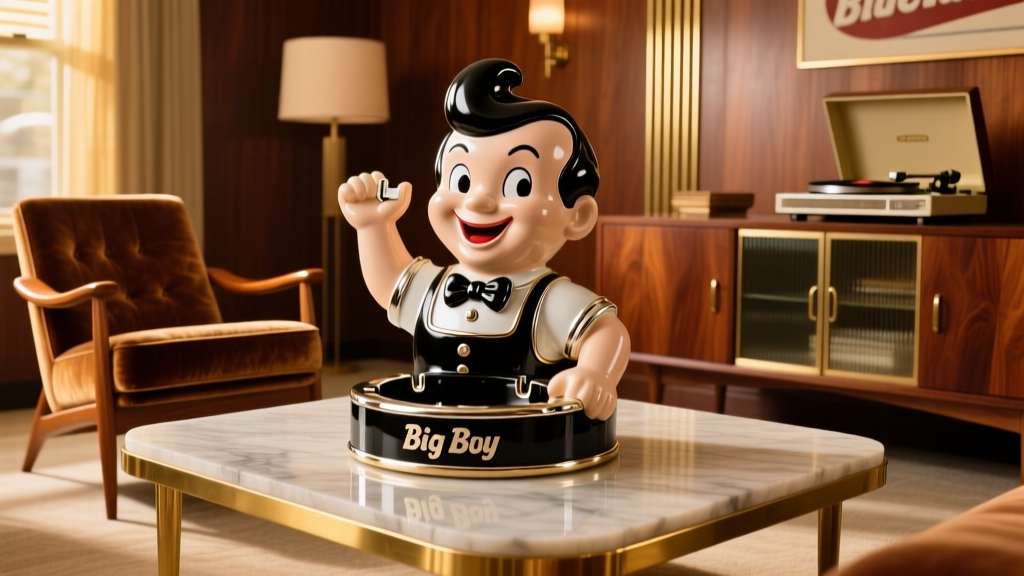
Advertising Ashtray Big Boy Figural: History, Identification, and Collectibility of the Iconic Restaurant Promotional Item
The 1948 Dunbar Model 3575052: Design Legacy, Structural Integrity, and Authentic Restoration Pathways

Royal Doulton Figurine 'First Prize' HN 3911 (1997): Identification, Historical Context, and Conservation Guidelines
Dragon-Head Earrings with Diamond Collars in 18K White Gold: Craftsmanship, Symbolism, and Market Value
Legras Vase: Pendent Flowers, Purple Flared Neck, Frosted Ground — A 1900 Art Nouveau Masterpiece (8¾ in)

The Cut-Glass Horseradish Jar with Rayed Lid and Balloon Stopper: A 1920s American Tableware Icon