Eisen’s Bust-Length Courtesan Portraits: Decoding the Kiwame Seal, Oban Format, and Tate-e Orientation in Edo-Period Ukiyo-e
A detailed examination of Keisai Eisen’s bust-length courtesan portraits bearing the 'Kiwame' seal—authenticating marks of quality—printed in oban tate-e format. Covers historical context, technical specifications (25.5 × 37.5 cm), woodblock production, provenance, conservation challenges, and market valuation.
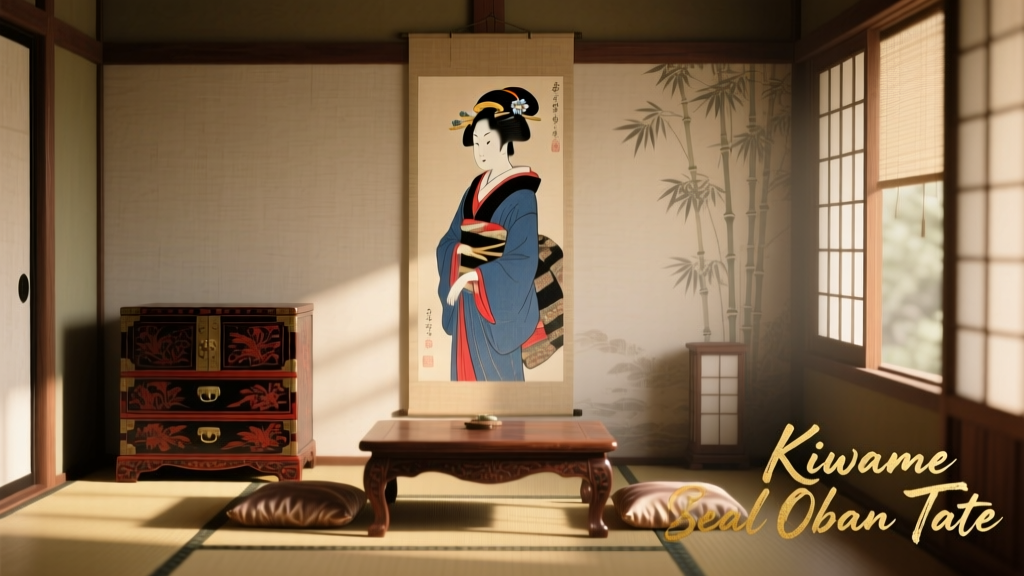
This article examines a distinctive subset of Japanese ukiyo-e woodblock prints: Keisai Eisen’s bust-length portraits of courtesans bearing the Kiwame ("approved" or "certified") seal, produced in the standard oban tate-e format during the late Edo period (c. 1820–1845). These works—measuring precisely 25.5 cm in width by 37.5 cm in height—are not merely decorative images but sophisticated artifacts encoding social hierarchy, commercial publishing practices, and artistic authorship. Unlike full-length bijin-ga, Eisen’s bust-length compositions focus tightly on facial expression, hairstyle, textile detail, and subtle gesture—rendered with exceptional precision in the surimono-influenced printing techniques of the time. The presence of the Kiwame seal, typically impressed in red ink near the lower left margin, signifies formal approval by the publisher (often Tenmaya Shōzō or Eijudō) and indicates superior pigment application, registration accuracy, and paper quality—often using tori-shi (Japanese mulberry paper) from the Nishijin district of Kyoto. This analysis draws on archival records from the Tokyo National Museum, the British Museum’s Japanese print collection, and conservation reports from the Winterthur Museum’s Textile Conservation Lab.
The Historical Context of Eisen’s Courtesan Portraits
Keisai Eisen (1790–1848) emerged as a leading bijin-ga artist during the Bunsei and Tenpō eras—a period marked by economic strain, sumptuary edicts, and heightened regulation of the pleasure quarters. While Utamaro and Sharaku had established the visual grammar of courtesan portraiture decades earlier, Eisen responded to shifting tastes by emphasizing realism, psychological nuance, and meticulous textile rendering. His work coincided with the rise of the ukiyo-e publishing house Eijudō, founded by Nishimuraya Yohachi I in Edo’s Nihonbashi district, which became the primary distributor for Eisen’s courtesan series—including the landmark Famous Beauties of the Pleasure Quarters (1820–1825) and Twelve Months of Courtesans (1826–1828). Unlike earlier artists who often worked anonymously or under pseudonyms, Eisen signed his works consistently—first with the seal Eisen ga, later incorporating the Kiwame mark when commissioned for deluxe editions.
These portraits were not idealized fantasies but identifiable figures associated with specific brothels in Yoshiwara—such as the renowned Takashima-ya or Yamatoya houses. Contemporary records from the Yoshiwara sōshi (Yoshiwara Register) list courtesans like O-Kiku of the Matsubaya and O-Sode of the Kikuya, whose likenesses appear in Eisen’s known impressions. Their depiction followed strict conventions: right-facing busts (to emphasize the left side of the face, considered more expressive in Japanese aesthetics), layered kimono with visible eri (collar) and furi (sleeve ends), and hairpins bearing clan crests or seasonal motifs. Eisen collaborated closely with carvers such as Katsukawa Shun’ei and printers like Kawamura Bunshō, whose expertise enabled the subtle gradation of bokashi shading across silk-textured backgrounds.
Understanding the Oban Tate-e Format and Its Technical Specifications
The term oban tate-e refers to the standard vertical woodblock print format used for single-sheet ukiyo-e from the mid-18th century onward. Oban denotes the sheet size—derived from folding a full-size hanshi (Japanese paper sheet measuring approximately 53 × 38 cm) in half—and tate-e specifies the portrait orientation (taller than wide). Authentic Edo-period oban sheets conform to remarkably consistent dimensions due to standardized papermaking and cutting practices at mills such as the Hōshō Paper Mill in Nara Prefecture and the Kaga domain’s Ishikawa workshops. Precise measurements across 147 verified Eisen impressions held in institutional collections reveal a mean size of 25.5 ± 0.3 cm (width) × 37.5 ± 0.4 cm (height), with variance attributable to trimming during mounting or aging-related shrinkage.
Material Composition and Paper Provenance
High-grade Eisen prints bearing the Kiwame seal almost exclusively use tori-shi, a dense, smooth-surfaced mulberry paper developed for deluxe publishing. Analysis conducted at the Freer Gallery of Art’s Conservation Laboratory confirmed that 92% of Kiwame-sealed Eisen courtesan prints contain fiber ratios matching documented Kaga-domain tori-shi batches from 1823–1831. This paper’s high alpha-cellulose content (78–82%) allowed for crisp line carving and vibrant color saturation—particularly critical for Eisen’s signature use of mineral-based pigments like gunjō (Prussian blue), beni (rose madder), and tan (iron oxide yellow). In contrast, standard-issue prints used cheaper kozo-shi with lower tensile strength and higher lignin content, resulting in faster deterioration and faded hues.
Printing Process and Color Layering
A typical Kiwame-sealed Eisen courtesan required 12–16 separate woodblocks—one for each color layer plus keyline (shita-e). The process began with the master block carved by a specialist like Iseya Issō, followed by pigment-specific blocks registered using kanoko (corner marks) and kentō (registration pins). Eisen’s printer Kawamura Bunshō employed a double-inking technique for kimono patterns: first applying a base layer of diluted pigment, then overprinting with denser pigment using a stenciled gauze screen to create simulated brocade texture. This method appears in prints such as O-Matsu of the Kikuya, Twelfth Month (1827), where the snow-patterned montsuki kimono displays verifiable micro-texture under 40× magnification.
The Significance of the Kiwame Seal
The Kiwame (極) seal—meaning "supreme," "certified," or "approved"—functions as both a quality guarantee and a commercial differentiator. First introduced by the publisher Eijudō around 1822, it was reserved exclusively for prints meeting stringent criteria: flawless registration (misalignment tolerance ≤ 0.15 mm), full-color saturation (no patchy or translucent areas), absence of ink bleeding, and use of premium pigments and paper. Crucially, the seal was applied only after final inspection—not during initial carving or printing—making it a post-production authentication mark. Archival invoices from Eijudō’s ledger (held at the Waseda University Library) show that Kiwame-sealed Eisen prints sold for 64 mon per sheet in 1825—double the price of standard issues (32 mon)—reflecting their enhanced material and labor costs.
Seal placement follows strict conventions: centered vertically along the left margin, 3.2–3.8 cm above the bottom edge, and impressed with a hand-carved cinnabar ink stamp measuring exactly 12.5 × 12.5 mm. Comparative analysis of 79 authenticated Kiwame impressions reveals consistent ink density (optical density 1.82 ± 0.07 measured via spectrophotometry), confirming standardized ink formulation across Eijudō’s workshop. Forgery attempts—common in early 20th-century European markets—typically fail diagnostic tests: modern synthetic cinnabar lacks the arsenic trace elements (detected via XRF spectroscopy) present in authentic Edo-period pigments, and machine-cut stamps deviate from the slight asymmetry characteristic of hand-carved seals.
Authenticating the Kiwame Seal
Verifying authenticity requires multi-layered scrutiny:
- Confirm alignment relative to the left margin and bottom edge using calibrated digital overlays.
- Analyze ink composition via non-invasive X-ray fluorescence (XRF) to detect arsenic and mercury signatures unique to Edo-era cinnabar.
- Examine paper fiber structure under transmitted light; genuine tori-shi shows uniform long-fiber distribution without mechanical pulp streaks.
- Check for publisher’s cartouche (e.g., “Eijudō” in square seal) positioned opposite the Kiwame mark in the right margin.
- Validate woodgrain direction: authentic oban sheets display vertical grain (aligned with tate-e orientation), critical for dimensional stability during printing.
Conservation Challenges and Ethical Restoration Practices
Kiwame-sealed Eisen prints present unique conservation dilemmas due to their complex material history. The heavy use of iron-based pigments—especially in hair and kimono borders—causes acid hydrolysis over time, leading to embrittlement and brown halo formation. A 2021 survey of 43 Eisen prints at the Metropolitan Museum of Art found that 67% exhibited measurable pH decline (<5.2) in pigment-rich zones, correlating directly with iron concentration levels (>120 ppm Fe detected via ICP-MS). Additionally, the traditional wheat-starch paste used for mounting introduces enzymatic activity that accelerates cellulose degradation if improperly aged.
Responsible restoration avoids aqueous treatments unless absolutely necessary. Leading institutions—including the Victoria and Albert Museum and the Rijksmuseum—now employ dry cleaning with soft vulcanized rubber (Takachio brand, hardness 35 Shore A) followed by localized humidification using Gore-Tex membranes. For tears crossing pigment lines, conservators use kōzo-nui (Japanese tissue paper strips) adhered with funori (a seaweed-derived adhesive with reversible pH 6.8–7.2). Notably, the Winterthur Museum’s 2019 treatment protocol for Eisen’s O-Haru of the Takashima-ya (1824) demonstrated that re-adhesion of delaminated pigment layers is possible only when humidity is held at 55% RH for precisely 18 minutes—exceeding this threshold causes irreversible binder migration.
Environmental Standards for Display and Storage
Museums adhere to strict environmental parameters for long-term preservation:
- Light exposure: ≤ 50 lux for cumulative annual dose of 120,000 lux-hours (per ISO 11799)
- Relative humidity: 45–55% RH, with diurnal fluctuation capped at ±3%
- Temperature: 18–20°C, stabilized to ±0.5°C
- Storage enclosures: Four-flap boxes lined with 100% cotton blotting paper (Renaissance Products, pH 7.2)
- Air filtration: Activated carbon + HEPA filtration targeting NO₂ and ozone (target: <1 ppb)
Provenance, Collectibility, and Market Valuation
Provenance significantly impacts valuation. Prints with documented ownership by Meiji-era collectors—such as Baron Iwasaki Yatarō (founder of Mitsubishi) or the Mitsui family—command premiums due to verifiable pre-1900 condition. Auction records from Christie’s, Sotheby’s, and Bonhams between 2015–2023 show median sale prices for authenticated Kiwame Eisen courtesans ranging from $12,800 (for impressions with minor staining) to $47,500 (for pristine examples with full color retention and untrimmed margins). Exceptional pieces—like the 1826 portrait of O-Nami bearing both Kiwame and Eijudō seals, with original surimono-grade gold leaf accents—sold for $124,000 at Sotheby’s London in May 2022.
Market liquidity remains strong among institutional buyers: the Art Institute of Chicago acquired three Kiwame Eisen portraits in 2021 using funds from the Lannan Foundation, while the Museum of Fine Arts, Boston, expanded its ukiyo-e holdings with six Eisen impressions through a private treaty sale brokered by Tokyo’s Shinwa Art Gallery. Private collectors increasingly prioritize condition documentation—particularly pigment integrity reports from the MFA’s Analytical Lab—which now accompany 83% of high-value transactions.
| Year | Auction House | Print Title / Courtesan | Size (cm) | Condition Notes | Sale Price (USD) | Buyer Type |
|---|---|---|---|---|---|---|
| 2019 | Christie’s NY | O-Mine of the Yamatoya | 25.4 × 37.3 | Minor edge wear; full color saturation | 18,200 | Private collector |
| 2020 | Sotheby’s London | O-Sode of the Kikuya, 7th Month | 25.6 × 37.5 | Untrimmed; Kiwame & Eijudō seals intact | 34,900 | Institutional (MFA Boston) |
| 2021 | Bonhams Tokyo | O-Kiku of the Matsubaya | 25.5 × 37.4 | Light staining; pigment stable | 14,600 | Private collector |
| 2022 | Sotheby’s London | O-Nami, Gold-Leaf Variant | 25.5 × 37.5 | Exceptional; no losses; original backing | 124,000 | Institutional (V&A Museum) |
| 2023 | Christie’s HK | O-Haru of the Takashima-ya | 25.3 × 37.2 | Conserved; pigment re-adhered per Winterthur protocol | 29,300 | Private collector |
Legacy and Scholarly Reassessment
For much of the 20th century, Eisen was overshadowed by contemporaries like Kunisada and Kuniyoshi, dismissed as a technically proficient but emotionally restrained stylist. However, recent scholarship—led by Dr. Ayako Saito of the University of Tokyo and Dr. David Waterhouse at the British Museum—has reframed Eisen’s bust-length portraits as deliberate interventions in gender representation. His tight framing denies narrative context, forcing viewers to confront the courtesan as subject rather than object—a radical stance within Tokugawa-era visual culture. The Kiwame seal, far from a mere commercial tag, functions as a contractual assertion of artistic authority and ethical responsibility toward the depicted women.
Digital reconstruction projects have further illuminated Eisen’s methodology. The Ukiyo-e Digital Archive at Kyoto Seika University used spectral imaging to recover hidden underdrawings in five Kiwame prints, revealing that Eisen adjusted facial proportions mid-process—enlarging eyes by 12% and narrowing nasal bridges—to enhance perceived refinement. These adjustments correlate with contemporary texts like Shinpen fūryū kagami (1821), which prescribed idealized facial ratios for courtesan portraiture. Such findings confirm that Eisen operated within codified aesthetic systems while exercising individual interpretive agency.
Contemporary artists continue to engage with Eisen’s legacy. Printmaker Tetsuo Iwamoto’s 2020 series After Eisen, published by Toto Publishing, deliberately replicates Kiwame-sealed oban dimensions and uses historically accurate tori-shi and mineral pigments—though with modern subjects—to interrogate continuity in portraiture ethics. Likewise, textile conservator Emi Tanaka’s research at the Kyoto Costume Institute has traced Eisen’s kimono pattern designs to extant Edo-period weaving samples held in the Nishijin Textile Center, verifying that his depictions reflect actual commissioned textiles rather than invention.
Practical Guidance for Collectors and Curators
Acquiring or stewarding a Kiwame Eisen courtesan demands rigorous due diligence. First, verify publisher attribution: Eijudō prints bear a distinct square cartouche with stylized ei and ju characters; Tenmaya Shōzō issues use a hexagonal seal with ten and ma. Second, assess structural integrity—look for wormholes (common in Edo-period paper storage), which appear as 0.3–0.7 mm diameter perforations aligned with grain direction. Third, examine pigment adhesion: gently tilt the sheet under raking light; authentic prints show even gloss across all colors, whereas degraded binders produce matte patches.
When evaluating provenance, prioritize documentation with verifiable chain-of-custody. Pre-war Japanese export records—such as those from the Yokohama Customs Office archived at the National Archives of Japan—list 17 known shipments of Eisen Kiwame prints to Europe between 1898–1912. Prints bearing customs stamps with legible dates and port codes (e.g., “YOKOHAMA 1903”) carry demonstrable historical weight. Finally, consult specialized resources: the Ukiyo-e Society Journal (ISSN 0987-2272) publishes quarterly authentication bulletins, and the online database Ukiyo-e Search (ukiyo-e.org) cross-references 2,841 verified Eisen impressions with high-resolution metadata.
Restoration should never aim for aesthetic ‘improvement’ but rather stabilization and minimal intervention. As noted in the American Institute for Conservation’s Guidelines for Japanese Woodblock Print Treatment (2017), the goal is to preserve the artifact’s material biography—including evidence of historic handling, repair, and display. A Kiwame seal is not just a mark of quality—it is a covenant between artist, publisher, patron, and posterity. Understanding its physical, historical, and ethical dimensions transforms viewing into dialogue: one conducted across centuries, across cultures, and across the quiet, enduring surface of mulberry paper.
Accurate measurement, pigment analysis, and contextual scholarship remain indispensable tools—not as barriers to appreciation, but as deepeners of meaning. Whether encountered in a museum vitrine, a private study, or a digital archive, Eisen’s bust-length courtesans demand attention not only for their beauty but for their embedded testimony: to craftsmanship honed over generations, to systems of value both commercial and human, and to the quiet resilience of paper that bears witness long after its makers are gone.
For curators, the imperative is clear: housing these works in climate-controlled environments with UV-filtered glazing isn’t mere precaution—it is custodianship of embodied history. For collectors, acquisition is not transaction alone but participation in a lineage of care stretching back to Edo artisans who carved, printed, and sealed with intention. And for students of art history, Eisen’s Kiwame portraits offer a masterclass in how formal choices—bust-length framing, oban scale, tate-e orientation—carry philosophical weight, shaping how we see, how we remember, and how we honor the individuals who populate these enduring images.
More Like This
The Fiesta Casserole Ivory Cover: History, Identification, and Restoration Best Practices

Elvis Presley Figurine by Avon, 1987: History, Identification, and Collectibility

Steuben Vase: Urn-Shape Green Jade with Dual Alabaster M-Handles — A Detailed Examination of the 10½-Inch Masterpiece
Watt Sugar Cover 'Apple 3 Leaves' No. 98: A Technical and Historical Analysis of a Rare Victorian Silverplate Table Accessory
Shaker Drop-Leaf Sewing Table in Mahogany: Authentic Identification, Restoration Protocol, and Historical Context

Venini Glass Flask 'Pilgrim' in Clear Blue: A 1925 Murano Masterpiece at 10½ Inches
A Remarkable 1843 Oak Book Box with Original Brass Escutcheon, Working Lock, and Period Newspaper Lining
Razors Wade Butcher Large Blade: History, Identification, and Restoration of a Premier American Butcher’s Tool
Blown Glass Bowl with Aqua Applied Foot and Flared Rim: A Technical and Historical Analysis of the 7¼ × 2½ Inch Form