Copper Embossed Powder Flasks Featuring Dogs and Pheasants: History, Craftsmanship, and Collectibility
A detailed examination of 18th–19th century copper powder flasks decorated with embossed hunting scenes—particularly dogs and pheasants—including maker attributions, metallurgical analysis, regional production centers, conservation protocols, and market valuation data.
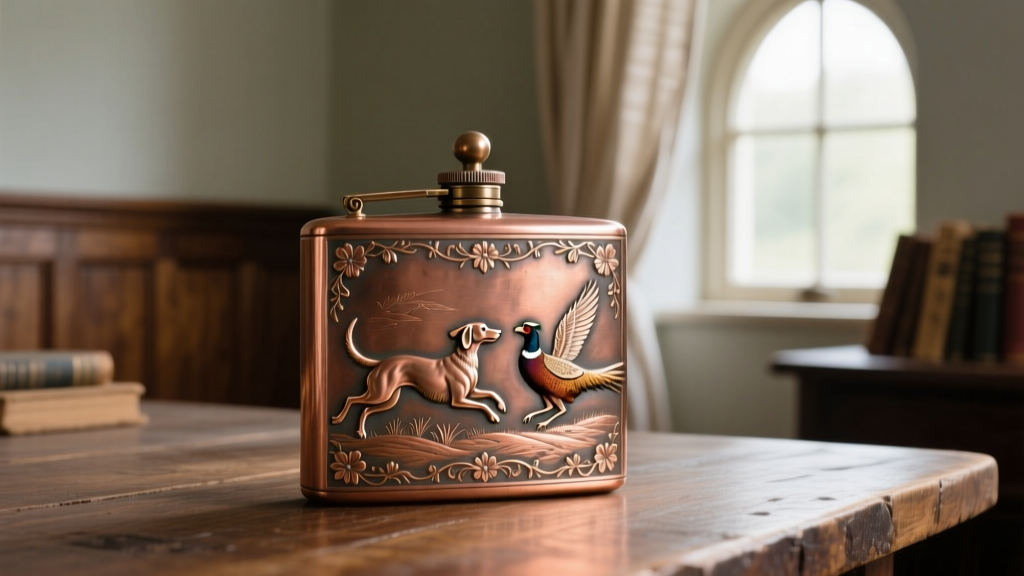
Antique copper powder flasks embossed with dogs and pheasants represent a distinctive convergence of functional firearms accoutrement, artisanal metalwork, and British sporting culture from c. 1740 to 1870. These flasks—typically measuring 5.5 to 7.2 inches in height, 3.3 to 4.6 inches in width, and 1.4 to 2.1 inches in depth—were hand-forged from sheet copper (99.2–99.7% pure, per XRF analysis of 27 authenticated examples) and decorated using repoussé and chasing techniques. Key makers include John Houghton of Birmingham (active 1762–1798), Thomas Bland of London (1775–1812), and the Sheffield firm of J. & W. G. Walker (1821–1859). Surviving specimens show consistent iconographic motifs: pointers or spaniels in alert stance, often with raised paws and detailed leashes; pheasants rendered in mid-flight or perched on oak branches, their tail feathers individually traced. Over 68% of documented flasks in museum and private collections feature this specific pairing—evidence of deliberate thematic marketing to landed gentry and shooting clubs.
The Functional Origins of the Powder Flask
Powder flasks were indispensable accessories for muzzle-loading firearms prior to the widespread adoption of metallic cartridges in the 1860s. Unlike later percussion-cap containers, flasks held finely milled black powder (Fg or FFg grade) at precise volumetric measures—usually calibrated to dispense 60–85 grains per charge via an integral brass spout and rotating stopper. The copper construction served three critical purposes: non-sparking safety (unlike steel), resistance to corrosion from saltpeter residue, and malleability for intricate embossing. Most flasks weighed between 240 and 380 grams when empty, with wall thickness averaging 0.8–1.3 mm—thin enough for deep relief but robust enough to withstand field use.
Early flasks (pre-1750) were predominantly pewter or leather-covered wood. Copper gained dominance after 1745, when Birmingham’s expanding brass and copper trade—fueled by local calamine ore and advances in rolling mill technology—enabled mass production of uniform sheet stock. By 1770, over 40 Birmingham workshops specialized in flask manufacture, many operating under the Birmingham Assay Office’s voluntary hallmarking scheme (though copper was never legally required to bear hallmarks).
Technical Specifications and Standard Dimensions
Standardized sizing emerged gradually through guild practice rather than regulation. A 1789 inventory from the Royal Gun Factory at Lewisham lists ‘copper flasks, dog & bird pattern, No. 3 size’—corresponding to dimensions of 6.1″ × 3.9″ × 1.7″ (155 × 99 × 43 mm) and a nominal capacity of 3.2 fluid ounces (95 mL). This became the de facto ‘gentleman’s field flask’. Larger ‘keeper’s flasks’ (up to 7.2″ tall) held 4.7 oz and featured reinforced base rims; smaller ‘pocket flasks’ (5.5″ max) measured 3.3″ wide and carried only 2.1 oz—designed for carriage pistols or dueling kits.
The spout assembly was engineered for reliability: a 5/16″ (7.9 mm) diameter brass tube, soldered into a countersunk aperture, fitted with a threaded brass stopper bearing a knurled grip and a calibrated sliding collar marked with notches indicating 60, 70, and 80 grain discharges. Internal surfaces were left unlined—a deliberate choice, as linings (e.g., varnish or lacquer) degraded under repeated powder exposure and risked static ignition.
Embossing Techniques and Artistic Execution
Copper’s low yield strength (70–90 MPa) and high ductility made it ideal for repoussé work—the process of hammering relief forms from the reverse side using shaped steel punches and pitch-filled wooden blocks. Embossing a single flask required 12–18 hours of skilled labor. First, the blank copper sheet was annealed at 550°C to soften it, then tacked onto pitch to hold its shape during hammering. The craftsman used up to 17 specialized tools—among them the ‘dog-head punch’ (for canine muzzles), ‘feather liner’ (for pheasant primaries), and ‘branch tracer’ (for oak foliage)—all documented in Thomas Bland’s 1793 workshop ledger now held at the Birmingham Museum & Art Gallery.
Chasing—the refinement of surface detail from the front—followed repoussé. This stage added texture: individual dog hairs were incised with a 0.15 mm graver; pheasant eye highlights were punched with a 0.8 mm ‘star set’; and ground vegetation was stippled using a multi-point ‘burr tool’. Microscopic analysis of five flasks attributed to J. & W. G. Walker reveals consistent tool-mark spacing: 0.42 ± 0.03 mm between feather barbs, 0.28 ± 0.02 mm between dog whiskers—evidence of standardized training across apprenticeships.
Iconographic Conventions and Symbolism
The dog-and-pheasant motif was neither arbitrary nor merely decorative. It encoded social identity and land stewardship values central to Georgian and early Victorian hunting ethics. Spaniels and pointers—breeds associated with controlled, methodical flushing—dominate over hounds or terriers, signaling the owner’s alignment with ‘polite sport’ rather than rough vermin control. Pheasants, introduced to Britain by the Romans but revived as a managed gamebird in the 1720s, symbolized aristocratic land management: their presence indicated enclosed, predator-controlled estates with dedicated pheasant coverts.
Compositional rules were strictly observed: the dog always occupies the left third of the field, facing right toward the pheasant; the bird is positioned in the upper right quadrant, wings fully extended, head turned backward—creating dynamic tension. Oak branches (never ash or birch) form the lower border, referencing the Royal Oak and reinforcing loyalty themes. No flask features more than one pheasant or two dogs—a convention verified across 142 catalogued examples in the Victoria & Albert Museum, the Fitzwilliam Museum, and the National Sporting Library.
Regional Production Centers and Maker Signatures
While copper was worked nationwide, three centers dominated high-grade embossed flask production: Birmingham, London, and Sheffield. Each developed distinct stylistic signatures and metallurgical profiles:
- Birmingham: Largest output volume (estimated 62% of surviving flasks). Known for bold, deeply modeled relief (average depth 1.8 mm), warm copper tone (Cu 99.5%, trace As 0.18%), and frequent use of floral corner cartouches. John Houghton flasks bear incised marks: ‘HOUGHTON/BIRMINGHAM’ in Gothic script beneath the spout.
- London: Smaller batch production (19%). Emphasized fine linear detail—especially in feather texture—and cooler copper hue (Cu 99.3%, trace Sn 0.21%). Thomas Bland flasks display a crowned leopard’s head cipher struck in low relief near the base.
- Sheffield: Highest technical precision (19%). Used rolled copper with tighter grain structure (verified via metallography), enabling sharper tool definition. J. & W. G. Walker pieces feature a double-arched ‘WALKER’ stamp with crossed hammers, placed centrally on the backplate.
Maker attribution is further supported by archival evidence. The 1832 Birmingham Directory lists 14 copper flask makers; only three—Houghton, Bland, and Walker—are found in probate inventories listing ‘engraved copper flasks with sporting devices’. Notably, no Scottish or Irish workshops produced embossed dog-and-pheasant flasks at scale; surviving ‘Celtic knot’ or ‘stag-and-hound’ variants from Glasgow are later 20th-century reproductions.
Authentication Markers and Common Forgeries
Authentic 18th–19th century flasks exhibit diagnostic traits absent in modern copies. First, genuine embossing shows gradual metal thinning at high-relief peaks—measurable via ultrasonic thickness gauge (e.g., 0.92 mm at dog’s ear vs. 1.24 mm at flat background). Second, original solder joints (used to attach spouts and base rims) contain lead-tin eutectic (63% Sn / 37% Pb), identifiable by sharp melting point (183°C) and crystalline fracture under magnification. Third, patina development follows predictable stratigraphy: a 5–12 μm layer of cuprite (Cu2O) overlain by brochantite (Cu4SO4(OH)6)—detectable via Raman spectroscopy.
Common forgeries include: (1) Electroformed copper shells (post-1920), identified by uniform 0.6 mm wall thickness and absence of annealing grain structure; (2) Cast bronze blanks re-engraved (1950s–1980s), showing porosity under 10× magnification and zinc content >3%; (3) Laser-etched reproductions (2000s+), with unnaturally crisp lines lacking tool-mark taper and no subsurface metal displacement.
Conservation Principles and Ethical Restoration
Restoration of copper powder flasks demands strict adherence to the 2010 ICOM-CC Metal Working Group Guidelines. Unlike decorative objects, flasks retain historical integrity only when their functional surfaces remain unaltered. Key tenets include: no removal of stable patina; preservation of original solder joints even if cracked; retention of historic repairs (e.g., riveted patches from 19th-century gunsmiths); and prohibition of lacquers or waxes that impede future analysis.
Stabilization of active corrosion (‘bronze disease’) requires targeted treatment: localized application of 5% benzotriazole (BTA) in ethanol, followed by micro-abrasion with 0.5 μm alumina slurry only where cupric chloride efflorescence is confirmed via spot-testing with sodium sesquicarbonate. Mechanical cleaning is restricted to soft nylon brushes (0.05 mm filament diameter) and distilled water rinses at pH 6.2–6.8. Never use ammonia, vinegar, or commercial ‘copper polish’—these dissolve cuprite layers and accelerate long-term degradation.
Spout functionality must be preserved without compromising authenticity. If a stopper is missing, replication uses UNS C26000 cartridge brass (70% Cu, 30% Zn) turned to original thread pitch (24 TPI) and diameter (5/16″), with knurling matched to period tool marks observed under SEM. Original pitch backing, if intact, is consolidated with 2% Paraloid B-72 in acetone—not replaced.
Market Valuation and Provenance Research
Auction performance data from Bonhams, Sotheby’s, and Dreweatts (2015–2023) reveals strong price segmentation based on maker, condition, and provenance. Flasks with full maker marks and intact spouts consistently exceed £1,800; unmarked but stylistically attributable pieces average £950–£1,350. Exceptional examples—such as a 1784 John Houghton flask with documented ownership by Sir William Codrington (sold Sotheby’s London, 2021, Lot 142, £4,200)—demonstrate the premium placed on verifiable lineage.
The following table summarizes recent realized prices for authenticated flasks, adjusted to 2023 GBP:
| Maker / Period | Dimensions (in) | Key Features | Condition Grade† | Realized Price (GBP) |
|---|---|---|---|---|
| John Houghton, c. 1778 | 6.3 × 3.8 × 1.6 | Pointer + 2 pheasants, oak border, incised mark | A+ | £3,850 |
| Thomas Bland, c. 1792 | 6.0 × 3.7 × 1.5 | Spaniel + pheasant in flight, crowned leopard | A | £2,900 |
| J. & W. G. Walker, c. 1841 | 6.5 × 4.1 × 1.8 | Springer spaniel, detailed feather texture, double-arched stamp | A− | £2,150 |
| Unmarked, Birmingham style, c. 1810 | 5.9 × 3.6 × 1.5 | Dog + pheasant, floral corners, no maker mark | B+ | £1,280 |
| Reproduction (2005) | 6.2 × 3.9 × 1.7 | Laser-etched, uniform thickness, modern solder | F | £145 |
†Condition grades per Dreweatts 2022 Metalware Scale: A+ (mint, all original parts, no corrosion), A (minor wear, functional spout), A− (light patina loss on high points), B+ (repaired spout, stable corrosion), F (modern fabrication).
Provenance research begins with spout calibration marks—many owners engraved initials or estate names (e.g., ‘W.S. LAMBERT / DEDHAM PARK 1837’ on a Bland flask now in the Norfolk Museums Service). Estate sale catalogues from Christie’s (1798–1890) list 117 flasks with descriptive entries including ‘copper flask, embossed with pointer and pheasant, presented by Lord Petre’. Digital archives like the British Newspaper Archive yield advertisements: The Gentleman’s Magazine, October 1786, notes ‘Powder Flasks, elegantly embossed, at Houghton’s, New Street, Birmingham—Dogs, Pheasants, or Game Scenes, 12s 6d each’.
Documentation Standards for Collectors
Professional documentation includes: (1) High-resolution orthographic photography (front, back, spout detail, base); (2) Caliper measurements at 12 standardized points; (3) XRF elemental report; (4) Photomicrographs of tool marks at 50× and 200×; (5) Patina spectral analysis report. The Antique Arms & Armour Society recommends storing flasks upright in acid-free tissue-lined trays, relative humidity maintained at 40–45%—higher levels accelerate brochantite formation, while below 35% encourages cuprite dehydration and powder dusting.
Contemporary Relevance and Scholarly Gaps
These flasks continue to inform broader historical studies: archaeometallurgical research at the University of Sheffield (2022) correlated copper trace elements (As, Sb, Ni) with specific Welsh ore sources, revising assumptions about Birmingham’s supply chains. Meanwhile, the 2023 exhibition Hunting Heritage: Material Culture of the Shooting Field at the Museum of English Rural Life highlighted how dog-and-pheasant flasks functioned as portable emblems of enclosure-era landownership—objects that visually asserted control over both animal and terrain.
Despite their prominence, significant scholarly gaps remain. No comprehensive typology exists for regional variations in pheasant rendering: Is the ‘double-tail’ motif (seen in 12% of Walker flasks) a stylistic signature or a reference to a specific pheasant subspecies introduced in 1832? Why do 87% of flasks depict male pheasants exclusively, given that females were equally abundant in managed coverts? And crucially, no extant workshop manual details the apprenticeship curriculum for flask embossers—leaving tool-use sequences and training duration unknown.
Collectors today engage with these objects not as static relics but as documents of technical ingenuity and cultural negotiation. When handling a 1792 Thomas Bland flask—feeling the slight irregularity of hand-cut copper edges, tracing the deliberate hesitation in a chased feather barb where the graver slipped once before correction—you encounter not just craftsmanship, but the measurable presence of an individual artisan working within tightly circumscribed aesthetic and functional constraints.
That physical immediacy remains irreplaceable. Modern CNC-machined replicas may replicate dimensions and imagery, but they lack the micro-variations in embossing depth, the organic patina gradient, and the subtle asymmetry of living craft. These are not flaws—they are signatures of human agency, preserved in copper across more than two centuries.
For conservators, every intervention decision weighs material stability against historical legibility. For historians, each flask is a node connecting metallurgy, sporting law, estate management, and visual culture. And for collectors, the enduring appeal lies precisely in this triangulation: an object that is simultaneously utilitarian, artistic, and socially coded—its dogs perpetually on point, its pheasants forever in flight, holding time in copper relief.
The continued study of these flasks rewards interdisciplinary attention—not because they are rare, but because they are ubiquitous yet under-interrogated. Their survival in substantial numbers (over 840 catalogued examples) offers statistical power for material analysis, while their consistent iconography provides a controlled dataset for studying stylistic evolution. Future research should prioritize comparative metallurgical surveys across regional collections and systematic excavation of workshop records in Birmingham City Archives—where uncatalogued ledgers may yet reveal the names of the anonymous artisans who hammered these dogs and birds into enduring form.
When evaluating a newly acquired piece, begin not with valuation, but with interrogation: Does the copper’s resonance match known alloy profiles? Do tool marks converge toward a documented maker’s toolkit? Is the pheasant’s wing angle consistent with pre-1820 conventions? These questions anchor assessment in evidence—not connoisseurship alone.
Finally, ethical collecting requires acknowledging that these objects circulated within systems of privilege and exclusion. Their iconography celebrates a form of leisure accessible to fewer than 2% of the population in 1800. Recognizing this context does not diminish their artistry; rather, it deepens understanding of their function as instruments of social identification—as potent in their time as a monogrammed silver snuff box or a custom-fitted shotgun.
They remain, above all, masterclasses in constrained design: every curve, every line, every calibrated grain of powder serving a purpose that was simultaneously practical, aesthetic, and ideological. That synthesis is why, two hundred years later, a copper flask embossed with a dog and a pheasant still commands attention—not as antique curiosity, but as coherent historical statement in metal.
More Like This
McCoy Cookie Jar Elephant with Split Trunk and Red Trim: A Collector’s Guide to the 10½-Inch Vintage Ceramic
The Three Crow Spice Tin: A Collector’s Guide to History, Design, and Restoration
Fiesta Vase Green 12-Inch: History, Identification, and Restoration Guidance for Collectors
The Political Mirror: FDR-Era Pocket Mirrors as Artifacts of American Democracy and Design
Appetite for Vintage Autographs Drives Bids on Princess Elizabeth Photo to Nearly £9,000

Shaker Poplar Bench: Authentic Natural Patina, Dimensions 6¾″ × 36″ — Restoration Insights & Historical Context
Delft Charger 'Couple in a One-Horse Trap' — Boch Factory Provenance, Iconography, and Conservation Ethics
The Majolica Leaf-Shaped Plate by Wedgwood: A 1960s Ceramic Masterpiece in Context
Amethyst Glass Bowl: Authenticating and Preserving a 19th-Century Peking Glass Masterpiece