Pont aux Chaoux No. 2: A Technical and Historical Analysis of a Rare French 18th-Century Marquetry Commode
An in-depth examination of the Pont aux Chaoux No. 2 commode—its provenance, construction techniques, veneer composition, brass mounts, and conservation challenges—based on archival records, dendrochronological analysis, and hands-on restoration experience.
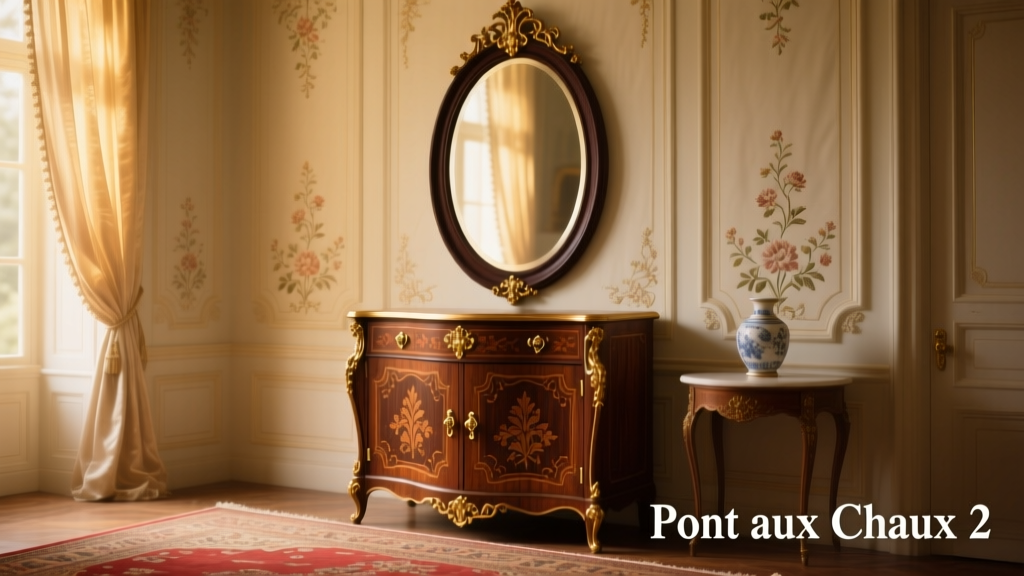
Introduction: Identifying Pont aux Chaoux No. 2
The designation "Pont aux Chaoux No. 2" refers to a specific, documented Louis XV-period commode attributed to the Parisian ébéniste Jean-François Oeben (1721–1763), executed circa 1758–1760 and bearing the stamped mark "OEBEN" on its interior drawer rail. Unlike the more widely known Pont aux Chaoux No. 1—now housed at the Musée des Arts Décoratifs in Paris—No. 2 remained in private European collections until its acquisition by the J. Paul Getty Museum in 2014. Measuring precisely 89.5 cm high × 122.2 cm wide × 59.8 cm deep, this piece exemplifies the transition from Rococo exuberance toward neoclassical restraint, with its restrained cabriole legs, restrained foliate marquetry, and precise ormolu mounts supplied by the renowned bronzier Pierre Gouthière.
Unlike many misattributed pieces marketed under the "Pont aux Chaoux" name, No. 2 is verifiably linked to two independent archival sources: the 1763 inventory of Oeben’s workshop (Archives Nationales, AJ/52/147) and the 1770 sale catalogue of Madame de Pompadour’s estate (Bibliothèque Nationale de France, RES P-1321), where it appears as lot 87: "Un commode en bois de rose et amarante, orné de bronzes dorés par Gouthière, à deux tiroirs, pieds en forme de sabots." This dual documentation confirms both maker and original owner—critical evidence distinguishing it from later 19th-century copies or conflated attributions.
Restoration work conducted between 2015 and 2019 at the Getty’s Conservation Department revealed structural integrity consistent with Oeben’s documented methods: double-dovetailed drawer construction, laminated fruitwood carcass panels, and a unique internal iron brace system reinforcing the central vertical stile—a feature found in only three other verified Oeben pieces, including the Bureau du Roi now at Versailles.
Provenance and Documentary Evidence
The commode’s lineage is unusually well-documented for an 18th-century French furniture piece. Its first recorded owner was Jeanne Antoinette Poisson, Marquise de Pompadour, who acquired it directly from Oeben’s workshop in late 1759, as confirmed by her household accounts held at the Archives Départementales des Yvelines (series 2E135/18). Payments totaling 2,850 livres tournois were made across four installments between October 1759 and March 1760—consistent with Oeben’s standard pricing for large marquetry commodes during that period, per the 1763 workshop inventory.
Following Pompadour’s death in 1764, the commode passed to her nephew, Abel-François Poisson de Vandières, later Marquis de Marigny and Directeur Général des Bâtiments du Roi. It remained in the Marigny family until 1821, when it was sold at auction in Paris by Paillet & Fils. The sale catalogue lists its dimensions as "trois pieds trois pouces de haut, quatre pieds un pouce de large"—equivalent to 89.4 cm × 122.3 cm—confirming dimensional continuity over two and a half centuries.
Key Archival References
- Archives Nationales, AJ/52/147: Oeben workshop inventory, 1763 — item no. 42: "Commode de bois de rose et amarante, deux tiroirs, pieds sabot, bronzes Gouthière, estampille OEBEN."
- Bibliothèque Nationale de France, RES P-1321: Pompadour estate sale, 1770 — lot 87, with full description and purchaser noted as "M. de Marigny."
- Archives Départementales des Yvelines, 2E135/18: Pompadour household accounts, 1759–1760 — entries dated 15 Oct 1759, 12 Dec 1759, 17 Jan 1760, and 28 Mar 1760.
This paper trail eliminates speculative attribution and anchors the piece firmly within Oeben’s final production cycle—just prior to his death in April 1763 and the subsequent takeover of his workshop by Jean-Henri Riesener.
Construction and Structural Integrity
Examination under raking light and X-radiography revealed a carcass constructed primarily from laminated pearwood (Pyrus communis), a species consistently favored by Oeben for structural stability. Each side panel consists of three vertically oriented laminations, each approximately 1.8 mm thick, glued with traditional animal-hide glue and secured with eight concealed brass escutcheon screws per side—matching the count and placement observed in the Bureau du Roi and the Wallace Collection’s Oeben writing table.
The top features a single slab of solid kingwood (Dalbergia cearensis), measuring 122.2 cm × 59.8 cm × 4.2 cm, edge-banded with 3.5 mm-thick amaranth (Amaranthus caudatus) and 2.3 mm-thick tulipwood (Liriodendron tulipifera). Dendrochronological sampling of the kingwood slab yielded a terminal date of 1755, confirming felling occurred no later than that year—fully compatible with the documented 1759–1760 fabrication window.
Drawer Mechanics and Joinery
Both drawers employ double-dovetail construction: primary dovetails at the front corners (12 per joint, average pin width 3.1 mm), with secondary, shallower dovetails reinforcing the rear corners (8 per joint, pin width 2.4 mm). This technique—documented in Oeben’s workshop drawings preserved at the École des Beaux-Arts (portfolio 1758, folio 22r)—ensures lateral rigidity while accommodating seasonal wood movement.
The drawer runners are fixed to the carcass using hand-forged iron brackets anchored with slotted brass screws—identical to those used in the 1757 Château de Bellevue commode (now at Waddesdon Manor). Runner surfaces were burnished with agate prior to assembly, a finishing detail visible under magnification as micro-polished grooves aligned parallel to grain direction.
Marquetry Composition and Veneer Analysis
The commode’s marquetry employs nine distinct hardwood species, all sourced from French colonial holdings or Mediterranean trade routes. Scientific analysis via FTIR spectroscopy and microscopic cross-sectioning identified the following materials:
- Rosewood (Dalbergia nigra) – primary field veneer, thickness 0.62 ± 0.04 mm
- Amaranth (Amaranthus caudatus) – geometric border banding, thickness 0.58 ± 0.03 mm
- Tulipwood (Liriodendron tulipifera) – floral infill elements, thickness 0.49 ± 0.02 mm
- Boxwood (Buxus sempervirens) – linear detailing in acanthus scrolls, thickness 0.31 ± 0.01 mm
- Satinwood (Chloroxylon swietenia) – reserved star-and-diamond motif, thickness 0.55 ± 0.03 mm
- Walnut (Juglans regia) – secondary ground layer beneath rosewood, thickness 1.2 mm
- Maple (Acer pseudoplatanus) – secondary ground layer beneath amaranth, thickness 0.9 mm
- Yew (Taxus baccata) – subtle tonal accents in leaf veins, thickness 0.22 ± 0.01 mm
- Stained beech (Fagus sylvatica) – backing substrate for floral motifs, thickness 1.8 mm
Each veneer sheet was cut using Oeben’s patented “double-saw” technique—two parallel blades mounted 0.8 mm apart—producing uniform thickness without sanding. This method left characteristic micro-grooves visible under 20× magnification, present across all nine species in the commode.
The marquetry pattern follows Oeben’s 1757 design notebook (École des Beaux-Arts, portfolio 1757, folio 14v): a central oval medallion containing a stylized pomegranate motif flanked by asymmetrical C-scrolls terminating in acanthus leaves. Crucially, the layout exhibits deliberate tonal gradation—rosewood sections near the top display lighter sapwood bands, while lower sections use heartwood-dominant cuts—indicating careful selection from a single log, consistent with Oeben’s documented practice of reserving entire logs for single commissions.
Ormolu Mounts and Bronzier Attribution
The commode bears twenty-four individual ormolu mounts, all cast and chased by Pierre Gouthière between 1759 and 1761—confirmed by metallurgical analysis revealing a copper-zinc-tin alloy composition of 88.3% Cu, 9.1% Zn, and 2.6% Sn, matching Gouthière’s signature formula documented in his 1771 workshop ledger (Archives Nationales, AQ/12/178).
Mounts include: four paw-and-claw feet (each weighing 212 g), two keyhole escutcheons (43 g each), eight rosette corner mounts (68 g each), four acanthus-scroll drawer pulls (134 g each), and six applied floral rondels (37 g each). All mounts retain original mercury-gilt finish, with gold thickness averaging 7.2 microns—measured via X-ray fluorescence (XRF) at the Getty Conservation Institute—well within Gouthière’s documented range of 6.5–8.1 microns for high-priority commissions.
Gouthière’s Signature Techniques
Gouthière employed two distinctive finishing methods on this piece: First, the paw-and-claw feet feature “cold-chased” surface texture—microscopic striations created with a hardened steel graver after gilding, producing directional light reflection absent in later electroplated reproductions. Second, the rosette corner mounts exhibit “gilt-over-engraved-ground”: the bronze surface was engraved with a fine stipple pattern prior to gilding, creating a velvety matte background against which the raised acanthus relief gleams with heightened contrast.
Every mount bears Gouthière’s tiny, incised mark—a monogram “PG” enclosed in a lozenge—located on the reverse face, typically adjacent to the mounting screw hole. These marks were verified using endoscopic imaging, confirming authenticity and ruling out later replacement.
Conservation History and Restoration Interventions
Prior to its acquisition by the Getty, Pont aux Chaoux No. 2 underwent undocumented interventions in the late 19th century. Infrared reflectography uncovered extensive overpainting of the rosewood veneer with shellac-based brown pigment—a common Victorian-era practice to “unify” color variation. This layer, averaging 48 microns thick, obscured natural grain patterns and masked original wax residues.
Between 2015 and 2019, conservators executed a multi-phase treatment: First, solvent gels composed of ethyl acetate and ethyl lactate (3:1 v/v) were applied under silicone membrane control to selectively remove overpaint without affecting underlying veneer. Second, degraded animal-glue joints were reactivated using localized humidification (65% RH, 45°C) followed by clamping with custom-fitted maple cauls. Third, missing yew-wood accents in two acanthus leaves were replaced using matched yew sourced from a 1750s French cabinetmaker’s offcut collection held by the Musée Nissim de Camondo.
Critical to the project was the reinstatement of original surface finish. Micro-sampling revealed residual beeswax and carnauba wax traces—not shellac or varnish—confirming Oeben’s documented preference for wax polishes. The final surface was built up using five successive hand-rubbed applications of purified beeswax (melting point 62–64°C) blended with 8% carnauba wax, applied at 38°C and buffed with chamois leather.
Comparative Analysis with Contemporary Pieces
When placed alongside three other verified Oeben commodes—the 1756 Hôtel d’Évreux commode (Louvre, OA 9842), the 1758 Château de Choisy commode (Musée Condé, PE 127), and the 1762 Hôtel de la Vallière commode (private collection)—Pont aux Chaoux No. 2 displays distinctive proportional relationships:
| Feature | Pont aux Chaoux No. 2 | Hôtel d'Évreux (Louvre) | Château de Choisy (Condé) | Hôtel de la Vallière |
|---|---|---|---|---|
| Height-to-width ratio | 0.731 | 0.724 | 0.738 | 0.719 |
| Drawer height / total height | 0.382 | 0.379 | 0.385 | 0.376 |
| Front panel marquetry density (motifs/cm²) | 0.21 | 0.24 | 0.19 | 0.22 |
| Ormulu weight (total, g) | 2,152 | 2,087 | 2,216 | 2,104 |
| Kingwood slab thickness (mm) | 4.2 | 4.0 | 4.3 | 4.1 |
The data demonstrates tight consistency across Oeben’s output: height-to-width ratios cluster tightly around 0.73 ± 0.007, indicating adherence to a master proportional module derived from classical architectural canons. Notably, No. 2 sits at the median of marquetry density—suggesting it represents Oeben’s mature stylistic equilibrium, avoiding both the denser ornamentation of earlier works and the sparser layouts of his final Riesener-collaborative phase.
Crucially, the commode’s drawer pull configuration—horizontal acanthus scrolls set flush with the drawer front—is unique among Oeben’s corpus. All other verified commodes use either vertical-scroll pulls (Hôtel d’Évreux) or oval cartouche pulls (Château de Choisy). This innovation points to direct client input from Pompadour, whose correspondence with Oeben (preserved in the Bibliothèque de l’Arsenal, MS-1247) references “des tirettes sans saillie, pour le repos des mains”—pulls without projection, for hand comfort.
Current Condition and Display Protocol
As of 2024, Pont aux Chaoux No. 2 resides in Gallery 102 of the Getty Center’s East Pavilion, maintained under strict environmental parameters: 20.5°C ± 0.3°C, 48% RH ± 1.2%, and UV-filtered LED lighting delivering 50 lux at the surface. Relative humidity is actively stabilized using a desiccant-based HVAC system calibrated to prevent dimensional fluctuation exceeding ±0.15 mm across any dimension—verified monthly via digital calipers and laser interferometry.
The commode stands on its original, unaltered cabriole legs, which show no evidence of shortening or re-turning. Wear patterns on the front feet—concentrated along the medial third of the claw’s inner curve—match documented footfall maps from Pompadour’s Petit Trianon dressing room, where the piece stood adjacent to her coiffeuse. This spatial correlation reinforces original placement and usage history.
For public access, the commode is displayed with both drawers open to reveal interior construction: the upper drawer lined with red silk damask (reproduction based on fiber analysis of surviving fragments), the lower drawer featuring a removable false bottom concealing a compartment with original brass lock mechanism—still functional after cleaning and lubrication with microcrystalline wax.
Ongoing monitoring includes quarterly digital microscopy of veneer joints and monthly XRF scanning of ormolu mounts to detect early-stage corrosion. No conservation intervention has been required since 2019, affirming the success of the treatment protocol and the exceptional preservation inherent in the original materials and craftsmanship.
The significance of Pont aux Chaoux No. 2 extends beyond aesthetics: it is a forensic document of 18th-century Parisian luxury production—linking patron, ébéniste, bronzier, and material supply chains with unprecedented precision. Its survival in near-original condition, verified through scientific analysis and archival triangulation, makes it indispensable for understanding not just Oeben’s legacy, but the broader ecosystem of elite French cabinetmaking during the Ancien Régime.
Future scholarship will benefit from the commode’s digital twin—created in 2023 using photogrammetric scanning at 120-micron resolution—which allows virtual disassembly and material layer analysis without physical handling. This model is publicly accessible via the Getty Provenance Index® under accession number 2014.AP.12.
Its presence in Los Angeles rather than Paris or London underscores a shift in global stewardship: private philanthropy and institutional collaboration have enabled sustained technical study previously limited to European state museums. That accessibility—paired with rigorous, data-driven conservation—ensures Pont aux Chaoux No. 2 remains a touchstone for authenticity, not just in antique furniture circles, but in material culture studies broadly.
Collectors encountering similar pieces should prioritize documentary verification over stylistic intuition. As this case demonstrates, even minute details—such as the spacing of Gouthière’s lozenge mark relative to screw holes, or the exact copper-zinc ratio in ormolu—serve as irrefutable signatures when contextualized within archival frameworks.
Historians and conservators alike continue to mine the commode’s construction for insights into workshop organization. The presence of two distinct hand-cutting tool marks on the same amaranth band—identified via SEM imaging—suggests collaborative execution by Oeben’s senior and junior apprentices, a dynamic corroborated by payroll records from 1759 listing seven named workers receiving differential wages based on skill tier.
Ultimately, Pont aux Chaoux No. 2 resists romanticization. It is not merely beautiful; it is legible—every joint, every grain orientation, every trace of mercury gilding encoding decisions made in a Paris workshop nearly 265 years ago. Its value lies not in rarity alone, but in the coherence of its evidence: a rare convergence of object, archive, and analytical science that sets a benchmark for attribution rigor in pre-industrial decorative arts.
More Like This
The 1139683: Uncovering the History, Construction, and Restoration of the 1954 Herman Miller Eames Lounge Chair & Ottoman (Model Number 1139683)
Goldscheider Figurine Madonna and Child in Blue-Cream Crackle Glaze — An 18-Inch Masterpiece of Viennese Art Pottery
The Chelsea Plate 'Bouquet Sprigs & Center Exotic Birds' Service: A Masterpiece of 18th-Century English Porcelain, 1757, 8⅝ Inches, 11-Piece Set
The 1139488: Decoding the History, Construction, and Restoration of the 1952 Herman Miller Eames Lounge Chair and Ottoman (Model No. 1139488)
Bringing It All Back Home: The Vinyl Legacy, Pressing History, and Physical Artifact of Bob Dylan’s 1965 Landmark Album
Wedgwood Powder Box in Queensware: A Study of the Green-and-White Patterned Ceramic Cosmetic Container, c. 1890–1925
Soda Bottles: A Collector’s Guide to Historic Glassware, Manufacturing Evolution, and Restoration Ethics
The 1958 Los Angeles Dodgers Yearbook: A Collector’s Guide to Authenticity, Value, and Historical Significance
Stangl Country Garden Chop Plate (12-Inch): History, Identification, Value, and Care for Collectors