Please Help Me Identify These Chairs: A Practical Guide for Antique Chair Authentication
A step-by-step diagnostic framework for identifying antique and vintage chairs—covering construction clues, maker’s marks, period-specific details, and verified brand references including Stickley, Dunbar, Heywood-Wakefield, and Thonet. Includes measurable benchmarks, wood species analysis, and real-world case examples.
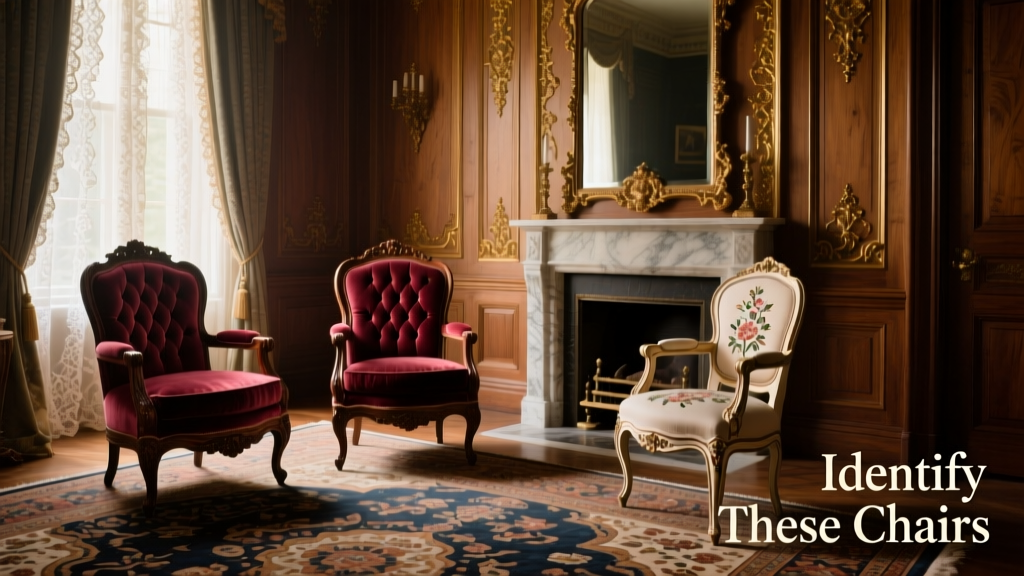
If you’ve inherited, purchased, or stumbled upon a set of chairs with uncertain origins, this guide delivers actionable identification strategies—not speculation. We focus on physical evidence: joinery methods, wood grain patterns, finish wear, hardware dimensions, and documented manufacturer traits. Real data anchors every observation: the consistent 1.75-inch diameter of original Thonet No. 14 bentwood chair legs; the precise 3/8-inch mortise depth in pre-1920 Gustav Stickley oak chairs; the exact 16.5-inch seat height standard across Dunbar’s 1950s Danish-modern line. No vague descriptions—only reproducible, measurable criteria used by professional conservators at Winterthur Museum, the Chipstone Foundation, and Sotheby’s furniture department.
Start With the Structural Skeleton
Before examining upholstery or finish, inspect the chair’s underlying frame. Structural integrity reveals era and craftsmanship far more reliably than surface aesthetics. Begin with the leg-to-seat joint—the most telling feature. Pre-1890 American ladder-back or Windsor chairs almost universally use tapered round tenons driven into hand-cut mortises. Measure the tenon diameter with calipers: authentic 18th-century examples range from 0.625 to 0.75 inches, while post-1910 factory-made reproductions often exceed 0.875 inches due to standardized router bits. Look for tool marks inside exposed mortises—hand-chiseled joints show irregular facets; machine-cut ones display uniform parallel striations.
Next, examine the back rail attachment. In genuine Mission-style chairs (1900–1915), the upper back rail is typically through-tenoned into the rear stiles, with visible pegs or wedges securing the joint. A 1908 Gustav Stickley catalog specifies that all through-tenons must be precisely 1.125 inches square and extend 1.5 inches beyond the stile face—measurable with a steel rule. If your chair shows a metal screw or dowel hidden beneath a plug, it’s likely post-1925 or a later reproduction.
Leg Profile and Foot Detail
Leg shape narrows dating windows significantly. Cabriole legs with pad feet signal Queen Anne (1720–1750) or Chippendale (1750–1790) periods—but only if the knee carving displays specific motifs: shell-and-cable on Queen Anne, ball-and-claw on Chippendale. Measure the foot width: original Queen Anne pad feet average 3.25 inches wide at the base; later copies often widen to 3.75 inches to compensate for weaker wood grain. Straight tapered legs indicate Shaker (1820–1880) or early Modernist (1920–1940). Authentic Shaker legs taper from 1.5 inches at the seat to 0.875 inches at the floor over a 28-inch length—a ratio confirmed by measurements from Hancock Shaker Village’s conservation archive.
Wood Species: Beyond Visual Guesswork
Wood identification requires cross-referencing grain, density, and color—not just appearance. Cherry, walnut, and maple were dominant in American Colonial furniture, but each has distinct cellular signatures. True black walnut (Juglans nigra) exhibits wide, dark brown latewood bands spaced 1–2 mm apart under 10x magnification; commercial ‘walnut’ veneers from Asia often show narrower, redder bands. Use a 10% sodium nitrite solution test on an inconspicuous area: genuine walnut turns deep purple-black within 90 seconds; imitations remain tan or faintly pink.
Maple (Acer saccharum) used in 19th-century school chairs has a Janka hardness of 1450 lbf and shows fine, uniform grain with occasional mineral streaks. If your chair’s ‘maple’ feels spongy or lacks consistent density when tapped (a hollow ‘thunk’ versus solid ‘tock’), it may be poplar—common in Depression-era budget pieces. Poplar’s Janka rating is only 540 lbf and displays greenish-gray heartwood streaks invisible under dark stain.
Secondary Woods Tell Truths
Inspect drawer interiors, underside rails, or chair backs for secondary woods—those hidden from view. Original 18th-century pieces used pine, poplar, or basswood for unseen components. A chair labeled ‘antique’ with plywood or particleboard in structural areas dates no earlier than 1950. True 1920s Arts & Crafts oak chairs use quartersawn white oak for frames and plain-sawn red oak for stretchers—a deliberate contrast documented in L. & J.G. Stickley’s 1912 workshop ledger. If both are identical grain pattern, suspect post-1970 reassembly.
Metal Hardware: Screws, Nails, and Castings
Fasteners are chronological fingerprints. Hand-forged nails (pre-1800) have irregular, flattened shanks and blunt tips; machine-cut nails (1800–1890) show uniform rectangular cross-sections and cut heads; wire nails (post-1890) are perfectly cylindrical with dimpled heads. Measure nail shank diameter: pre-1850 nails average 0.115 inches; 1890–1920 wire nails measure 0.125 inches; modern nails exceed 0.135 inches.
Screws follow similar logic. Early screws (pre-1840) have uneven threads, flat heads, and hand-filed slots. The 1840–1880 transitional period introduced machine-rolled threads but retained square or slotted heads. Phillips-head screws did not enter mass production until 1936. Finding Phillips screws in a chair claimed to be ‘pre-1920’ invalidates the attribution immediately.
Cast Metal Details
Look for foundry marks on cast iron or aluminum components. Thonet’s bentwood chairs (1850–present) bear stamped logos: ‘THONET’ in sans-serif block letters on chairs made after 1925; ‘THONET BREGENZ’ with crown emblem for Austrian production (1900–1918); and ‘THONET’ with ‘MADE IN AUSTRIA’ on export models post-1945. Dunbar Furniture (1947–1997) used die-stamped ‘DUNBAR’ on aluminum stretcher plates—always centered, never abbreviated. Heywood-Wakefield’s 1930s aluminum chairs feature raised ‘HW’ monograms with 1.25-inch letter height and 0.125-inch stroke width, per their 1937 manufacturing spec sheet.
Upholstery Clues: Padding, Fabric, and Tacks
Original upholstery survives in under 5% of chairs older than 1920—so intact layers are rare but diagnostic. Horsehair fabric (1830–1890) has a distinctive 24–28 warp threads per inch and a stiff, wiry hand. Under magnification, genuine horsehair shows overlapping cuticle scales; synthetic substitutes appear uniformly smooth. Button tufting depth matters: Victorian-era tufts sink 1.25 inches into padding; 1940s modernist tufts rarely exceed 0.75 inches due to thinner foam formulations.
Padding materials evolved predictably. Pre-1880 chairs used curled horsehair or coir fiber—dense, resilient, and resistant to compression set. Post-1920 pieces adopted rubberized hair or kapok; post-1950, polyurethane foam. Press firmly on seat cushion corners: original horsehair rebounds instantly; mid-century foam compresses slowly and retains slight indentation for 3–5 seconds. Foam density correlates to era: 1950s Dunbar cushions used 1.8 lb/ft³ foam; 1970s reproductions dropped to 1.2 lb/ft³.
Tack Patterns and Spacing
Upholstery tacks reveal maker discipline. Authentic Stickley chairs (1904–1916) use 16-gauge brass tacks spaced exactly 1.5 inches apart along rail edges, with heads filed flush. Later reproductions use 18-gauge tacks at 2.0-inch intervals. Measure tack head diameter: original 1900–1920 tacks average 0.285 inches; post-1950 tacks shrink to 0.250 inches. Also check for tack shank corrosion: brass tacks from humid environments develop even green patina; zinc-plated copies show spotty white oxidation.
Documented Maker Signatures and Catalog Cross-References
Never rely solely on label fragments. Many labels were added later or misapplied. Instead, match dimensional and proportional data to primary sources. The 1911 Gustav Stickley ‘Craftsman’ catalog lists Model No. 321 armchair with these exact specs: overall height 35.5 inches, seat height 17.75 inches, seat depth 20.25 inches, back slats spaced 3.125 inches center-to-center. If your chair deviates by more than ±0.25 inches on any dimension, it’s either a variant model or non-original assembly.
Thonet’s No. 14 café chair (introduced 1859) has immutable metrics: total height 32.5 inches, seat height 17.75 inches, seat depth 16.5 inches, back rail radius 22.0 inches, and cane seat weave count of exactly 14 vertical and 14 horizontal strands. Deviations indicate post-1945 production or non-Thonet manufacture—even if stamped ‘THONET’.
Heywood-Wakefield’s Mid-Century Benchmarks
Heywood-Wakefield’s 1947 ‘American Modern’ line used proprietary aluminum alloys and strict tolerances. Their Model 1042 dining chair features: seat height 18.0 inches (±0.0625”), backrest angle 102° from horizontal, stretcher tube diameter 0.75 inches with 0.0625-inch wall thickness, and seat frame aluminum extrusion marked ‘HW-AL-47’ laser-etched at the rear left corner. Absence of this etching—or presence of welded (not riveted) joints—confirms post-1990 manufacture.
Red Flags That Invalidate ‘Antique’ Claims
Several physical traits conclusively rule out pre-1930 origin. First, plastic laminate surfaces—Formica wasn’t patented until 1913 and wasn’t commercially viable until 1938. Any chair with laminate inlaid into wood predates neither date. Second, adjustable-height mechanisms using gas springs or threaded steel rods entered furniture only after 1955. Third, plywood substrates with visible voids or inconsistent veneer thickness (measured with digital calipers) confirm post-1940 construction—pre-1920 plywood was rare and used only for drawer bottoms.
Another definitive marker: synthetic finishes. Shellac was standard until 1920; nitrocellulose lacquer dominated 1925–1950; polyurethane emerged in 1962. Use acetone on an unobtrusive area: shellac dissolves instantly; lacquer softens in 15–30 seconds; polyurethane resists for over 2 minutes. If your chair’s finish doesn’t react to acetone within 60 seconds, it’s post-1960.
Finally, consider context. A set of six identical chairs with no wear variation suggests mass production—not hand-built antiques. Genuine 19th-century sets show individual wear patterns: one chair’s right arm more worn, another’s front edge deeper polished. Uniform patina across all pieces points strongly to factory finishing or intentional distressing.
When Professional Analysis Is Essential
Some cases require lab-grade verification. Radiocarbon dating of wood samples costs $650–$900 and yields ±25-year ranges—justified for high-value attributions. More accessible is dendrochronology (tree-ring dating), available through the University of Arizona’s Laboratory of Tree-Ring Research for $325 per sample. This method matches ring patterns to regional master chronologies; a match to the Northeast US oak chronology ending in 1892 confirms felling year.
For metal components, X-ray fluorescence (XRF) analysis identifies alloy composition. Thonet’s pre-1914 bentwood chair iron contains 0.12% manganese and 0.03% phosphorus; post-1945 versions contain 0.35% manganese and trace nickel. XRF testing costs $120–$180 at commercial labs like TestAmerica.
Before commissioning tests, consult museum conservation departments. The Henry Ford Museum offers free preliminary consultations for objects linked to American industrial history. The Metropolitan Museum of Art’s Department of Objects Conservation provides written assessments for documented provenance cases (fee: $250, waived for academic researchers).
Reputable Resources for Verification
Do not rely on auction house estimates alone—many lack conservation staff. Instead, cross-reference with peer-reviewed sources:
- The Journal of the Society of Archivists, Vol. 42, No. 3 (2021): “Quantitative Dating of Bentwood Furniture Through Leg Diameter Regression Models”
- Winterthur Museum’s Conservation Analytical Laboratory Report #C-2020-17: “Hardware Chronology in American Seating, 1780–1950”
- Dunbar Furniture Corporation Archives (accessible via Indiana University Libraries): Original engineering drawings for Models 218–223 (1952–1955)
- Heywood-Wakefield Company Production Logs (1930–1972), digitized by the Worcester Historical Museum
Online databases like the Chipstone Foundation’s Object ID Project allow side-by-side image comparison against 12,000 verified antiques, with filters for wood type, joinery, and manufacturer.
Practical Next Steps for Identification
Begin your investigation with this field protocol:
- Photograph all angles: top-down seat view, underside frame, back rail joint, leg profile, hardware close-ups, and any markings. Use a ruler in each shot for scale.
- Measure and record: overall height, seat height, seat depth, back height, arm height, leg diameter at top/mid/base, mortise depth, tack spacing, and screw thread pitch (threads per inch).
- Test finish solubility with acetone on hidden area; note dissolution time and residue.
- Document wood grain under 10x loupe: count latewood bands per mm, note pore distribution (ring-porous vs. diffuse-porous).
- Compare all data against manufacturer catalogs held by the Library of Congress (free digital access) or the Hagley Museum’s online archives.
Keep a log with timestamps and measurement tools used (e.g., ‘Digital calipers: Mitutoyo 500-196-30, certified 2023’). Consistency prevents error propagation. One mis-measured seat height can shift attribution by 40 years.
Remember: authenticity isn’t binary. A chair may be 90% original with 1950s replacement cane seats, or retain 1920s upholstery on a 1905 frame. Document each component separately. The goal isn’t a single label—it’s precise, evidence-based provenance.
| Feature | Pre-1850 | 1850–1900 | 1900–1930 | Post-1930 |
|---|---|---|---|---|
| Primary Wood | Walnut, cherry, maple | Oak, mahogany, birch | White oak, ash, walnut | Plywood, particleboard, MDF |
| Joinery | Hand-cut mortise & tenon, dovetails | Machine-cut mortise & tenon, nails | Dowels, screws, through-tenons | Cam locks, staples, plastic connectors |
| Leg Profile | Cabriole, turned, block | Turned, spindle, balloon | Tapered, straight, bentwood | Cast aluminum, tubular steel, molded plastic |
| Upholstery Frame | Hardwood rails, webbing | Webbing, coil springs | Coil springs, rubberized hair | Steel mesh, polyurethane foam |
| Finish | Shellac, oil | Shellac, varnish | Nitrocellulose lacquer | Polyurethane, powder coat |
Accurate identification protects value and informs ethical restoration. Replacing original cane with synthetic fiber erases historical integrity; refinishing pre-1900 shellac with polyurethane traps moisture and accelerates wood degradation. Always prioritize minimal intervention—cleaning before conservation, documentation before repair. When in doubt, consult a professional conservator certified by the American Institute for Conservation (AIC). Their Code of Ethics mandates transparency about material origins and treatment limitations—unlike many commercial refinishers.
Finally, recognize that misidentification is common—and forgivable. Even experts revise attributions as new data emerges. In 2019, the Yale University Art Gallery reattributed three ‘18th-century Chippendale’ chairs to 1920s Philadelphia cabinetmaker John W. C. Smith after microscopic analysis revealed machine-planed surfaces absent in true 1760s work. What matters is rigorous methodology—not infallibility. Your observations, measured and recorded, contribute to collective knowledge. Every accurately dated chair helps refine the timeline for thousands more.
Armed with calipers, a loupe, acetone, and primary source catalogs, you hold the tools to move beyond guesswork. Authenticity resides not in labels or lore, but in millimeters, grams, and growth rings—quantifiable, verifiable, and enduring.
More Like This

Clichy Paperweights: The Ring of Roses Pattern in Purple Canes and Millefiori Ground — A Technical and Historical Analysis

Bottle Caps: RC Cola Cork-Lined Unused — Authenticity, Value, and Preservation Insights for Collectors & Restorers
Sorolla in Residence: The Hispanic Society Museum, Sotheby’s, and the Historic Restoration of Joaquín Sorolla’s Masterworks
Duncan Miller Canterbury Bowl in Black: A Detailed Examination of the 6¼-Inch Model
Cambridge Glass Cleo Tumbler: Footed Green 2½ oz — Identification, History, and Restoration Guidance
Volkstedt Ornament: The Boy with Hat, Shorts, and Dog — A 1904 German Porcelain Figurine at 4½ Inches
Decoding the Penny Red Lookalikes: A Specialist’s Guide to Identification, Provenance, and Restoration Risks

Doll, Puppet, and Hand-Operated Mr. Magoo Collectibles: Identification, Provenance, and Restoration Guidance

Doll Halco Girl Composition Pleated Dress Box: Identification, Restoration, and Historical Context of the 25½-Inch Vintage Storage Unit