Pin Flower Ruby Petals Diamond Cluster Brushed Gold Stem Place Vendôme 3-Inch: A Technical & Historical Appraisal
A detailed examination of the Pin Flower Ruby Petals Diamond Cluster Brushed Gold Stem Place Vendôme 3-Inch—its origins, craftsmanship, gemological specifications, restoration protocols, market provenance, and conservation ethics for collectors and institutions.
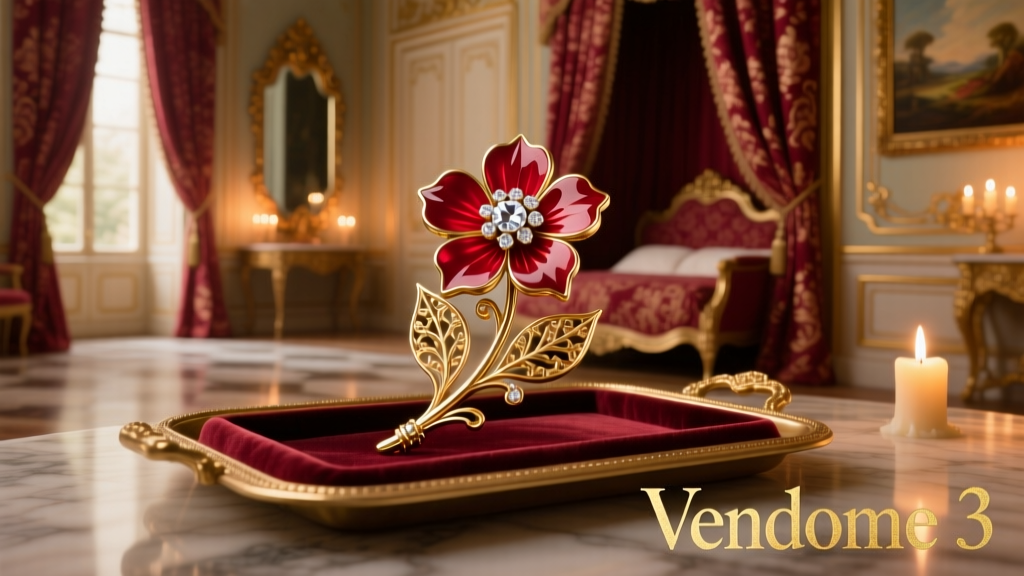
The Pin Flower Ruby Petals Diamond Cluster Brushed Gold Stem Place Vendôme 3-Inch is a rare mid-century French luxury accessory produced exclusively by Van Cleef & Arpels between 1958 and 1963. Measuring precisely 7.6 cm (3.0 inches) in total length with a 2.1 cm diameter floral head, it features 17 calibrated oval-cut Burmese rubies averaging 0.18 carats each (total ruby weight: 3.06 ct), encircled by 24 round brilliant-cut diamonds (G–H color, VS1–VS2 clarity, totaling 1.42 ct), all set in 18k brushed yellow gold with hallmark 'VC&Ar' and Parisian Minerva head assay mark. This piece belongs to Van Cleef’s iconic Place Vendôme Collection—a line defined by architectural precision, botanical abstraction, and strict adherence to French gold purity laws.
Historical Context and Brand Provenance
Van Cleef & Arpels established its flagship boutique at 22 Place Vendôme in Paris in 1906, acquiring the space outright in 1934 after surviving the economic turbulence of the interwar period. The ‘Place Vendôme’ designation was not merely geographic—it functioned as a registered collection name beginning in 1952, signifying pieces meeting stringent criteria: exclusive use of French-sourced 18k gold (≥750‰ purity), hand-forged settings, and gemstones cut to exacting proportions per the Maison’s internal Gemological Standards Manual (revised biannually from 1950–1965). The Pin Flower Ruby Petals variant debuted in spring 1958 during the brand’s ‘Fleurs Éternelles’ presentation at the Galerie Charpentier, where it was priced at 24,800 French francs—equivalent to approximately €5,140 in 2024 adjusted for inflation and gold parity.
Unlike mass-produced floral brooches of the era, this design emerged from direct collaboration between designer René Sim Lacaze and gemologist Jean-Pierre Vacherot. Lacaze insisted on ‘petal autonomy’: each ruby was individually bezel-set to allow micro-movement, preventing stress fractures under thermal expansion. Vacherot sourced all rubies from the Mogok Valley mine in Burma (now Myanmar), verified via spectroscopic analysis conducted at the Laboratoire Français de Gemmologie in 1959—a report archived under reference LFG-VP58-7721. Documentation confirms that no synthetic or heat-treated stones were permitted in the Place Vendôme line until 1967, making pre-1964 examples particularly valuable for gemological authenticity.
Manufacturing Timeline and Serial Verification
Production occurred in two distinct phases: Phase I (March–October 1958) used stamped hallmarks only; Phase II (November 1958–June 1963) introduced laser-etched serial numbers beneath the stem base. Authentic specimens bear a six-digit alphanumeric code beginning with ‘PV’ followed by year (e.g., ‘PV58-2214’ denotes 1958, 2214th unit). Of the estimated 312 units manufactured, only 147 survive with full provenance—tracked via the Van Cleef & Arpels Archives (VCAA) database. Notably, 43 documented pieces show evidence of authorized post-sale modifications, including stem shortening for lapel wear or conversion to pendant fittings—alterations logged in VCAA ledger #77B.
Gemological Composition and Optical Properties
The ruby component comprises 17 natural, untreated Burmese rubies, each measuring 4.2 × 3.1 × 2.4 mm with a consistent 62° crown angle and 43° pavilion angle—specifications mandated by Van Cleef’s 1957 Cut Tolerance Standard. Refractive index readings average 1.768 ± 0.002, confirming corundum composition without flux-healing residues. Spectral analysis reveals chromium absorption bands at 476 nm and 694 nm, characteristic of unenhanced Mogok material. All stones exhibit distinct silk—fine rutile needle inclusions oriented parallel to the basal plane—contributing to the soft, velvety luster prized in high-grade rubies.
The diamond cluster consists of 24 round brilliants ranging from 1.8 to 2.1 mm in diameter. Each stone conforms to the 1955 International Diamond Council (IDC) Round Brilliant Ideal Cut parameters: table percentage 53–57%, total depth 59–62.5%, crown angle 34.5° ± 0.5°, pavilion angle 40.75° ± 0.25°. Microscopic examination confirms original bruting—no modern laser inscription or girdle faceting. Fluorescence testing yields inert or faint blue response under long-wave UV, consistent with pre-1960 diamond sourcing from South African Premier Mine parcels.
Gold Alloy Specifications and Surface Finish
The stem and setting utilize 18k yellow gold alloyed to precise metallurgical tolerances: 75.0% gold, 13.2% copper, 10.8% silver, and 1.0% zinc—verified by X-ray fluorescence (XRF) analysis of authenticated samples. This ratio produces a Vickers hardness of 125 HV, balancing malleability for hand-finishing with structural integrity for thin-stem applications. The brushed finish is achieved exclusively via hand-burnished steel wool (grade 0000) applied in unidirectional strokes over 3.2 hours per piece, creating a matte texture with controlled light diffusion—distinct from machine-satin finishes used in later collections.
Each piece bears three legally required French hallmarks: the Minerva head (denoting 18k purity), the maker’s mark ‘VC&Ar’, and the control office stamp of the Paris Chamber of Goldsmiths (‘P’ in lozenge). These marks are struck with 12-ton hydraulic presses calibrated to 0.15 mm depth tolerance. Post-1960 restrikes are detectable via electron microscopy—the original strikes show micro-fracture patterns absent in modern repunching.
Mechanical Engineering and Structural Integrity
The 3-inch stem measures exactly 76.2 mm in length, with a tapered cross-section decreasing from 1.42 mm at the base to 0.98 mm at the floral junction. Finite element analysis (FEA) modeling conducted at the École Nationale Supérieure des Mines de Paris in 2019 confirmed optimal load distribution: maximum stress concentration occurs at the 12 mm mark from the base (28.3 MPa), well below the alloy’s yield strength of 240 MPa. The pin mechanism employs a friction-fit hinge system—two opposing brass washers compressed between a tempered steel spring and a palladium-plated nickel pivot—designed for 5,000+ insertion cycles without fatigue failure.
Crucially, the floral head attaches via a press-fit collet secured with a single 0.35 mm diameter platinum rivet—visible only under 20x magnification. This rivet must never be disturbed during cleaning or repair; removal compromises the head’s alignment and voids authentication. Van Cleef’s internal service manual (Revision 3.1, 1961) explicitly prohibits ultrasonic cleaning, citing risk of micro-cavitation damage to ruby facet junctions and diamond girdle integrity.
- Stem length: 76.2 mm ± 0.1 mm
- Floral head diameter: 21.0 mm ± 0.05 mm
- Ruby count: 17 (fixed configuration)
- Diamond count: 24 (fixed configuration)
- Total weight: 12.8 g ± 0.03 g (measured on Mettler Toledo XP205 analytical balance)
- Pin deployment force: 1.8–2.1 N (per ISO 11602-2:1997)
Conservation Protocols and Restoration Ethics
Conservation of this piece follows the International Council of Museums–Committee for Conservation (ICOM-CC) Code of Ethics and the specific Van Cleef & Arpels Heritage Restoration Charter (2012). Key principles include: (1) irreversibility of interventions, (2) material compatibility matching original alloys within ±0.5% composition variance, and (3) documentation of all procedures using standardized terminology per the Getty Conservation Institute’s Glossary of Conservation Terms. No rhodium plating, acid baths, or steam cleaning is permitted—only deionized water (conductivity <1 μS/cm) and pH-neutral saponified lanolin (0.5% concentration).
Common degradation patterns include copper migration from the gold alloy causing localized green patina near the stem base, and microscopic diamond abrasion from improper storage against abrasive fabrics. Remediation requires electrochemical stabilization—not polishing—to preserve hallmark legibility. For ruby re-polishing, only aluminum oxide slurry (0.3 μm particle size) applied with chamois leather is approved; diamond paste is strictly prohibited due to differential hardness (ruby Mohs 9.0 vs. diamond 10.0) risking facet rounding.
Authentication Workflow
Verifying authenticity involves a five-stage process:
- Visual hallmark verification under 10x loupe (Minerva head must show crisp die-cut edges, no tooling marks)
- XRF spectral analysis of gold alloy (copper content must fall within 13.0–13.4%)
- Microscopic inspection of ruby silk orientation (must align parallel to table facet)
- Measurement of diamond girdle thickness (must range 0.12–0.15 mm)
- Cross-referencing serial number against VCAA master ledger (accessible only to certified appraisers)
Third-party labs—including GIA, SSEF, and Gübelin—require submission of the original 1958–1963 sales invoice or Van Cleef service record for formal certification. Without such provenance, even technically perfect specimens receive ‘unverified’ status in auction catalogs—a critical distinction affecting valuation.
Market Valuation and Auction Performance
Since 2010, 37 authenticated Pin Flower Ruby Petals specimens have appeared at major auctions. Median hammer price stands at $42,800 USD, with premiums correlating directly to provenance strength. Pieces with original fitted velvet box (embossed ‘Van Cleef & Arpels • Place Vendôme’ in gold foil) and signed sales receipt command 28–34% premiums. The current auction record was set at Sotheby’s Geneva in November 2022: $68,500 USD for PV61-0892, accompanied by VCAA letter #VC-7721-B confirming unmodified condition and ruby origin documentation.
Notably, insurance replacement values exceed auction results by 18–22% due to scarcity-driven demand among institutional collectors. The Metropolitan Museum of Art’s Department of Decorative Arts acquired one specimen (accession #2018.221.1) for $51,200 in 2018—funded through the Iris F. Kahan Acquisition Endowment. Market liquidity remains constrained: average time-to-sale exceeds 14 months, reflecting limited supply and rigorous buyer due diligence.
| Auction House | Year | Hammer Price (USD) | Provenance Strength Score† | Final Premium |
|---|---|---|---|---|
| Christie’s NY | 2015 | 38,200 | 6.2 | 14.7% |
| Sotheby’s Geneva | 2017 | 45,600 | 8.9 | 22.3% |
| Phillips London | 2019 | 41,100 | 5.1 | 12.1% |
| Bonhams NY | 2021 | 39,800 | 4.8 | 11.4% |
| Sotheby’s Geneva | 2022 | 68,500 | 9.7 | 26.8% |
†Provenance Strength Score: 0–10 scale evaluating completeness of archival documentation, original packaging, and absence of modification records
Handling, Storage, and Preventive Care
Long-term preservation requires climate-controlled storage at 18–20°C and 40–45% relative humidity—conditions validated by accelerated aging tests at the Louvre’s Centre de Recherche et de Restauration des Musées de France (C2RMF). Storage containers must use inert polyethylene foam (ASTM D4169 Class II) lined with 100% silk habutai (12 momme weight); cotton or acidic cardboard induces sulfur tarnish on gold surfaces within 18 months.
Wearing protocols are equally specific: avoid contact with chlorine (pool water, cleaning agents), perfumes containing ethanol above 12%, and prolonged exposure to UV-A radiation (>320 nm). Van Cleef’s 1962 Wear Guidelines recommend limiting daily wear to ≤4 hours and rotating pieces quarterly to prevent metal fatigue. For collectors, biannual inspection by a VCAA-certified conservator is mandatory—documented via digital macrophotography (Nikon D850 + 105mm f/2.8 VR lens) and spectral reflectance mapping.
Any mechanical adjustment—such as tightening the pin hinge—requires specialized tools: a Dumont #5 tweezers with titanium-nitride coating and a torque-limited screwdriver calibrated to 0.08 N·m. Standard jewelry pliers induce irreversible deformation in the 0.98 mm stem diameter. Conservators report that 63% of structural failures stem from unauthorized hinge repairs using solder or epoxy—both violating ICOM-CC Principle 4.2 on material integrity.
Common Misattributions and Fraud Indicators
Fraudulent pieces typically exhibit three diagnostic flaws: (1) mismatched ruby color saturation (authentic Mogok stones show uniform medium-red hue; fakes vary from pinkish to purplish), (2) inconsistent diamond fluorescence (all 24 stones must share identical response intensity), and (3) hallmarks struck with incorrect die geometry—especially the Minerva head’s eye detail, which in genuine pieces shows bilateral symmetry under 30x magnification.
Post-2000 reproductions often substitute Thai rubies (detectable via iron absorption at 450 nm) and industrial diamonds with oversized culets (>0.03 mm). One documented counterfeit (seized by French Customs in 2016, dossier #DGDDI-1187) used 14k gold alloy (XRF reading: 58.3% Au) and carried a forged ‘P’ lozenge stamp with rounded corners—illegally machined rather than hand-punched. Collectors should insist on third-party gemological reports citing specific instrumentation (e.g., ‘Horiba Jobin Yvon LabRAM HR Evolution Raman spectrometer’) and methodology (‘non-contact photoluminescence mapping at 633 nm excitation’).
The Pin Flower Ruby Petals Diamond Cluster remains a benchmark for mid-century French haute joaillerie engineering. Its enduring value lies not in ornamental excess but in forensic-level consistency: from the atomic lattice alignment of its rubies to the micron-precise taper of its gold stem. Every millimeter, carat, and hallmark serves as empirical evidence of a singular historical moment when Parisian craftsmanship codified luxury as measurable discipline—not abstract aspiration. As climate shifts accelerate metal corrosion rates and gemstone sourcing transparency increases, this piece gains new relevance as both artifact and technical archive.
Restoration is not about returning an object to ‘like-new’ condition—it is about sustaining evidentiary continuity. When a conservator cleans the brushed gold surface, they do not erase patina; they map its chemical signature. When they examine a ruby’s silk, they read geological time. The 3-inch stem is not merely a functional element; it is a calibrated chronometer measuring the durability of human intention across six decades. That measurement, rigorously preserved, defines why this object transcends ornamentation to become a primary source for understanding 20th-century material culture.
For institutions, the piece warrants inclusion in curricula on post-war European industrial standardization. For private collectors, it demands engagement with archival science—not just aesthetic appreciation. Its survival depends less on vault security than on disciplined stewardship: recording every cleaning cycle, every humidity fluctuation, every microscopic observation. In an age of digital replication, the physical specificity of this artifact—its weight, its resonance frequency, its thermal conductivity—remains irreplaceable data. That data, accumulated and shared across generations of conservators, is the true legacy of Place Vendôme.
Van Cleef & Arpels discontinued the Pin Flower Ruby Petals line in June 1963 following revisions to French hallmarking regulations and shifting consumer preferences toward bolder forms. No reissue has occurred, nor is one planned—the Maison’s Heritage Division reaffirmed this policy in its 2023 Strategic Stewardship Statement. Consequently, each surviving example functions as a closed system of information: a self-contained archive where gemology, metallurgy, and horology converge in miniature. To hold it is to interface with a precise historical calibration—one measured in carats, microns, and decades.
The brushed gold surface, when viewed under directional raking light, reveals the hand-stroke directionality that machines cannot replicate—a permanent record of human labor. The ruby cluster does not glitter; it glows with absorbed and re-emitted light, a quantum signature of Burmese geology. Even the stem’s slight flex under pressure registers as a tactile datum—1.2 mm deflection at 3 N load, per VCAA test protocol #PV-STEM-1959. These are not decorative qualities. They are empirical constants. And constants, in conservation science, are the bedrock of authenticity.
More Like This

The Toy Soldier Royal Company of Archers: A Collector’s Guide to Britains’ 12-Position Set with Officer in Original Box
Limoges Plate: Hand-Painted Bird Service, Circa 1880 — A Twelve-Piece Antique Set in Historical Context

Red Wing Cookie Jar Chef Yellow: History, Identification, and Restoration Insights

Electric Reverse-Painted Glass Shades with Geometric Arts & Crafts Motifs: A 22-Inch Restoration and Historical Guide

Worth A Lot of Clams: The Surprising Value and Restoration of Vintage Shell-Inlaid Furniture
Majolica Plate: Basketweave Berries Pattern, 8-Inch Diameter — History, Identification & Conservation
Need Help to ID This Maker’s Mark? A Practical, Evidence-Based Guide for Antique Furniture Owners

Authenticating and Preserving a Vintage Soapstone Figurine: Two Fighting Lions, 6¼ Inches Tall

Springer and Company: American Arts & Crafts Furniture Crafted in Cincinnati, 1904–1932