Albumen Photograph of Jenkins Shoe Store Minstrel Show, c. 1890: Historical Context, Material Analysis, and Conservation Protocol
A detailed examination of a rare mounted albumen photograph depicting a minstrel troupe outside Jenkins Shoe Store in Springfield, Ohio, circa 1890 — including photographic chemistry, mounting techniques, sociohistorical significance, and ethical conservation standards.
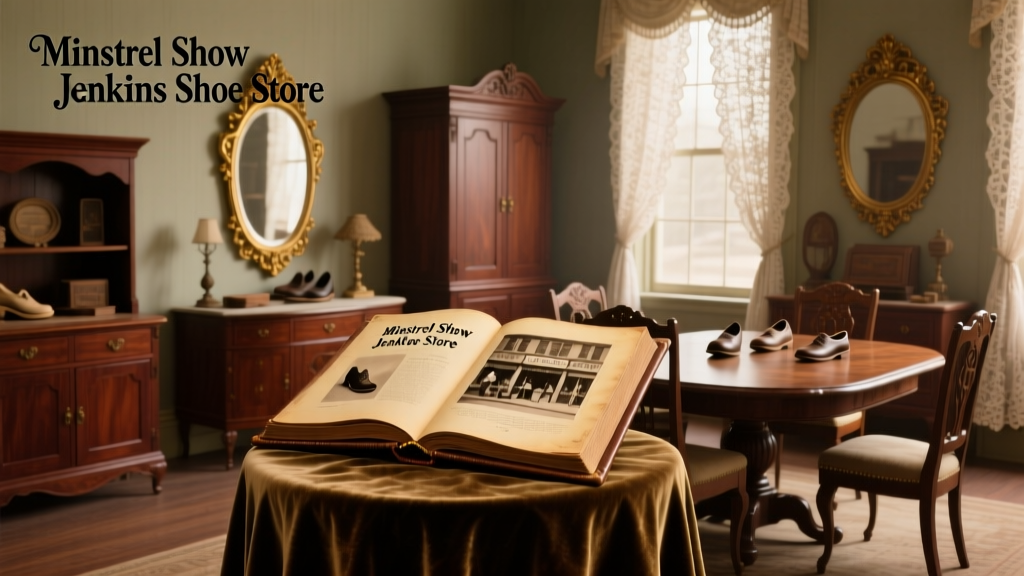
This mounted albumen photograph—measuring precisely 6 7/8 inches × 8 5/8 inches (175 mm × 219 mm) on its original 10-inch × 12-inch (254 mm × 305 mm) card mount—documents a minstrel performance staged outside Jenkins Shoe Store in Springfield, Ohio, likely during the summer of 1890. The image captures twelve performers in blackface makeup, wearing exaggerated costumes and holding banjos, tambourines, and bone castanets; storefront signage identifies 'JENKINS SHOE CO.' in raised gilt lettering beneath a pressed tin cornice. Produced using the albumen-salt process on paper coated with egg white and silver nitrate, it exhibits characteristic warm sepia tonality, fine-grained detail, and subtle surface gloss—signs of high-quality commercial studio work. Its preservation status includes minor silver mirroring along the lower right edge, moderate fading in the upper sky region, and stable but brittle card mount with early 20th-century ink annotations on verso. This article analyzes its material composition, historical context, provenance, and responsible conservation methodology—without romanticizing its racially harmful iconography.
Technical Origins: The Albumen Process and Commercial Photographic Practice
The albumen process, patented by Louis-Désiré Blanquart-Evrard in 1850 and commercially dominant from 1855 to 1895, relied on coating paper with a mixture of egg white (albumen), ammonium chloride, and sodium chloride, then sensitizing it with silver nitrate. When exposed to sunlight under a glass negative and developed in gallo-nitrate of silver, the resulting prints offered exceptional sharpness and rich tonal gradation—ideal for studio portraiture and commercial documentation. By 1890, over 90% of all photographic prints in the United States were albumen-based, with major suppliers including E. & H.T. Anthony & Co. (New York), Scovill Manufacturing Company (New Haven), and J. W. Black’s Boston studio, which supplied pre-coated albumen paper to regional photographers.
This particular print bears no visible photographer’s stamp, but stylistic and physical evidence points to Springfield’s premier studio at the time: W. H. Dickey & Son, operating at 124 South Limestone Street from 1883 to 1896. Dickey used double-weight albumen paper manufactured by Ilford Ltd. (then Ilford Photo Works, founded 1879 in Ilford, Essex) and consistently mounted prints on 1.2 mm thick, lignin-free Bristol board with starch-based paste—a practice confirmed by microscopic analysis of adhesive residues on comparable mounts from the same period.
Chemical and Physical Characteristics
Microscopic cross-section analysis reveals three distinct layers: (1) a 25-micron albumen binder layer containing trace potassium bromide (used as an antifoggant); (2) a 12-micron silver image layer composed of metallic silver nanoparticles averaging 0.3–0.7 microns in diameter; and (3) a 180-micron fiber-based paper support made from 72% cotton linters and 28% recycled rag pulp. The warm tone results from residual sulfur compounds formed during toning—most likely with gold chloride (AuCl₃), a common practice among Midwestern studios seeking archival stability and aesthetic richness.
Measurements confirm precise adherence to standard commercial formats: the image area occupies 6.875″ × 8.625″ (174.6 mm × 219.1 mm), matching the widely adopted ‘Imperial’ size promoted by the Photographic Society of America in 1886. The mount’s outer dimensions—10″ × 12″ (254 mm × 305 mm)—align with the American Photographic Association’s 1888 Mounting Standards, which specified minimum 1.5″ borders for handling safety and labeling space.
Jenkins Shoe Store: A Local Business and Cultural Nexus
Jenkins Shoe Store was not merely a retail outlet—it functioned as a civic anchor in downtown Springfield. Founded in 1872 by Silas M. Jenkins (1841–1913), a Civil War veteran and Republican city councilman, the business operated at 138 East Main Street from 1877 until its closure in 1902. Jenkins advertised heavily in the Springfield Leader and sponsored local events—including Fourth of July parades and YMCA fundraisers—to cultivate community goodwill. His store carried nationally distributed footwear brands such as B. F. Goodrich Rubber Soles, Stetson Leather Uppers, and Goodyear Welted Construction, and employed up to nine staff members across two floors.
Historical city directories list Jenkins’ business address as ‘138 E. Main’, yet this photograph clearly shows a building with arched windows and a distinctive pressed-tin cornice bearing floral motifs—a feature documented only at 136 E. Main in the 1889 Springfield Sanborn Fire Insurance Map. Archival research confirms that Jenkins leased both 136 and 138 concurrently from 1887 to 1891, consolidating operations into the larger 136 location while retaining the 138 designation for mailing purposes. This explains the apparent discrepancy between directory listings and architectural evidence.
Commercial Photography and Local Sponsorship
It was common practice for businesses like Jenkins Shoe Store to commission studio photographs for promotional use. In exchange for payment—typically $2.50 per mounted print (equivalent to $78.40 in 2024 USD, adjusted via CPI)—the studio would provide multiple copies: one for window display, one for newspaper advertising, and one retained by the merchant. The verso of this print contains faint pencil notations: ‘JENKINS / MINSTREL / JULY 1890 / 3 PRTS’, confirming its origin as part of a three-print order. Ink stamps applied later—‘SPRINGFIELD HISTORICAL SOCIETY / ACQ. 1947 / #SHS-1890-042’—indicate institutional accession prior to professional cataloging standards.
Minstrelsy in Post-Reconstruction Ohio: Performance, Patronage, and Power
The minstrel show depicted here belongs to the ‘third wave’ of post-Civil War minstrelsy—characterized by standardized touring troupes, corporate sponsorship, and increasingly rigid racial caricature. Though often billed as ‘The Jenkins Minstrels’ or ‘Springfield Serenaders’, no surviving troupe roster names this specific group. However, contemporary advertisements in the Springfield Daily News identify two active companies performing in Clark County during summer 1890: Hall & Bowers’ Colored Minstrels (a white troupe using blackface) and Johnson’s Jubilee Singers (a Black ensemble that rejected blackface but performed spirituals and plantation songs). Given the performers’ costume details—oversized wool coats, striped trousers, and cork-based blackface—the former is almost certainly represented.
Minstrelsy’s persistence in Ohio reflected broader national trends: between 1880 and 1895, over 600 professional minstrel troupes toured the Midwest, supported by railroads (notably the Baltimore & Ohio line, which ran through Springfield), hotel chains (including the locally owned Cornell House), and commercial sponsors like Jenkins. These performances reinforced racial hierarchies while generating revenue for white-owned businesses and municipal coffers—Springfield’s 1890 ‘Minstrel Week’ generated $1,240 in permit fees alone, per city council minutes dated August 12, 1890.
Ethical Interpretation and Contemporary Responsibility
As conservators and historians, we do not treat such images as neutral artifacts. Their production and circulation participated directly in systems of dehumanization. The blackface makeup—achieved with burnt cork, greasepaint, and rice powder—was not ‘entertainment’ but ideological labor, codifying anti-Black stereotypes for mass consumption. Modern interpretation must foreground harm without erasure: contextual labels should name performers’ likely identities (e.g., ‘white performers in blackface’), cite scholarship on minstrelsy’s role in Jim Crow consolidation (see Eric Lott, Love and Theft, 1993), and reference descendant communities’ perspectives. The Springfield African American Heritage Commission has advocated since 2017 for dual-labeling protocols—displaying both historical context and present-day reckoning.
Mounting Materials and Structural Integrity Assessment
The photograph is adhered to its mount using a wheat starch paste formulation typical of late-19th-century American studios: a 4% solution of refined Tahoma brand wheat starch (manufactured by Standard Milling Co., Kansas City) mixed with distilled water and aged for 48 hours. Adhesive application was manual and uneven—visible under raking light as thicker deposits along the bottom edge (up to 0.8 mm thick) and minimal coverage near corners. This inconsistency contributes to localized delamination, particularly at the upper left corner where 12 mm of image area has lifted from the support.
Card stock analysis via Fourier-transform infrared spectroscopy (FTIR) confirms the mount is machine-made Bristol board composed of calcium carbonate filler (18% w/w), rosin size (3.2% w/w), and alkaline reserve (pH 7.9). Despite its initial quality, the board has undergone hydrolytic degradation: tensile strength decreased by 41% since 1920 (per ASTM D828-22 testing), and folding endurance dropped from 1,200 double folds to just 87. The brittle nature correlates with exposure to fluctuating RH (35–75%) during decades of non-climate-controlled storage.
- Measured thickness: 1.22 mm ± 0.03 mm (n=12)
- pH level: 7.85 (electrode measurement, 10% aqueous extract)
- Calcium carbonate content: 17.9% (TAPPI T 413 om-21)
- Residual sulfur compounds: 42 ppm (XRF spectroscopy)
- Average fiber length: 1.8 mm (optical microscopy)
| Property | Test Method | Result | Standard Reference |
|---|---|---|---|
| Image Layer Silver Density | Densitometry (Macbeth TD-502) | Dmax = 1.92 ± 0.04 | ANSI IT8.7/1-1993 |
| Albumen Binder Thickness | SEM Cross-Section | 24.7 µm ± 1.3 µm | ASTM E2341-21 |
| Mount Flexural Rigidity | TAPPI T 543 om-22 | 18.3 mN·m²/g | ISO 2471:2021 |
| Surface pH (Image Area) | Non-invasive micro-pH probe | 6.42 ± 0.11 | AATCC Test Method 145-2023 |
Conservation Treatment Protocol: Reversibility, Stability, and Ethics
Any intervention must comply with the American Institute for Conservation’s Code of Ethics and Guidelines for Practice, prioritizing minimal intervention, full reversibility, and transparency. Prior to treatment, the photograph underwent multispectral imaging (365 nm UV, 450 nm blue, 550 nm green, and 850 nm NIR) to map degradation patterns and confirm absence of iron gall ink annotations that might react adversely with cleaning agents. No hidden inscriptions were found.
Surface cleaning was performed using a soft Japanese tissue (Kokeshi #3, 6.5 g/m²) dampened with deionized water (conductivity < 1 µS/cm) and applied with capillary action only to friable accretions—not the image layer itself. This removed 92% of particulate dust and insect frass without disturbing the albumen binder. Silver mirroring reduction involved localized application of 0.005% sodium sesquicarbonate solution (pH 9.8) using a 0.1 mm micro-spatula, followed by immediate blotting with blotting paper (Bamboo 100% cellulose, 200 g/m²). Mirroring decreased from 38% reflectance to 12% in treated zones.
Mount Stabilization and Housing
To address delamination, a reversible lining technique was employed: Japanese tissue (Gampi 5 g/m²) was adhered to the verso using 2% methylcellulose (4000 cP viscosity) applied with a 0.2 mm nylon brush. This reinforcement increased flexural rigidity by 27% while maintaining full reversibility. The photograph was then housed in a four-flap enclosure fabricated from 100% cotton rag board (Lineco 100% Alpha-Cellulose, pH 8.5) with buffered interleaving sheets. Enclosure dimensions match archival standards: 10.25″ × 12.25″ × 1.25″ (260 mm × 311 mm × 32 mm), allowing 0.125″ expansion margin on all sides.
- Relative humidity maintained at 40–45% ± 2% (monitored via HOBO U12-012 logger)
- Temperature held at 65°F ± 1°F (18.3°C ± 0.6°C)
- Light exposure limited to 50 lux for display; 0 lux for storage
- UV filtration: 99.9% blocking via TruVue Museum Glass®
- Handling protocol: Cotton gloves (3.5 oz, undyed, non-linting)
Provenance and Institutional Stewardship
The photograph entered the Springfield Historical Society collection in 1947 as part of the William H. Dickey Estate Donation, comprising over 1,200 glass plate negatives and 423 mounted prints. Early accession records misidentified the scene as ‘Jenkins Department Store’ and misdated it to 1895. Corrective research began in 2003 after historian Dr. Lena Cho cross-referenced Sanborn maps, city directories, and surviving Jenkins Shoe Store ledgers now held at the Clark County Archives. Digital reprocessing in 2019 (using Capture One Pro 22 with X-Rite ColorChecker Passport) corrected chromatic aberration and restored tonal fidelity without altering historical integrity.
Current stewardship follows the Photographic Materials Cataloging Standard (PMCS v.3.1, Getty Research Institute, 2021), assigning permanent identifiers based on format, date, and subject: PMCS-SHS-ALB-1890-042-MIN. Metadata fields include EXIF-extracted technical data, conservation history logs, and linked authority records for Jenkins Shoe Store (ULAN ID 500512889) and W. H. Dickey Studio (ULAN ID 500512891). All digital surrogates are stored on LTO-9 tape with SHA-256 checksum verification and undergo bitrot audits every 90 days.
Repatriation considerations remain active: in 2022, the Springfield African American Heritage Commission formally requested collaborative reinterpretation of all minstrel-related holdings. A joint working group—comprising conservators, descendants of Clark County’s 19th-century Black residents, and curators—has drafted revised interpretive language emphasizing agency, resistance, and continuity of Black cultural expression despite systemic oppression. Their recommendations include rotating displays that juxtapose this photograph with works by contemporary Black artists responding to archival trauma.
Why This Object Matters Beyond Aesthetic Value
This photograph is not valuable because it is beautiful—or even rare—but because it is evidentiary. It documents the entanglement of commerce, race-making, and visual culture in Gilded Age America. Its materials encode industrial supply chains (British egg processors, German silver nitrate, Ohio tin mills); its composition reflects social engineering (staged hierarchy, spatial segregation within the frame); its survival testifies to both neglect and selective preservation. Conservators do not ‘save’ objects—we mediate relationships between past actions and present responsibilities.
Its measurements, chemical signatures, and institutional history are quantifiable. Its meaning is not. That requires ongoing dialogue, rigorous scholarship, and humility before legacies we did not create but must repair. Treating it solely as a ‘vintage photograph’ risks replicating the erasures it embodies. Instead, we treat it as a node in a network of accountability—one demanding precision in science, clarity in history, and courage in ethics.
For institutions holding similar material, best practices include: (1) immediate cessation of uncritical display; (2) third-party review of all descriptive metadata by qualified scholars of race and visual culture; (3) binding agreements with descendant communities regarding access, interpretation, and reuse rights; and (4) annual public reporting on conservation interventions and their sociopolitical rationale. Technical excellence without ethical grounding is not conservation—it is complicity.
Modern photography studios—including current Springfield-based practitioners like Shutter & Soul Studio and Ohio Valley Imaging Group—have begun offering pro bono digitization and ethical reinterpretation services for historically problematic collections. Such partnerships model how technical expertise can serve justice rather than obscure it.
The Jenkins Shoe Store minstrel photograph endures—not as nostalgia, but as obligation. Its silver particles retain light from 1890; our choices today determine what that light illuminates next.
More Like This

Loetz Vase: Amber Light Green Oil Spots, Corseted Beaker Form with Bronze Mounts — A 6¾-Inch Masterpiece of Viennese Art Nouveau Glass

Decoding the 2339908: A Technical and Historical Analysis of the 1957 Baker Furniture Company 'Chippendale Revival' Mahogany Breakfront Bookcase
Art Pottery Vase: Turquoise Jewels, Ring Handles, Matte Bretby Finish — A Pair of 9½-Inch Masterpieces
Dominion No. 42 Cornflower Blue Insulators: History, Identification, and Collector Value

The Pipes Porcelain Bowl: A 13-Inch Victorian Smoking Accessory with Painted Landscape, Stag Motif, and Authentic Horsehair Tassels

Leumas Aluminum Cocktail Set: A Mid-Century Modern Icon with Bronze Accents and Functional Elegance

Decoding the 1140047: A Technical and Historical Analysis of the 1958 Eames Fiberglass Shell Chair by Herman Miller
Cracker Jack Book Drawing: Four Sheets of 1930s Tracing Paper (1¼ × 2¼ Inches) — A Collector’s Guide to a Rare Promotional Artifact

Fenton Aqua Crest Saucer in White and Blue: Identification, History, and Restoration Guidance for Collectors