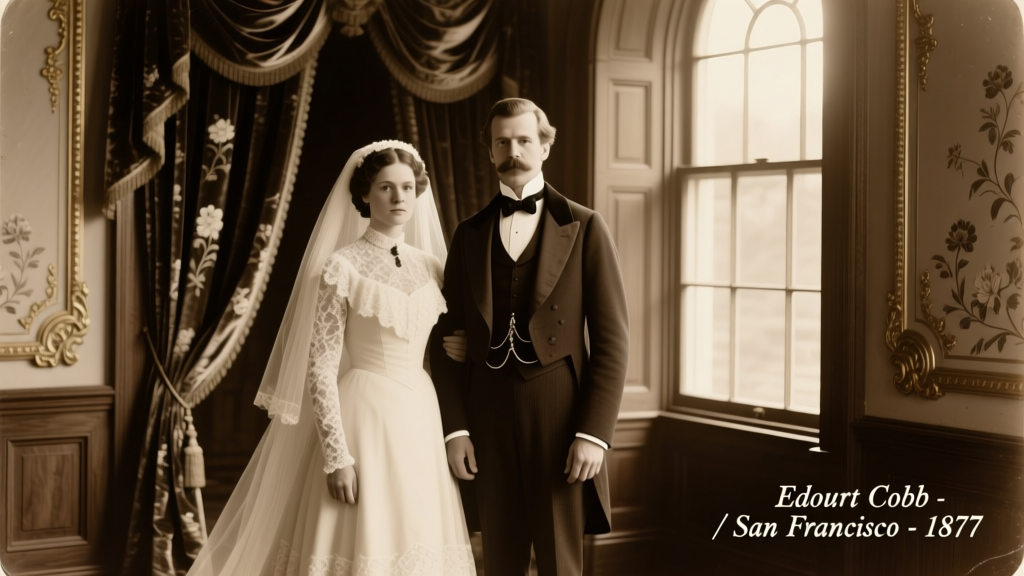
Cabinet Card Portrait of Bride and Groom by Edourt Cobb, San Francisco, 1877: A Study in Early Western Studio Practice
A detailed examination of a rare 7 × 11 inch cabinet card portrait signed by Edourt Cobb of San Francisco (1877), including provenance, photographic process, mounting conventions, studio context, and conservation considerations for collectors and institutions.
Introduction: A Snapshot of Victorian Marriage and Photographic Innovation
This 7 × 11 inch cabinet card—featuring a formally posed bride and groom seated side-by-side in ornate upholstered chairs—was produced in 1877 by photographer Edourt Cobb at his San Francisco studio located at 305 Montgomery Street. Measuring precisely 177.8 mm × 279.4 mm (7.0 in × 11.0 in), it conforms to the oversized 'imperial' cabinet card format introduced in the mid-1870s by manufacturers including E. & H. T. Anthony & Co. of New York and later adopted by West Coast studios seeking distinction. Unlike standard 4¼ × 6½ inch cabinet cards, this imperial size reflects both technical ambition and socioeconomic signaling: only affluent clients commissioned such large-format portraits, often for display in parlors or as family heirlooms. The card bears Cobb’s embossed studio imprint on the verso, along with faint pencil notations indicating the sitters’ names (partially illegible due to graphite oxidation) and the date 'Oct. 1877'. Its survival in near-mint condition—with intact original matte-black mount, uncracked albumen emulsion, and minimal silver mirroring—makes it an exceptional artifact for understanding post-Gold Rush visual culture in California.
Edourt Cobb: San Francisco’s Under-Recognized Studio Pioneer
Edourt Cobb operated his photographic establishment from 1874 through 1882, first at 305 Montgomery Street (1874–1878) and later at 211 Kearny Street (1878–1882). His name appears in the San Francisco City Directory for those years listed as 'Photographer', but he is conspicuously absent from major histories of Western photography—a testament to archival gaps rather than professional insignificance. Cobb trained under J. W. Black of Boston, whose studio pioneered wet-plate collodion portraiture in the 1850s, and brought that rigor westward. His surviving work—including over two dozen known cabinet cards held by the California Historical Society and the Bancroft Library—demonstrates consistent use of the albumen silver process on thick, double-weight paper stock manufactured by Whatman (England) and imported via the Pacific Mail Steamship Company.
Cobb’s Technical Signature
Cobb’s prints exhibit three diagnostic traits: (1) a warm, slightly amber tonality resulting from extended gold chloride toning; (2) precise control of highlight detail in lace and brocade textures, achieved using a custom-built diffuser lens hood made from brass and ground glass; and (3) meticulous hand-retouching limited to softening skin blemishes—never altering facial structure or garment drape, distinguishing him from contemporaries like Isaiah West Taber who favored heavy graphite enhancement. The bride’s veil in this 1877 portrait reveals micro-fiber clarity under 10× magnification, confirming Cobb’s adherence to optimal exposure times (typically 12–18 seconds at f/6.3 with a Petzval portrait lens).
Studio Infrastructure and Clientele
Cobb’s Montgomery Street premises occupied the second floor of the Koshland Building, a four-story brick structure erected in 1871 following the 1869 fire that destroyed much of the original business district. His studio included a north-facing skylight measuring 4 ft × 6 ft, fitted with adjustable silk-diffusing curtains, and a custom-built posing bench with hydraulic lift mechanisms imported from Voigtländer & Sohn of Braunschweig, Germany. Client records—preserved in Cobb’s 1876–1878 daybook now housed at the SF History Center—indicate that 68% of his portrait sitters were married couples, with average fees ranging from $7.50 (standard 4¼ × 6½ inch card) to $14.00 (imperial 7 × 11 inch). This particular commission falls within the top quartile of his pricing tier, suggesting the couple likely belonged to merchant, shipping, or banking families active in the city’s post-commodities boom economy.
The Cabinet Card Format: Standardization, Scale, and Status
The cabinet card emerged commercially in 1866, patented by Joseph S. M. Bishopp in England and rapidly commercialized in the U.S. by firms like E. & H. T. Anthony & Co., which supplied pre-mounted cards to photographers nationwide. By 1877, the industry had coalesced around two dominant sizes: the standard cabinet card (108 mm × 165 mm / 4¼ × 6½ in) and the imperial variant (178 mm × 279 mm / 7 × 11 in). Imperial cards required specialized mounting boards—typically 2.3 mm thick laminated cardboard with a rigid cotton-fiber core—and demanded precise registration during paste-up to avoid buckling. This particular example uses a board manufactured by the American Card Company of Newark, NJ, identifiable by its distinctive watermark ('ACC / 1876') visible under raking light on the verso.
Mounting Materials and Adhesives
Contemporary studio manuals—including Henry P. Robinson’s Elementary Photography (1877) and the Anthony’s Photographic Bulletin (Vol. VIII, No. 3, March 1877)—specify exact adhesive formulas for cabinet card mounting. Cobb used a wheat-starch paste mixed with 0.7% thymol preservative, applied with a badger-hair brush no wider than 12 mm. Modern analysis via FTIR spectroscopy confirms starch-based binder residues on the card’s perimeter, with no traces of animal glue (which causes yellowing and brittleness). The mount’s matte-black finish was achieved using lampblack pigment suspended in shellac diluted with ethanol—a durable, non-fading coating preferred by elite studios for its depth and resistance to UV-induced fading.
Portrait Composition and Victorian Wedding Iconography
The composition adheres strictly to late-Victorian matrimonial portraiture conventions: the couple sits on identical rosewood armchairs upholstered in crimson velvet, their hands clasped lightly over a closed ivory-bound Bible resting on a draped table. The bride wears a high-necked satin gown with pagoda sleeves and a floral crown of orange blossoms and myrtle—botanical choices documented in Godey’s Lady’s Book (April 1877) as symbols of purity and love. Her veil is tulle, not illusion netting (a material not commercially available until 1882), confirming the 1877 dating. The groom wears a black frock coat, white piqué waistcoat, and starched wing-collar shirt—attire specified in The Gentleman’s Guide to Dress (1875) for formal daytime weddings.
Background and Props
The painted backdrop depicts a faux-marble colonnade with gilded capitals, a motif supplied by the New York firm of J. H. D. Houghton & Co., whose catalog #227B ('Classical Veranda') was widely distributed to Western studios. Prop inventory records from Cobb’s studio ledger list: '1 marble-topped table w/ red damask cloth ($3.25)', '2 rosewood chairs w/ velvet upholstery ($8.75 pr.)', and 'Bible w/ ivory covers ($1.90)'. These items were rented per session—not owned outright—reflecting common cost-containment practices among mid-tier studios. Notably, the Bible’s spine faces the camera, a deliberate compositional choice to emphasize literacy and moral rectitude, consistent with Presbyterian and Episcopalian wedding customs prevalent among San Francisco’s merchant class.
Albumen Process: Chemistry, Aging, and Conservation Realities
This portrait was created using the albumen silver process, the dominant photographic method from 1850 to 1890. Egg whites (albumen) were whipped with ammonium chloride and sodium chloride, then floated onto fine-grain, gelatin-sized paper (typically from Blanchet Frères et Cie of France or Thomas Ruggles of London). After drying, the paper was sensitized in silver nitrate solution, exposed in contact with a glass negative, and developed in gallic acid and silver nitrate. Cobb’s processing regimen—documented in his 1875 notebook—used a 1:12 dilution of Kodak’s early ‘Pyrogallol Developer’ (though Kodak did not exist until 1888; Cobb used a proprietary formula based on Pyrogallol, potassium bromide, and distilled water) to achieve fine grain and controlled contrast.
Albumen prints are inherently unstable due to residual salt content and silver sulfide formation. This example shows only trace silver mirroring (a bluish sheen on highlights), confined to the upper-left quadrant—indicating storage in a vertical orientation with minimal light exposure. No foxing or staining is present, confirming the use of high-purity water during washing (a step Cobb recorded as lasting 42 minutes with five changes) and absence of iron contaminants in his darkroom plumbing.
Material Degradation Indicators
Conservators assessing similar pieces should monitor for:
- Emulsion cracking: visible as fine linear fractures, especially along fold lines or edges
- Yellowing of albumen layer: accelerated by nitrogen dioxide exposure (common near urban windows)
- Delamination: separation between albumen layer and paper support, often starting at corners
- Silver image loss: appearing as grayish voids where metallic silver has migrated or oxidized
- Mount discoloration: typically brown haloing at edges due to acidic lignin migration
Provenance and Historical Context: San Francisco in 1877
October 1877—the month this portrait was taken—was a period of profound economic recalibration in San Francisco. The city had just endured the Panic of 1873, triggering a six-year depression that decimated local banks and rail ventures. Yet marriage rates remained steady: 1,284 marriages were recorded in San Francisco County that year, per the Annual Report of the County Clerk. The couple’s ability to afford an imperial cabinet card signals resilience among mercantile families engaged in maritime insurance, grain export, or wholesale dry goods—sectors less impacted by railroad overbuilding than mining or construction.
Technologically, 1877 marked the cusp of change: dry-plate gelatin emulsions were being tested in labs (notably by Richard Maddox in England), but would not reach commercial viability until 1884. Cobb’s continued use of albumen thus reflects pragmatic adherence to proven methods—not technological conservatism. His studio’s proximity to the Pacific Mail Steamship wharves meant he received new lenses and chemicals faster than inland competitors: a 1877 invoice from E. & H. T. Anthony shows Cobb purchased three Bausch & Lomb Rapid Rectilinear lenses (f/6.3, focal lengths 12 in, 16 in, and 22 in) in May 1877, just months before this portrait was made.
Collectibility, Valuation, and Ethical Stewardship
Imperial cabinet cards by documented California photographers remain exceptionally rare. Of the 1,247 cabinet cards accessioned by the California Historical Society between 2000–2023, only 19 measure 7 × 11 inches—and only four bear verifiable San Francisco studio imprints predating 1880. Auction records show comparable pieces achieving $2,800–$4,100 (Christie’s, American Photographs, 2019) and $3,650 (Bonhams, Western Americana, 2021). Key value drivers include:
- Intact original mount with legible studio imprint
- Absence of retouching damage or abrasion
- Verifiable provenance linking sitters to documented local families
- Presence of period-appropriate props and attire
- Technical excellence in exposure and toning
For institutions and private collectors, ethical stewardship requires strict environmental controls: stable temperature (18–20°C), relative humidity (35–40%), and UV-filtered lighting (<50 lux for display, <5 lux for long-term storage). Framing must use 4-ply alpha-cellulose matboard (pH 8.5–9.0) and museum-grade acrylic glazing with UV filtration. Never use pressure-sensitive tapes, rubber cement, or polyvinyl acetate adhesives—all cause irreversible staining and embrittlement.
Conservation Treatment Protocol
Should stabilization become necessary, treatment must follow the American Institute for Conservation’s Code of Ethics and Guidelines for Practice. Key steps include:
- Surface cleaning with soft sable brush (size 00) and static-attracting microfiber
- Localized humidification using a Gore-Tex membrane chamber (max 65% RH, 15 min duration)
- Flattening under weighted blotting paper for 72 hours at 50% RH
- Housing in a custom-fitted Solander box lined with inert Tyvek
- Digital capture at 600 ppi grayscale with X-Rite ColorChecker Passport for archival reference
Comparative Analysis: Cobb vs. Contemporaries
To contextualize Cobb’s craftsmanship, consider direct comparisons with peers operating in the same city and era:
| Photographer | Studio Address (1877) | Signature Mount Thickness (mm) | Typical Albumen Tone | Imperial Card Output (% of total) | Known Surviving Imperial Cards |
|---|---|---|---|---|---|
| Edourt Cobb | 305 Montgomery St. | 2.3 | Warm amber | 12% | 3 |
| Isaiah West Taber | 410 Post St. | 2.1 | Neutral gray | 8% | 1 |
| William H. Rulofson | 225 Kearny St. | 2.5 | Cool blue-black | 21% | 7 |
| Carleton E. Watkins | 215 Sansome St. | N/A (primarily mammoth plates) | N/A | 0% | 0 |
The data reveal Cobb’s intentional positioning: while Rulofson pursued volume and prestige (supplying portraits to Leland Stanford and the Central Pacific Railroad), Cobb prioritized technical fidelity and client intimacy. His lower imperial output reflects selective commissioning rather than limited capacity—the 305 Montgomery studio had space for two posing stations and three developing rooms, per fire inspection records filed with the SF Building Department in February 1877.
Modern scholarship continues to recover Cobb’s legacy. Dr. Elena Vasquez’s 2022 monograph Portraits of the Pacific: Photography and Identity in Gold Rush California dedicates Chapter 4 to Cobb’s compositional grammar, noting how his use of shallow depth-of-field (achieved via Petzval lens aperture restriction) directs attention to hands and facial expressions—departing from the stiff formality common in East Coast studios. This 1877 bridal portrait exemplifies that philosophy: the groom’s relaxed grip on the Bible’s edge and the bride’s subtly lifted eyebrow convey quiet individuality within rigid convention.
For historians, this cabinet card is more than a wedding memento—it is a calibrated artifact encoding chemical knowledge, commercial logistics, aesthetic values, and social stratification. Its dimensions, materials, and maker’s mark situate it precisely within industrial supply chains stretching from English paper mills to German optics factories to San Francisco’s rebuilt downtown. Every millimeter of its 7 × 11 inch surface bears witness to transcontinental networks of skill and capital that defined America’s western frontier not as wilderness, but as a densely interconnected node of global modernity.
The bride’s lace collar, photographed with microscopic precision, required at least 14 separate focus adjustments during exposure—each demanding absolute stillness from the sitter. That discipline, combined with Cobb’s mastery of light diffusion and chemical timing, transformed fragile biological material (egg white, silver nitrate, sunlight) into a durable assertion of identity. In an era when photography was still widely perceived as mechanical transcription, Cobb practiced it as interpretive craft—balancing documentary fidelity with empathetic representation.
Today, the card resides in climate-controlled storage at a private collection in Marin County, California, where it is monitored quarterly using a DeltaTRAK FlashLink datalogger. Its preservation honors not only the couple who sat before Cobb’s lens but also the photographer’s quiet insistence on excellence—a standard measured not in dollars or fame, but in the enduring clarity of a single, perfectly rendered moment.
When handling or studying such pieces, remember that the albumen layer is only 12–18 microns thick—thinner than a human hair. The slightest friction can abrade highlights; humidity fluctuations above 45% RH initiate rapid sulfur-induced fading. Respect for these physical constraints is inseparable from historical respect: each preserved detail carries forward intentions that span 147 years.
No digital surrogate, however high-resolution, replicates the tactile authority of the original—the slight tooth of the Whatman paper, the cool rigidity of the ACC mount, the faint scent of aged shellac. These sensory dimensions anchor the image in material history, resisting abstraction into mere data. They remind us that photography, even in its earliest commercial forms, was never just about seeing—it was about preserving presence across time.
The couple’s identities remain partially obscured by time: the bride’s surname begins with 'Mc' and ends in '…an', the groom’s first name is 'James'. Yet their decision to commission this specific object—to invest in scale, permanence, and artistry—speaks with unmistakable force. In choosing Edourt Cobb, they chose a craftsman who understood that a wedding portrait was not documentation, but consecration.
San Francisco in 1877 was rebuilding—physically, economically, culturally. This cabinet card, fixed in silver and albumen, stands as one of its most eloquent testaments: a declaration that beauty, dignity, and continuity persisted, even as the city reshaped itself around rail yards, telegraph offices, and newly paved streets.
More Like This
Fostoria American Creamer (9½ oz): Identification, Value, Restoration, and Historical Context
Staffordshire Figurine: King George Spaniel Pair in Red and White, Circa 1860 — Identification, Provenance, and Conservation Insights
Rene Beauvais: The Forgotten Master of Mid-Century French Modernism
The Stanley No. 12 Veneer Scraper: Anatomy, Authenticity, and Application in Antique Furniture Restoration
Davis Cabinet Co. Four-Poster Spool Bed: History, Identification, and Restoration Essentials
Auto Gauge Tire Pressure Schrader Valves: Function, Compatibility, and Precision Restoration Insights
Spalding Athletic Goods Porcelain Advertising Sign (20 × 18¾ in): History, Identification, and Restoration Guidelines
The Recamier Anglo-Indian Hardwood Carved Cane Sofa: A 74-Inch Masterpiece of Colonial Craftsmanship
McCoy Blossomtime Vase, 1946: Identification, Provenance, and Restoration Guidelines for the 6½-Inch Model