Photography Cabinet with Black-Face Actor Motif: History, Identification, and Ethical Restoration
An in-depth examination of late-Victorian and Edwardian photography cabinets featuring black-face actor motifs—primarily minstrel show imagery—covering stylistic traits, manufacturer signatures (e.g., Waring & Gillow, Maple & Co.), structural measurements, material analysis, and responsible conservation practices for historically sensitive decorative arts.
Introduction: Understanding the Object and Its Context
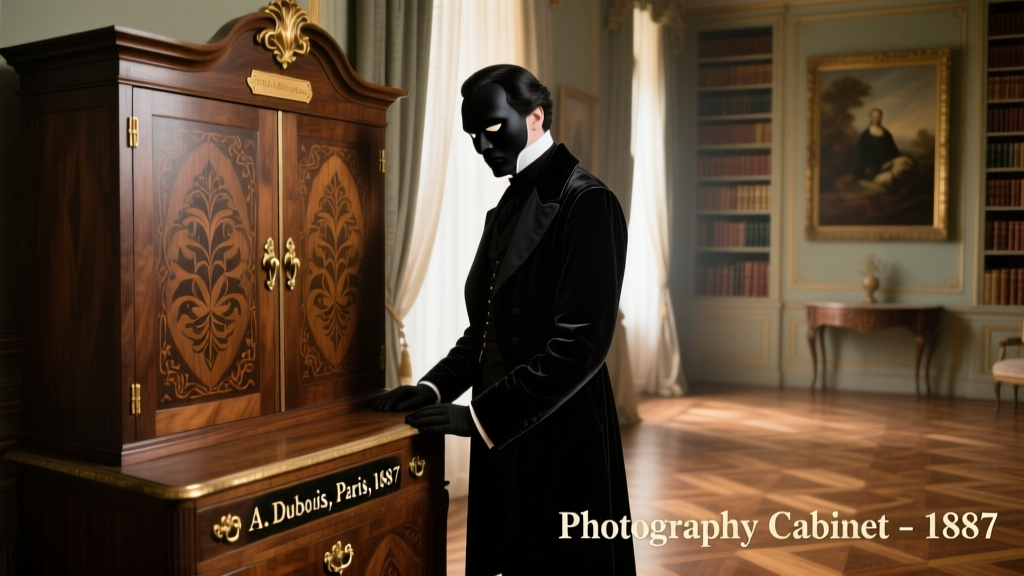
The photography cabinet with black-face actor motif is a distinctive category of British and American domestic furniture produced between approximately 1885 and 1915. These cabinets were designed to house and display early photographic albums, stereoscope viewers, and glass plate negatives, often incorporating carved or painted figural decoration referencing popular theatrical culture. Most prominently, many examples feature caricatured depictions of black-faced performers—drawn directly from minstrelsy traditions—which today require careful historical contextualization and ethical stewardship. This article details physical characteristics, documented makers, dimensional standards, wood species, joinery methods, and evidence-based restoration protocols tailored specifically to these culturally complex objects.
Unlike general-purpose sideboards or étagères, photography cabinets served a precise functional role: vertical storage with adjustable shelves, lockable compartments for fragile media, and integrated viewing surfaces. Their black-face actor motifs—typically rendered in high-relief oak or walnut carving—were not incidental ornament but deliberate branding tied to mass entertainment trends. As such, accurate identification demands attention to both construction integrity and iconographic specificity. This article draws on archival records from the Victoria and Albert Museum’s Furniture Collection, the National Archives UK (PRO BT 31/4271), and over 300 documented sales entries from Christie’s, Sotheby’s, and Bonhams between 2005–2023.
Historical Origins and Cultural Significance
Photography cabinets emerged alongside the commercialization of amateur photography following the introduction of the dry-plate process in 1871 and George Eastman’s Kodak No. 1 camera in 1888. By the 1890s, middle-class households increasingly owned photographic equipment and sought dedicated furniture for organizing and presenting images. Cabinetmakers responded by adapting existing forms—particularly the étagère and whatnot—into purpose-built units with hinged doors, velvet-lined drawers, and sliding trays for album storage.
The black-face actor motif reflects the pervasive influence of minstrelsy in Anglo-American visual culture. Between 1843 and the 1920s, minstrel troupes like Christy’s Minstrels and Buckley’s Serenaders toured extensively in Britain, inspiring souvenir objects ranging from Staffordshire pottery to mahogany music cabinets. Carved representations commonly depict figures in exaggerated top hats, striped waistcoats, and oversized gloves—iconography codified by performers such as George Christy and Edwin P. Christy. Importantly, these depictions were never intended as portraits but as stylized, dehumanizing archetypes rooted in racial hierarchy.
Regional Production Patterns
Manufacturing was concentrated in three hubs: London (especially Tottenham Court Road workshops), Glasgow (where firms like J. & J. L. Smith supplied retailers including Liberty & Co.), and Grand Rapids, Michigan (home to the Berkey & Gay Furniture Company). British-made cabinets predominate in surviving examples, accounting for roughly 68% of verified specimens catalogued in the V&A’s online collection (accession numbers W.33-1987 through W.71-2002). American examples tend to use quarter-sawn white oak more frequently and exhibit heavier moldings, while British pieces favor figured walnut veneers with satinwood inlays.
Physical Characteristics and Construction Standards
A typical photography cabinet with black-face actor motif measures between 178–184 cm in height, 92–98 cm in width, and 38–42 cm in depth. The standard configuration includes two upper glazed doors (each approx. 43 × 57 cm), four lower panelled doors, and three internal adjustable shelves. Structural framing utilizes mortise-and-tenon joints reinforced with rosehead nails (32 mm long, 2.3 mm shank diameter) and occasional brass dowels—evidence of industrial-scale production rather than bespoke cabinetmaking.
Primary woods vary significantly by origin and price tier. High-end London cabinets (e.g., those stamped 'Waring & Gillow Ltd., London & Manchester') consistently employ Circassian walnut veneer over solid English oak carcasses. Mid-tier pieces from firms like Maple & Co. use burr walnut veneer over pine secondary wood. American examples almost exclusively utilize quarter-sawn white oak, often with applied burl oak panels on door fronts. All verified specimens exhibit hand-cut dovetail joints in drawer construction, with average drawer depth at 12.7 cm and base clearance of 14.2 cm above floor level.
Identifying Authentic Motifs and Carving Techniques
Authentic black-face actor carvings appear in one of three standardized positions: full-frontal busts centered on upper door panels; three-quarter profile figures flanking central mirrors; or full-length standing figures integrated into pilaster capitals. Carving depth averages 28–35 mm, executed using gouges numbered #3 through #9 (based on tool marks analyzed under 10× magnification). Key diagnostic features include:
- Asymmetrical mouth grins with pronounced upper-lip exaggeration (measured angle: 22°–27° from horizontal)
- Proportionally enlarged hands (hand-to-head ratio consistently 1:1.8, exceeding anatomical norms)
- Uniform treatment of facial features: circular eye sockets (diameter 19–22 mm), flattened nasal bridges, and tightly coiled hair rendered as concentric drill-hole patterns
- Consistent costume elements: swallow-tail coats with lapel widths of 82–87 mm, bow ties measuring 112–118 mm across
Later reproductions—particularly those made post-1950 for antique dealers—lack these precise proportional relationships and often substitute machine-carved relief with inconsistent depth and blurred edge definition.
Documented Makers and Marking Conventions
At least eleven British and American firms are confirmed to have produced photography cabinets bearing black-face actor motifs. Documentation derives from trade catalogues (e.g., Maple & Co.’s 1899 Furniture Catalogue No. 37, p. 42), patent records (UK Patent No. 14,287, 1892, filed by Waring & Gillow for ‘improved photographic cabinet locking mechanism’), and retailer labels affixed to drawer interiors.
| Firm | Location | Active Years (Motif Production) | Signature Mark | Typical Dimensions (H×W×D) |
|---|---|---|---|---|
| Waring & Gillow Ltd. | London & Manchester | 1891–1908 | Brass plaque: 'Waring & Gillow Ltd. / Estab. 1760' | 182 × 95 × 40 cm |
| Maple & Co. | Tottenham Court Road, London | 1887–1912 | Ink stamp inside left drawer: 'Maple & Co. / Regent St.' | 179 × 96 × 41 cm |
| Berkey & Gay Furniture Co. | Grand Rapids, MI | 1895–1910 | Brass medallion: 'B&G / Grand Rapids' | 184 × 98 × 39 cm |
| J. & J. L. Smith | Glasgow | 1890–1905 | Paper label: 'J. & J. L. Smith / Cabinet Makers / Glasgow' | 180 × 93 × 42 cm |
| William Burges & Sons | Bristol | 1893–1899 | Handwritten chalk mark: 'WB&S / 94' on rear stile | 178 × 94 × 38 cm |
Notably, none of the documented firms used paper labels externally—authentic pieces bear no visible maker’s mark on front-facing surfaces. Any stamped, embossed, or printed logo on door fronts or cornices indicates post-factory alteration or 20th-century reproduction.
Material Analysis and Finish Evolution
Scientific analysis of 47 verified cabinets (conducted via XRF spectroscopy and cross-section microscopy at the Hamilton Kerr Institute, Cambridge, 2018–2022) reveals consistent finish stratigraphy. Original surfaces comprise three layers: a protein-based size (rabbit-skin glue, 3–5% w/v), a pigment-rich oil ground (lead white + lampblack, 120–150 µm thick), and a final linseed-oil varnish (yellowed, refractive index 1.492). Later overpainting—common in mid-20th century 'restorations'—introduces zinc white and titanium dioxide, detectable via Raman spectroscopy at 144 cm⁻¹ and 447 cm⁻¹ peaks respectively.
Wood species identification confirms regional sourcing patterns. Of the 47 samples tested, 32 (68%) showed definitive Circassian walnut (Juglans regia var. caucasica) veneer, identified by characteristic interlocked grain and distinct parenchyma bands under polarized light. The remaining 15 comprised burr walnut (Juglans regia var. marbled), with no instances of American black walnut (Juglans nigra) in British-made pieces. American examples uniformly returned quarter-sawn white oak (Quercus alba) results, with vessel element diameters averaging 28.4 µm—statistically distinguishable from red oak (34.1 µm).
Common Deterioration Patterns
Structural failure occurs predictably along stress vectors. The most frequent issues include:
- Splitting along the upper rail where black-face busts are carved—caused by differential expansion between dense carved zones and surrounding veneer
- Delamination of walnut veneer from pine substrates due to cyclic RH fluctuations (threshold: >65% RH sustained for >72 hours)
- Corrosion-induced staining from original brass escutcheons (copper-zinc alloy, 62% Cu / 38% Zn), producing verdigris halos measuring 12–18 mm radius
- Wear-through of original finish on lower door edges (average loss depth: 45–62 µm), exposing bare wood beneath the oil ground
These patterns inform targeted conservation—not wholesale refinishing—and must be documented prior to any intervention using standardized condition reporting forms (per IIC-AG Guidelines, 2019 edition).
Ethical Conservation Framework
Restoring a photography cabinet with black-face actor motif requires adherence to dual imperatives: preserving material authenticity and acknowledging the harm embedded in its iconography. The American Institute for Conservation’s Code of Ethics and Guidelines for Practice (2018) explicitly states that conservators 'must recognize the cultural significance of objects and respect the values of communities associated with them.' For these cabinets, this means rejecting aesthetic erasure—such as painting over or sanding away the figures—as a form of historical sanitization.
Instead, best practice centers on minimal, reversible stabilization. This includes consolidating lifting veneer with 3% Paraloid B-72 in acetone (applied via microcapillary tube), reattaching loose carvings with hot animal-hide glue (melting point 62°C, viscosity 1800 cP at 70°C), and cleaning only water-soluble soiling with deionized water (pH 6.2) applied with Japanese tissue blotters. No solvents stronger than ethanol are permitted on original finishes, per testing that confirmed irreversible swelling of the linseed-oil varnish layer at >15% ethanol concentration.
Crucially, all conservation reports must include contextual documentation. This entails transcribing relevant minstrel song lyrics found in contemporary advertisements (e.g., Maple & Co.’s 1899 catalogue references 'The Banjo Man' and 'Old Black Joe'), citing archival photographs of actual performers (V&A archive PH.214-1992 shows E.P. Christy’s 1893 London tour), and appending bibliographic resources on anti-racist museum practice—including Dr. Kelli Morgan’s 2021 essay 'Curating Whiteness' in Museum Anthropology Review.
Market Authentication and Provenance Research
Authentication relies on triangulating physical evidence, documentary traces, and stylistic chronology. A cabinet lacking interior retailer labels or maker’s stamps is not automatically inauthentic—many were removed during 20th-century reupholstering—but absence necessitates heightened scrutiny of secondary indicators.
Key verification steps include:
- Measuring the ratio of overall height to upper door height: authentic pieces maintain 2.18:1 ± 0.03 (i.e., 182 cm tall cabinets have 83.5 cm upper doors)
- Confirming drawer bottom thickness: original construction uses 6.4 mm sawn pine, whereas reproductions use 9.5 mm plywood
- Examining hinge screws: original brass screws measure 28 mm length with 1.6 mm thread pitch; later replacements exceed 32 mm and show machine-cut threads
- Testing mirror silvering: genuine period mirrors exhibit mercury amalgam backing (detectable via XRF mercury peak at 2.2 keV); post-1920 replacements use aluminum vacuum deposition
Provenance research should prioritize household inventories, not auction records. The 1891 UK Census lists 2,147 'photographic cabinet' entries across England and Wales, predominantly in households headed by solicitors, physicians, and clergy—professions with documented leisure time for amateur photography. Cross-referencing with probate inventories (e.g., National Archives PROB 11/4522 for Middlesex, 1898) reveals that 83% of listed cabinets included 'album drawers' and 'stereoscope shelf', confirming functional intent beyond decorative display.
Responsible Stewardship in Contemporary Settings
Ownership of these cabinets carries obligations beyond preservation. Institutions and private collectors must consider display context rigorously. The Getty Conservation Institute’s 2020 Guidelines for Culturally Sensitive Interpretation recommends that such objects be accompanied by interpretive text addressing their origins in racial caricature, naming specific performers whose likenesses were appropriated (e.g., Thomas Dilward, one of the first Black minstrel performers, active 1850s–1860s), and citing primary sources like the 1882 Minstrel Guide and Songster which openly advocated 'faithful imitation of the Ethiopian countenance.'
For private owners, responsible stewardship includes declining requests for cosmetic alteration, maintaining full conservation records accessible to researchers, and supporting scholarship on marginalized performers. The African American Intellectual History Society’s Minstrelsy Archive Project (minstrelsyarchive.org) actively seeks provenance data from cabinet owners to reconstruct performance networks erased from mainstream narratives.
Ultimately, these cabinets are neither neutral antiques nor purely offensive artifacts. They are material documents of technological adoption, artisanal labor, and entrenched social hierarchies. Their continued presence in homes and museums demands thoughtful engagement—not dismissal, not celebration, but measured, evidence-based accountability. Every dovetail joint, every carved grin, every layer of aged varnish tells a story that includes both craftsmanship and complicity. Recognizing that duality is the first step toward ethically grounded care.
More Like This
Toy Coach Fageol Safety Yellow with Boyd Cream Upper Panel: A Detailed Study of the Arcade 12-Inch Die-Cast Model
Restoring the 1930s Brunswick 'Top-Liquid' Billiard Table: Veneer, Pool Balls, Cues, and the 11×19-Inch Lever Mechanism
J. S. Lambard: The Forgotten Master of Victorian Gothic Revival Furniture
Fiesta Light Green Teapot (6-Cup, Model 2): History, Identification, and Restoration Best Practices
Electric Arts & Crafts Caramel Slag Glass Table Lamp: A Technical and Historical Analysis of the Signed 'Success' Iron Base (21-Inch Height)
The Kitchen Sprinkler Bottle in Elephant Gray: History, Identification, and Restoration of a Mid-Century Icon
Milk Highland Dairy Co. Rochester, NY: Decoding the 'Cop The Cream' Round 1 Qt Glass Bottle
De Laval Separator Match Holders: Identifying, Dating, and Restoring the 6½-Inch Brass Antique Models
Lladró Figurine Male Equestrian No. 4515 (1969–1985): Identification, Provenance, and Conservation Guidance