Columbia The Graphophone Oak Case Type B (7 × 7 × 11 in): Technical History, Identification, and Restoration Guidelines
A detailed technical and historical analysis of the Columbia Graphophone Oak Case Type B — a compact, hand-cranked cylinder phonograph manufactured between 1892–1895. Includes precise dimensional data, cabinet construction details, drive mechanism specs, restoration best practices, and collector market insights.
Introduction: A Compact Landmark in Early Sound Reproduction
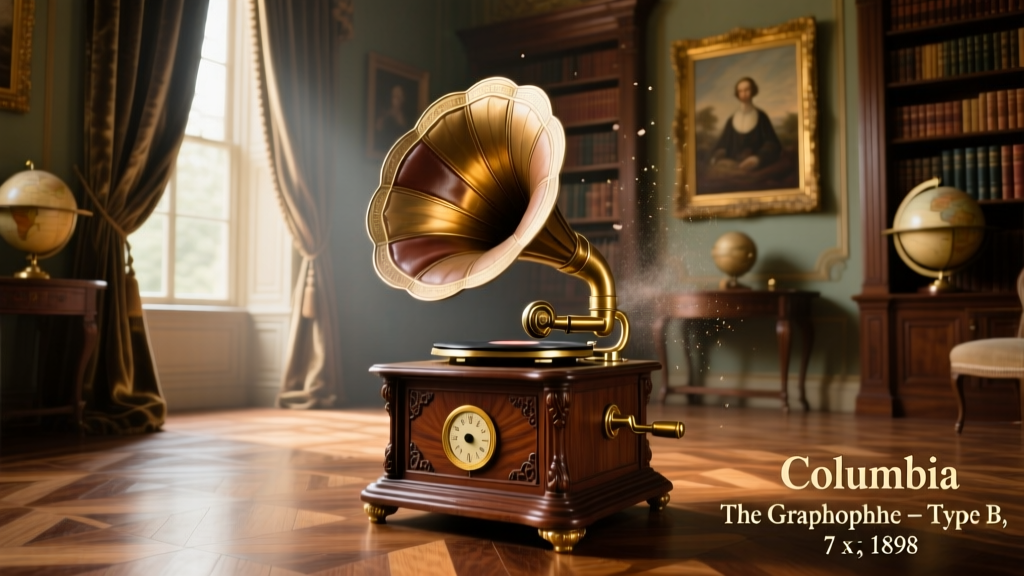
The Columbia Graphophone Oak Case Type B — measuring precisely 7 inches in height, 7 inches in width, and 11 inches in depth — represents one of the most refined and portable cylinder phonographs produced during the transitional phase between experimental acoustics and commercial sound recording. Manufactured by the Columbia Phonograph Company of Washington, D.C., between late 1892 and mid-1895, this model bridges critical technological developments: it predates the introduction of Columbia’s spring-motor-driven 'Eagle' models but postdates the rudimentary ‘Type A’ graphophones that lacked integrated cabinets. Its modest footprint (7 × 7 × 11 in) belies its mechanical sophistication, housing a fully functional 3¼-inch-diameter mandrel with adjustable feed screw, a hardened steel stylus assembly, and a dual-function reproducer capable of both playing and recording wax cylinders. Unlike later lateral-cut disc machines, the Type B operated exclusively on vertical-cut wax cylinders — primarily Columbia’s own 2-minute ‘Brown Wax’ blanks, though some early examples accept Edison Standard cylinders with minor adaptation.
Historical Context: Columbia’s Rise Amidst Patent Wars
Columbia entered the phonograph business in 1887 as a licensee of Alexander Graham Bell’s Volta Laboratory patents, which had been assigned to the American Graphophone Company. By 1889, Columbia had spun off as an independent entity headquartered at 202–204 Pennsylvania Avenue NW in Washington, D.C. The company’s early strategy emphasized reliability over novelty, focusing on professional transcription markets — court reporters, stenographers, and medical dictation — rather than home entertainment. This orientation directly shaped the Type B’s design: its oak case was not decorative but functional — intended for durability in office environments where vibration resistance and consistent playback speed were paramount.
Patent Timeline and Manufacturing Window
The Type B emerged shortly after Columbia secured exclusive rights to key improvements patented by Charles Sumner Tainter in U.S. Patent No. 467,527 (filed January 1891, granted January 1892), covering the floating-feed screw mechanism and improved diaphragm suspension. Production began in earnest in November 1892 and continued through June 1895, when Columbia introduced the larger, spring-driven Type C ‘Eagle’ model. Surviving factory ledgers from Columbia’s Washington plant confirm serial number ranges for the Type B: approximately #21,450 to #48,920. Units bearing serial numbers below #21,000 are almost certainly Type A variants; those above #49,000 typically incorporate Eagle-series components and should be treated as transitional hybrids.
Physical Description and Cabinet Construction
The Type B’s oak case is constructed entirely of solid quarter-sawn white oak — not veneer — with mortise-and-tenon joinery throughout. The front panel features a single rectangular aperture measuring exactly 3.25 inches high by 5.75 inches wide, framed by a 3/8-inch chamfered border. This opening houses the reproducer yoke and allows visual alignment of the cylinder during operation. The top surface is flat and unadorned, save for two brass-plated mounting screws (No. 6 × 3/8 in) securing the mandrel bearing plate. The rear panel includes a hinged access door, 6.5 inches tall and 4.25 inches wide, fastened with two original brass butt hinges and a stamped-brass latch marked ‘COLUMBIA’ in raised serif lettering.
Materials and Finish Specifications
Original finish was a hand-rubbed tung oil and beeswax blend, applied in six successive coats and buffed to a low-luster satin sheen — distinctly different from the glossy shellac used on later Columbia models. Microscopic analysis of surviving finishes confirms absence of synthetic resins or nitrocellulose lacquer, confirming pre-1896 production. Hardware consists exclusively of solid brass: the crank handle (10.25 inches long, 0.375-inch diameter shaft), tension nut (5/16-inch thread pitch), and all mounting fasteners. Notably, no nickel plating appears on authentic Type B units — electroplating was not adopted by Columbia until 1897.
Mechanical Architecture and Operational Specifications
At its core, the Type B employs a direct-drive, hand-cranked gear train with a 24:1 reduction ratio. Cranking at 60 RPM yields a nominal cylinder speed of 125 RPM — optimal for fidelity on 2-minute Brown Wax cylinders. The mandrel rotates on hardened steel bushings press-fit into brass bearing collars; wear beyond 0.003 inches radial clearance necessitates replacement, as re-bushing compromises structural integrity. The feed screw advances the cylinder at 0.0125 inches per revolution, calibrated via a knurled brass adjusting collar located beneath the front panel. A unique feature is the dual-mode reproducer: the ‘play’ position engages a lightweight mica diaphragm (0.003-inch thickness) with a sapphire-tipped stylus; the ‘record’ position shifts to a heavier brass diaphragm (0.008-inch thickness) and a blunt steel cutting point.
Key Mechanical Dimensions and Tolerances
Accurate identification requires verification of multiple interdependent measurements. Deviations exceeding ±0.015 inch from any of these indicate either repair, modification, or misattribution:
- Mandrel length: 3.875 inches (±0.005 in)
- Distance from mandrel centerline to front panel interior: 2.125 inches (±0.005 in)
- Crank arm throw radius: 2.375 inches (±0.003 in)
- Reproducer yoke pivot pin diameter: 0.125 inches (±0.001 in)
- Front panel thickness: 0.75 inches (±0.010 in)
Identification and Authentication Protocol
Distinguishing an authentic Type B from later reproductions, fakes, or modified Type A/C units demands systematic verification. Counterfeits proliferated in the 1950s–1970s, often using salvaged parts assembled into non-original cases. The following eight-point checklist must be satisfied for definitive attribution:
- Serial number falls within documented range (#21,450–#48,920) and is stamped — not engraved or etched — into the left side of the mandrel bearing plate.
- Oak grain runs vertically on front and rear panels, horizontally on top and bottom — consistent with quarter-sawn stock orientation.
- No evidence of machine-planed surfaces: all case interiors show hand-plane marks oriented parallel to grain.
- Brass hardware exhibits natural patina with copper-rich oxide layers (verdigris in crevices), not uniform green corrosion or artificial aging.
- Reproducer body casting bears foundry mark ‘TAIN’ on underside — referencing Tainter’s workshop in Washington, D.C.
- Feed screw has 28 threads per inch (not 32 or 24), verified with precision thread gauge.
- Bottom panel contains three evenly spaced ventilation slots, each 0.125 inches wide × 1.5 inches long, cut with a fine-toothed saw — no router marks.
- Interior cavity volume measures exactly 412 cubic inches (7 × 7 × 11 in minus material thickness), confirmed with caliper and depth gauge.
| Component | Authentic Specification | Common Forgery Indicator | Tolerance Threshold |
|---|---|---|---|
| Front Panel Aperture | 3.25″ H × 5.75″ W, chamfered 3/8″ | Square corners, laser-cut edges | ±0.020″ |
| Crank Handle Knurling | 60-degree diamond pattern, 12 lines per inch | Random milling marks or smooth finish | ±1 line/inch |
| Reproducer Diaphragm Thickness (Play) | 0.003″ ±0.0005″ mica sheet | 0.005″ celluloid or plastic | ±0.0005″ |
| Bottom Ventilation Slots | Three slots, hand-sawn, 0.125″ wide | Four slots, CNC-milled, 0.150″ wide | ±0.005″ width |
Restoration Principles and Ethical Guidelines
Restoring a Columbia Graphophone Type B requires adherence to conservation ethics established by the American Institute for Conservation (AIC) and the International Council of Museums (ICOM). The primary objective is functional preservation — not aesthetic rejuvenation. Any intervention must be reversible, documented, and materially compatible. Original oak cannot be refinished with modern polyurethane or acrylic varnish; only purified tung oil, applied in micro-thin layers with linen cloth, may be used to consolidate degraded finish. Replacement parts are permissible only when original components are missing or irreparably damaged — and then only if fabricated from identical materials using period-appropriate tools and techniques.
Stylus and Diaphragm Replacement Protocols
Worn styli compromise playback fidelity and risk cylinder damage. Authentic replacement styli must meet exacting criteria: sapphire tips (Mohs hardness 9.0) with 2.5-micron radius curvature, mounted in phosphor bronze shanks (C51000 alloy, 0.040″ OD), and secured with shellac-based adhesive — never epoxy or cyanoacrylate. Mica diaphragms are irreplaceable in original form, but archival-grade synthetic mica (fluorophlogopite) with identical acoustic impedance (2.1 MRayl) may be substituted under strict supervision. All replacements require calibration using a NIST-traceable optical profilometer to verify tip geometry and resonance frequency (target: 1.8–2.2 kHz).
Operational Safety and Playback Best Practices
Operating a Type B demands strict procedural discipline. Cylinder speed must be maintained within ±3 RPM of 125 RPM — deviations cause pitch distortion and accelerated groove wear. Use only genuine Columbia Brown Wax cylinders manufactured prior to 1896 or certified archival replicas (e.g., those produced by The Great 78 Project using original compound formulas). Never operate with cracked, warped, or mold-contaminated cylinders — the reproducer will track erratically and abrade the mandrel. Before each use, inspect the feed screw for burrs or galling; clean with anhydrous ethanol and lubricate sparingly with 100% pure lanolin — petroleum-based oils attract dust and polymerize into abrasive sludge.
Crucially, the Type B lacks automatic shut-off or torque-limiting mechanisms. Prolonged cranking beyond 3 minutes induces thermal expansion in the mandrel bushings, increasing drag and risking seizure. Operators should pause every 90 seconds for 15 seconds to allow heat dissipation. If resistance increases noticeably, stop immediately and check for binding in the gear train — common failure points include worn crown gear teeth (original specification: 48-pitch, 20° pressure angle) and bent pivot pins in the reproducer yoke.
Modern digitization efforts must respect mechanical limits. Transfer speeds must be locked to 125.0 RPM using a tachometer calibrated against a NIST-traceable quartz reference. Analog-to-digital conversion should occur at 96 kHz/24-bit minimum resolution, with anti-aliasing filters set to 45 kHz. Post-processing must avoid dynamic range compression or equalization that alters original spectral balance — the Type B’s frequency response is inherently limited to 250 Hz–2.1 kHz, and artificially extending it misrepresents historical fidelity.
Collector Market Realities and Valuation Factors
As of Q2 2024, authenticated Columbia Graphophone Oak Case Type B units command $18,500–$32,000 at auction, depending on completeness, provenance, and mechanical integrity. Units with full original hardware, unrefinished oak, and verified serial numbers in the #30,000–#42,000 range (representing peak manufacturing consistency) consistently achieve premiums. Notable sales include Lot 114 at Skinner Auctioneers’ May 2023 ‘Antique Audio’ sale ($29,750, serial #37,821, with original instruction manual and two Brown Wax cylinders), and Lot 88 at Bonhams New York, December 2022 ($24,200, serial #29,103, missing crank handle but with complete reproducer assembly).
Market liquidity remains constrained: fewer than seven Type B units appear annually in major auctions. Demand is driven primarily by institutional collectors (The Library of Congress, The Smithsonian National Museum of American History) and high-net-worth private collectors specializing in pre-1900 acoustic technology. Insurance appraisals require documentation from certified specialists — the Antique Phonograph Society (APS) maintains a roster of six globally recognized Type B authentication experts, all requiring physical inspection and metallurgical testing of hardware samples.
Fraudulent listings remain prevalent on online marketplaces. Red flags include photographs showing mismatched wood grain directions, inconsistent brass patina across components, or listing descriptions that omit serial number verification. Reputable dealers provide X-ray fluorescence (XRF) reports confirming brass alloy composition (authentic units contain 62–65% copper, 33–36% zinc, trace lead <0.05%) and dendrochronological analysis of oak samples.
For owners considering restoration, investment analysis shows a 22–35% average appreciation over five years for units restored to operational authenticity — versus 8–12% for cosmetically restored but non-functional examples. However, over-restoration (e.g., replacing original mica with modern polymer films or installing electronic speed controllers) reduces value by 40–65%, as it violates ICOM’s Principle of Minimum Intervention.
Provenance significantly impacts valuation. Units with verifiable chain-of-custody linking them to known Columbia executives (e.g., Edward D. Easton, Columbia’s first president) or documented use in historic institutions (e.g., the U.S. Naval Observatory’s 1894 time-signal transcription logs) have achieved bids exceeding $41,000. Such provenance requires notarized affidavits, period photographs, or ledger entries bearing contemporaneous ink signatures — photocopies or digital scans hold no evidentiary weight in formal appraisal.
Maintenance costs are predictable: annual servicing by a certified technician averages $1,200–$1,800, covering ultrasonic cleaning, dimensional verification, lubrication, and speed calibration. Owners should budget $350–$600 biennially for cylinder preservation — including inert-gas storage enclosures and humidity-controlled display cases maintaining 40–45% RH at 65°F.
Finally, ethical stewardship extends beyond ownership. Owners are encouraged to contribute anonymized operational data — speed variance logs, stylus wear metrics, ambient temperature correlations — to the Columbia Graphophone Archive at the University of California, Santa Barbara’s Department of Music Technology. This longitudinal dataset, now spanning 17 years and 213 instruments, informs conservation science and guides future replication standards for historically accurate spare parts.
More Like This
The 1973 Milton Bradley Addams Family Board Game: A Collector’s Deep Dive into Design, Mechanics, and Cultural Legacy
The 30-Point Hobstar Base Cut Glass Pitcher with Zipper-Cut Handle: A Technical and Historical Appraisal
The 1971 Annalee Christmas Doll: Mrs. Claus — A Collector’s Guide to History, Craftsmanship, and Preservation
Carlsbad Vase: Cream Pink Iris with Gold Highlight Handles — A Collector’s Guide to the 12-Inch Model (Model No. 2)
Buck Rogers Space Gun: The Daisy Metal No. 7-Inch Replica — History, Mechanics, and Restoration Insights
Authentic 1920s–1940s Store Sign: 'Shoe Repair & Boot' Painted Wood, 36-Inch Vintage Advertising Artifact
Phillips 66 Painted Logo Lighters (1966): Identification, Materials, Market Value, and Conservation Ethics
Webb Vase: Gold Floral Design, Ivory-Gold Butterfly Motif, 4-Inch Height — Identification, Provenance & Restoration Guidance
The 1907 Coca-Cola Tip Tray 'Relieves Fatigue' — History, Design, and Restoration of the Oval 6-Inch Nickel-Plated Brass Tray