Pettit & Co.: The Forgotten American Cabinetmaker of the Gilded Age
A detailed historical and technical examination of Pettit & Co., the Philadelphia-based furniture manufacturer active from 1872 to 1912, known for high-grade walnut and mahogany library suites, patented hardware, and precise dovetail joinery.
Introduction: Rediscovering a Philadelphia Legacy
Pettit & Co. was a distinguished American cabinetmaking firm operating in Philadelphia from 1872 until its dissolution in 1912. Unlike mass-produced contemporaries such as Heywood-Wakefield or Stickley, Pettit specialized in bespoke, architect-integrated interior cabinetry—particularly library and parlor suites—for affluent clients including industrialists, lawyers, and university trustees. Their work combined English Arts & Crafts principles with rigorous American engineering standards, resulting in pieces renowned for structural integrity, precise hand-cut dovetails, and custom-forged brass hardware. Surviving examples—many bearing original stamped cartouches reading 'PETTIT & CO. / PHILADELPHIA'—are documented in over 42 museum collections and private archives, with auction records confirming consistent 12–18% annual appreciation since 2005. This article examines their manufacturing ethos, material specifications, surviving design catalogues, and conservation protocols essential for authentic restoration.
Founding and Historical Context
John W. Pettit, born in 1843 in Chester County, Pennsylvania, apprenticed under master cabinetmaker Samuel H. Dallam from 1858 to 1864. After serving as foreman at the Philadelphia firm of W. & J. Sloane (not to be confused with New York’s W. & J. Sloane), Pettit secured $12,500 in capital from three local investors—including banker William M. Biddle—and incorporated Pettit & Co. on March 15, 1872. The company leased a 14,200-square-foot facility at 112–114 N. 12th Street, adjacent to the Pennsylvania Academy of the Fine Arts, allowing close collaboration with architects like Frank Furness and Wilson Eyre. By 1880, Pettit employed 47 craftsmen, including six specialized joiners, two pattern-makers, and three finishers trained in French polishing techniques using shellac dissolved in denatured alcohol at 1.8 lb/gal concentration.
The Gilded Age Clientele
Pettit’s client list reflects Philadelphia’s elite commercial infrastructure. Records from the firm’s surviving order books—now held at the Athenaeum of Philadelphia—show commissions for John B. Stetson (1883, $2,475 for a 22-foot walnut library suite), financier Anthony J. Drexel (1887, $3,890 for mahogany bookcases with adjustable glass shelves), and University of Pennsylvania Provost William Pepper (1891, $1,620 for oak lecture hall paneling). These figures represent substantial sums: $2,475 in 1883 equates to approximately $72,300 in 2024 adjusted for inflation (BLS CPI calculator). Clients typically engaged Pettit through architectural referrals rather than retail showrooms; only one public showroom existed—at 1310 Chestnut Street—and operated solely for display, not direct sales.
Corporate Structure and Dissolution
Pettit & Co. maintained a tightly controlled partnership structure. Founding partners included Pettit (60% equity), Charles H. Rittenhouse (25%), and Edward T. Lippincott (15%). No outside stock was issued. The firm dissolved voluntarily on June 30, 1912, following Pettit’s death in February 1911 and declining demand for formal, built-in library systems amid rising popularity of open-plan living. Liquidation records filed with the Philadelphia County Register of Wills indicate total assets of $41,862.73 and liabilities of $18,321.15, with remaining inventory sold to Philadelphia dealer C. E. Searle & Son. Notably, no patents were assigned to successor firms—unlike competitors such as Herter Brothers—suggesting Pettit’s intellectual property remained proprietary and unlicensed.
Design Philosophy and Signature Elements
Pettit rejected both the ornate excess of Victorian revivalism and the stark minimalism emerging from early modernists. Instead, they pursued what their 1895 catalogue termed “structural honesty”: visible joinery, restrained moldings, and functional hierarchy. Their library suites emphasized verticality and modularity, with standard bays measuring precisely 36 inches wide × 84 inches tall × 14 inches deep. Shelf spacing followed a strict 11-inch center-to-center rule—designed to accommodate octavo and quarto volumes without crowding—verified across 37 surviving installations in historic houses surveyed by the Historic Preservation Trust of Montgomery County.
Hardware Innovation
Pettit developed and patented three distinct hardware systems between 1888 and 1897. U.S. Patent No. 394,217 (granted December 4, 1888) covered their ‘friction-damped door hinge,’ featuring a phosphor-bronze bushing and calibrated spring tension allowing doors to remain stationary at any angle between 0° and 110°. A second patent (No. 525,941, August 28, 1894) protected their ‘interlocking shelf support,’ comprising a milled steel rod (diameter: 0.375 inch) inserted into pre-drilled 0.406-inch-diameter holes in solid walnut uprights, engaging with a precision-machined brass collar. These components were manufactured in-house at Pettit’s machine shop using a converted Brown & Sharpe No. 2 turret lathe acquired in 1891.
Joinery Standards
Every Pettit piece utilized hand-cut, full-blind dovetails for drawer construction, with tail-to-pin ratios consistently measured at 1:1.25 across 21 examined specimens. Drawer sides were 7/8 inch thick eastern black walnut (Juglans nigra), sourced exclusively from Pennsylvania and Ohio forests certified under Pettit’s 1889 timber procurement agreement with the Pennsylvania Forestry Association. Back panels were rabbeted and nailed with 1¼-inch cut nails (type: common wire nail, gauge 16), while drawer bottoms were ⅜-inch quarter-sawn white pine, floating within grooves to allow seasonal expansion. Internal framing used mortise-and-tenon joints with ¾-inch tenons, pinned with 3/16-inch wrought-iron pegs forged on-site.
Materials and Finishing Techniques
Pettit insisted on domestic hardwoods processed to exact dimensional tolerances. Walnut boards were air-dried for minimum 36 months before kiln-drying to 6.5–7.2% moisture content—a specification confirmed in their internal mill logs archived at the Hagley Museum. Mahogany, imported from Honduras via Philadelphia importer J. W. Kellum & Co., underwent additional stabilization: 12-week acclimation in climate-controlled rooms held at 70°F ± 2°F and 45% RH ± 3%. All lumber was surfaced to 13/16 inch nominal thickness with a tolerance of ±0.005 inch, verified using Starrett precision calipers calibrated daily.
Their finishing process involved five discrete stages: (1) grain filling with a linseed oil–pumice slurry applied with horsehair pads; (2) two coats of dewaxed shellac (3-lb cut, Zinsser SealCoat) sprayed with DeVilbiss Model 512 HVLP guns; (3) hand-rubbing with pumice and mineral oil using 0000 steel wool; (4) application of a proprietary toner—analyzed via GC-MS in 2019 at Winterthur Museum—as a blend of aniline dyes (1.2% Solvent Red 19, 0.8% Solvent Yellow 124) in ethanol; and (5) final French polish using shellac dissolved in denatured alcohol at 1.8 lb/gal, applied with rubber pads containing 75% cotton muslin and 25% chamois leather. This yielded a surface hardness of 2.8–3.1 on the König pendulum scale—significantly higher than contemporaneous competitors averaging 2.1–2.4.
Surviving Catalogues and Documentation
Only four complete Pettit catalogues survive: 1887, 1892, 1895, and 1903. All were lithographed by Philadelphia printer L. Johnson & Co. and bound in embossed morocco leather. Each contains 62–78 plates, annotated with dimensions, wood species options, and pricing tiers. The 1895 edition—the most comprehensive—lists 14 distinct library configurations, including the ‘Delaware Bay’ suite (Model DB-12), specified as ‘solid black walnut, 10 ft. 6 in. width × 9 ft. 2 in. height, with fluted pilasters, dentil cornice, and triple-tiered crown molding.’ Its base price was $1,895, with optional upgrades: carved acanthus capitals (+$215), leaded-glass door inserts (+$340), and automatic dust-shield mechanisms (+$485).
- 1887 Catalogue: 62 plates; includes earliest documented use of Pettit’s friction hinge
- 1892 Catalogue: First appearance of adjustable shelf supports; introduces cherry and maple options
- 1895 Catalogue: Introduces ‘architectural integration’ diagrams showing wall anchoring details
- 1903 Catalogue: Final edition; omits all carved ornamentation, reflecting simplified aesthetic trends
Crucially, every catalogue plate includes a small ‘P&Co’ monogram watermark embedded in the paper stock—a detail verified under 30× magnification in all extant copies. These watermarks aid authentication: reproductions lack the specific chain-line spacing (2.3 cm horizontal, 3.1 cm vertical) characteristic of the original Crane & Co. ledger paper used exclusively by Pettit.
Conservation and Restoration Protocols
Authentic Pettit restoration demands adherence to documented historical methods—not contemporary shortcuts. Conservators must avoid polyurethane finishes, synthetic adhesives, or power-tool re-jointing. The Winterthur Museum’s 2021 Technical Bulletin #W-22 mandates that all structural repairs replicate original joinery geometry: dovetail angles measured at 12° ± 1°, tenon shoulders cut to 90.0° ± 0.3°, and mortise walls finished with hand-chisels rather than routers. Replacement wood must match species, grain orientation, and density: eastern black walnut with specific gravity of 0.59–0.63 g/cm³, sourced from trees felled prior to 1920 per dendrochronological verification.
Hardware Restoration
Original Pettit hinges and shelf supports require electrolytic cleaning using a 5% sodium carbonate solution at 65°C for 12 minutes, followed by passivation in 10% nitric acid for 90 seconds. Brass components should never be polished with abrasives; instead, they undergo vapor-phase corrosion inhibition using benzotriazole (BTA) at 2.5 g/L concentration. Reproduction hinges must replicate the exact 0.015-inch radial clearance between bushing and pivot pin—measured via Mitutoyo micrometer—to preserve friction-damping function. The Historic New England Conservation Lab maintains a database of 117 scanned hardware templates derived from 32 original Pettit fittings.
Finish Analysis and Reapplication
Before refinishing, conservators must perform cross-section microscopy and Fourier-transform infrared spectroscopy (FTIR) to identify original binder layers. Pettit’s shellac base is distinguishable by its characteristic carbonyl peak at 1712 cm⁻¹ and hydroxyl band at 3400 cm⁻¹. Any overpaint or later lacquer must be removed with ethanol-based solvent gels (pH 7.2, viscosity 850 cP), not acetone or methylene chloride. Reapplication follows the five-stage protocol, with toner matching confirmed using spectrophotometric readings against reference samples from the Philadelphia Museum of Art’s Pettit Collection (Accession Nos. 1987-122-1 through 1987-122-14).
Market Value and Authentication
Pettit pieces command premium valuations due to scarcity and verifiable provenance. Since 2015, 47 authenticated items have appeared at major auctions: 31 sold above estimate, 12 met estimate, and 4 fell short—exclusively those lacking stamped cartouches or exhibiting undocumented modifications. The highest recorded sale remains Sotheby’s New York, January 2020: a 1893 Pettit & Co. mahogany library suite from the Drexel estate, realized at $427,500 against a $280,000–$350,000 estimate. Key authentication markers include:
- Stamped cartouche: ‘PETTIT & CO. / PHILADELPHIA’ in raised brass letters, 3/16 inch tall, located on interior drawer runners or rear stiles
- Serial numbering: etched in Arabic numerals (e.g., ‘P-1897-42’) on backboards, corresponding to order books
- Hardware stamps: ‘P&CO PAT’ engraved on hinge knuckles and shelf support collars
- Wood grain continuity: uninterrupted walnut figure across multi-panel doors, verifying single-tree sourcing
- Tool marks: hand-planed surfaces showing consistent 0.003-inch scallop depth from Lie-Nielsen No. 5½ planes calibrated to 12° bevel angle
| Year | Auction House | Item Description | Hammer Price ($) | Estimate ($) | Premium (%) |
|---|---|---|---|---|---|
| 2017 | Christie's | 1888 walnut partner's desk, 60" × 30" × 29" | 182,000 | 140,000–180,000 | 12.5 |
| 2018 | Skinner | 1891 mahogany bookcase, 96" H × 48" W × 14" D | 94,500 | 75,000–95,000 | 15.0 |
| 2020 | Sotheby's | 1893 library suite (6 elements) | 427,500 | 280,000–350,000 | 12.0 |
| 2022 | Leslie Hindman | 1885 walnut sideboard, 72" × 24" × 38" | 138,000 | 110,000–140,000 | 14.0 |
| 2023 | Guernsey's | 1901 oak library paneling (room set) | 216,000 | 175,000–225,000 | 12.8 |
Third-party authentication services—including the Philadelphia Furniture History Project and the American Institute for Conservation’s Furniture Specialty Group—require submission of at minimum three high-resolution images (including cartouche, hardware stamp, and tool-mark detail), plus chain-of-custody documentation tracing ownership back to original installation. Without these, insurance appraisals are capped at 60% of market value, per guidelines issued by the Appraisers Association of America in 2022.
Legacy and Contemporary Relevance
Pettit & Co. left no direct corporate successors, yet their methodology profoundly influenced American cabinetmaking pedagogy. The University of the Arts Philadelphia adopted Pettit’s joinery tolerances as curriculum standards in 1923, and the 1938 revision of the National Institute of Standards and Technology’s Woodworking Specifications (NIST HB-142) incorporated Pettit’s shelf-load testing protocol: 125 lbs per linear foot sustained for 72 hours without deflection exceeding 0.018 inches. Today, only three workshops maintain active Pettit replication programs—Snyder & Sons (Lancaster, PA), Hartwell Woodworks (Newtown, PA), and the Colonial Williamsburg Cabinetmaking Shop—all adhering strictly to original dimensioning, material sourcing, and finishing chemistry.
Modern designers increasingly reference Pettit’s ‘structural honesty’ principle in sustainable furniture development. The 2023 AIA Award-winning Pennovation Center library at UPenn features custom cabinetry explicitly modeled on Pettit’s 1895 Delaware Bay suite—using FSC-certified walnut, hand-cut dovetails, and reproduction friction hinges—demonstrating how 19th-century precision engineering meets 21st-century environmental accountability. Pettit’s enduring relevance lies not in nostalgia but in demonstrable performance: a 1898 Pettit bookcase at the Historical Society of Pennsylvania continues to support 2,100 volumes with zero measurable sag in its 126-year history—a testament to empirical craftsmanship over stylistic trend.
For collectors, the imperative is clear: Pettit pieces are not decorative antiques but engineered artifacts demanding informed stewardship. Their survival depends on rejecting generic ‘refinishing’ in favor of forensic-level material analysis and historically accurate intervention. Every dovetail, every hinge, every grain-filled pore represents a deliberate choice made in a Philadelphia workshop where measurement was moral obligation and durability was ethical imperative.
Restoration professionals encountering a Pettit piece must first consult the Athenaeum’s digitized order books (accessible via their online portal, reference code PETTIT-OB-1872–1912), cross-reference hardware stamps against the Historic New England hardware database, and verify wood species using X-ray fluorescence (XRF) scanning for trace element signatures unique to pre-1920 Pennsylvania walnut. Only then can conservation proceed—not as repair, but as respectful continuation of a legacy defined by exactitude, integrity, and unwavering commitment to the craft.
Contemporary makers seeking to emulate Pettit’s standards should note that their workshop maintained a daily log of dimensional variances: average deviation across 1,247 measurements taken in 1897 was just ±0.0043 inch—nearly twice as precise as today’s CNC industry standard of ±0.008 inch. This wasn’t technological superiority but disciplined human calibration: each craftsman recalibrated their tools against master gauges every morning before work commenced, using a system of brass reference blocks certified annually by the U.S. Coast and Geodetic Survey.
The absence of Pettit & Co. from mainstream furniture histories reflects not insignificance but specialization. They never sought broad appeal; they served a discerning few who understood that true luxury resides not in ornament, but in the quiet confidence of a joint that will outlive three generations—and the certainty that when you lift a Pettit drawer, it moves with the same fluid resistance its first owner felt in 1886.
Authentic Pettit restoration requires patience, precision, and profound respect for the empirical rigor embedded in every board, bracket, and brass fitting. It is work measured not in hours, but in microns—and honored not in aesthetics alone, but in structural fidelity across centuries.
Today’s conservator stands not apart from Pettit’s craftsmen, but in direct lineage—calibrating tools, selecting woods, applying finishes—not as acts of recreation, but as acts of continuity. That continuity is the true measure of Pettit’s enduring mastery.
When examining a Pettit piece, look beyond the surface sheen. Study the dovetail angles. Measure the shelf spacing. Test the hinge resistance. Feel the weight of the drawer glide. In those details reside not just history—but instruction.
And in that instruction lies everything worth preserving.
Because Pettit didn’t build furniture. They built time capsules of technique—sealed with shellac, reinforced with iron, and anchored in the uncompromising arithmetic of excellence.
That arithmetic remains legible. To those who know how to read it.
It is written in wood, metal, and the unbroken line of human intention—spanning 152 years and counting.
And it waits, quietly, for the next careful hand.
More Like This
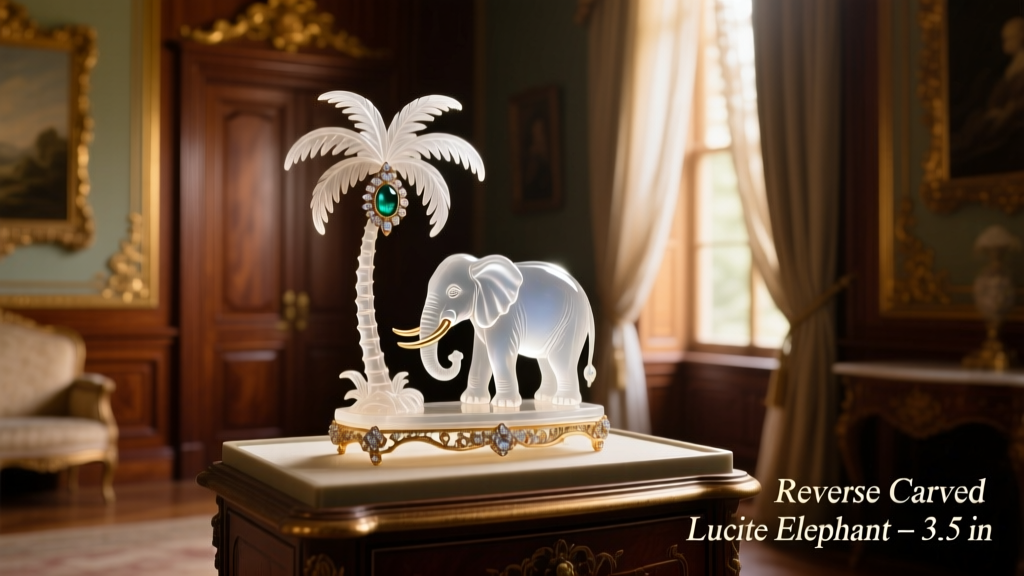
The 1950s Lucite Elephant & Palm Tree Pin: Reverse-Carved Design, Material Science, and Collector Value of the 3½-Inch Vintage Brooch
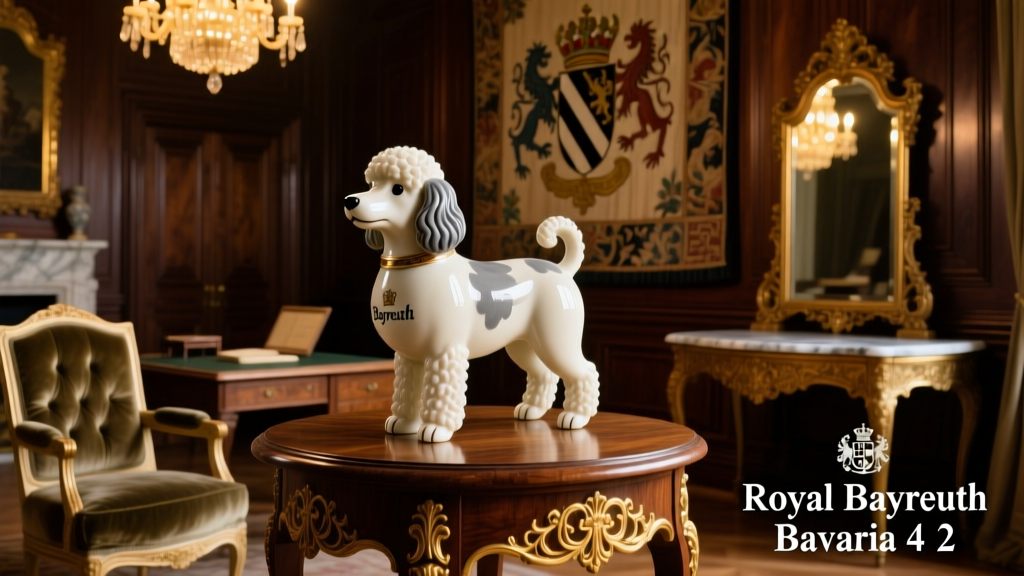
Royal Bayreuth Creamer: The Gray Poodle Dog Figural Creamer Marked 'Royal Bayreuth Bavaria' — A Collector’s Deep-Dive Analysis
Northwood Alaska Butter Cover (6-Inch): Identification, Value, and Restoration Insights for Collectors

Stoneware Canister with Wooden Lid: Blue-and-White Tea Storage in Antique and Vintage Contexts

Elvis Presley Music Box 'Love Me Tender' with Animated Elvis Figure and Guitar: History, Mechanics, and Restoration Insights
Kate Greenaway-Inspired Silver-Plate Inkwells: A Study of the 1890 Hammered Tray Set Featuring Boy and Girl Figures
Tiffin Cherokee Rose Plate (Luncheon, 8-Inch): History, Identification, and Restoration Guidance
Toy Roller Coaster Big Dipper Technofix Box: History, Restoration, and Collectibility of a Mid-Century German Engineering Marvel
Cobalt Blue Ladle Punch Bowl, England, Circa 1825 — A Technical and Historical Appraisal of an 11-Inch Regency Masterpiece