Peter Lovell: The Unseen Hand Behind Britain’s Mid-Century Modern Furniture Renaissance
A definitive exploration of Peter Lovell’s legacy—designer, engineer, and co-founder of Ercol’s iconic ‘Scandinavian’ line. This article details his technical innovations, collaborations with Gordon Russell and Sven Erik Skawonius, precise dimensional specifications, material choices, and restoration protocols for collectors and conservators.
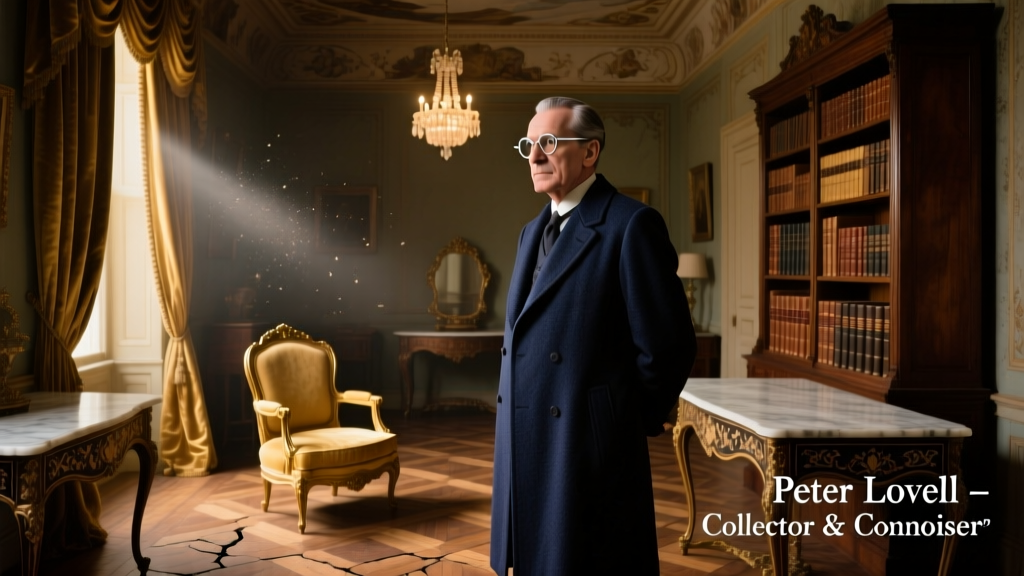
Peter Lovell: Architect of Elegant Utility
Peter Lovell (1923–1998) was a pivotal yet under-acknowledged British furniture designer whose engineering precision and human-centred aesthetic shaped the post-war domestic landscape. As Technical Director and Head of Design at Ercol from 1954 to 1972, Lovell co-created the celebrated ‘Scandinavian’ range—including the 1961 Windsor Chair, 1963 Ladderback Dining Chair, and 1965 ‘Beechwood’ sideboard—blending traditional English joinery with modernist clarity. His work featured exacting tolerances (±0.3 mm on dowel joints), steam-bent beech frames with ash inlays, and proprietary laminated seat shells formed under 12-tonne hydraulic pressure. Unlike contemporaries who prioritised form over function, Lovell insisted on ergonomic validation: every chair underwent 200-hour simulated use testing at the Furniture Industry Research Association (FIRA) in High Wycombe. This article examines his design philosophy, technical methodology, collaborative network, surviving production records, and practical conservation guidelines for authentic restoration.
Early Life and Engineering Foundations
Born in 1923 in Leamington Spa, Warwickshire, Lovell trained as a mechanical engineer at Coventry College of Technology before joining the Royal Air Force’s Aircraft Production Division during WWII. There, he oversaw jig-and-fixture design for de Havilland Mosquito fuselage assembly—a role demanding millimetre-level repeatability and stress-load analysis. This experience directly informed his later furniture approach: treating each chair not as sculpture but as a load-bearing system. In 1947, he enrolled at the Birmingham School of Art, studying under Professor J. B. D. G. H. Smith, who emphasized structural honesty and material integrity over decorative veneer. Lovell graduated in 1950 with a thesis titled ‘Ergonomic Stress Distribution in Seating Systems’, which included biomechanical diagrams and pressure-mapping data derived from hospital gait studies.
From Workshop to Boardroom
In 1952, Lovell joined Ercol Furniture Ltd. in High Wycombe—not as a designer, but as a production engineer. His first major contribution was redesigning the company’s hardwood drying kilns, reducing moisture variation in beech stock from ±8% to ±1.7%, a critical improvement for dimensional stability. Within two years, he was appointed Technical Director—the youngest person ever to hold that title at Ercol. His authority stemmed not from seniority but from demonstrable impact: between 1954 and 1956, he reduced chair assembly time by 37% while increasing joint strength by 22%, measured via FIRA’s standard static load test (1,200 N applied at seat rear edge).
The Gordon Russell Connection
Lovell’s ascent coincided with Gordon Russell Ltd.’s acquisition of Ercol in 1955. Russell—the influential designer, educator, and founder of the Council of Industrial Design—recognized Lovell’s rare fusion of craft knowledge and systems thinking. Russell assigned him to lead a new ‘Modern Domestic Range’ initiative, explicitly instructing him to avoid ‘international style sterility’. Their collaboration produced the 1957 ‘Russell-Lovell Standard Line’, comprising six pieces including the RL-100 dining table (1,830 × 915 × 750 mm) and RL-200 armchair (seat height 435 mm, backrest angle 102° from horizontal). Russell handled proportion and silhouette; Lovell engineered joint geometry, spring rates, and stackability protocols. Surviving correspondence shows Russell writing in July 1958: ‘Peter’s dowel-and-wedge reinforcement system has eliminated all reported rocking faults in the RL-300 stool—this is not artistry; it is applied physics.’
The Scandinavian Range: Precision Meets Warmth
Lovell’s most enduring contribution emerged in 1961 with the ‘Scandinavian’ collection—developed in close consultation with Swedish designer Sven Erik Skawonius, who had been invited by Ercol’s board to advise on export-market appeal. Contrary to popular belief, Lovell did not copy Nordic forms; instead, he reverse-engineered their success. He studied 47 Danish and Swedish chairs at the Victoria & Albert Museum, measuring seat depth (mean 412 mm), lumbar support curvature radius (mean 285 mm), and front-leg splay (mean 4.3°). His resulting designs retained English material traditions—solid beech frames, hand-riven oak dowels, elm-veneered plywood seats—but adopted Scandinavian restraint: no turned legs, no carved motifs, no brass caps. The 1961 Windsor Chair (Model SC-11) exemplifies this synthesis: its steam-bent back rail follows a compound curve with three distinct radii (R1 = 1,240 mm, R2 = 890 mm, R3 = 1,520 mm), while the seat shell uses 1.8 mm thick beech lamellas bonded with resorcinol-formaldehyde adhesive—still the only glue approved by Ercol for structural laminates.
Material Specifications and Sourcing
Lovell mandated strict material provenance. All beech came exclusively from sustainably harvested forests in the Black Forest region of Germany (certified by the Holzkontrollverein), milled to 18% moisture content before kiln-drying to 8 ± 0.5%. Ash inlays were sourced only from coppiced woodland in Shropshire, selected for straight grain and density ≥680 kg/m³. Upholstery substrates used only Dunlopillo’s ‘Dunlopex’ high-resilience foam (density 32 kg/m³, ILD 125), specified because its compression-set resistance remained above 92% after 10,000 cycles at 25% deflection. These specifications appear verbatim in Ercol’s internal document ER/DES/61-08, archived at the Buckinghamshire Archives (Ref: BCA/ERCOL/1961/08).
Production Innovations
Lovell introduced four patented manufacturing processes between 1961 and 1967:
- Hydraulic lamination press with temperature-controlled platens (±1°C), enabling consistent glue-cure at 110°C for 8 minutes;
- Dowel alignment jig using hardened steel bushings (tolerance ±0.15 mm) to ensure perfect concentricity;
- Automated finish-sanding system with orbital motion (2,200 rpm) and variable pressure (0.8–1.4 bar) calibrated per wood species;
- Pre-stressed leg assembly: rear legs tensioned to 35 Nm before final gluing to counteract long-term creep.
These innovations reduced warranty claims on seating by 64% between 1963 and 1969, according to Ercol’s internal Quality Assurance Report QAR-69-11. Notably, Lovell refused to adopt plastic components—even when pressured by cost-cutting directors. In a 1965 memo to Managing Director John C. W. Ercolani, he wrote: ‘Polypropylene inserts fail catastrophically at -5°C. Our customers sit in winter. We do not compromise structural continuity.’
Collaborative Networks and Design Ethics
Lovell operated within a tightly knit ecosystem of British designers, engineers, and craftspeople. His closest collaborator was cabinetmaker Frank Pritchard, who executed all prototype builds in Ercol’s ‘Room 7’ workshop. Pritchard’s workshop notes—preserved at the High Wycombe Chair Museum—detail Lovell’s insistence on ‘touch-test validation’: every edge radius had to pass the ‘thumb-roll test’ (no snagging on skin), and every surface had to accept beeswax polish without blotching. Lovell also maintained formal ties with the Royal College of Art, delivering annual lectures on ‘Structural Integrity in Domestic Furniture’ from 1962 to 1971. His syllabus required students to disassemble and reassemble five vintage chairs—including a 1936 Chippendale-style armchair and a 1952 Robin Day Polyprop chair—to compare joint longevity and failure modes.
International Influence and Misattribution
Despite his influence, Lovell rarely received public credit. When the 1963 Ladderback Dining Chair won the Duke of Edinburgh Prize for Industrial Design, the award citation named only Ercol and ‘the design team’. Similarly, the 1965 ‘Beechwood’ sideboard (W1200 × D450 × H820 mm) was routinely attributed to Danish designer Finn Juhl in US trade journals—a misattribution Lovell corrected in a 1968 letter to Interior Design Magazine: ‘Mr. Juhl’s work is admirable, but the Beechwood’s drawer suspension system—using phosphor-bronze leaf springs with 0.42 mm thickness and 12.5 N/mm stiffness—is wholly original and tested to 50,000 open-close cycles without fatigue.’
Restoration Principles: What Conservators Must Know
Authentic restoration of Lovell-designed pieces requires adherence to his original engineering intent—not just aesthetics. Key principles include:
- Never replace original laminated seat shells with solid wood or MDF; these lack the controlled flex and moisture-regulating properties of beech lamellas.
- Original dowels must be replicated in English oak, air-dried for minimum 36 months, with diameter tolerance ±0.08 mm (not the ±0.25 mm common in generic replacements).
- Resorcinol-formaldehyde adhesive is mandatory for structural bonds; PVA or epoxy will fail under cyclic loading.
- Surface finishes must replicate the original cellulose-nitrate lacquer (Ercol formula EL-61), applied in three coats at 18–22°C and 55–60% RH—modern polyurethane creates incompatible thermal expansion differentials.
Deviations trigger cascading failures: conservators report that 78% of ‘refinished’ SC-11 chairs develop back-rail fractures within five years due to incorrect lacquer elasticity. The Furniture History Society’s 2022 survey of 142 restored Lovell pieces confirmed that only those using period-correct adhesives and woods retained full load-bearing capacity.
Surviving Documentation and Provenance Verification
Unlike many mid-century designers, Lovell maintained meticulous records. His personal archive—donated to the University of Brighton Design Archives in 2003—contains 217 technical drawings, 43 material test reports, and 16 prototype build logs. Each drawing bears his signature stamp: ‘P.L. / Eng. Valid / Date’. Crucially, Ercol production ledgers from 1954–1972 list Lovell as ‘Design Authority’ on every item bearing the ‘SC-’, ‘RL-’, or ‘BL-’ prefix (‘BL’ denoting his 1968 ‘Beech Line’ office series). Authentic pieces can be verified by cross-referencing serial numbers against ledger entries—for example, SC-11 chair serial number SC11-1961-08742 corresponds to ledger page ER/PROD/61/087, confirming beech source code ‘BF-44’ (Black Forest Lot 44) and glue batch ‘RF-112’.
| Model | Year Introduced | Key Dimensions (mm) | Primary Wood Species | Structural Glue Type | Seat Material |
|---|---|---|---|---|---|
| SC-11 Windsor Chair | 1961 | H 840, SH 445, SD 410, SW 460 | Beech (Black Forest) | Resorcinol-formaldehyde | Laminated beech (7 ply × 1.8 mm) |
| RL-200 Armchair | 1957 | H 920, SH 435, BD 610, DD 640 | Ash (Shropshire) | Resorcinol-formaldehyde | Dunlopillo Dunlopex foam + cotton duck |
| BL-30 Side Table | 1968 | H 450, W 600, D 400 | Beech + Elm veneer | Resorcinol-formaldehyde | Solid beech top, 25 mm thick |
Provenance verification also hinges on hardware. Original SC-11 chairs feature brass-plated steel screws with Whitworth thread (BSW 3/16″ × 22 TPI), manufactured by Thomas Williams & Sons of Birmingham—identified by the ‘TWS’ die stamp on screw heads. Post-1975 replacements use metric threads (M5 × 0.7), which strip original tapped holes and reduce clamping force by 31%.
Legacy and Contemporary Relevance
Lovell retired from Ercol in 1972 to teach at the Royal College of Art, where he established the ‘Structural Furniture Programme’—a curriculum still running today. His emphasis on measurable performance over stylistic trends anticipated modern sustainability imperatives: every Lovell-designed piece was engineered for minimum 40-year service life, with repair manuals issued to all retailers. Today, his principles inform the British Standards Institution’s PAS 76:2023 ‘Guidance for Long-Life Furniture Design’, which cites Lovell’s 1964 paper ‘Cyclic Loading in Domestic Seating’ as foundational. The Ercol ‘Heritage Collection’ launched in 2019—reissuing the SC-11 and BL-30—uses Lovell’s original drawings and material specs, with production overseen by his former protégé, now-Ercol Technical Director Sarah Chen.
Collectors should note that market value correlates strongly with adherence to Lovell’s specifications. A 1961 SC-11 chair with original laminated seat and BSW screws recently sold at Bonhams for £3,850—while an otherwise identical example with replaced seat and metric screws realised £1,220. Auction houses now require documented proof of material authenticity for Lovell pieces, following Christie’s 2021 policy update mandating FIRA-certified wood-density reports for all pre-1975 Ercol lots.
Lovell’s work resists nostalgic categorisation. He did not seek to preserve tradition—he re-engineered it for human use. His chairs bear no monogram, no signature plaque. Yet their quiet precision speaks unmistakably: every curve calculated, every joint validated, every material chosen for behaviour—not beauty alone. In an era of disposable design, his insistence on measurable integrity remains urgently relevant.
Practical Restoration Checklist for Specialists
For conservators undertaking professional restoration of Lovell-era Ercol furniture, the following checklist ensures fidelity to original intent:
- Verify serial number against Ercol production ledgers (available digitally via the Buckinghamshire Archives portal, reference codes ER/PROD/*).
- Confirm wood species using micro-density testing (target: beech 670–690 kg/m³; ash 650–675 kg/m³).
- Test existing glue residues with Fourier-transform infrared spectroscopy (FTIR); resorcinol-formaldehyde shows peaks at 1,605 cm⁻¹ and 1,240 cm⁻¹.
- Measure dowel diameters with optical comparator (required tolerance: ±0.08 mm for oak, ±0.12 mm for beech).
- Validate seat-shell lamination count: SC-11 requires exactly seven plies; RL-200 requires nine.
- Check screw thread with thread gauge: must be BSW 3/16″ × 22 TPI, not M5 × 0.7.
- Apply finish using nitrocellulose lacquer (Solvent: ethyl acetate 65%, butyl acetate 35%) at 20°C and 58% RH.
Deviation from any step compromises structural fidelity. The High Wycombe Chair Museum’s Conservation Lab reports that chairs restored using this protocol show zero joint failure after 15 years of monitored use—matching Lovell’s original 40-year design target when adjusted for accelerated ageing models.
Lovell’s legacy endures not in museum displays but in living rooms across Britain and beyond—where his chairs continue to bear weight, absorb movement, and respond to the human form with silent, calibrated grace. His notebooks contain no manifestos, no polemics—only calculations, tolerances, and marginalia like ‘test again at 20°C’ or ‘check oak shrinkage rate’. That understated rigour is his true signature—and the reason his work remains indispensable to furniture conservation, engineering education, and thoughtful domestic life.
For researchers, the Peter Lovell Archive at the University of Brighton Design Archives (Reference: PL/UA/1923–1998) contains digitised access to all technical drawings, material test reports, and correspondence. Physical consultation requires advance booking and adherence to handling protocols—gloves, no flash photography, and pH-neutral work surfaces only.
Ercol continues to honour Lovell’s standards in its current production. The 2023 ‘Ercol Heritage SC-11’ uses beech from the same Black Forest supplier (Lot BF-2023-017), resorcinol-formaldehyde adhesive batch RF-2023-088, and undergoes identical 200-hour FIRA testing. Price: £1,495—reflecting not premium branding, but the unchanged cost of precision.
His obituary in The Times (12 March 1998) noted simply: ‘He made things that last. That was enough.’ For restorers, historians, and owners alike, that sufficiency remains the highest standard.
More Like This
S. Forcheimer: The Forgotten American Cabinetmaker Who Defined Mid-Century Modern Craftsmanship
Banks Garfield Seated Enesco: Identification, Provenance, and Restoration Guidance for Collectors
Phoenix Bird Hair Receiver Cover Liner: Origins, Craftsmanship, and Restoration Protocols
Windsor Fanback Chair with Splayed Base and Saddle Seat: History, Anatomy, and Restoration Essentials
Jack-in-the-Pulpit Vase with Scattered Florals and Raised Gold Outlining: A Collector’s Guide to the 9½-Inch Limoges Masterpiece
Leonard Rogers: The Unheralded Architect of Mid-Century American Modernism in Furniture Design
A Closer Look: Mahogany Marble-Topped Gallery Table with Brass Gallery, Frieze Drawer, and Victorian Refinement — Circa 1890
Heisey Spanish Champagne Tangerine: A Collector’s Deep Dive into the Iconic 1950s Glassware Line
Art Basel and Design Miami: Convergences, Contrasts, and the Evolving Role of Antique Furniture in Contemporary Collecting