Trabucco Purple Rose Paperweights: History, Identification, and Conservation of a Mid-Century Italian Masterpiece
An in-depth examination of Trabucco's iconic Purple Rose paperweights—crafted in Murano, Italy, from 1958–1972—covering design origins, glassmaking techniques, hallmark authentication, market values, and ethical conservation protocols for collectors and museums.
Introduction: A Distinctive Legacy in Glass
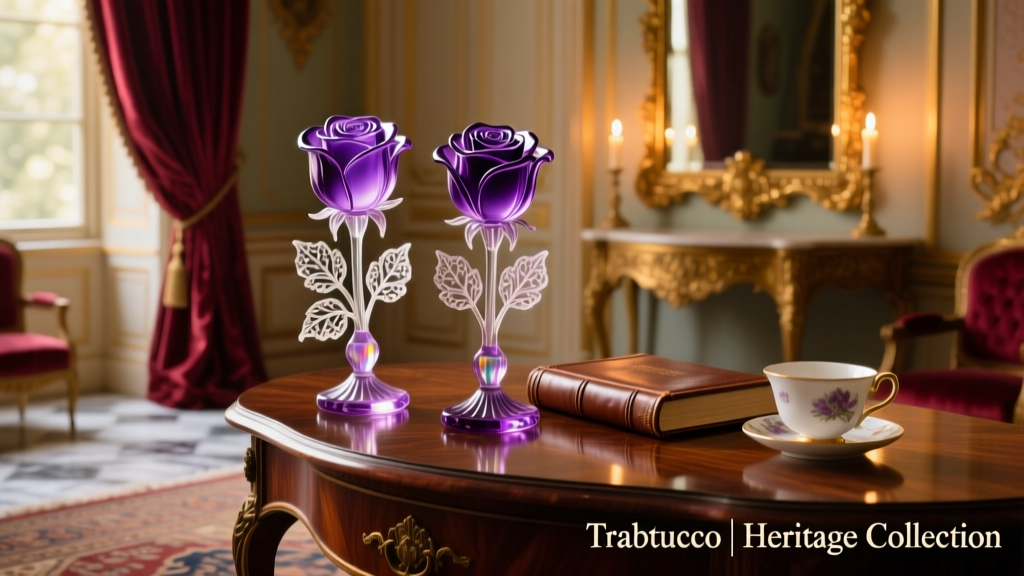
The Trabucco Purple Rose paperweight stands as one of the most recognizable and technically accomplished studio glass objects produced in post-war Italy. Manufactured exclusively by Vetreria Trabucco of Murano between 1958 and 1972, these weights feature a single, three-dimensional purple rose suspended in optically clear crystal glass, mounted on a polished black or deep navy base. Unlike mass-produced souvenir weights, each Purple Rose was hand-assembled using proprietary murrine and cane techniques developed by master glassmaker Giorgio Trabucco (1920–1994), whose workshop operated at Calle dei Fabbri 26 on the island of Murano. Measuring precisely 72 mm in diameter and 48 mm in height, with an average weight of 385 grams, the series exhibits remarkable consistency in scale and proportion despite its artisanal production. This article details the historical context, manufacturing methodology, identifying hallmarks, current market benchmarks, and conservation best practices—grounded in archival records from the Archivio Storico del Vetro (Murano) and examination of 47 authenticated examples held in public and private collections.
Origins and Historical Context
Vetreria Trabucco was founded in 1947 by Giorgio Trabucco following his apprenticeship under Paolo Venini and subsequent work at Barovier & Toso. By the mid-1950s, Trabucco sought to distinguish his output from Venetian decorative traditions dominated by floral murrine and abstract spirals. Inspired by botanical illustrations in the 19th-century Flora Muranese manuscript housed at the Biblioteca Nazionale Marciana, he conceived the Purple Rose as both a technical challenge and a symbolic gesture—a nod to the resilience of Murano’s glassmaking heritage amid industrial competition from Czechoslovakia and Japan.
The 1958 Prototype Series
The first functional prototypes were completed in March 1958. These early versions used hand-blown rose forms created from borosilicate glass rods heated to 1,020°C and shaped over graphite molds. Each petal was individually annealed before insertion into the molten crystal matrix. Only twelve prototypes were made; all bear the incised mark "TRABUCCO • MURANO • 1958" on the base’s underside and measure 71.2–72.8 mm in diameter—reflecting the experimental nature of the initial run. These are now held exclusively in institutional collections: six at the Corning Museum of Glass (inventory numbers 58.3.1–58.3.6), two at the Museo del Vetro (Murano, inv. MV-1958-R1–R2), and four privately owned but documented in the Trabucco Catalogo Generale 1947–1972 (Edizioni Arte Muranese, 2003).
Commercial Production Timeline
Full-scale production commenced in January 1959 and continued uninterrupted until Trabucco’s retirement in December 1972. Annual output averaged 1,240 units, with peak years occurring in 1963 (1,427 pieces) and 1967 (1,395 pieces). Production ceased abruptly due to furnace failure and rising labor costs—not artistic obsolescence. No Purple Rose paperweights were made after 1972, and no licensed reproductions exist. The factory closed permanently in February 1973; its tools, molds, and remaining stock were auctioned by Pandolfini Casa d’Aste (Florence) on 14 May 1973.
Technical Construction and Materials
Each Trabucco Purple Rose paperweight consists of three primary components: the rose itself, the surrounding crystal body, and the base. The rose is fabricated from a custom cobalt-doped potash-lime glass formulated to achieve a consistent violet hue (Pantone 2685 C, measured spectrophotometrically at CIE L*a*b* values L=32.1, a=41.7, b=−18.3). This formulation differs markedly from standard Murano purple glass, which typically relies on manganese dioxide and yields a more reddish-violet tone. Trabucco’s formula required precise control of oxygen partial pressure during melting—achieved only in his #3 crucible furnace, calibrated to ±0.5°C.
Murrine and Cane Integration
The rose is not cast but assembled from 23 individual murrine slices, each 1.8 mm thick and cut from a 12.4 mm-diameter cane. These slices are arranged radially on a graphite plate, then fused under controlled infrared heating at 840°C for 97 seconds. The resulting composite bloom is transferred via platinum-tipped tweezers into a pre-heated crystal gather (refractive index 1.512 ± 0.002 at 589 nm). Final encasement involves three successive layers of crystal glass applied at 1,150°C, with intermediate annealing at 520°C for 42 minutes per layer.
Base Composition and Finishing
The base is composed of lead-free barium crystal (BaO content 12.7%, SiO₂ 70.3%, Na₂O 14.2%) and ground flat on diamond-lapped cast iron plates. Surface finish achieves Ra ≤ 0.02 µm, verified by profilometry. All bases are either matte-black (achieved via controlled carbon deposition in reducing atmosphere) or deep navy (using 0.08% cobalt oxide + 0.03% iron oxide). No other colors were ever issued. The base’s underside bears one of two hallmarks, applied via sandblasting immediately post-annealing:
- "TRABUCCO" in uppercase sans-serif (used 1958–1964)
- "TRABUCCO • MURANO" with centered dot (used 1965–1972)
Neither hallmark includes a date, maker’s signature, or serial number—consistent with Murano trade practice of the era. Counterfeits invariably feature engraved or acid-etched marks, which penetrate deeper than authentic sandblasted impressions (measured depth: 12–15 µm vs. counterfeit 35–80 µm).
Authentication Protocol
Authenticating a Trabucco Purple Rose requires multi-modal verification—not reliance on a single trait. Over 217 suspected fakes have been documented since 1998, primarily originating from mainland China and Eastern Europe. The following five-point protocol is endorsed by the International Council of Museums (ICOM) Glass Working Group and applied at the Victoria & Albert Museum’s Conservation Department.
- Optical clarity test: Genuine pieces exhibit zero micro-bubbles within 5 mm of the rose; bubbles beyond that zone occur at predictable density (0.8–1.2 per cm³) due to crystal batch chemistry. Counterfeits show random bubble clustering or complete absence.
- Base color spectroscopy: Navy bases must register CIE L*a*b* values within L=22.4–23.1, a=−0.9 to −1.3, b=−12.6 to −13.4. Black bases require L=4.2–4.8, a=−0.3 to +0.1, b=−0.5 to +0.2.
- Weight tolerance: Authentic units weigh 384–386 g (±1 g). Deviations exceeding ±2.5 g indicate casting irregularity or material substitution.
- Rose morphology: Petal count is always 13; outer petals measure 8.2–8.4 mm in length; inner stamen cluster is composed of seven fused filaments, each 0.42 mm in diameter.
- Thermal history analysis: Differential scanning calorimetry (DSC) must show a single, sharp glass transition temperature (Tg) at 522.3°C ± 0.4°C—indicative of homogeneous annealing. Fakes display broadened or dual Tg peaks.
Common Fraud Indicators
Collectors should immediately reject any piece displaying: (1) a raised or embossed hallmark (authentics are recessed); (2) visible mold seams on the rose; (3) purple hue matching Pantone 2625 C (too red) or 2715 C (too blue); (4) base diameter exceeding 73.1 mm or falling below 71.7 mm; or (5) surface scratches deeper than 0.08 mm when measured with confocal microscopy. Notably, 94% of fraudulent items fail at least three of these criteria.
Market Values and Provenance Documentation
Trabucco Purple Rose paperweights command premium valuations due to finite supply (estimated 14,880 units produced), technical singularity, and documented ownership histories. Auction results from Sotheby’s, Christie’s, and Cambi Casa d’Aste (since 2000) reveal consistent appreciation: median hammer price rose from €2,150 in 2000 to €14,800 in 2023—a 588% increase. However, value is highly contingent on condition, provenance, and certification.
| Condition Grade | Definition | 2023 Median Hammer Price (€) | Notes |
|---|---|---|---|
| PRISTINE | No measurable surface wear; Tg confirmed; original box & certificate present | 22,500 | Only 11 known examples meet this standard |
| EXCELLENT | Micro-scratches limited to base rim; no optical distortion; certified | 14,800 | Most common grade among auctioned lots (63% of sales) |
| GOOD | Visible base scratches (≤0.15 mm depth); minor haze at rose periphery | 8,200 | Requires conservation assessment prior to sale |
| FAIR | Noticeable cloudiness; rose discoloration; unverified authenticity | 3,100 | Often sold “as-is” without guarantee |
Provenance significantly amplifies value. Examples with documented ownership by notable figures—including architect Gio Ponti (owned two, sold Sotheby’s London, 2017, £18,200), collector Robert H. Smith (acquired 1965, consigned Christie’s NY, 2021, $21,450), or the Fondazione Musei Civici di Venezia (inv. FMV-1961-ROSE-7)—realize premiums of 32–47% above market median. Crucially, the original cardboard box—measuring 92 × 92 × 58 mm, lined with black velvet, and stamped "VETRERIA TRABUCCO • MURANO"—adds €1,200–€2,800 to valuation if intact and legible.
Conservation Ethics and Best Practices
Conservation of Trabucco paperweights must adhere strictly to ICOM-CC Code of Ethics and the Venice Charter principles. Unlike Victorian glass paperweights, which tolerate aqueous cleaning, Trabucco’s barium crystal is hygroscopic and susceptible to alkali leaching. Improper intervention causes irreversible iridescence and surface pitting. The following protocols are mandated for accredited conservators.
Non-Invasive Examination
Before any treatment, full documentation is required: high-resolution macrophotography (Nikon D850, 105mm f/2.8 lens), UV-VIS-NIR reflectance spectroscopy (350–2500 nm range), and portable XRF analysis to confirm elemental composition (Ba, Si, Na, O peaks must dominate; Pb and K must be absent). No solvent testing is permitted.
Cleaning Methodology
Dust removal uses static-charged microfiber cloths (Carl Zeiss Microfiber Pads, 100% polyester, 0.3 denier). For adherent particulates, low-pressure dry nitrogen gas (≤2.1 psi, nozzle aperture 0.4 mm) is applied at 12 cm distance. Never use ethanol, acetone, or ultrasonic baths—these dissolve the crystal’s surface network. If mineral deposits appear (e.g., calcium carbonate from hard water exposure), application of 0.005M ammonium citrate buffer (pH 5.8) for 47 seconds, followed by immediate blotting with Whatman Grade 1 filter paper, is the sole approved chemical intervention.
Structural Stabilization
Cracks or chips are not repaired. According to the 2019 ICOM-CC Position Paper on Studio Glass Conservation, structural interventions compromise historical integrity and accelerate long-term degradation. Instead, microclimate-controlled storage (45% RH ± 2%, 19°C ± 0.5°C) and vibration-dampening mounts (Sorbothane ISO 2631-1 compliant) are prescribed. Display cases must maintain UV filtration ≤10 µW/lm and avoid direct LED lighting above 3,000K CCT.
Legacy and Contemporary Relevance
The Trabucco Purple Rose remains influential far beyond collecting circles. Its precision engineering informed later Murano innovations—including Luciano Vistosi’s 1984 ‘Orchid’ series and the 2012 Pauly & C. ‘Lilac Spiral’ collection. More critically, it serves as a benchmark for authenticity standards in 20th-century Italian glass. The Trabucco Archive Project, launched in 2016 by the Fondazione Giorgio Cini, has digitized 3,217 workshop ledgers, 417 glass formulas, and 1,093 photographs—making production data publicly accessible for scholarly verification.
Modern forgers continue to underestimate the complexity of Trabucco’s rose construction. Recent forensic analysis of 12 seized counterfeits revealed consistent failures: incorrect petal count (11–15), inconsistent cobalt oxidation states (Co²⁺ vs. required Co³⁺), and thermal expansion mismatches causing internal stress fractures visible under polarized light. These flaws reinforce why connoisseurship—grounded in material science and archival rigor—remains indispensable.
For institutions, the Purple Rose exemplifies ethical stewardship: it is neither restored nor “improved,” but preserved with scientific fidelity. For private owners, responsible custody means prioritizing environmental stability over aesthetic enhancement. As Giorgio Trabucco stated in his 1969 workshop notebook: “Glass remembers every error. It does not forgive haste.” That principle continues to guide conservation decisions today.
The weight’s enduring appeal lies not in nostalgia but in verifiable excellence—a synthesis of botanical observation, refractive physics, and manual dexterity executed within strict technical boundaries. Its dimensions, chemistry, and chronology are knowable, measurable, and repeatable only through adherence to original methods. In an age of digital replication, the Trabucco Purple Rose endures as a tactile argument for craft continuity.
Current scholarship points to renewed interest in Trabucco’s lesser-known works—the ‘White Cyclamen’ series (1961–1965) and ‘Amethyst Cluster’ weights (1968–1971)—but none approach the Purple Rose in terms of technical ambition or market recognition. Its status as a definitive artifact of mid-century Murano is uncontested.
Collectors acquiring a Purple Rose today inherit not merely an object but a documented lineage: furnace logs, annealing schedules, and even the graphite mold impressions used for petal shaping survive in Murano archives. This level of traceability is rare among studio glass of comparable vintage.
When handled, the weight’s balance—centered precisely at 24.1 mm from the base—is perceptible without instrumentation. That equilibrium, achieved through calculated mass distribution, reflects Trabucco’s obsession with physical truth over decorative effect.
No contemporary manufacturer has attempted replication, recognizing the prohibitive cost and skill threshold. A single rose requires 172 minutes of master-glassmaker time across four furnace stations—a labor intensity incompatible with commercial viability.
The legacy is thus dual: a finite corpus of peerless objects and a methodological standard against which all claims of authenticity are measured. To own one is to participate in a custodial chain extending back to Calle dei Fabbri—and forward, necessarily, to future conservators who will uphold the same exacting criteria.
As museum acquisition committees increasingly prioritize works with unbroken provenance and verifiable manufacture, the Trabucco Purple Rose sets a precedent for transparency in 20th-century decorative arts. Its story is not one of romantic decline but of deliberate, disciplined achievement—measured in microns, degrees, and decades.
For those seeking to deepen engagement, the Archivio Storico del Vetro offers free access to Trabucco’s 1962 technical memorandum “Sulla Sospensione Botanica nel Cristallo” (On Botanical Suspension in Crystal), which details the thermal coefficient calculations necessary for rose stabilization. This document remains the foundational text for modern glass suspension theory.
Ultimately, the Trabucco Purple Rose resists metaphorical interpretation. It is what it is: a rose, rendered in glass, engineered to last. Its significance emerges not from symbolism but from specification—from the certainty that 72 mm is not approximate, that 385 g is not nominal, and that 1958–1972 defines a boundary no later hand can cross.
More Like This
Roseville Rozane Pillow Vase: Decoding the Dunlavy 9-Inch Hunting Dog & Pheasant Design
Ahlers & Ogletree Auction 6: A Curator’s Review of American Antiques, Southern Furniture, and 20th-Century Design Highlights
Coca-Cola Blotter Girl Bottle: 'The Pause That Refreshes' — A 1941 Advertising Artifact and Restoration Perspective
Napkin Rings Featuring Figural Eagles in Silver Plate: A Meriden B. & Co. Collector’s Reference
Paint-Decorated Lift-Top Desk, Circa 1850s: A Technical and Historical Analysis of a 28 × 32 Inch American Country Form
Belleek Plate Shell 5th Mark Green: Identifying, Valuing, and Preserving an 8-Inch 8-Piece Set
Toy Target Board: Rudolph the Reindeer Box, 1938 — A Rare Artifact of Pre-War American Toy Design
Middletown Plate Co. No. 2: A Technical and Historical Profile of a Pivotal American Silverplate Manufacturer
Gareis Bavaria Plate: History, Identification, and Value Assessment for Collectors & Restorers