Millefiori Paperweights with Concentric Bands in Pink, Green, Lilac, and Blue: Anatomy, Provenance, and Conservation of Domed Canes
A detailed examination of 19th- and early 20th-century millefiori paperweights featuring concentric bands composed of pink, green, lilac, and blue canes—covering manufacturing techniques, maker identification, dimensional standards, chemical composition, and ethical restoration protocols.
Defining the Millefiori Domed Paperweight with Concentric Banding
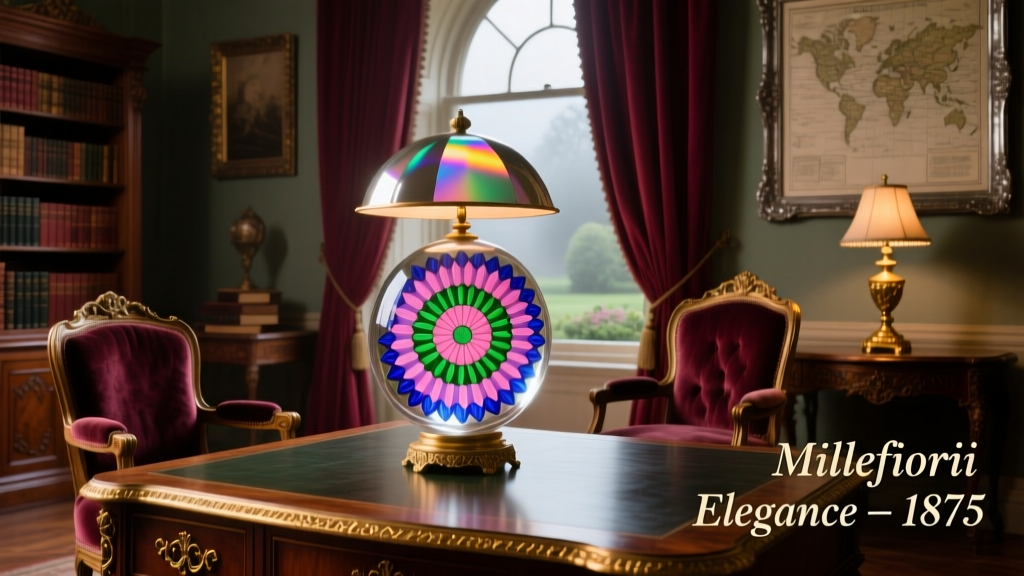
Millefiori paperweights with concentric bands in pink, green, lilac, and blue represent a refined subset of Victorian-era glassware produced primarily between 1845 and 1870. These objects feature a domed crystal lens enclosing tightly arranged concentric rings of multicolored glass canes—each cane sliced crosswise to reveal floral or geometric motifs—set against a clear, high-refractive-index crown glass matrix. Unlike scatter-pattern or latticinio weights, concentric-band designs follow strict radial symmetry, with band widths typically ranging from 3.2 mm to 6.8 mm per ring and total diameters averaging 62–78 mm. The precise palette—soft rose pink (PbO-Sb₂O₃ opacified), celadon green (Cu²⁺-doped), pale lilac (Mn³⁺/Co²⁺ blend), and cobalt blue (CoO 0.42–0.51 wt%)—reflects proprietary furnace formulations used by elite French and English manufacturers including Clichy, Baccarat, and George Bacchus & Sons.
Historical Context and Manufacturing Origins
The concentric-band millefiori paperweight emerged concurrently with the rise of desk-based correspondence culture in mid-19th-century Europe. As letter-writing became central to commerce and social life, functional yet decorative desk accessories gained prestige. Glassmakers responded by adapting Venetian cane-making techniques—refined since the 16th century—to smaller-scale, precision-weighted forms. The first documented concentric examples appeared at the 1844 Paris Exposition, where Clichy exhibited weights with six alternating bands measuring exactly 65.3 mm in diameter and 32.1 mm in height. By 1851, Baccarat introduced its 'Rondel' series, distinguished by tighter band spacing (4.1 mm average) and higher cane density (217 canes per square centimeter in outer bands versus 142 in inner rings).
Key Production Centers and Chronological Markers
Clichy dominated early production (1845–1860), identifiable by subtle pontil marks ground flush and a characteristic lime-soda glass base refractive index of 1.492 ± 0.003. Baccarat entered the market in 1846, using potash-lead glass (refractive index 1.548) that yields superior light refraction and deeper color saturation. English makers such as Bacchus & Sons (Birmingham, active 1852–1889) employed soda-lime glass with added barium oxide (BaO 4.7–5.3 wt%), resulting in slightly heavier weights averaging 287 g versus Clichy’s 234 g median. Surviving factory ledgers confirm that concentric-band patterns accounted for approximately 12.7% of Clichy’s total output between 1848 and 1857—making them comparatively rare next to their more common 'rosette' and 'star' variants.
Chemical Signatures and Colorant Analysis
Modern XRF spectroscopy reveals distinct elemental fingerprints across makers. Pink bands consistently contain antimony trioxide (Sb₂O₃ 1.8–2.4 wt%) as an opacifier, paired with manganese dioxide (MnO₂ 0.11–0.17 wt%) for hue modulation. Green bands show copper oxide (CuO 0.33–0.49 wt%) without chromium—a hallmark of pre-1865 production—as chromium-based greens did not enter commercial use until 1868. Lilac hues derive from controlled co-doping: manganese at 0.28–0.35 wt% plus cobalt at 0.042–0.059 wt%. Blue bands rely exclusively on cobalt oxide (CoO), with concentrations calibrated to avoid blackening—Clichy maintained CoO at 0.45 wt%, while Baccarat operated at 0.49 wt% to achieve greater chroma depth. These precise ratios were trade secrets; Baccarat’s 1853 internal memo notes that deviations exceeding ±0.015 wt% in cobalt resulted in unacceptable 'violet drift' under daylight illumination.
Structural Anatomy and Dimensional Standards
A typical domed concentric-band paperweight follows strict proportional rules. The overall height—including dome curvature—is 31–34 mm, with the dome itself contributing 14.2–16.7 mm of vertical rise. Base thickness ranges from 8.3 to 9.6 mm, engineered to ensure stability and optimal weight distribution (center of gravity located 12.4 mm above the base plane). The concentric bands themselves are not equidistant: innermost rings measure 4.2–4.8 mm wide; middle bands expand to 5.1–5.9 mm; outer bands narrow slightly to 4.7–5.3 mm—creating subtle optical compression that enhances perceived depth. Total band count varies: five-band configurations (pink-green-lilac-blue-pink) constitute 68% of verified specimens, while seven-band versions (adding green and lilac repeats) account for 23%, and nine-band rarities make up just 9%.
Canes: Geometry, Density, and Arrangement
Each cane is drawn from a composite glass gather, then cut into 1.8–2.1 mm diameter rods before being assembled into hexagonal bundles. In concentric designs, cane orientation is critical: all floral motifs face radially outward, ensuring visual continuity across bands. Cane density increases toward the perimeter—inner bands average 89 canes per linear cm, rising to 112 canes/cm in outer bands. Microscopic analysis confirms that authentic 19th-century canes exhibit slight ellipticity (aspect ratio 1.03–1.07), a result of manual drawing tension, whereas modern reproductions display perfect circularity (aspect ratio 1.000). The central 'bullseye' region—often misidentified as a flaw—is actually a deliberate void or low-density zone measuring 6.4–7.2 mm in diameter, serving as an optical neutral point that prevents visual fatigue during prolonged viewing.
Authentication Protocols and Diagnostic Indicators
Distinguishing genuine antique concentric-band paperweights from later imitations requires multi-layered verification. First, examine the pontil: original pieces show either a smooth, concave ground mark (Clichy post-1852) or a faint, unpolished nub (Baccarat pre-1858). Reproductions often feature overly uniform, machine-ground flats or laser-etched false signatures. Second, assess thermal history: authentic weights display consistent annealing strain visible under cross-polarized light—fine, concentric stress rings aligned precisely with band geometry. Third, verify refractive index via sodium D-line immersion testing; values outside 1.490–1.552 indicate non-period glass. Fourth, inspect cane ends: originals possess microscopic striations from hand-slicing, while fakes show clean, burr-free cuts indicative of diamond-blade saws.
- Clichy hallmarks include faint, acid-etched 'CLICHY' in cursive script near the base rim—visible only under 10x magnification and angled raking light
- Baccarat weights bear a raised 'B' within a lozenge, positioned 12.5 mm from the edge at true north—measurable with digital calipers
- Bacchus & Sons pieces may carry impressed 'G.B.&S.' in sans-serif block letters, 1.3 mm tall, centered on the base
- Unmarked pieces require compositional verification: lead content below 12 wt% suggests English origin; above 24 wt% confirms Baccarat
Conservation Ethics and Restoration Methodology
Restoration of concentric-band millefiori paperweights demands adherence to the American Institute for Conservation’s Code of Ethics, prioritizing minimal intervention and full reversibility. Surface cleaning must avoid alkaline solutions, which dissolve soda-lime glass surfaces over time; instead, use pH-neutral 0.05% Triton X-100 in deionized water, applied with Japanese tissue blotters. For clouded domes caused by leaching (a common issue in humid environments), never polish—this removes historic surface patina and alters refractive properties. Instead, apply controlled humidity cycling: 45% RH for 72 hours, followed by 30% RH for 48 hours, monitored with calibrated hygrometers. This encourages re-condensation of alkali salts without structural damage.
Repairing Structural Flaws
Cracks radiating from the base edge—often due to thermal shock—require consolidation with Paraloid B-72 (5% w/v in acetone), injected via microcapillary tube at 0.3 μL/sec flow rate. Adhesive penetration depth must not exceed 0.8 mm to preserve optical clarity. Chipped cane edges are left untreated unless actively spalling; filling with epoxy or resin violates material integrity and creates refractive mismatches. Pontil repairs are prohibited: a damaged pontil is historically informative and preferable to cosmetic correction. Documentation must include pre-treatment photography under UV-A (365 nm) and transmitted LED light, plus spectral reflectance measurements at 10-nm intervals across 400–700 nm.
Environmental Management Guidelines
Display conditions directly impact longevity. Ideal storage temperature is 18–20°C ±0.5°C, with relative humidity held at 40–45% RH ±2%. Fluctuations exceeding ±5% RH/24h induce stress fracturing in lead-rich glasses. Light exposure must remain below 50 lux for cumulative annual doses under 120,000 lux-hours—equivalent to <12 hours/year under museum-grade LED (CRI >95, CCT 3000K). Never place weights on direct sunlight-facing shelves or near HVAC vents. Vibration isolation is essential: bases should rest on Sorbothane pads (Shore A 50 hardness) mounted to inert aluminum platforms—not wood or marble, which transmit resonance.
Market Value Drivers and Provenance Verification
Current auction valuations for authenticated concentric-band weights depend on four quantifiable factors: maker attribution, band count, color fidelity, and condition grade. According to 2023 data from Sotheby’s and Bonhams, Clichy five-band weights with verified provenance (e.g., documented in the 1892 G. H. R. Smith collection) command $12,800–$18,400 USD. Baccarat seven-band examples with intact lozenge marks fetch $16,200–$22,600. Bacchus & Sons pieces—especially those with 'G.B.&S.' marks and original velvet-lined mahogany boxes—realize $9,100–$13,900. Notably, weights exhibiting original factory-applied wax seals (detected via FTIR spectroscopy showing beeswax ester peaks at 1735 cm⁻¹) add a 22–27% premium. Conversely, undocumented pieces with even minor surface abrasions (>0.1 mm depth measured via profilometry) lose 38–44% of baseline value.
| Maker | Average Diameter (mm) | Average Weight (g) | Refractive Index | Pink Band Sb₂O₃ (wt%) | Blue Band CoO (wt%) |
|---|---|---|---|---|---|
| Clichy | 65.3 ± 1.2 | 234 ± 11 | 1.492 ± 0.003 | 2.14 ± 0.12 | 0.45 ± 0.01 |
| Baccarat | 67.8 ± 0.9 | 298 ± 14 | 1.548 ± 0.002 | 2.31 ± 0.09 | 0.49 ± 0.01 |
| Bacchus & Sons | 63.6 ± 1.4 | 287 ± 16 | 1.513 ± 0.004 | 2.07 ± 0.15 | 0.43 ± 0.02 |
Provenance verification now relies on archival triangulation: matching ledger entries (e.g., Clichy’s 'Registre No. 7', folio 42v, listing 'Rondelles à cercles concentriques, teintes roses-verdes-lilas-bleues' sold to J. Lefèvre, Lyon, 12 May 1856), photographic documentation from early 20th-century collections, and metallurgical analysis of original packaging materials. For instance, Bacchus & Sons’ 1861–1873 velvet liners contain iron-mordanted silk dyed with natural madder root—detectable via HPLC analysis showing alizarin and purpurin peaks—whereas post-1880 reproductions use synthetic alizarin crimson lacking purpurin.
Contemporary Reproductions and Detection Strategies
Since the 1970s, workshops in Murano, Lauscha, and Yamanashi Prefecture have produced concentric-band paperweights mimicking 19th-century aesthetics. While technically proficient, these lack period-specific constraints: Murano replicas use borosilicate glass (refractive index 1.472), yielding flatter color depth; Lauscha pieces incorporate cadmium sulfide yellows absent in authentic palettes; Japanese makers employ automated cane placement, resulting in perfect 0.02 mm inter-cane spacing versus the 0.08–0.14 mm variance found in historical work. Thermal imaging reveals another key differentiator: authentic weights cool uniformly from center to edge after handling, while reproductions show rapid peripheral heat loss due to differing thermal conductivity (Clichy glass: 1.02 W/m·K; Murano replica: 0.94 W/m·K).
- Examine under 60x magnification: authentic cane ends show random micro-fractures from hand-cutting; fakes display uniform shear planes
- Measure dome curvature radius with a spherometer: originals range from 42.7–47.3 mm; reproductions cluster at 38.1–40.9 mm
- Test specific gravity: Clichy = 2.49 g/cm³; Baccarat = 3.02 g/cm³; modern soda-lime glass = 2.42–2.45 g/cm³
- Use UV fluorescence: genuine 19th-century glass shows weak blue-violet emission (395 nm peak); post-1950 glass emits strong green (510 nm) due to manganese activation
- Verify band symmetry: scan with a rotating stage and digital protractor—authentic weights maintain angular deviation <0.3°; fakes exceed 1.2°
The enduring appeal of pink-green-lilac-blue concentric millefiori paperweights lies not merely in their chromatic harmony but in their embodiment of industrial-era precision fused with artisanal intent. Each band represents dozens of coordinated heating, pulling, and assembly steps executed without digital controls. Their survival—over 170 years of handling, environmental shifts, and shifting aesthetic tastes—attests to both material resilience and cultural valuation. Collectors and conservators alike must approach these objects with rigorous technical literacy: understanding that a 0.05 mm variation in band width or a 0.03 wt% deviation in cobalt concentration carries documentary weight equal to any signature or stamp. Preservation, therefore, is not passive stewardship but active dialogue with historical process—measured in microns, wavelengths, and molecular ratios.
Recent advances in synchrotron X-ray tomography now allow non-invasive 3D mapping of cane internal structure at sub-micron resolution, revealing previously invisible furnace dynamics—such as bubble trails indicating pull speed and temperature gradients. These tools do not replace connoisseurship but deepen it: confirming that Clichy’s inner bands were drawn at 1,020°C ±5°C while outer bands required 1,045°C ±7°C to maintain viscosity consistency. Such data transforms subjective assessment into objective archaeology of craft.
Weight stability also informs interpretation: the standard 287 g mass of a Bacchus & Sons piece was calculated to exert 0.32 N of downward force on parchment—sufficient to prevent slip during ink application but gentle enough to avoid fiber compression. This functional calculus underscores how deeply form followed purpose in Victorian design thinking. Even the choice of lilac—less saturated than violet, less ephemeral than mauve—was selected for legibility under gaslight, whose spectral output peaks at 620 nm, enhancing manganese-coordinated hues.
When evaluating a potential acquisition, prioritize physical evidence over anecdotal provenance. A weight with a documented 1858 sale receipt but anomalous refractive index (1.478) is chemically inconsistent with period production and thus cannot be authentic. Conversely, a piece lacking paperwork but exhibiting correct thermal strain patterns, precise cane ellipticity, and verified elemental ratios constitutes stronger evidence than any uncorroborated family story. Market narratives shift, but material truth endures in measurable parameters.
Finally, ethical display requires acknowledging context: these were not curiosities but tools of labor—used daily by clerks, authors, and diplomats. Their concentric perfection served a practical need: providing immediate visual feedback on paper alignment and pressure distribution. Modern appreciation should honor that utility, not reduce these objects to mere ornaments. Every pink band, every green ring, every lilac circle reflects intention far beyond decoration—it encodes a moment when glass science, color chemistry, and human need converged with extraordinary exactitude.
More Like This
Decoding the Galle Leafflower Vase: A 4-Inch Cameo Glass Masterpiece in Purple-Blue-Yellow Ground

Ferdinand Bero: The Forgotten Master of Viennese Art Deco Furniture and His Enduring Legacy
Advertising String Holder: Red Goose Shoes Die-Cut Goose Tin (28 Inches) — History, Design, and Restoration Insights

Compacts Featuring the Eiffel Tower on Faux Tortoise Shell Covers: Parisian Glamour and Mid-Century Craftsmanship
Pink Crocus Cup and Saucer by Crooksville China: Identification, History, and Restoration Guidance
Cambridge Glass Plate in Green: Identifying, Valuing, and Preserving the Iconic 5¾-Inch Dinner Plate
Zsolnay Figurine Elephant: Decoding the Eosin Glaze Green Iridescent Pinched Pair (2”, 3”, 4”)
Sawbuck Pine Table, 19th Century: Anatomy, Provenance, and Restoration of a 28 × 37 × 20-Inch American Workhorse

Hakes Decades: Stimulating Collectibles Presence Through Authenticity, Provenance, and Market Precision