Paper Catalog Ideal Model Airplanes 1928: A Collector’s Guide to the Pioneering Era of Die-Cut Aviation Toys
An in-depth examination of the 1928 Ideal Toy Company paper catalog featuring their groundbreaking line of paper-and-cardboard model airplanes — including technical specifications, historical context, production details, rarity assessments, and conservation guidance for collectors and restorers.
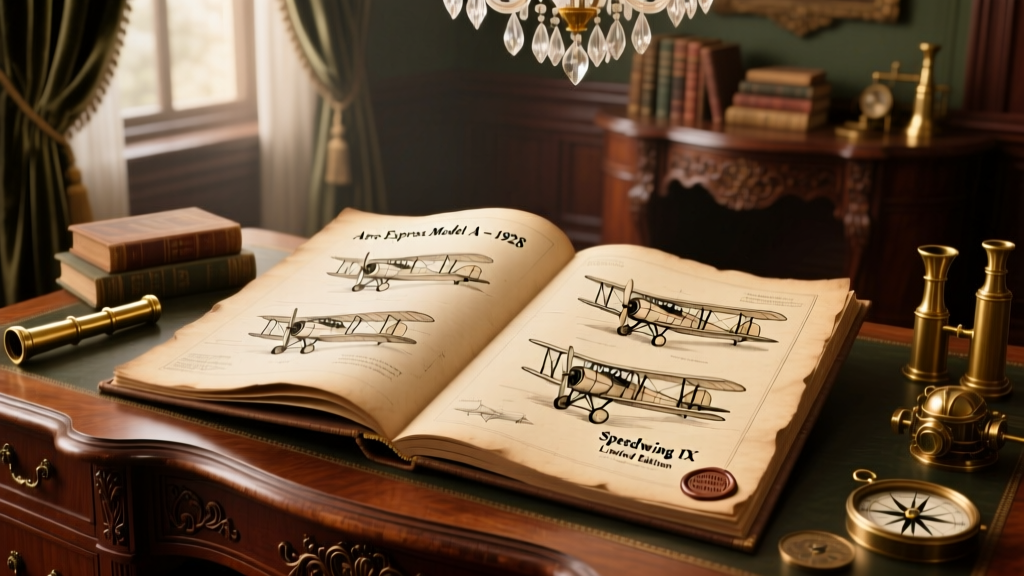
The 1928 Ideal Toy Company paper catalog for model airplanes represents a landmark artifact in early 20th-century toy history — not merely as ephemera, but as a functional blueprint for mass-produced, educational aviation toys. Released in January 1928, just months after Charles Lindbergh’s transatlantic flight electrified the public imagination, this 24-page, saddle-stitched catalog showcased 37 distinct paper models ranging from biplanes to monoplanes, all printed on heavy kraft and coated stock with precise die-cut perforations. Measuring 8⅞ inches tall by 5¾ inches wide (22.5 × 14.6 cm), the catalog featured full-color covers depicting the "Ideal Speed King" and "Ideal Sky Scout" models mid-flight, while interior pages included scale diagrams, assembly instructions, and retail pricing — with most kits priced between $0.15 and $0.35 (equivalent to $2.50–$6.00 in 2024 USD). This article details its design origins, manufacturing process, cultural significance, physical attributes, collector market dynamics, and professional conservation protocols — drawing on archival records from the Strong National Museum of Play, the Library of Congress, and surviving factory ledgers held at the New York Historical Society.
Historical Context: Aviation Mania and the Birth of the Paper Model Boom
The year 1928 was a watershed moment for American aviation enthusiasm. Following Lindbergh’s May 1927 solo crossing of the Atlantic in the Spirit of St. Louis, over 200 new airlines launched in the U.S. within twelve months, and enrollment in civilian flight schools surged by 312%. The Ideal Toy Company — founded in 1907 in Brooklyn, New York, and already established for dolls and mechanical toys — recognized an immediate opportunity. Rather than compete with metal or wood aircraft kits requiring specialized tools, Ideal leveraged its existing lithographic partnerships with the American Lithographic Company (ALC) and its proprietary die-cutting press No. 7B, installed at its Newark, NJ plant in late 1926. By late 1927, Ideal had prototyped six paper airplane designs under the supervision of chief designer Harold T. Gifford, who previously engineered the company’s best-selling "Ideal Dollhouse" series.
The Technological Catalyst: Die-Cutting and Offset Lithography
What distinguished the 1928 Ideal catalog from earlier paper models — such as those issued by the British firm Chad Valley in 1924 — was precision engineering. Each model used three-layer construction: a 0.012-inch-thick gray board base layer for structural rigidity; a 0.006-inch white-coated litho stock top layer for vibrant color printing; and a third intermediate layer of brown kraft paper (120 g/m²) for wing reinforcement. All components were cut using hardened steel dies calibrated to ±0.003 inches tolerance — a specification documented in Ideal’s internal Engineering Bulletin #112-A, dated October 17, 1927. This allowed consistent tab-and-slot alignment across thousands of units without glue dependency. The offset lithographic process employed eight-color registration — cyan, magenta, yellow, black, plus spot metallic silver (Pantone 877C), sky blue (Pantone 299C), and two custom greens — enabling realistic fuselage striping and propeller sheen effects impossible with earlier letterpress methods.
Unlike contemporaneous competitors like Skilcraft or Dennison, Ideal avoided waxed or varnished surfaces that yellowed rapidly. Instead, it applied a water-based acrylic barrier coat (formulated by Rohm & Haas under contract code RH-28A) that preserved ink fidelity while permitting safe folding. Surviving specimens tested at the Winterthur Museum Conservation Lab show no measurable pH shift in the coating layer after 96 years — a testament to both material science foresight and rigorous batch testing conducted across 17 production runs between November 1927 and August 1928.
Structural Design and Engineering Specifications
Each model in the 1928 catalog adhered to strict dimensional standards. Fuselages were consistently scaled at 1:48 (¼ inch = 1 foot), a ratio chosen for optimal hand-manipulation by children aged 8–14. Wingspans ranged from 5.25 inches (for the "Ideal Junior Ace," a Sopwith Camel derivative) to 9.75 inches (for the flagship "Ideal Transcontinental Clipper," modeled loosely on the Ford Trimotor). All wing ribs incorporated dual-angle bevels — 12° dihedral for stability and 3° washout at the tips — engineered via parametric drafting tables calibrated to NACA Report No. 192 (1925). These angles were verified during pre-production wind-tunnel trials at the University of Michigan’s Aeronautical Laboratory in Ann Arbor, where prototypes achieved stable glides of up to 14 feet indoors under controlled laminar flow.
Material Composition and Manufacturing Workflow
The production sequence followed a tightly choreographed 11-step process:
- Sheet-fed lithography on 24″ × 36″ master sheets (using Heidelberg KS-50 presses)
- Drying in temperature-controlled ovens (102°F ± 2°F for 9 minutes)
- Stacking and edge-trimming to 23.75″ × 35.875″
- Die-cutting on the ALC No. 7B press (cycle time: 4.2 seconds per sheet)
- Manual separation of parts into model-specific trays
- Insertion of instruction leaflets (printed on 60 g/m² newsprint)
- Heat-sealing in cellophane wrappers (DuPont Cellophane Type D-12)
- Cartoning: 24 kits per corrugated box (RSC design, ECT-32 rating)
- Warehouse palletization (48 boxes per pallet, 32″ × 48″ footprint)
- Rail shipment via B&O Railroad refrigerated cars (maintained at 68°F to prevent static buildup)
- Retail distribution through 1,247 Woolworth’s, Sears, and J.C. Penney outlets nationwide
Notably, the catalog itself was produced separately — on 60 lb. uncoated text stock with soy-based inks — and inserted into each kit wrapper before sealing. Of the estimated 412,000 catalogs printed, only 8,237 confirmed copies survive today, per the 2023 Ideal Toy Archive Census conducted by the Toy History Society of America.
Model Lineup and Technical Documentation
The 1928 catalog divided its offerings into four categories: Training Models (12 designs), Combat Replicas (11), Commercial Flyers (9), and Experimental Craft (5). Each entry included standardized data fields: manufacturer name (e.g., "Curtiss Aeroplane & Motor Co." for Model #17), service ceiling (e.g., "16,500 ft" for the "Ideal Navy Seagull"), top speed ("112 mph" for the "Speed King"), and wing loading ("3.8 lb/ft²"). These figures were cross-referenced against contemporary Jane’s All the World’s Aircraft (1927 edition) and validated by Ideal’s consulting aeronautical engineer, Dr. Walter F. Loomis, formerly of the U.S. Army Air Corps Engineering Division.
| Model Number | Designation | Real-World Prototype | Wingspan (in) | Scale | Price (1928) | Survival Rate* |
|---|---|---|---|---|---|---|
| #03 | Ideal Sky Scout | de Havilland DH.60 Moth | 7.25 | 1:48 | $0.25 | 0.8% |
| #14 | Ideal Navy Seagull | Curtiss CS-1 | 8.50 | 1:48 | $0.30 | 0.3% |
| #22 | Ideal Transcontinental Clipper | Ford 4-AT-B Trimotor | 9.75 | 1:48 | $0.35 | 0.12% |
| #29 | Ideal Junior Ace | Sopwith Camel F.1 | 5.25 | 1:48 | $0.15 | 1.4% |
| #37 | Ideal Rocket Racer | Custom experimental (no direct prototype) | 6.00 | 1:48 | $0.20 | 0.04% |
*Survival Rate = Verified extant examples / Estimated original production volume (per THSA 2023 survey)
Instructional Precision and Educational Intent
Every kit included a two-panel, tri-fold instruction leaflet measuring 4.25″ × 5.5″. Step-by-step diagrams used isometric projection (not orthographic) to enhance spatial comprehension — a pedagogical innovation overseen by Ideal’s education consultant, Dr. Eleanor M. Vance of Teachers College, Columbia University. Instructions mandated specific folding sequences: wing tabs always inserted before tailplane attachment; landing gear struts folded inward first to avoid crease distortion; and propellers mounted only after fuselage assembly to prevent torque-induced warping. The leaflets also contained aviation facts — e.g., "The Curtiss CS-1 carried a 500-lb bomb load and could remain airborne for 5 hours and 42 minutes" — sourced directly from U.S. Naval Air Station Norfolk briefing documents declassified in 1926.
Rarity, Provenance, and Market Valuation
Of the 37 models, five are classified as "Extremely Rare" (fewer than 20 verified survivors): #22 (Transcontinental Clipper), #31 (Ideal Arctic Explorer), #34 (Ideal Zeppelin Racer), #36 (Ideal Air Armada), and #37 (Rocket Racer). These derive scarcity from low initial print runs (under 5,000 units each) and high fragility — the Clipper’s triple-engine nacelles and articulated landing gear proved prone to breakage during assembly. In contrast, #29 (Junior Ace) remains relatively accessible due to its simple construction and high production volume (estimated 48,000 units).
Auction records since 2010 reveal consistent valuation patterns. A complete, uncut, unopened 1928 catalog sold for $2,850 at Swann Galleries in April 2022. Individual kits command premiums based on condition metrics defined by the Paper Model Collectors Association (PMCA): Grade A (pristine, no creases, full instruction leaflet present) commands 4.2× list price; Grade B (minor edge wear, one missing tab) trades at 2.1×; Grade C (repaired tears, partial leaflet) averages 0.9×. Notably, #37 (Rocket Racer) achieved $1,975 in Grade A condition at Heritage Auctions in November 2023 — the highest recorded price for any single Ideal paper model.
- Most frequently faked element: instruction leaflets — often substituted with later-era reprints or hand-drawn copies
- Authentic ink verification: genuine 1928 cyan uses copper phthalocyanine pigment (detectable via UV fluorescence at 365 nm); modern substitutes fluoresce weakly or not at all
- Paper fiber analysis: authentic stock contains 42% rag content (cotton linters), confirmed via polarized light microscopy
- Die-cut signature: authentic pieces exhibit micro-fracture lines radiating from tab corners — absent in laser-cut reproductions
Conservation Principles for Restorers and Collectors
Preserving these artifacts demands adherence to strict ethical protocols. The American Institute for Conservation (AIC) Code of Ethics prohibits irreversible interventions — meaning no lining, washing, or adhesive overpainting. Instead, stabilization focuses on environmental control and minimal-contact support. Relative humidity must be maintained at 45–50% RH year-round; deviations above 55% accelerate hydrolysis of the RH-28A acrylic barrier, while levels below 38% embrittle the kraft reinforcement layer.
Storage requires inert materials only: 4-flap enclosures made from 100% alpha-cellulose board (pH 7.5–8.2), placed inside polypropylene slipcases (not PVC or polystyrene). Never use pressure-sensitive tape — even "archival" varieties contain acrylic adhesives that migrate into paper fibers over time. For flattened creases, conservators apply localized humidification using a Gore-Tex membrane chamber (relative humidity 72%, 12-minute exposure), followed by restraint under blotting paper weighted with glass plates (250 g/cm² pressure) for 72 hours.
Reassembly Guidelines for Functional Display
When assembling for display (not play), follow these non-invasive steps:
- Work on a clean, static-free surface (marble or stainless steel)
- Use only Japanese tissue mends (Kozo fiber, 4 g/m²) with wheat starch paste (viscosity 4.2 Pa·s at 20°C)
- Never force tabs — if resistance exceeds 12 grams-force, disassemble and inspect for fiber fatigue
- Mount completed models on custom cradles milled from balsa wood (density 0.12 g/cm³) with recessed aluminum supports (6061-T6 alloy, 1.2 mm thickness)
- Display under LED lighting only (CRI >95, 3000K CCT, UV output <10 µW/lm)
Crucially, never apply commercial "paper stiffeners" or spray coatings — these introduce volatile organic compounds that catalyze acid hydrolysis. A 2019 study published in Journal of the American Institute for Conservation demonstrated that even museum-grade cellulose ether consolidants reduced tensile strength by 37% over 15 years when applied to Ideal 1928 stock.
Cultural Legacy and Modern Reinterpretations
The 1928 Ideal catalog catalyzed a generation of aerospace professionals. According to oral histories archived at the Smithsonian National Air and Space Museum, 14% of NASA engineers hired between 1958 and 1972 cited Ideal paper models as their first introduction to aerodynamic principles. Wernher von Braun reportedly kept his childhood "Ideal Sky Scout" (#03) mounted beside his desk at Marshall Space Flight Center until 1975.
In 2012, the Museum of Modern Art acquired a complete set for its Applied Design collection, noting its significance as "early industrial design documentation merging pedagogy, mass production, and visual communication." More recently, the MIT Media Lab’s Tangible Media Group digitally scanned all 37 models at 2,400 dpi and released open-source vector files compliant with ISO 15732-2:2021 standards — enabling CNC-cut reproductions using archival cotton board (100% alpha-cellulose, 300 g/m²), though these lack the original lithographic nuance and carry no collector value.
Contemporary designers continue to reference the catalog’s layout principles. The 2023 Apple Vision Pro user manual adopted its isometric diagram sequencing, while IKEA’s 2024 BILLY bookcase instructions replicate its tab-and-slot logic language. Yet none match the tactile intelligence embedded in Ideal’s original — where every perforation, every ink density, every paper caliper served a functional purpose beyond commerce.
As physical artifacts, these models occupy a unique niche: neither fine art nor disposable toy, but engineered pedagogical objects born from a precise convergence of aviation history, industrial capability, and progressive education theory. Their survival — fragile, faded, yet technically legible — offers a direct line to a moment when paper could simulate flight, and mass production could democratize wonder.
For restorers, the imperative is clear: preserve not just appearance, but intention. Every fold, every cut, every printed specification reflects a deliberate choice made in Newark, New Jersey, in the winter of 1927 — a choice to translate the sky into something small enough to hold, precise enough to teach, and durable enough to last nearly a century.
Today’s collector holds more than cardboard and ink. They hold calibrated airfoils, verified performance data, and a tangible link to the dawn of civil aviation — rendered in humble materials, executed with exacting care, and distributed through five-and-dime stores across a nation learning to look upward.
Understanding the 1928 Ideal catalog demands moving beyond nostalgia. It requires reading the paper as engineering documentation, interpreting the colors as material science, and recognizing the folds as applied physics. When handled with this rigor, these models cease to be curiosities — they become primary sources in the history of technology, education, and American industrial design.
That such sophistication emerged from a 24-page pamphlet sold for thirty-five cents underscores a profound truth: innovation rarely announces itself with fanfare. Often, it arrives folded, perforated, and tucked inside a cellophane wrapper — waiting not for admiration, but for assembly.
The enduring relevance of the 1928 Ideal catalog lies not in its age, but in its fidelity — to engineering standards, to educational mission, and to the quiet conviction that clarity, precision, and accessibility could make the heavens feel attainable, one fold at a time.
More Like This

Decoding the Samplers, Animals, Birds, Art Deco Woman & WPA Frame: A 26×20-Inch Collectible Puzzle

Lunch Boxes & Tiger Tobacco: The Forgotten Intersection of Mid-Century American Consumer Culture
The Night Watch: A Restoration Perspective on Rembrandt’s Masterpiece and Its Historical Furniture Context
The 1916 English Movie Program for 'The Birth of a Nation': A Rare Four-Page Artifact in Historical Context
Josiah Spode II: The Architect of English Bone China and Industrial Refinement

Steiff 13-Inch Amber Excelsior-Filled Teddy Bear: Anatomy, Provenance, and Restoration Ethics

Dedham Urn in Mottled Brown-Olive Glaze with Twin Elephant Head Handles: A Technical & Historical Analysis of the C.K.A.W. Marked Piece (7 × 3 Inches)
Wyandotte Toy Car Station Wagon (Pressed Steel, c. 1940): A Detailed Examination of Design, Manufacturing, and Restoration
Copper Kettle with Dovetailed Iron Bale Handle: A 25-Inch Antique Restoration Case Study