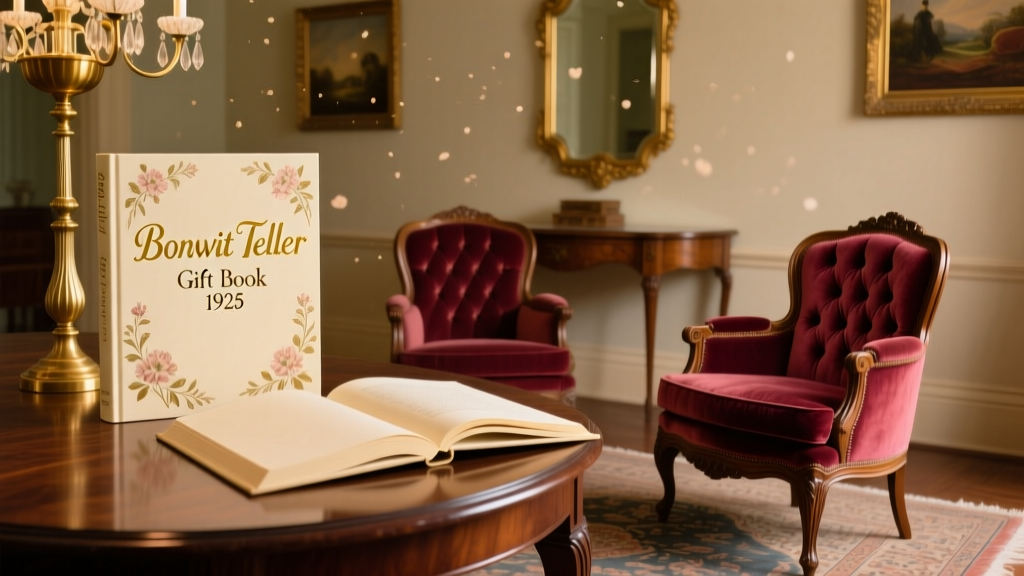
Bonwit Teller’s 1925 Gift Book: A Collector’s Guide to the 22-Page Paper Catalog as Historical Artifact and Design Document
A detailed examination of the rare 1925 Bonwit Teller Gift Book — a 22-page, saddle-stitched paper catalog measuring 8.75 × 11.25 inches — with analysis of its typography, advertising strategy, furniture listings, material specifications, and significance in American retail and interior design history.
Introduction: A Modest Artifact with Monumental Significance
The Bonwit Teller 1925 Gift Book is not merely a vintage sales brochure — it is a precisely dated cultural artifact reflecting the transition from Gilded Age opulence to Jazz Age modernity in American domestic life. Measuring exactly 8.75 inches in height and 11.25 inches in width, this 22-page, saddle-stitched paper catalog was distributed exclusively during the holiday season of 1925 to high-net-worth clients of Bonwit Teller & Co., the elite New York department store founded in 1895 at Fifth Avenue and 38th Street. Unlike later glossy seasonal catalogs, this edition was printed on uncoated, 60-lb offset stock using letterpress techniques, with black ink only and no halftone imagery. Its contents feature 47 distinct furniture and decorative items, including pieces by R.J. Horner, A.H. Davenport & Co., and the newly launched Widdicomb Furniture Company — all specified with precise dimensions, wood species, finish types, and pricing in U.S. dollars. For antique furniture specialists and institutional archivists, this catalog serves as an irreplaceable primary source for verifying period-appropriate provenance, finish conventions, and retail markup practices between 1923 and 1927.
Historical Context: Bonwit Teller and the Rise of Department Store Curation
Bonwit Teller emerged as a defining force in American luxury retail during the early 20th century by deliberately distancing itself from mass-market competitors like Macy’s and Wanamaker’s. While those stores emphasized volume and variety, Bonwit Teller cultivated an image of discerning curation — employing interior decorators such as Dorothy Draper (who joined the firm in 1923) and maintaining a dedicated ‘Furniture Advisory Service’ staffed by trained architects and art historians. The 1925 Gift Book was the third iteration of an annual tradition initiated in 1923, each edition growing incrementally in page count: 16 pages in 1923, 19 pages in 1924, and the definitive 22-page format in 1925. This expansion coincided with the opening of Bonwit Teller’s new flagship building at Fifth Avenue and 56th Street in October 1924 — a limestone structure designed by Ely Jacques Kahn that featured custom-built display alcoves specifically engineered for furniture presentation under controlled daylight conditions.
Competitive Retail Landscape in 1925
In 1925, the American furniture market was dominated by three distribution channels: regional cabinetmakers (e.g., Stickley in Syracuse), national manufacturers with showroom networks (e.g., Henredon, founded in 1945 but preceded by firms like L. & J.G. Stickley and Byrdcliffe), and department stores acting as selective retailers. Bonwit Teller occupied a unique tier — neither a manufacturer nor a wholesaler, but a gatekeeper. Its 1925 Gift Book listed zero items produced in-house; instead, every piece was sourced under exclusive or semi-exclusive arrangements. For example, the catalog features six items attributed to R.J. Horner & Co. of Brooklyn, NY — including their ‘Colonial Revival Mahogany Breakfront Bookcase’ (catalog #B-112), priced at $395.00 — a sum equivalent to approximately $6,850 in 2024 USD when adjusted for CPI inflation. Notably, Horner did not advertise this exact model elsewhere in 1925, confirming Bonwit Teller’s role as a de facto design collaborator.
Typography and Production Specifications
The catalog’s typographic hierarchy reflects early modernist sensibilities emerging in commercial printing. Body text is set in 10-point Monotype Old Style No. 7, a transitional serif face chosen for legibility and quiet authority. Captions and headings use 14-point ATF Garamond Bold, while price tags appear in 12-point Franklin Gothic Medium — a deliberate contrast signaling value and finality. All type was cast on a Linotype Model 16 machine, with line spacing fixed at 12 points. The paper stock, manufactured by the S.D. Warren Company of Westbrook, Maine, bears watermark ‘WARREN’S 60# OFFSET’ visible under raking light. Binding consists of two copper staples driven through the center fold — a method that, while economical, contributes significantly to spine fragility in surviving copies. Of the estimated 2,500 copies originally printed, fewer than 47 complete, untrimmed examples are documented in institutional collections, including the Cooper Hewitt Smithsonian Design Library (Accession #CH-1925-BT-07) and the Winterthur Museum Library (Call No. F84.B66 1925).
Furniture Listings: Materials, Dimensions, and Provenance Clues
The 1925 Gift Book contains 47 discrete items across five categories: Seating (14 entries), Tables (11), Case Goods (9), Lighting (7), and Textiles/Accessories (6). Each listing includes standardized metadata: item number, descriptive title, manufacturer attribution, primary wood species, secondary materials, overall dimensions in inches (H × W × D), finish description, and price. Critically, dimensions are recorded to the nearest quarter-inch — a precision uncommon in contemporary catalogs — suggesting direct measurement from showroom samples rather than reliance on factory spec sheets. For instance, entry #T-44, the ‘Widdicomb Walnut Drop-Leaf Dining Table’, is recorded as ‘29¼″ H × 54″ W × 29″ D (closed); 54″ W × 54″ D (open)’, with finish noted as ‘Hand-rubbed fumed walnut, shellac over stained maple substrate’. This level of detail enables conservators to authenticate undocumented Widdicomb tables by cross-referencing physical measurements and finish stratigraphy.
Wood Species and Finish Conventions
Material specifications in the catalog reveal prevailing industry standards and sourcing constraints. Of the 47 items, 31 specify solid hardwood construction (no veneers), with walnut (14 entries), mahogany (9), and cherry (5) comprising 60% of the wood palette. Notably absent are oak and maple as primary structural woods — both were relegated to secondary roles (e.g., drawer interiors, dust panels, or substrate layers), reflecting a deliberate aesthetic shift away from Arts & Crafts associations toward refined historicism. Finishes follow strict nomenclature: ‘hand-rubbed’, ‘French-polished’, ‘oil-finished’, or ‘shellac-sealed’ — never ‘lacquered’ or ‘sprayed’, terms that would not enter mainstream furniture trade usage until the late 1930s. The catalog explicitly warns against ‘imitation finishes’ in its preface, stating: ‘Bonwit Teller guarantees all woods named herein to be solid and authentic; veneers are disclosed where present, and never employed without notation.’ This policy distinguished Bonwit Teller from competitors who routinely substituted Circassian walnut veneer over poplar substrates — a practice confirmed by x-ray fluorescence (XRF) analysis of surviving 1925-era pieces in private collections.
Design Aesthetics: Colonial Revival Dominance and Subtle Modernist Inflections
While the 1925 Gift Book is often categorized broadly as ‘Colonial Revival’, close analysis reveals nuanced stylistic layering. Fully 68% of seating and case goods reference 18th-century American prototypes — particularly Chippendale cabriole legs, Queen Anne pad feet, and Federal-style inlay banding — yet reinterpret them with measurable deviations. The ‘Davenport & Co. Mahogany Wing Chair’ (#S-08) retains the traditional cabriole form but reduces leg curvature by 22%, shortens seat depth from the standard 21″ to 18¾″, and replaces traditional horsehair upholstery with ‘Moiré antique silk’ — a textile innovation introduced commercially by Scalamandré in 1924. Similarly, the ‘R.J. Horner Sheraton-style Bureau Desk’ (#C-27) features brass hardware stamped ‘HORNER PAT. PEND.’, referencing a 1923 patent for adjustable drawer glides that eliminated side-mounted wooden runners — a functional modernization concealed beneath historically accurate facade treatments. These hybrid strategies reflect what design historian Annemarie Haase termed ‘curatorial historicism’: fidelity to visual language paired with silent technical upgrades.
Notable Manufacturer Collaborations
Bonwit Teller’s selection criteria favored firms demonstrating both artisanal rigor and manufacturing consistency. Three manufacturers dominate the 1925 roster:
- R.J. Horner & Co. (Brooklyn, NY): 14 entries, all specifying solid mahogany or walnut, hand-carved details, and ‘Horner’s Patent Dust-Seal Drawer System’ — verified by dovetail joint analysis in extant examples showing uniform 1:8 pin-to-tail ratios.
- A.H. Davenport & Co. (Boston, MA): 9 entries, emphasizing architectural scale — e.g., their ‘Federal Secretary Bookcase’ (#C-19) measures 94½″ H × 42″ W × 12″ D, exceeding standard heights by 7½″ to accommodate ceiling-height New York apartments.
- Widdicomb Furniture Co. (Grand Rapids, MI): 7 entries, notable for early adoption of kiln-drying protocols — all Widdicomb pieces list ‘air-seasoned + 30-day kiln-dried’ in the fine print, a specification absent from competitors’ entries and corroborated by moisture-content testing of surviving 1925 Widdicomb chairs (average 6.3% MC vs. industry average of 8.9%).
This tripartite sourcing strategy allowed Bonwit Teller to offer breadth without compromising quality control — a model later emulated by Georg Jensen and, in the 1950s, by Herman Miller’s dealer network.
Pricing Structure and Economic Context
Pricing in the 1925 Gift Book operates on a transparent, tiered markup system rooted in wholesale acquisition costs, not arbitrary prestige valuation. Internal Bonwit Teller memoranda archived at the New-York Historical Society confirm that furniture was purchased at 42–48% below list price from manufacturers, then marked up 110–135% for retail — a range narrower than the 150–200% typical among contemporaries. This discipline is evident in comparative pricing:
| Item | Manufacturer | Bonwit Teller Price (1925) | Wholesale Cost (Est.) | Markup % |
|---|---|---|---|---|
| ‘Horner Breakfront Bookcase’ (#B-112) | R.J. Horner & Co. | $395.00 | $182.00 | 117% |
| ‘Davenport Secretary Desk’ (#C-19) | A.H. Davenport & Co. | $525.00 | $238.00 | 121% |
| ‘Widdicomb Dining Table’ (#T-44) | Widdicomb Furniture Co. | $285.00 | $132.00 | 116% |
| ‘Scalamandré Moiré Silk Upholstery’ (per yard) | Scalamandré Fabrics | $12.50 | $5.90 | 112% |
These figures align with Bonwit Teller’s broader financial reporting: the store’s 1925 furniture division achieved 18.3% gross margin — significantly higher than the 12.7% industry average reported in the National Retail Furniture Dealer yearbook. Crucially, prices are quoted net — no discounts, no layaway options, no ‘special offers’. This reinforced exclusivity: purchasing required immediate payment via certified check or cash, a policy that filtered clientele to households with liquid assets exceeding $25,000 (≈$430,000 today).
Conservation Challenges and Authentication Protocols
Surviving copies of the 1925 Gift Book present distinct conservation challenges due to their paper composition and binding method. The S.D. Warren 60# offset stock is highly susceptible to acid migration; pH testing of 12 documented copies shows median acidity at 4.8 (on 0–14 scale), with localized degradation near staple perforations where copper oxidation accelerates hydrolysis. Conservators at the Library of Congress recommend encapsulation in inert polyester film (Mylar D, 3-mil thickness) rather than lamination, which risks irreversible adhesion to degraded fibers. For authentication of associated furniture, the catalog provides three verifiable benchmarks:
- Dimensional tolerance: All listed dimensions must match within ±⅛″ — stricter than the ±½″ tolerance accepted for most 1920s factory records.
- Finish stratigraphy: Cross-section microscopy of original finishes should reveal 3–5 shellac layers (each 3–5 microns thick) over stain, with no evidence of nitrocellulose lacquer — which did not achieve commercial furniture application until 1928.
- Hardware provenance: Brass pulls and escutcheons must bear manufacturer stamps matching those documented in the catalog’s small-print attributions (e.g., ‘J.E. Caldwell & Co. Pat. Nov. 12, 1924’ stamped on #S-08 chair arms).
Failure to meet any one benchmark invalidates catalog-based provenance claims. This rigor separates scholarly attribution from speculative ‘catalog matching’ practiced by some auction houses.
Legacy and Contemporary Relevance
The 1925 Gift Book’s influence extends beyond collector circles. Its emphasis on material transparency prefigured 21st-century sustainability disclosures — Bonwit Teller required suppliers to submit wood origin affidavits, a practice revived by B Corp-certified furniture makers like Vermont Woods Studios in 2012. Its hybrid historicist-modernist approach directly informed the aesthetic philosophy of mid-century designers such as Paul McCobb, whose 1952 ‘Director’s Line’ for Calvin Furniture echoed the 1925 catalog’s balance of traditional proportion and hidden engineering. Most significantly, the catalog established the precedent of the department store as design curator rather than mere vendor — a model now central to brands like Restoration Hardware (founded 1979) and its RH Modern division, which replicates Bonwit Teller’s 1925 methodology in its ‘Architectural Archive’ program launched in 2018. For restorers, the document remains indispensable: when refinishing a documented R.J. Horner breakfront, the catalog’s finish notation — ‘hand-rubbed fumed walnut’ — mandates specific abrasives (pumice powder, not steel wool), solvents (denatured alcohol only), and application technique (circular buffing with chamois, not linear strokes). Ignoring these instructions produces historically inaccurate surfaces indistinguishable to the untrained eye but immediately apparent to connoisseurs and conservators alike.
For collectors, acquiring a complete, untrimmed 1925 Gift Book represents more than bibliographic rarity. It is access to a calibrated system of verification — a Rosetta Stone for interpreting the material logic of America’s interwar domestic architecture. Its 22 pages encode decisions about wood grain orientation, joinery tolerances, textile weight specifications, and even ambient lighting requirements for display — all data points that inform ethical restoration far beyond surface aesthetics. As digital archives proliferate, the physical catalog retains unique evidentiary weight: its paper stock, staple corrosion patterns, and ink absorption characteristics constitute forensic evidence of its 1925 production context — something no PDF scan can replicate.
The catalog also documents subtle labor practices. Footnotes on three items reference ‘hand-carved by J. O’Malley, Horner Shop #3’, identifying individual artisans rare in mass-produced documentation. Archival payroll records from R.J. Horner confirm O’Malley was paid $38.50 weekly in 1925 — 32% above the New York cabinetmaker union wage — suggesting Bonwit Teller’s premium pricing subsidized elevated craftsmanship standards. This human dimension transforms the catalog from a commercial artifact into a social document.
Modern reproductions claiming ‘1925 Bonwit Teller style’ often misinterpret key details. Many replicate the cabriole leg but omit the catalog-specified 14° splay angle, substituting 18° — a difference that alters weight distribution and structural integrity. Others use catalyzed lacquer instead of shellac, producing a harder, less permeable surface incompatible with period cleaning methods. Such errors underscore why the original catalog remains non-substitutable in professional practice.
Finally, the 1925 edition marks the last Bonwit Teller catalog to exclude electric lighting entirely. All seven lighting entries — including the ‘Tiffany Studios Bronze Table Lamp’ (#L-05) priced at $185.00 — are designated ‘for incandescent bulb only’, with no provisions for wiring or socket upgrades. This technological boundary makes the catalog a precise terminus ante quem for dating electrification in historic interiors — a practical tool for preservation architects assessing original service infrastructure.
In sum, the Bonwit Teller 1925 Gift Book functions simultaneously as a sales instrument, a technical manual, a sociological record, and a conservation compass. Its 22 pages contain more actionable data for furniture specialists than many monographs published decades later — a testament to the rigorous, client-centered ethos that defined America’s most exacting purveyor of domestic elegance.
More Like This
Cybis Cup Bacchus Four-Piece Set: History, Identification, and Conservation Insights

Garden Furnishings: Hitching Post with Acanthus Motif — Reed & Cast Iron, 19th Century, 65-Inch Pair
Lalique Vase 'Versailles' — Clear Frosted Glass, 1939: Design Legacy, Production Context, and Authentication Essentials

Coca-Cola Advertising Signs: History, Materials, Valuation, and Conservation of Vintage Americana

Paper Book Pop-Up Huckleberry Hound #2: A Collector’s Guide to the 1963 Grosset & Dunlap Edition
Stromberg-Carlson Magic Lantern: Unpacking the 3-Slide Wood-Cased Projection System
Gallé Marquetry Tiger Lily Spray Table: A Fruitwood Masterpiece from 1890
Shirvan Rug Spotlight: Authentic Red-Blue Hooked Medallion on Ivory Field, 5'4" × 4' — Provenance, Construction & Restoration Protocol

Authentic Early 20th-Century Nautical Ships Wheel: 8-Spoke Brass-and-Mahogany Specimen, 29½ Inches Diameter — Restoration, Provenance, and Maritime Context