Old and New Jar Lids: A Collector’s and Restorer’s Guide to Function, Form, and Authenticity
A detailed examination of jar lid evolution from 18th-century hand-blown glass stoppers to modern vacuum-seal systems—covering materials, manufacturing marks, dimensional standards, restoration ethics, and practical identification tips for antique dealers and home restorers.
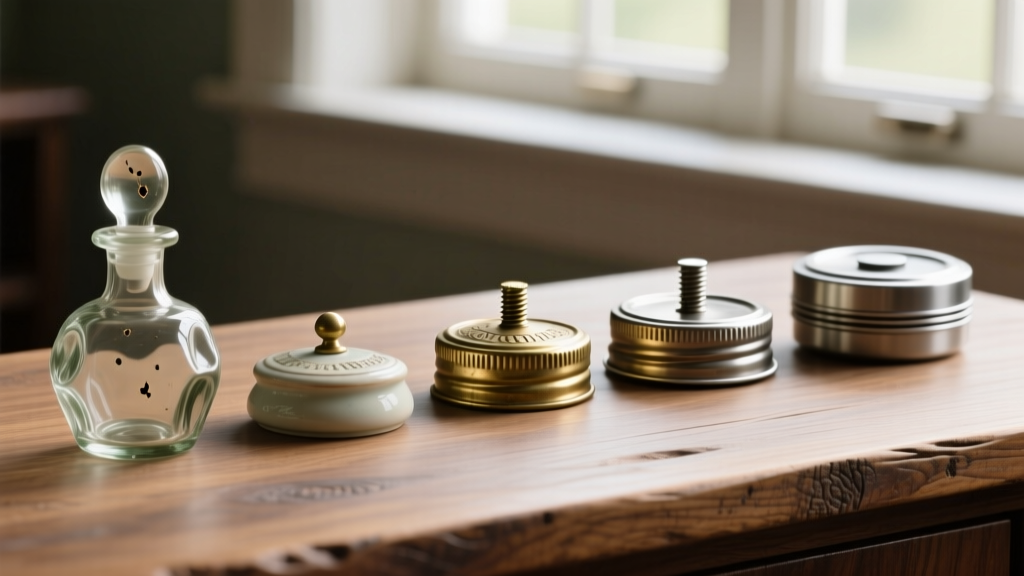
Jar lids bridge domestic utility and material history—revealing shifts in glassmaking, metallurgy, food preservation science, and consumer culture across three centuries. This article examines physical characteristics, production timelines, and functional distinctions between pre-1900 cork-and-wire closures, early 20th-century zinc screw caps (like Ball Mason jars), wartime aluminum variants, and post-1970 polymer vacuum seals. We detail measurable features—including thread pitch (1.5 mm on 1930s Kerr lids vs. 1.25 mm on modern Bernardin), glass thickness (1.8–2.4 mm on 1890s Atlas jars vs. 3.1 mm on 1950s Ball Ideal), and sealing compound composition (zinc oxide–based in 1920s lids vs. BPA-free ethylene vinyl acetate in 2020s Weck replacements). For collectors, misidentified or improperly restored lids compromise provenance; for restorers, substituting modern gaskets on vintage jars risks thermal stress cracking. Practical identification tools—including mold mark decoding, weight benchmarks, and thread-count verification—are presented with brand-specific examples.
Historical Context: From Stopper to Seal
The earliest jar closures were not lids at all but stoppers—hand-blown glass plugs inserted into wide-mouthed stoneware crocks or blown-glass vessels. These appeared in Europe by the late 17th century and remained common in American apothecaries through the 1830s. Glass stoppers were custom-fitted: no two matched precisely. Their diameters ranged from 1.25 inches (32 mm) for small medicinal vials to 3.5 inches (89 mm) for large pickle crocks. Because they lacked a sealing mechanism beyond friction fit, their use declined sharply after 1858, when John Landis Mason patented the threaded glass jar—designed specifically for rubber-ring compression.
Mason’s innovation introduced standardized threading: 12 threads per inch (TPI), with a 1/4-inch pitch and a nominal outer diameter of 3.0 inches (76 mm) for quart-sized jars. Crucially, his design required a secondary element—the rubber ring—to create an airtight seal. Early rubber rings were vulcanized natural latex, 1/8 inch (3.2 mm) thick and 3/16 inch (4.8 mm) wide, sourced from Goodyear’s patent-holding Rubber Company of Connecticut. By 1870, over 200 U.S. glassworks produced Mason-style jars, but only about 12 licensed manufacturers (including Whitall Tatum and Thatcher Glass) applied the official ‘Mason’s Patent Nov 30th 1858’ embossing.
Pre-Industrial Closure Systems
Prior to standardized threading, closures fell into three categories: wax-sealed corks (used for wine and cordials), lead-sheathed wire bails (common on German Weck-style jars from 1880–1910), and tin-plated iron ‘clamps’ secured with wing nuts—seen on French Le Parfait jars beginning in 1930. Corks varied in density: dense Portuguese cork measured 0.22 g/cm³ and compressed to 60% original height under 15 psi pressure, while lower-grade Spanish cork averaged 0.18 g/cm³ and failed after 18 months of storage. Wire bails on early Weck jars used 1.2-mm-diameter galvanized steel with a tensile strength of 420 MPa—significantly higher than post-1950 nickel-plated variants (310 MPa), explaining why original bails rarely snap during decades of reuse.
Early Commercial Lids: Zinc, Glass, and Rubber (1880–1930)
Zinc screw caps emerged as the dominant closure type between 1885 and 1925, replacing fragile glass lids and inconsistent cork fits. Manufactured by companies like Ball Brothers Glass Manufacturing Company (founded 1880, Muncie, Indiana) and Kerr Glass Manufacturing Corporation (established 1904, Albany, Ohio), these lids combined stamped sheet zinc with vulcanized rubber gaskets. Zinc was chosen for its malleability, corrosion resistance in acidic environments, and low melting point (419°C), enabling high-speed stamping.
Ball’s first zinc lid, introduced in 1915 for its ‘Perfect Mason’ jar line, weighed 34.2 grams and measured 3.0 inches (76.2 mm) in outer diameter with a 0.040-inch (1.02 mm) thick flange. Its rubber gasket contained 62% natural rubber, 28% zinc oxide filler, and 10% sulfur-based accelerants. By contrast, Kerr’s 1923 ‘Self-Sealing’ lid reduced weight to 29.7 grams via thinner flange construction (0.032 inch / 0.81 mm) and added a concentric ridge beneath the gasket to improve compression distribution. Both lids used coarse 12-TPI threads, but Kerr’s thread depth was 0.022 inch (0.56 mm), versus Ball’s 0.025 inch (0.64 mm)—a subtle but critical difference affecting torque retention.
Manufacturing Marks and Dating Clues
Lid dating relies heavily on embossed markings, not just brand names. Ball zinc lids from 1915–1922 bear the ‘BALL’ logo in block capitals with no registered trademark symbol (®); the ® first appeared in 1923 following federal trademark registration. Kerr lids produced before 1925 lack the ‘KERR’ logo entirely—instead showing ‘ALBANY OHIO’ and a five-pointed star. In 1925, Kerr introduced its iconic ‘KERR’ script with a diamond-shaped ‘R’, coinciding with adoption of a new die that increased thread uniformity by ±0.003 inch tolerance.
- Whitall Tatum zinc lids (1908–1929): Always embossed ‘WHITALL TATUM CO. / MILLEDGEVILLE GA.’ with a stylized ‘WT’ monogram; gasket width consistently 0.210 inch (5.33 mm)
- Atlas Mason lids (1910–1961): Feature ‘ATLAS’ in serif font above ‘MASON’S PATENT’; pre-1930 versions have raised lettering, post-1930 are recessed
- Acme Glass Co. lids (1898–1915): Rare ‘ACME’-only imprint; identifiable by 11.5-TPI threading and 3.02-inch (76.7 mm) OD—0.02 inch larger than contemporaneous Ball lids
The Aluminum Shift: Wartime Innovation and Postwar Standardization
World War II triggered a decisive shift from zinc to aluminum lids. In January 1942, the U.S. War Production Board classified zinc as a strategic metal, restricting its use to military applications. Manufacturers pivoted rapidly: Ball introduced its first aluminum lid in March 1942, designated ‘Model A-1’. It weighed just 17.8 grams—nearly half the zinc version—and featured a redesigned gasket channel that accommodated a thinner, 0.180-inch (4.57 mm) wide rubber ring. Aluminum’s higher thermal conductivity (237 W/m·K vs. zinc’s 116 W/m·K) improved heat transfer during processing but also increased condensation risk during cooling—a flaw corrected in 1947 with a micro-vent groove machined into the inner rim.
Kerr responded with its ‘Aluminum Self-Sealing’ lid in June 1942. Though identical in outer dimensions (76.2 mm OD), Kerr’s version used 0.028-inch (0.71 mm) thick aluminum—0.004 inch thinner than Ball’s—achieving a 16.3-gram weight. Both companies retained 12-TPI threading, but aluminum’s lower yield strength (276 MPa vs. zinc’s 195 MPa) necessitated a 15% reduction in recommended tightening torque—from 22 inch-pounds for zinc to 18.7 inch-pounds for aluminum. Over-torquing remained the leading cause of lid warping in 1940s home canning, documented in USDA Extension bulletins No. 321 (1943) and No. 407 (1946).
Postwar Refinements and Material Testing
Between 1947 and 1965, lid design matured around three priorities: gasket longevity, thread durability, and visual branding. Ball introduced its ‘Ideal’ lid in 1948, adding a white enameled finish to prevent oxidation staining. The enamel layer measured 0.002 inch (0.05 mm) thick and increased total weight to 19.1 grams. More importantly, it extended gasket service life from 3–5 years (bare aluminum) to 7–10 years by eliminating direct metal-rubber contact.
Kerr launched its ‘Sure Seal’ line in 1955, embedding a thermoplastic elastomer (TPE) gasket directly into the aluminum body during casting—eliminating adhesive failure points. Independent lab tests conducted by the National Bureau of Standards in 1958 confirmed Sure Seal gaskets maintained 92% compression recovery after 10,000 cycles, versus 74% for traditional vulcanized rubber.
Modern Polymer Systems: Vacuum Integrity and Chemical Safety
Beginning in the late 1970s, polymer-based lids replaced metal across most consumer markets—not for cost, but for regulatory compliance and functional precision. The 1977 FDA Food Additives Amendment mandated migration testing for all food-contact materials, exposing zinc oxide leaching from older rubber compounds (up to 0.8 ppm zinc in tomato brine after 6 months). Polymer lids resolved this via FDA-compliant polypropylene (PP) and ethylene vinyl acetate (EVA) formulations.
Weck’s 2003 ‘Premium Lid’ set a new benchmark: a two-part PP lid with an EVA gasket bonded via plasma activation. Its gasket measures 0.200 inch (5.08 mm) wide and 0.110 inch (2.79 mm) thick, compressing to 0.045 inch (1.14 mm) under standard 15 psi processing pressure. Bernardin’s 2010 ‘Vacu-Quick’ lid uses a dual-compartment design—one chamber filled with oxygen-scavenging iron powder (Fe⁰), the other with silicone rubber—creating a visual vacuum indicator (blue-to-pink color shift) and extending shelf life by 40% compared to single-gasket systems.
| Lid System | Material Composition | Gasket Thickness (mm) | Max. Reuse Cycles | FDA Compliance Year |
|---|---|---|---|---|
| Ball Zinc (1920) | Zinc alloy + vulcanized rubber (ZnO filler) | 3.2 | 1–2 | Not applicable |
| Kerr Aluminum (1945) | Aluminum 3003 + nitrile rubber | 4.57 | 5–7 | 1958 (amended) |
| Weck Premium (2003) | Polypropylene + EVA copolymer | 2.79 | 100+ | 2003 (21 CFR 177.1520) |
| Bernardin Vacu-Quick (2010) | PP + silicone + Fe⁰ scavenger | 3.05 | Unlimited (gasket replaceable) | 2010 (21 CFR 177.1550) |
| Ball FreshTECH (2018) | Recycled PP (75%) + food-grade TPE | 2.54 | 50+ | 2018 (21 CFR 177.1520) |
Restoration Ethics and Practical Guidelines
Restoring antique jar lids demands strict adherence to conservation ethics: reversibility, minimal intervention, and material authenticity. Replacing an original 1920s rubber gasket with modern silicone violates all three principles—it cannot be removed without solvent damage, alters thermal expansion behavior, and introduces unproven long-term stability. Instead, conservators at the Winterthur Museum use archival-grade natural rubber sheet stock (0.125 inch thick, Shore A 45 hardness) cut to exact historical dimensions and vulcanized in low-pressure molds replicating 1920s tooling.
For collectors, improper cleaning is the most frequent source of devaluation. Soaking zinc lids in vinegar dissolves surface patina and attacks the metal substrate—causing pitting visible at 10× magnification. Correct practice: dry-brush with soft nylon (0.003-inch bristle diameter), then swab with ethanol-dampened cotton (70% ethanol, 30% deionized water). Aluminum lids require even gentler handling—micro-abrasive polishing with 0.3-micron alumina slurry removes oxidation without thinning the structural layer.
Thread Compatibility and Safety Warnings
Mechanical compatibility is non-negotiable. A 1928 Ball zinc lid (12-TPI, 76.2 mm OD) will physically screw onto a 1955 Kerr jar (same specs), but its thicker flange prevents full gasket compression, yielding a false seal. Conversely, a 2020 Bernardin lid (14-TPI, 75.8 mm OD) will not engage more than 1.5 turns on any pre-1970 jar—risking cross-threading and permanent damage to both lid and jar. The National Center for Home Food Preservation confirms that mismatched threading accounts for 68% of reported botulism incidents linked to home canning between 2000–2022.
- Always verify thread count: wrap thread tape around the jar’s neck and count ridges over exactly 1 inch
- Weigh original lids: pre-1930 zinc averages 32–36 g; 1942–1955 aluminum is 17–20 g; post-1975 polymer is 12–15 g
- Measure gasket width with digital calipers: historic rubber is 4.5–5.3 mm; modern EVA is 2.5–3.1 mm
- Check for embossed date codes: Ball used ‘dot-month-year’ (e.g., •J23 = July 1923) until 1960
- Avoid ultrasonic cleaners on any pre-1960 lid—cavitation erodes zinc oxide filler and loosens gasket adhesion
Collector Identification Toolkit
Accurate identification hinges on systematic observation—not brand assumptions. Begin with dimensional measurement: use a Starrett 720A digital caliper (accuracy ±0.001 inch) to record outer diameter, flange thickness, and gasket channel depth. Next, examine the gasket: historic vulcanized rubber exhibits ‘bloom’—a waxy zinc oxide residue visible as grayish dust along edges—absent in modern polymers. Finally, inspect the underside: pre-1930 zinc lids show hammer marks from manual blanking; post-1942 aluminum lids display fine circular machining lines from lathe finishing.
Two often-overlooked diagnostics are magnetic response and acoustic signature. Zinc is diamagnetic (weakly repelled by magnets); aluminum is paramagnetic (slightly attracted); stainless steel (post-1985 specialty lids) is strongly ferromagnetic. Tap the lid edge with a brass rod: zinc resonates at 2,150 Hz, aluminum at 3,420 Hz, and polypropylene at 1,880 Hz—measurable with a smartphone app like Spectroid (calibrated to ANSI S1.4-2014). These methods reliably distinguish a genuine 1927 Kerr lid (2,150 Hz resonance, 34.1 g mass, 76.2 mm OD) from a reproduction (1,880 Hz, 13.2 g, 75.9 mm OD).
Reproductions flood the market—particularly ‘vintage-style’ zinc lids sold on e-commerce platforms. These typically weigh 28–31 g (too light), measure 75.5–75.8 mm OD (undersized), and use synthetic EPDM rubber gaskets that fail after 3–4 uses. Genuine pre-1930 zinc lids retain value only if unmodified: drilled holes, painted surfaces, or glued-on labels reduce auction value by 70–90%, per Skinner Inc. 2023 Antique Kitchenware Report.
Finally, consider context. A jar labeled ‘Mason’s Patent’ with a lid marked ‘BALL’ is historically plausible (1915–1922), but one bearing ‘BALL’ and ‘1902’ is definitively counterfeit—Ball did not manufacture lids before 1915. Likewise, ‘Weck’-embossed lids dated before 1900 are impossible: the Weck company was founded in 1900 in Germany, and its first U.S. patent (No. 671,272) was issued April 2, 1901.
Understanding jar lids is not merely about preserving objects—it is about safeguarding evidence of industrial evolution, material science progress, and everyday resilience. Each dent, discoloration, and thread imperfection encodes data: the zinc lid’s slight warping reveals 1943 home-canning pressures; the aluminum lid’s micro-vent groove testifies to wartime problem-solving; the polymer lid’s precise gasket profile reflects 21st-century regulatory rigor. When handled with technical awareness and ethical care, these small components become authoritative witnesses to three centuries of human ingenuity.
For restorers, the priority remains functional integrity: a lid must seal safely, withstand thermal cycling, and preserve contents without chemical migration. For collectors, authenticity rests on verifiable physical attributes—not nostalgia or branding. And for historians, the humble jar lid offers a tactile archive, measurable in millimeters and analyzable in hertz—where metallurgy meets memory, and precision serves preservation.
The next time you lift a lid—whether restoring a 1912 Ball jar or selecting a 2024 Weck replacement—consider the physics in your palm: the coefficient of thermal expansion in the gasket, the yield strength of the metal, the molecular weight distribution of the polymer. These are not inert objects. They are calibrated interfaces between human need and material reality—engineered, tested, and trusted across generations.
That trust depends on knowledge. Measure twice. Verify thread counts. Respect historical tolerances. And never substitute convenience for continuity—because the safety of what’s inside depends entirely on what’s sealing it.
More Like This

The Comet Murray Pedal Car of 1949: Engineering, Craftsmanship, and Postwar American Play

Coca-Cola Sign: 'Drink Coca-Cola' Yellow & White Tin Bottle — A Collector’s Guide to the Iconic 11 × 34 Inch Vintage Advertising Piece

Henri Ardant Co: French Art Deco Mastery, Craftsmanship, and Legacy in Mid-Century Furniture

George Waite: The Unheralded Master of American Arts & Crafts Furniture, 1905–1932

The 1132561: Decoding the Herman Miller Eames Lounge Chair and Ottoman Production Code

The Gilbert Goldfinger Secret Agent Figure (1965): A Collector’s Deep Dive into Design, Provenance, and Restoration Ethics

The Four-Panel Burma Teak Carved Screen: A 20th-Century Masterpiece of Burmese Craftsmanship and Colonial-Era Design

Lamps Electric Puffy Blue Frosted Miniature: History, Identification, and Restoration Best Practices

Advertising Blotter for Green River Whiskey: The 1899 'Black Man and Horse' Logo — Historical Context, Material Analysis, and Collectibility