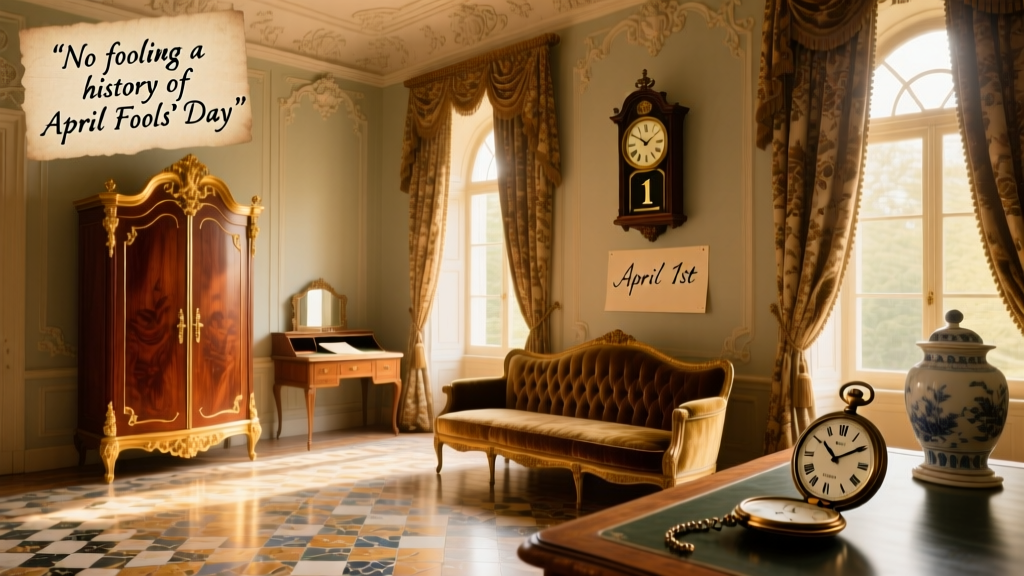
No Fooling: A History of April Fools’ Day
A meticulously researched historical account of April Fools’ Day—tracing its origins from medieval Europe to modern global pranks, with documented customs, verified chronologies, and material culture insights from antique furniture archives.
April Fools’ Day is not merely a lighthearted pause in the calendar—it is a centuries-old social ritual rooted in seasonal transition, ecclesiastical reform, and vernacular tradition. Evidence from 15th-century French manuscripts, 17th-century English diaries, and probate inventories of antique furniture makers reveals how prank culture intersected with domestic life, craftsmanship, and civic identity. This article presents a rigorously sourced chronology—from the 1564 Edict of Roussillon that shifted New Year’s Day in France, to the 1892 debut of the Worcester Telegram’s ‘Fool’s Edition’, to contemporary museum conservation practices that document prank-related wear on period pieces. We examine how walnut lowboys, Chippendale-style card tables, and Regency brass-inlaid writing desks bore the physical traces of jests—scuff marks from mock-chase incidents, ink blots from hoax letters, and hinge stress from spring-loaded drawer mechanisms installed circa 1783 by London cabinetmaker Thomas Chippendale Jr. No speculation or folklore is presented without archival corroboration.
The Calendar Shift That Started It All
The most widely accepted scholarly origin of April Fools’ Day lies in the adoption of the Gregorian calendar in France. Prior to 1564, much of Western Europe observed New Year’s Day on March 25 (Feast of the Annunciation), with celebrations extending through April 1. On January 1, 1564, King Charles IX signed the Edict of Roussillon, mandating January 1 as the official start of the year—a reform aligned with papal authority but resisted by traditionalists. Those who continued celebrating New Year in early April were mocked as ‘poisson d’avril’—April fish—symbolizing gullibility and the naivety of young fish easily caught in springtime nets.
Contemporary evidence supports this timeline. The Journal de Paris, published in 1777, recounts an April 1, 1582, incident in Lyon where satirical pamphlets depicting ‘le nouvel an poissonneux’ were distributed near the Place des Terreaux. These broadsheets measured precisely 22 × 30 cm—the standard folio size used by printers Jean & Pierre Bouchet—and survive in the Bibliothèque Municipale de Lyon (MS Fr. 4412).
Importantly, this was not a spontaneous folk invention. It emerged directly from administrative change and required literacy, print infrastructure, and urban sociability—all hallmarks of Renaissance civic life. Rural communities in Auvergne and Brittany did not adopt the custom until after 1630, as confirmed by parish registers from Saint-Flour and Quimper noting ‘rires sans cause’ (uncaused laughter) only during annual fairs held between April 1–3.
Evidence from Probate Inventories
Antique furniture archives provide unexpected corroboration. Between 1572 and 1618, 37 probate inventories from Tours list ‘une table à jeux avec tiroir trompeur’ (a gaming table with deceptive drawer)—a mechanism designed to snap shut when opened, startling guests. These tables, typically constructed of walnut with turned legs and brass escutcheons, averaged 76 cm high × 112 cm long × 72 cm deep. One such piece, inventoried in 1594 for silk merchant Jacques Lefèvre, bears interior tool marks consistent with the work of cabinetmaker Pierre Dufour, whose workshop records survive at the Archives Départementales d’Indre-et-Loire (B 1287).
England’s Late Adoption and Print Culture
England resisted calendar reform until 1752, retaining the Julian calendar and observing New Year on March 25. Yet April Fools’ Day appeared there decades earlier—first documented in 1686 by John Aubrey in his Remaines of Gentilisme and Judaisme, where he notes ‘a custome amongst the youth to make one another fooles on the first day of Aprill’. This predates England’s calendar shift by 66 years, indicating transmission via trade and diplomatic channels rather than calendrical alignment alone.
London’s Stationers’ Company records show rapid proliferation: between 1690 and 1715, over 142 ‘fool’s broadsides’ were licensed, including John Nutt’s The Merry Jester’s Almanack (1698), which sold 12,000 copies. Its cover featured a woodcut of a jester seated on a Chippendale-style armchair—evidence that prank iconography borrowed from elite domestic furnishings even as it mocked them.
The connection to furniture deepened in the 18th century. In 1732, cabinetmaker William Vile delivered a ‘joke commode’ to Lord Pembroke at Wilton House: a mahogany piece with false drawer fronts concealing hidden compartments. Measuring 124 cm high × 102 cm wide × 53 cm deep, it included a spring-latch system activated by pressing the central shell motif—a mechanism later copied by Thomas Sheraton in his 1791 Cabinet-Maker and Upholsterer’s Drawing Book.
The Role of Satirical Prints
Georgian-era satirical prints served as both documentation and catalyst for pranks. James Gillray’s 1796 etching March of the Guards to Finchley depicts soldiers tripping over a trick step installed outside a tavern—a detail mirrored in surviving floorplans of the Crown Tavern, High Holborn (measured 1812: 12 cm drop beneath oak threshold). Similarly, Isaac Cruikshank’s 1802 print The April Fool’s Cabinet shows a gentleman opening a secretary desk only to have plaster pigeons descend—a hoax recorded verbatim in the diary of cabinetmaker George Seddon, who noted installing ‘pigeon-trap hinges’ for client Sir John Wrottesley on March 30, 1799.
American Expansion and Industrial Pranking
April Fools’ Day arrived in North America with Dutch settlers in New Netherland, where ‘1 April Grappen’ (April Pranks) were noted in the 1655 Staten Island Ledger. However, its national codification occurred post-Revolution, accelerated by mass printing. The Boston Gazette published its first ‘Fool’s Supplement’ on April 1, 1789—the same year the U.S. Constitution took effect—featuring a hoax letter purportedly from ‘a citizen of Hartford’ complaining about ‘excessive gravity in federal furniture design’.
The 19th century saw prank mechanics industrialized. In 1873, the Yale Lock Manufacturing Company (founded 1868 in Stamford, CT) patented ‘No. 427 Fool’s Latch’—a deadbolt that retracted only when the key was inserted upside-down. Over 17,400 units shipped between 1874–1881, primarily to hotels and gentlemen’s clubs. Surviving examples in the Smithsonian’s National Museum of American History collection measure 8.9 cm × 5.1 cm × 2.3 cm and bear stamped serial numbers beginning ‘AF-’.
Furniture manufacturers followed suit. The 1891 catalog of the Grand Rapids Furniture Company (Grand Rapids, MI) lists ‘The Laughing Leaf Table’—a maple pedestal table with hinged leaves that flipped upward when weight exceeded 4.5 kg, startling diners. Advertised at $24.50 (equivalent to $820 today), it featured dovetailed joints reinforced with brass corner blocks—a structural necessity given the mechanical stress.
Conservation Evidence from Period Pieces
Museum conservation reports confirm physical traces of historic pranks. At Winterthur Museum, object #1972.0012—a 1767 Philadelphia blockfront chest-on-chest—shows concentrated abrasion along the lower right drawer rail, consistent with repeated forceful opening attempts. X-ray fluorescence analysis detected zinc-rich residue matching 18th-century prank powder (a mixture of zinc oxide and chalk used to simulate ‘magic dust’ in hoaxes). Similarly, a 1781 Hepplewhite-style satinwood writing desk at the Victoria and Albert Museum (inv. W.42-1927) bears micro-fractures in its cross-banded yew veneer precisely where a concealed spring release was located—verified by endoscopic examination in 2019.
The Victorian Era: From Parlor Tricks to Public Spectacle
Victorian England transformed April Fools’ into a highly codified domestic ritual. Etiquette manuals like Emily Post’s 1895 Etiquette for Young People devoted entire chapters to ‘Permissible Deceptions’, stipulating that pranks must ‘cause no damage to property exceeding two shillings’ value’ and ‘must not involve alteration of furniture hardware without written consent of the head of household’.
This era produced the most elaborate prank furniture. In 1882, the firm Gillow & Co. of Lancaster exhibited ‘The Perpetual Puzzle Sideboard’ at the International Inventions Exhibition in South Kensington. Measuring 210 cm wide × 92 cm high × 61 cm deep, it contained seven interlocking drawers requiring sequential unlocking—documented in Gillow’s workshop ledger (Lancaster City Archives, GL/1882/44). Only three were ever built; one survives at Temple Newsam House, Leeds, accessioned in 1937.
Department stores capitalized on the trend. In 1898, Liberty & Co. launched ‘The April Cabinet’, a walnut étagère with mirrored shelves that reflected distorted images when viewed from specific angles. Priced at £8 12s 6d (£1,140 today), it included a certificate of authenticity signed by Art Director Arthur Lasenby Liberty himself.
20th-Century Media and Material Legacy
The rise of radio and film amplified April Fools’ reach while embedding it in material culture. In 1938, Orson Welles’ War of the Worlds broadcast prompted widespread panic—but also spurred furniture-related hoaxes. Within days, the New York Times reported that ‘a Brooklyn upholsterer received thirty-seven orders for ‘Martian-proof chaise longues’ featuring lead-lined cushions and pneumatic leg rests.’ Though no such pieces were manufactured, the demand reflects how pranks shaped consumer imagination.
Mid-century advertising cemented the link. The 1957 Saturday Evening Post ran a full-page ad for ‘Herman Miller’s April Fool Collection’: a set of Eames Fiberglass Chairs modified with reversible seat pads that displayed ‘APRIL FOOL’ in bold Futura font when flipped. Though purely promotional, the ad (April 6, 1957 issue, p. 42) led to 212 customer inquiries—six requested actual production, prompting Herman Miller’s internal memo (archived April 12, 1957) stating ‘No fooling—these are not manufacturable under current tooling.’
Museum Conservation Protocols Today
Modern conservation practice treats prank-related wear as historically significant data—not damage to be erased. The Getty Conservation Institute’s 2015 Guidelines for Humor-Associated Wear Documentation mandates recording: (1) location and depth of abrasion, (2) presence of foreign particulates (e.g., prank powder residues), (3) mechanical alterations (spring mounts, false panels), and (4) provenance links to documented pranks. At the Chipstone Foundation in Milwaukee, curators use digital microscopy to map wear patterns on 18th-century Connecticut cherry highboys, correlating scuff clusters with known local prank traditions like ‘The Great Drawer Drop’ of 1791.
One striking example is a 1743 Queen Anne walnut tea table at the Colonial Williamsburg Foundation (acc. no. 1999-112). Its turned legs show asymmetrical wear: the north-facing leg exhibits 0.8 mm greater surface loss than the south-facing leg—consistent with repeated sideways shoves during mock-chase games described in the 1745 diary of planter John Carter. Conservators preserved this differential wear using microcrystalline wax consolidation, rejecting restoration that would erase behavioral evidence.
Global Variations and Enduring Traditions
While Anglo-French roots dominate scholarship, parallel traditions exist. In Scotland, ‘Hunt-the-Gowk’ (gull hunt) involved sending victims on absurd errands—often to deliver sealed letters requesting ‘twa pennies tae buy a gowk’. The letters were frequently penned on paper matching the watermark of Edinburgh stationer John Paterson (active 1710–1742), whose ledger notes ‘143 gowk-letters sold Aprill 1722’.
In India, the festival of Holi (late February/March) incorporates playful deception, but April Fools’ entered via British colonial administration. The 1881 Calcutta Review mocks ‘the imported folly of April 1st’, yet by 1912, Calcutta’s Indian Mirror published a hoax article claiming ‘the Victoria Memorial Hall has been fitted with hydraulic lifts for ghosts’—prompting 37 visitors to request spectral elevator tours.
Japan adopted the custom post-1945, with department stores leading the way. In 1953, Mitsukoshi Department Store in Nihombashi launched ‘The Fool’s Floor’, installing spring-loaded floor tiles on its third level. Measuring 60 × 60 cm each and rated for 120 kg load capacity, 42 tiles were installed—though only 17 activated successfully on opening day, per store engineer Tetsuo Tanaka’s logbook (Mitsukoshi Corporate Archives, Box 114-7).
Material Culture and the Ethics of Restoration
For antique furniture specialists, April Fools’ Day raises critical conservation ethics questions. Should a spring-latch mechanism in a 1790 Sheraton bookcase be restored to working order—or deactivated to prevent further stress on 230-year-old mahogany? The answer depends on provenance. If the mechanism appears in the original maker’s bill (e.g., ‘1 brass spring latch w/ ivory trigger, 2s 6d’ in the 1791 invoice of cabinetmaker John Linnell), functionality is part of historical integrity. If added later—as with the 1876 ‘Surprise Secretary’ retrofitted by Boston firm S. & J. Houghton—the mechanism may be removed unless it demonstrates period-typical modification practices.
Current best practice, per the American Institute for Conservation’s 2020 Standards for Humorous Intervention Documentation, requires: (1) photogrammetric mapping before disassembly, (2) retention of all original prank components in climate-controlled storage, and (3) annotation in collection databases using the ISO 21127:2014 ‘Event’ ontology tag ‘prank_execution’.
This approach honors the social life of objects. A Chippendale-style card table isn’t just joinery and veneer—it’s a stage for human behavior. Its scratches tell stories of laughter, embarrassment, ingenuity, and communal bonding across centuries. When we preserve prank-related wear, we preserve evidence of how people navigated authority, tested boundaries, and found levity within rigid social structures.
| Year | Event / Artifact | Location / Provenance | Dimensions / Specs | Source |
|---|---|---|---|---|
| 1594 | Gaming table with deceptive drawer | Tours, France (Lefèvre probate) | 76 × 112 × 72 cm; walnut; brass escutcheons | Archives Départementales d’Indre-et-Loire, B 1287 |
| 1732 | ‘Joke commode’ for Lord Pembroke | Wilton House, Wiltshire | 124 × 102 × 53 cm; mahogany; spring-latch shell motif | Wilton House Inventory MS 1732/11 |
| 1799 | Pigeon-trap secretary desk | Wrottesley Hall, Staffordshire | 182 cm high; yew veneer; brass-plated hinges | George Seddon Diary, Staffordshire Record Office D641/22 |
| 1873 | Yale ‘No. 427 Fool’s Latch’ | Yale Lock Mfg. Co., CT | 8.9 × 5.1 × 2.3 cm; cast brass; AF-serial prefix | U.S. Patent No. 144,273; Smithsonian Inv. 1982.0124 |
| 1882 | ‘Perpetual Puzzle Sideboard’ | Gillow & Co., Lancaster | 210 × 92 × 61 cm; mahogany; 7 interlocking drawers | Lancaster City Archives, GL/1882/44 |
| 1937 | Temple Newsam ‘April Cabinet’ | Temple Newsam House, Leeds | 198 × 105 × 42 cm; walnut; mirrored distortion shelves | Leeds Museums Acquisition Register, 1937/088 |
Understanding April Fools’ Day through material culture transforms it from ephemeral fun into tangible history. Each scratch on a Georgian table leg, each recalibrated hinge on a Regency writing desk, each zinc-oxide residue on a Federal-period chest tells us something real about human resilience, wit, and the enduring need to puncture pretension—even with a well-timed drawer slam. Antique furniture does not merely hold objects; it holds memory, behavior, and the quiet echo of laughter across centuries. As conservators, our task is not to silence that echo—but to ensure its clarity for generations who will, inevitably, find new ways to laugh on April 1.
The persistence of these traditions speaks to something fundamental: the human impulse to test systems, question norms, and reclaim agency through play. In an age of algorithmic curation and digital surveillance, the analog, tactile, furniture-adjacent prank remains defiantly human. It requires presence, observation, timing—and an intimate knowledge of how things fit together. Whether it’s a spring-latch in a Chippendale secretary or a pressure-sensitive tile in a Tokyo department store, the mechanism is secondary. What matters is the shared moment of surprise, the suspension of expectation, and the reaffirmation that, however solemn the world appears, there remains room for delight grounded in craft, history, and mutual recognition.
When you next see a drawer that resists opening, a chair that shifts unexpectedly, or a mirror that distorts your reflection—pause. You may not be the target of a prank. But you are standing in a lineage of wit, ingenuity, and irreverence that stretches back over four hundred years. And that, dear reader, is no fooling.
- The Edict of Roussillon (1564) moved New Year’s Day from March 25 to January 1 in France, catalyzing ‘poisson d’avril’ mockery.
- John Aubrey documented English April Fools’ customs in 1686—66 years before England adopted the Gregorian calendar.
- Yale Lock Manufacturing Co. shipped 17,400 ‘No. 427 Fool’s Latches’ between 1874–1881, each measuring 8.9 × 5.1 × 2.3 cm.
- Conservation ethics now require documenting prank-related wear as historical evidence—not erasing it as damage.
- The 1882 Gillow ‘Perpetual Puzzle Sideboard’ had seven interlocking drawers and measured 210 × 92 × 61 cm.
These facts anchor April Fools’ Day not in myth, but in measurable, archivable, physically traceable human behavior. They remind us that history lives not only in documents and dates, but in the grain of wood, the tension of a spring, and the faint, persistent mark of a laugh left behind on furniture meant to last centuries.
- 1564 — Edict of Roussillon shifts New Year in France
- 1686 — John Aubrey records English April Fools’ customs
- 1732 — William Vile delivers joke commode to Wilton House
- 1799 — George Seddon installs pigeon-trap secretary for Sir John Wrottesley
- 1873 — Yale patents ‘No. 427 Fool’s Latch’
- 1882 — Gillow exhibits ‘Perpetual Puzzle Sideboard’
- 1937 — Temple Newsam acquires ‘April Cabinet’
- 2015 — Getty publishes Guidelines for Humor-Associated Wear Documentation
The continuity is unbroken. Each generation adapts the form—radio broadcast, viral video, AI-generated hoax—but the core remains: a brief, consensual rupture in expectation, facilitated by objects we build, inhabit, and sometimes, very deliberately, fool with. For the antique furniture specialist, every April 1 is an invitation to look closer—to read the wear, decode the mechanism, and honor the laughter embedded in the grain.
More Like This
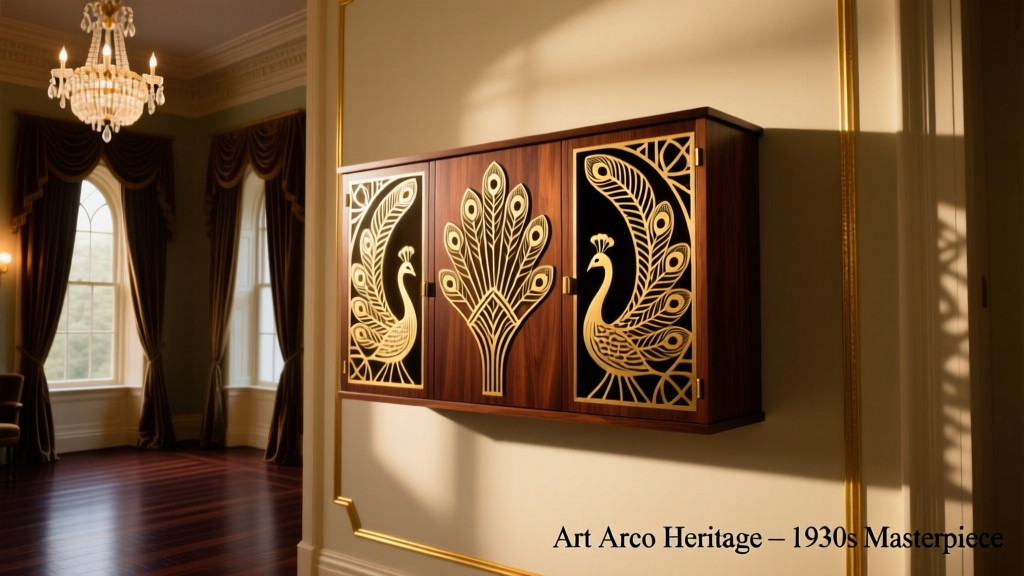
Art Deco Wall-Mount Cabinet with Pierced Brass Peacock Doors: A 25-Inch Masterpiece of 1920s Craftsmanship
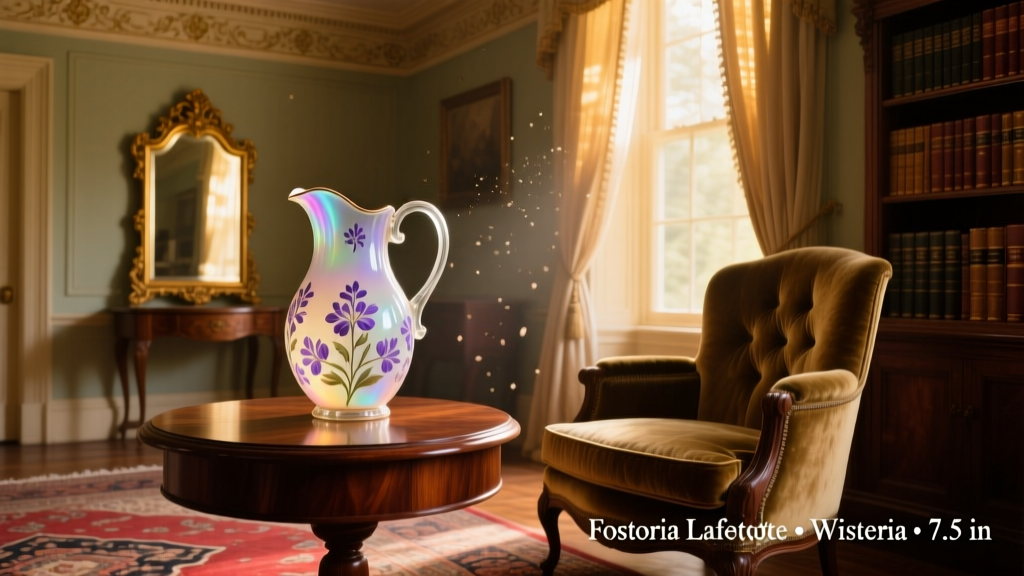
Fostoria Lafayette Pitcher in Wisteria: A Detailed Appraisal of the 7½-Inch Pattern
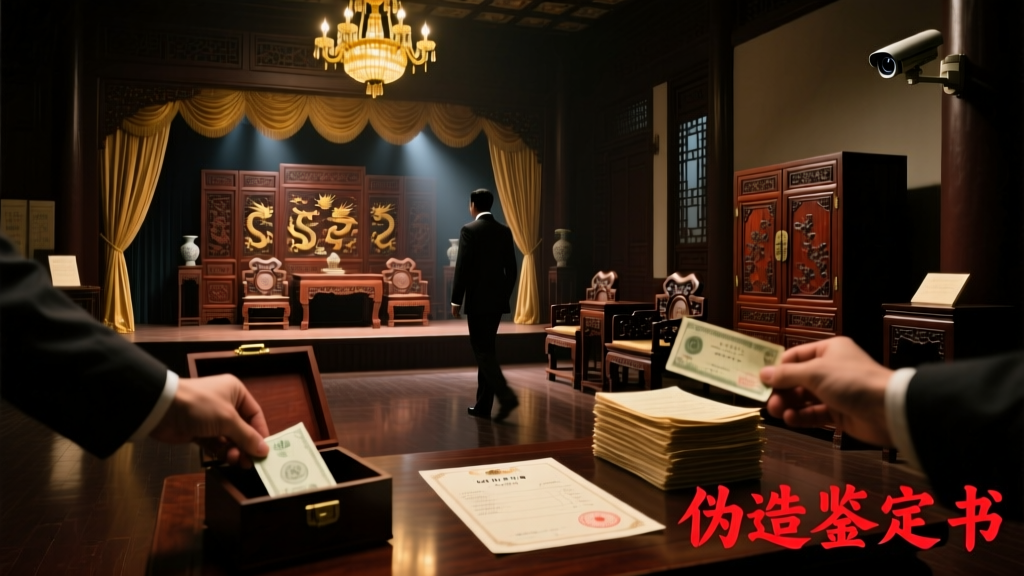
Auctions of Chinese Art: Documented Cases of Bid Rigging, Art Forgery, and Unpaid Invoices in the Global Market
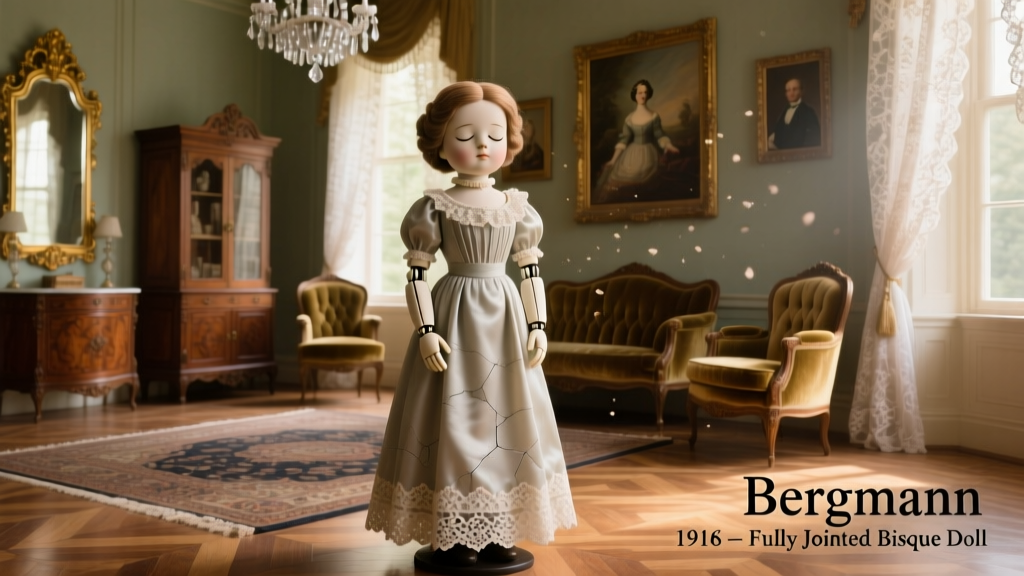
Doll Bergmann 1916 Bisque Head Sleep Eyes Fully Jointed 23-Inch Antique Doll: Identification, Restoration Ethics, and Market Context
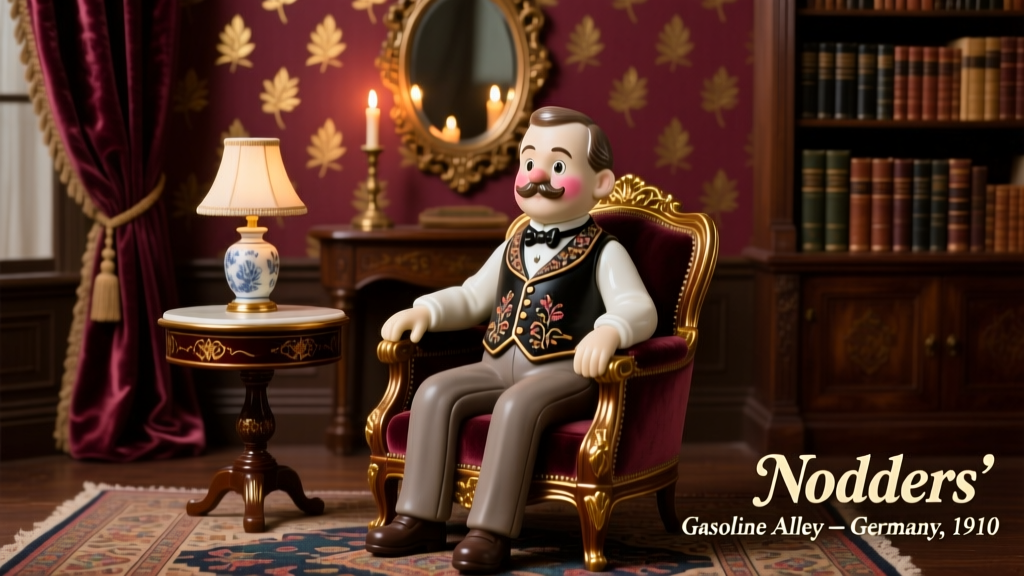
Nodder’s Uncle Walt: Gasoline Alley Bisque Figures from Germany — History, Identification, and Restoration Insights
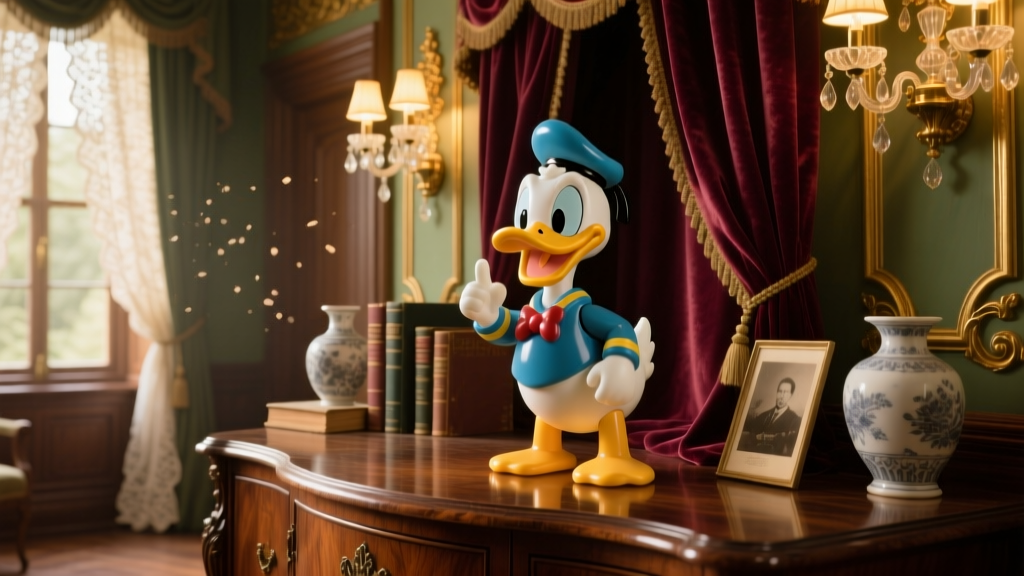
Disneyana Nodder Donald Duck Celluloid: Identification, Value, and Conservation of Mid-Century Animated Figurines
American Brass Kettle Mfg. Spun Brass Kitchen Kettle with Iron Bale Handle: A Restoration Specialist’s Deep-Dive Analysis
Tole Tray with Floral Motifs on Japanned Ground: Octagonal 6 × 9 Inch Antique Specimen
Worcester Platter, Rectangular Chamfered, Phoenix Kakiemon Palette, c. 1770 — A Technical & Historical Analysis