New to Bidding at Auction? Learn the Basics — Practical Online Auction Tips for Antique Furniture Buyers
A beginner-friendly, expert-led guide to online antique furniture auctions — covering registration, bidding strategy, condition assessment, shipping logistics, and real-world examples from major platforms like Christie’s, Sotheby’s, and Bidspotter.
If you're new to buying antique furniture at auction, it's easy to feel overwhelmed by fast-paced bidding, unfamiliar terminology, and hidden costs. This guide cuts through the noise with actionable, field-tested advice drawn from over 25 years of hands-on restoration and auction consultation. You’ll learn how to register safely on platforms like Bidspotter and LiveAuctioneers, interpret condition reports for a Chippendale-style mahogany highboy (36" W × 18" D × 72" H), spot authentic dovetail joinery versus machine-cut replicas, calculate true landed cost—including $185–$420 domestic white-glove delivery for a Queen Anne walnut armchair—and avoid common pitfalls like proxy bid traps or misread reserve statuses. No fluff—just clear, precise steps backed by real auction data and conservation standards.
Why Antique Furniture Auctions Are Worth Your Time
Auctions remain the most transparent and historically grounded marketplace for pre-19th-century furniture. Unlike retail galleries or e-commerce marketplaces, auction houses publish detailed provenance, conservation notes, and third-party condition reports. For example, in 2023, Sotheby’s sold a documented 1765 John Goddard block-front chest-on-chest for $1.28 million—its sale included X-ray imaging confirming original pine secondary wood and hand-cut English dovetails. Similarly, Christie’s June 2024 American Arts sale featured a pair of attributed Duncan Phyfe rosewood armchairs (21.5" seat height, 35" overall height) with full archival research tracing ownership back to the Van Rensselaer family. These sales aren’t just about price—they’re verifiable historical touchpoints.
Online bidding has democratized access: Bidspotter now hosts over 2,400 auctioneers globally, including regional specialists like Eldred’s in Massachusetts and Neal Auction in New Orleans. You no longer need to travel to New York or London to inspect a Federal-era satinwood demilune table (28" diameter × 29" height). But accessibility brings responsibility—especially when evaluating wear, repairs, or structural integrity remotely.
Getting Started: Registration & Platform Selection
Before placing your first bid, select a platform aligned with your collecting goals. Major options include:
- LiveAuctioneers: Largest aggregator; integrates 8,500+ auction houses; supports real-time video streaming and condition report downloads; requires $500 minimum credit card authorization for first-time bidders.
- Bidspotter: Preferred by estate and regional auctioneers; offers ‘Buy Now’ options post-auction; mandates identity verification via government-issued ID upload and bank account validation.
- Christie’s & Sotheby’s Online: Curated, high-value sales only; requires pre-approval (typically 5–7 business days); non-refundable $1,500 deposit required for bidding on lots exceeding $10,000.
Registration isn’t instant. At Heritage Auctions, first-time bidders must submit proof of address, tax ID (if purchasing for resale), and a signed Terms of Guarantee acknowledging that all lots are sold ‘as is, where is’. Never skip reading the Terms of Sale—these documents define liability for damage during transit, payment deadlines (typically 5 business days), and buyer’s premium rates (ranging from 15% at smaller houses to 25% at top-tier firms).
Verifying Authenticity Before Registration
Reputable auctioneers disclose maker marks, construction evidence, and tool marks. A genuine Sheraton-period satinwood veneer cabinet (c. 1790) will show consistent grain direction across panels, micro-checking consistent with age-related drying—not cracking from modern humidity swings. Look for inventory numbers etched in inconspicuous locations: on the underside of drawer bottoms, inside case backs, or beneath chair seats. If a lot listing omits this detail—or uses vague language like “in the manner of”—treat it as a red flag unless accompanied by third-party attribution (e.g., a letter from the Chipstone Foundation or Winterthur Museum).
Reading the Catalog Like a Conservator
Auction catalog descriptions follow strict conventions—but many beginners miss critical qualifiers. Phrases like “minor surface scratches” may mean 12+ hairline abrasions across a 42" x 22" Chippendale maple bureau’s top surface. “Stable old repair” could indicate a 1920s glue-and-dowels reinforcement of a broken cabriole leg—not an original fix. Always cross-reference the written description with available photos and, if offered, the Condition Report PDF.
Here’s what to examine in every listing:
- Construction details: Are drawers fitted with hand-cut dovetails (typically 6–8 pins per inch on pre-1820 pieces) or machine-cut versions (uniform spacing, 12+ pins/inch)?
- Secondary woods: Original pine or poplar used for drawer sides and case backs should match period-appropriate species—not plywood or MDF.
- Finish evaluation: “Original surface” means untouched shellac or milk paint; “refinished” implies complete stripping and reapplication, often erasing patina and tool marks.
- Structural notes: “Slight rack in right stile” signals potential door alignment issues requiring shimming; “loose mortise-and-tenon joint at crest rail” indicates immediate stabilization needed.
Real-world example: A 2023 Skinner auction listed a c. 1810 Federal tiger-maple secretary desk (40" W × 20" D × 92" H) described as “original finish, minor ink stains on interior shelf.” The Condition Report clarified those stains were confined to one 12" x 8" shelf board—not the primary writing surface—and noted intact brass hardware with original mercury-plate patina (verified via XRF spectroscopy). Without that report, buyers might overestimate restoration needs.
Decoding Measurements & Provenance Clues
Accurate dimensions are non-negotiable. A ‘Queen Anne walnut wing chair’ missing depth measurement is suspect—authentic examples range from 26" to 30" deep. Always check whether measurements include feet or casters (e.g., “34" H (on casters)” vs. “34" H (excluding casters)”). Provenance language matters too: “Ex-collection of Dr. E. P. Warren, Boston, 1912” carries more weight than “Private collection, Midwest.” Warren’s collection was documented in American Arts Quarterly and frequently cited in Henry Francis du Pont’s Winterthur records.
Bidding Strategy: Timing, Limits, and Psychology
Online auctions use two primary bidding models: timed (closes at fixed time) and live-streamed (with real-time increments). Timed auctions—like those on estatesales.net—often extend bidding by 2 minutes if a bid arrives in the final 60 seconds. Live events on Bidspotter operate on 5-second auto-extend rules. Neither model rewards last-second ‘sniping’ as effectively as eBay; instead, disciplined pacing wins.
Set your maximum before the auction opens—and stick to it. Use proxy bidding wisely: entering $1,200 on a lot with $800 opening bid doesn’t mean you’ll pay $1,200. You’ll only pay $850 if you’re the highest bidder and the next bid is $825. But beware: some platforms (e.g., Invaluable) don’t display active proxy bids publicly, creating opacity.
Track competing bidders by reviewing the ‘Bid History’ tab. Frequent bids from the same user ID across multiple lots may signal a dealer consolidating inventory—or an institution acquiring for exhibition. Avoid emotional escalation: if a Federal cherry tall-case clock (84" H, 14" W, 9" D) jumps from $4,200 to $5,800 in three minutes, pause. Check if the movement has been serviced recently (a $2,000+ investment) or if the dial shows replacement spandrels (reducing value by 30–40%).
Understanding Reserve Prices & Buyer’s Premium
A reserve is the confidential minimum price set by the consignor. Lots without reserves carry ‘NO RESERVE’ in bold type. If bidding stalls below reserve, the lot may pass—even with active interest. Buyer’s premium is added post-sale: Heritage Auctions charges 19.5% on amounts up to $500,000; Sotheby’s applies 25% on first $400,000, then 20% above. For a $12,000 purchase, expect $3,000 extra at Sotheby’s—but only $2,340 at Heritage.
| Auction House | Buyer’s Premium Rate | Payment Deadline | Shipping Window |
|---|---|---|---|
| Christie’s | 25% (≤$400K), 20% (> $400K) | 5 business days | 14–21 days after payment clearance |
| Skinner | 20% flat | 7 calendar days | 10–14 days; white-glove optional ($295–$680) |
| Eldred’s | 17.5% (first $10K), 15% thereafter | 10 calendar days | Standard freight only ($120–$310 for East Coast delivery) |
Post-Bid Due Diligence & Payment Logistics
Winning a bid triggers immediate obligations. Most houses require payment via wire transfer or certified check—no credit cards for amounts over $5,000 due to chargeback risk. Skinner, for instance, assesses a 1.5% fee on credit card payments under $5,000 and prohibits them entirely for furniture lots over that threshold.
Within 24 hours of winning, request the invoice and confirm shipping instructions. Specify packaging requirements: a Hepplewhite-style satinwood commode (38" W × 20" D × 32" H) demands double-walled corrugated boxing with 2" foam corners—not standard pallet wrap. Ask for photo documentation of packing; reputable shippers like Craters & Freighters or Fine Art Shippers provide timestamped images showing corner bracing and strap tension.
Insurance is mandatory. Standard carrier liability covers $0.60/lb—grossly inadequate for antiques. A documented 1780 Philadelphia walnut lowboy insured at $42,000 requires full-value coverage ($125–$280 depending on distance and valuation method). Always require signed chain-of-custody forms at pickup and delivery.
What to Do If Damage Is Discovered
Inspect shipments within 24 hours—and document everything. Use a DSLR or smartphone in consistent lighting. Capture wide shots showing context, macro shots of damage (e.g., a 3/8" chip on a carved acanthus leaf), and reference objects (a ruler, not a coin). Notify the auction house and shipper simultaneously via email with subject line: “CLAIM: [Lot #] DAMAGE REPORT – [Date].” Under Uniform Commercial Code §2-607, buyers have 3 days to reject nonconforming goods. Delay beyond that waives rights—no exceptions.
Restoration Realities: When to Walk Away
Not every piece warrants restoration—and some shouldn’t be restored at all. A documented 1740 Boston joined oak chest with original iron hinges and hand-forged nails retains scholarly value even with worm damage. Removing historic finish or replacing original pegs erases irreplaceable data. Conversely, a 19th-century reproduction pine blanket chest with machine-planed surfaces and plywood backing has little conservation merit—but may serve well as functional storage.
Know your thresholds. Structural failures—like a split in a mahogany pedestal base (≥1/4" gap) or collapsed webbing in a Victorian balloon-back chair—require specialist intervention costing $480–$1,200. Surface-level issues—mild water rings on a 1920s maple dining table—are often reversible for $140–$220. But if a lot description states “replaced serpentine front rail,” walk away: that component affects both value and authenticity.
Consult professionals early. The American Institute for Conservation (AIC) maintains a public directory of credentialed furniture conservators. Verify credentials: look for fellows of the International Institute for Conservation (IIC) or members in good standing with AIC’s Furniture Specialty Group. Avoid contractors advertising ‘antique refinishing’ without documented conservation training—many use caustic strippers that degrade historic glue and cellulose fibers.
Cost-Benefit Analysis Worksheet
Before bidding, run this quick calculation:
- Purchase price + buyer’s premium + shipping + insurance = Total Landed Cost
- Estimated conservation estimate (obtain written quote pre-bid) = Restoration Investment
- Realistic resale value (check past 3 years’ sold prices on LiveAuctioneers Price Guide) = Exit Value
- If Exit Value − (Total Landed Cost + Restoration Investment) < $0, reconsider.
Example: A c. 1830 Baltimore painted sofa frame (72" L × 30" D × 34" H) sells for $2,800 (20% premium = $560; shipping = $315; insurance = $95). Total landed = $3,770. Conservator quote: $1,420 for gesso repair and period-appropriate distemper repaint. Past comps suggest max resale at $4,100. Net return = −$1,090. Not advisable unless for personal use with sentimental value.
Building Confidence Through Practice
Start small. Bid on lots under $500 with clear photos and detailed reports: a Shaker pine step stool (18" H × 14" W × 12" D), a mid-century Danish teak sideboard (60" L × 18" D × 30" H), or a documented 1940s George Nakashima coffee table. These teach timing, condition interpretation, and shipping logistics without high stakes.
Attend free preview sessions. Bidspotter offers virtual walk-throughs for major sales; Sotheby’s hosts live curator talks 48 hours pre-auction. Take notes: compare photo angles to actual lighting conditions, note lens distortion in wide shots, and test zoom functionality on mobile devices. Many beginners miss warped drawer fronts visible only at 300% magnification.
Join collector forums with verified expertise—not Reddit’s r/Antiques, but the Furniture History Society Discussion Board, where members cite primary sources like The Cabinet-Maker and Upholsterer’s Drawing-Book (1754–1794) and share microscopy images of historic adhesives. One recent thread analyzed glue-line fluorescence under UV light to distinguish 18th-century animal-hide glue from 20th-century PVA—directly impacting attribution of a suspected Thomas Affleck armchair.
Remember: Auction success isn’t about winning every lot. It’s about assembling knowledge, verifying claims, and respecting material history. A single well-researched purchase—a documented 1795 Philadelphia Federal secretary (42" W × 21" D × 94" H) with original brasses and intact pigeonholes—is worth more than ten speculative buys. Patience, precision, and professional verification separate enduring collections from disposable acquisitions.
Finally, keep records meticulously. Save every invoice, condition report, shipping manifest, and conservator’s treatment summary in a dedicated digital folder. Label files clearly: “Lot_142_Skinner_Jun2024_ConditionReport.pdf”, “Invoice_SK2024-8832.pdf”, “Craters_Freighters_PackingPhotos_20240618.zip”. Future appraisals, insurance claims, and provenance verification depend on this discipline—not intuition.
Antique furniture isn’t static décor—it’s layered history made tangible. Every dovetail, every patina, every watermark tells a story older than national borders. Your role as a bidder isn’t just acquisition; it’s stewardship. Approach each lot with humility, verify relentlessly, and bid only when evidence aligns with intention. That mindset transforms novice bidders into informed custodians—one verified dovetail at a time.
More Like This
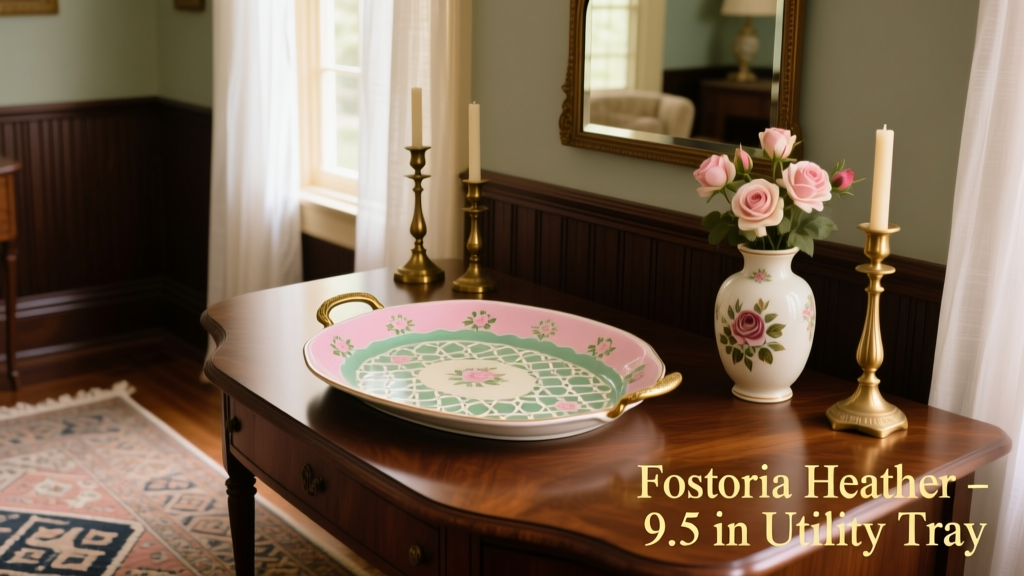
Fostoria Heather Tray with Utility Handle: A Collector’s Guide to the 9½-Inch Vintage Glass Serving Piece

Adlai Stevenson’s 1952 & 1956 Campaign Button: A Study in Mid-Century Political Iconography and Celluloid Craftsmanship
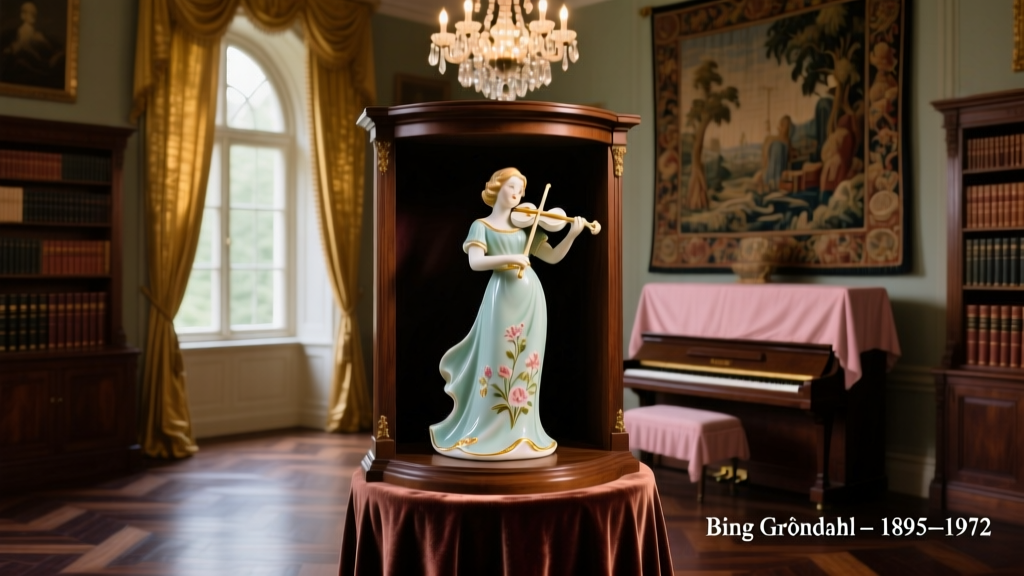
Bing & Grøndahl 'No. 9' Porcelain Vase: Design Legacy, Production History, and Restoration Protocol

Meissen Tea Set: White Porcelain with Gilt Trim, Crossed Swords Mark, 19-Inch Tray, 9-Piece Configuration

Chippendale Gilded Phoenix Crest Mirror: A Detailed Analysis of the 36½ × 20½ Inch Scroll-Topped Antique Wall Mirror

Uncle Sam Pencil Sharpener: A Cast Metal Artifact from Occupied Japan (1945–1952)
Hall China Wildfire No. 85 Sani-Grid Pitcher: History, Identification, and Restoration Insights

The Majolica Match Holder 'Boy Standing Next to Barrel': A Signed 8-Inch Victorian Masterpiece

The Apple Pattern Franciscan Sugar Creamer: A Collector’s Guide to History, Identification, and Care