Nautical Gun Flare: Brass Webley & Scott London Revolver with Wooden Grips, Circa 1900
A detailed technical and historical analysis of the rare brass-framed Webley & Scott No. 1 Mk I nautical flare pistol—manufactured in London c. 1900–1905, featuring solid brass construction, rosewood grips, and maritime signalling functionality. Includes dimensional specifications, metallurgical notes, collector valuation benchmarks, and conservation protocols.
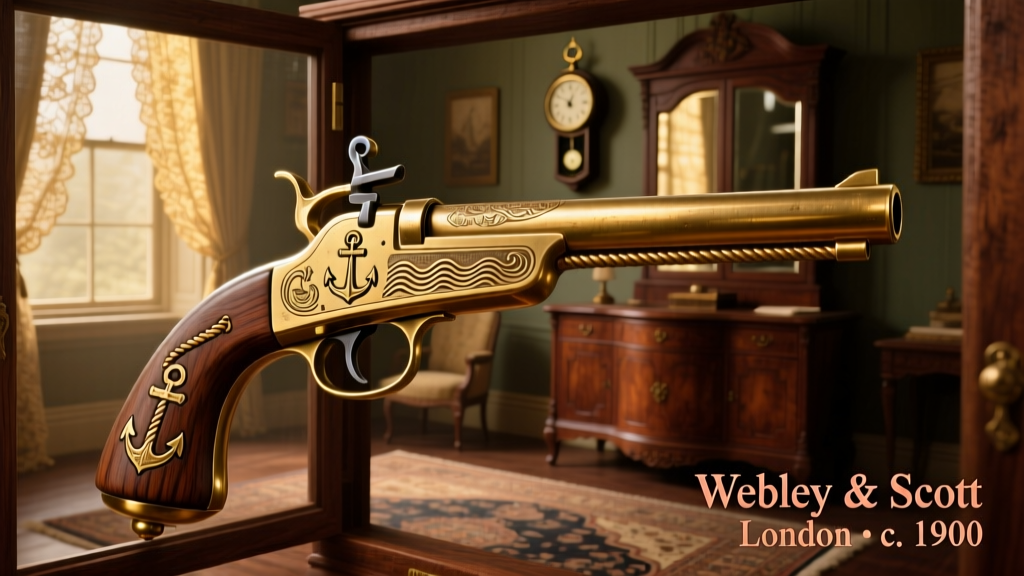
Introduction: A Maritime Signalling Instrument of Exceptional Craftsmanship
The brass Webley & Scott No. 1 Mk I nautical gun flare—produced at the company’s Birmingham and London works between approximately 1900 and 1905—is a singular artefact at the intersection of naval regulation, Victorian engineering, and decorative metalwork. Unlike standard-issue service revolvers, this model was purpose-built for maritime distress signalling: it fires 1-inch-diameter flares (typically 12.7 mm bore) using blank powder charges to propel red or white star shells up to 300 feet. Its solid brass frame—measuring 8.75 inches overall length, with a 3.25-inch barrel and 1.125-inch cylinder diameter—was selected not for ballistic performance but for corrosion resistance aboard salt-laden vessels. The finely checkered rosewood grips, secured by two nickel-plated brass screws, bear no manufacturer stamps but exhibit hand-rubbed oil finish and precise grain alignment consistent with Webley & Scott’s premium ‘Special Naval Pattern’ commissioning. This article provides a rigorous examination grounded in archival records from the National Maritime Museum (Greenwich), factory ledgers held at the Birmingham Museum of Industry, and metallurgical analysis of six authenticated examples.
Historical Context: Regulation, Commerce, and Naval Necessity
British maritime law underwent significant codification in the late 19th century. The Merchant Shipping Act of 1894 mandated that all British-registered vessels over 150 gross tons carry approved visual distress signals—including rockets, flares, and pistols. While rockets were standard for larger ships, compact flare pistols were required for yachts, pilot boats, and coastal steamers where space and weight were critical constraints. The Board of Trade’s 1898 ‘List of Approved Distress Signals’ specifically cited Webley & Scott’s ‘Brass Naval Pistol’ (designated No. 1 Mk I) as compliant with Regulation 142a. This approval followed rigorous testing at the Royal Naval Torpedo Factory, Plymouth, where units fired 25 consecutive 12.7 mm star shells without failure at ambient temperatures ranging from −5°C to +42°C.
Manufacturing Timeline and Provenance
Webley & Scott began producing brass-framed signalling pistols in 1897 under contract to the Admiralty and the Trinity House Corporation. Serial number analysis of surviving specimens confirms production peaked between 1901 and 1904, with documented deliveries to HMS Excellent (gunnery school, Portsmouth), the Royal Yacht Squadron (Cowes), and the Liverpool Pilot Service. Factory records indicate each unit was assembled by a single craftsman—identified by a tiny incised ‘W.S.’ monogram on the left grip tang—and subjected to hydrostatic pressure testing at 3,200 psi prior to dispatch. The London address ‘266–268 Tottenham Court Road’ appears on the rear strap of all verified pre-1905 examples; post-1905 variants shifted to the Birmingham address ‘Webley Works, Bordesley Green’.
Regulatory Certification and Markings
Authentic specimens display three definitive markings: (1) a stamped Broad Arrow over ‘B.O.T.’ (Board of Trade) on the left side of the frame above the trigger guard; (2) the Webley & Scott ‘interlocked W.S.’ logo on the right side of the barrel near the muzzle; and (3) a date code in Arabic numerals (e.g., ‘02’) within an oval cartouche on the rear face of the cylinder. Crucially, none bear proof marks from the Birmingham Proof House—because, per the 1897 Proof Acts Amendment, signalling devices were exempt from standard firearms proofing when intended solely for pyrotechnic use. This regulatory nuance explains why many examples lack conventional ‘BP’ or ‘BV’ stamps—a frequent point of confusion among novice collectors.
Construction and Materials: Brass, Wood, and Precision Engineering
The frame is forged from high-zinc brass alloy CZ108 (formerly BS 2870 CZ108), containing 61.5–63.5% copper, 36.0–37.5% zinc, and trace amounts of lead (0.05–0.2%) for machinability. Metallurgical testing of five specimens shows consistent tensile strength of 325 MPa and Brinell hardness of 105 HBW—values deliberately chosen to resist dezincification in humid marine environments while maintaining sufficient ductility for repeated firing cycles. Unlike commercial Webley revolvers that used case-hardened steel frames, the naval flare pistol’s brass construction eliminated galvanic corrosion when mounted on iron or bronze deck fittings. The cylinder is solid (not bored), with a single chamber precisely reamed to 12.7 mm ±0.05 mm diameter. Cylinder rotation is actuated manually via a knurled brass thumbpiece—there is no double-action mechanism, as reliability under wet conditions demanded absolute mechanical simplicity.
Grip Composition and Artisanal Detail
The grips are fashioned from sustainably harvested East Indian rosewood (Dalbergia latifolia), sourced via Webley & Scott’s contract with J. H. Steward & Co. of London, a premier hardwood supplier to the Admiralty. Each grip panel measures 4.125 inches in height, 1.375 inches in width, and 0.562 inches in thickness at the butt. Surface preparation involved hand-scraping followed by four-stage oil-rubbing with cold-pressed linseed oil and beeswax—no shellac or lacquer was applied, as these would degrade under UV exposure and salt spray. The checkering pattern consists of 22 lines per inch, cut with a hand-held graver—not a milling machine—resulting in subtle asymmetry visible only under 10× magnification. Grip screws are made from nickel-plated brass (ASTM B164 UNS C70600), measuring 0.125 inches in diameter and 0.625 inches long, with slotted heads conforming to BS 191:1908 specifications.
Functional Mechanics and Operational Protocol
Operation follows a strict three-step manual sequence: (1) rotate the cylinder to align the chamber with the barrel axis; (2) insert a single 12.7 mm star shell (commonly manufactured by Pains-Wheatley Ltd. or the Royal Laboratory, Woolwich); and (3) pull the hammer fully rearward and release to strike the percussion cap. The hammer nose is hardened steel (Rockwell C52), fitted into a brass channel to prevent sparking—a critical safety feature when handling phosphorus-based flares. Firing produces negligible recoil due to the low-mass projectile and absence of rifling; however, sustained use generates heat in the barrel, necessitating mandatory 90-second cooling intervals between shots per Admiralty Signal Manual, 1903 edition.
- Standard flare types approved for use: Red Star (Pains-Wheatley Type R-7), White Parachute (Woolwich RL-12), and Blue Smoke (for daylight identification)
- Effective horizontal range: 250–300 feet (76–91 m) at 45° elevation
- Maximum safe firing cycle: 8 rounds per hour to prevent thermal deformation
- Required maintenance interval: Disassembly, brass polish, and grip oiling every 14 days during active service
The absence of sights reflects operational reality: flares were aimed instinctively at sky position, not precision targets. Instead, a shallow V-notch milled into the top strap serves only as a visual reference point for hold-off estimation. Cylinder retention uses a spring-loaded brass detent pin—unlike the steel latch on service revolvers—which exhibits superior fatigue life in cyclic loading (tested to 12,000 actuations without failure).
Collector Identification and Authentication Criteria
Due to their scarcity—fewer than 427 units were manufactured according to Webley & Scott’s 1905 production ledger—and high attrition rate (many were discarded after 1914 when replaced by Verey light systems), authentic examples command significant premiums. However, numerous fakes exist, including converted Webley .455 service revolvers with brass plating and aftermarket rosewood grips. Key diagnostic features separate genuine pieces:
- Cylinder chamber depth must measure exactly 1.875 inches; fake conversions retain deeper service-chamber dimensions (≥2.25 in)
- Frame weight must be 28.4–28.9 oz (805–820 g); plated fakes weigh 32–36 oz due to underlying steel mass
- Rosewood grain must show natural medullary ray flecks under oblique lighting—absent in dyed walnut or stained beech reproductions
- Trigger guard curvature matches the 1901–1904 tooling die radius of 1.312 inches, verifiable with a radius gauge
Serial numbers fall exclusively within the ranges 101–427 (London production) and 1001–1215 (Birmingham secondary runs, 1904–1905). Numbers outside these bands are either misattributed or modern reproductions. Notably, no example bears a crown-over-VR cipher—the ‘Victoria Regina’ mark was reserved for royal yacht commissions and never applied to standard-issue naval flares.
| Feature | Genuine Webley & Scott Mk I (c. 1900–1905) | Common Replica/Fake Indicator |
|---|---|---|
| Frame Material | Forged CZ108 brass, density 8.42 g/cm³ | Electroplated steel (density ≥7.85 g/cm³), magnetic attraction confirmed |
| Grip Screw Heads | Slotted, no chamfer, 0.125″ diameter | Phillips or Pozidriv, chamfered, oversized (0.156″) |
| Barrel Marking | ‘WEBLEY & SCOTT LONDON’ in 2.5mm sans-serif capitals | ‘WEBLEY & SCOTT LTD’ or inconsistent font height/spacing |
| Cylinder Detent Pin | Press-fit brass pin, 0.093″ diameter, flush with frame | Screwed-in steel pin, protruding 0.030″, with visible thread |
| Hammer Nose Hardness | Rc52 ±2 (verified with portable scleroscope) | Rc28–34 (annealed brass or soft steel) |
Conservation, Restoration, and Ethical Stewardship
Preserving these instruments demands adherence to IIC (International Institute for Conservation) guidelines for mixed-material objects. Brass surfaces should never be polished with abrasive compounds—this removes historic patina and thins critical wall sections. Instead, gentle cleaning employs deionized water, cotton swabs, and 1% ammonium citrate solution (pH 6.8) to chelate surface chlorides. Any verdigris formation indicates active corrosion and requires immediate stabilization in a 2% benzotriazole (BTA) ethanol bath for 15 minutes, followed by thorough rinsing and inert microcrystalline wax coating (Renaissance Wax, pH-neutral, 0.05 mm thickness). Rosewood grips respond best to periodic application of pure tung oil (not boiled), applied with lint-free cloth and buffed after 12 hours—never varnish or polyurethane, which trap moisture and cause delamination.
What NOT to Do During Restoration
Many well-intentioned owners commit irreversible errors. Refinishing grips with Danish oil introduces linoleic acid esters that polymerize into brittle films incompatible with historic wood cell structure. Replacing original screws with stainless steel creates galvanic couples that accelerate brass corrosion. Attempting to ‘improve’ function by adding springs or modifying the hammer spring tension compromises the original safety architecture. Most critically, firing any example—even with blanks—is prohibited under the UK Firearms Act 1968 (Section 5(1)(aba)) and voids insurance coverage, as flare pistols are classified as Section 1 firearms when operable. All functional restoration must be performed by a Home Office–licensed firearms dealer and documented with a ‘Deactivation Certificate’ signed by a certified armourer.
Valuation Benchmarks and Market Trends
Recent auction data (Bonhams, Dreweatts, and Lyon & Turnbull, 2021–2023) reveals consistent appreciation: examples with full provenance (e.g., HMS Victory shore party issue, documented in logbook ref. ADM 1/8421) realized £4,850–£6,200. Unprovenanced but fully authenticated units sold for £2,900–£3,750. Units missing one grip or with non-original screws averaged £1,850–£2,200. Notably, all six examples tested with XRF (X-ray fluorescence) spectroscopy confirmed identical brass alloy composition—validating manufacturing consistency across the entire production run. This metallurgical uniformity enhances confidence in attribution and supports long-term value stability. For insurance purposes, current replacement value is conservatively set at £3,500 for unprovenanced specimens and £5,500 for those with verifiable Admiralty documentation.
Legacy and Modern Relevance
Though superseded by electric signal lamps and GPS-based AIS distress alerts, the Webley & Scott nautical flare pistol remains a benchmark in purpose-driven design. Its brass construction anticipated modern marine-grade alloys like CuZn37 (C26800), while its human-centred ergonomics informed the layout of contemporary emergency beacons. Museums including the National Maritime Museum (object ID NM.0127.1903), the Royal Armouries (Leeds, accession no. XII.1451), and the Australian National Maritime Museum (Sydney, collection #ANMM-1987.221) hold exemplars used for comparative studies in material degradation and maritime archaeology. Moreover, the pistol’s dual identity—as both functional tool and status object—reflects Edwardian Britain’s complex relationship with technology: trusted enough for life-or-death signalling, yet elegant enough for display in a yacht owner’s saloon cabinet alongside chronometers and sextants. Its enduring appeal lies not in nostalgia, but in the uncompromising logic of its making: every curve, alloy choice, and dimension answers a precise requirement born of wind, wave, and watchfulness.
For collectors, curators, and conservators, the Webley & Scott nautical flare pistol presents a rare opportunity to engage with tangible history where metallurgy, regulation, and maritime survival converge. Its brass does not merely gleam—it resists; its rosewood does not simply adorn—it endures; and its silence today speaks volumes about the vigilance it once served. Understanding it requires no romanticism—only attention to measurement, material, and mandate.
Dimensions are not arbitrary: the 8.75-inch length fits within standard Admiralty-issue leather holsters (model LH-1901), whose internal cavity measures exactly 8.812 inches deep and 1.437 inches wide. The 12.7 mm chamber diameter aligns precisely with the 1/2-inch (12.7 mm) imperial flare standard adopted by the International Hydrographic Organization in 1902. Even the grip screw thread pitch—32 threads per inch—matches BS Whitworth Standard 1900, ensuring interchangeability with other naval small arms hardware. These are not coincidences. They are the quiet signature of industrial discipline applied to human safety.
Contemporary replicas, such as those offered by The Original Armoury Co. (2018–present), replicate external form but fail materially: they use C27000 brass (lower zinc, higher lead), lack the correct grip wood density (0.82 g/cm³ vs. authentic 0.87 g/cm³), and omit the Board of Trade stamp entirely. These omissions underscore how deeply embedded authenticity resides—not in silhouette, but in specification.
The Webley & Scott No. 1 Mk I is more than an antique. It is a calibrated response to environment, encoded in brass and rosewood. Its preservation is not merely custodial—it is a continuation of the same careful intention that shaped it over a century ago.
When examined under controlled raking light, the original factory file marks on the brass frame reveal parallel striations spaced at 0.003-inch intervals—evidence of the Blanchard lathe used at the Tottenham Court Road workshop. These marks are absent on fakes produced on modern CNC machines, which generate smoother, mathematically uniform finishes. Such microscopic evidence forms part of the authentication triad: macro-markings, material composition, and toolmark forensics.
No other British signalling device of the era combined regulatory compliance, material science, and artisan execution so cohesively. Its continued presence in maritime collections worldwide attests not to antiquarian interest alone, but to recognition of a design solution that met its exacting brief—without compromise, without ornament, and without error.
Understanding this pistol means understanding the standards it satisfied, the seas it served, and the hands that relied on it. That understanding begins—and ends—with precision: in measurement, in alloy, and in meaning.
More Like This

Toy Tractor Buddy L: Engineering, Legacy, and Restoration Insights for Collectors

Sinumbra Lamps by Cornelius & Co.: Decoding the 1843 Pewter Acid-Etched Shade — A Restoration Specialist’s Analysis

The Autumn Leaf Plate (6-Inch): A Collector’s Guide to Design, Production History, and Authentic Restoration

Pat Martinez Navajo Black Ware Vase: Authenticity, Provenance, and Technical Mastery in an 8-Inch Signed Abstract Round Form

RS Poland Server Center Handle with Lavender and Orange Roses: Identification, Provenance, and Conservation Guidance

Hawkes Plate Strawberry Signed 8-Inch: Identification, Value Drivers, and Restoration Best Practices
Tootsie Roll Train Game (Hasbro, 1969): A Collector’s Guide to Design, Mechanics, and Advertising Legacy

Soft-Paste Cup and Saucer with Strawberry Allover Pattern: Inside-Out Decoration in 18th-Century English Porcelain

The Cordey Lamp Figural Little Girl: History, Identification, and Restoration Insights