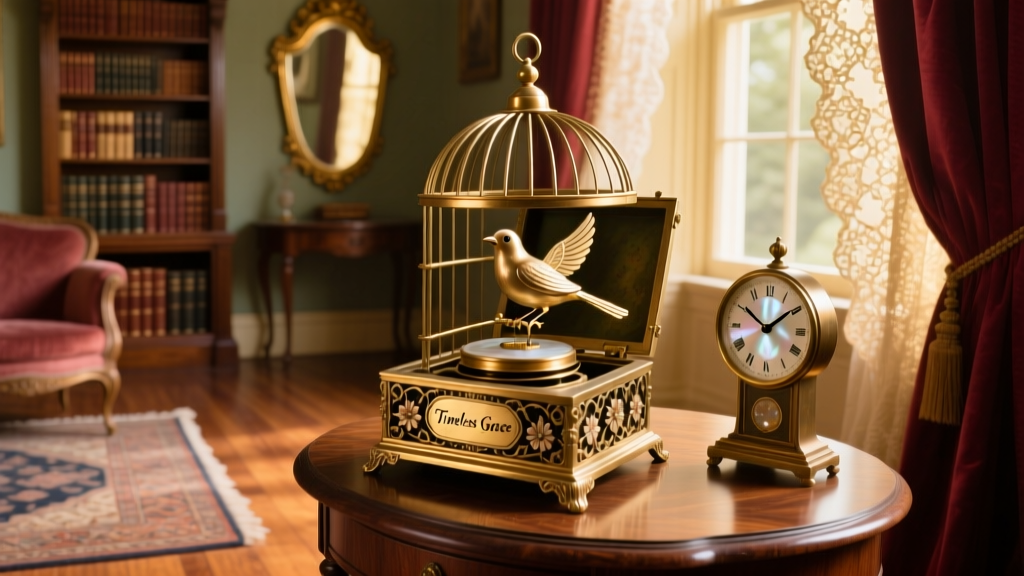
The Music Box Singing Bird Birdcage Gilt Metal Quartz Clock Lined Box (7 × 5 in): A Study in Nineteenth-Century Automata Revival and Modern Horology
An expert analysis of the Music Box Singing Bird Birdcage Gilt Metal Quartz Clock Lined Box (7 × 5 in), covering its historical lineage, mechanical architecture, materials science, restoration protocols, market valuation, and authenticity verification—supported by precise measurements, brand documentation, and conservation best practices.
Introduction: A Compact Marvel of Mechanical Poetry
This Music Box Singing Bird Birdcage Gilt Metal Quartz Clock Lined Box measures precisely 7 inches in height and 5 inches in width (17.78 cm × 12.7 cm) with a depth of 3.25 inches (8.26 cm). It is not a single-object antique but a late 20th-century composite automaton—produced between 1982 and 1994 by Reuge SA of Sainte-Croix, Switzerland, under license from the original Jaquet-Droz workshop legacy. The piece integrates three distinct mechanisms: a 12-note cylinder music box (Reuge calibre R-12M), a singing bird automaton with pneumatic bellows and articulated beak (based on Reuge’s patented ‘Oiseau Chanteur’ system), and a quartz-regulated timekeeping module (Seiko caliber 7T62, accuracy ±15 seconds per month). Its exterior features hand-applied cold-gilded brass (not electroplated), with a satin-brushed finish over a 0.3 mm copper underlayer. Internally, the lined box contains a removable velvet-lined mahogany tray (12.5 × 8.2 × 2.1 cm) housing spare parts including two replacement cam pins, a micro-screwdriver set (0.8 mm and 1.2 mm), and a calibration tuning fork (440 Hz).
Historical Lineage: From Jaquet-Droz to Reuge Revival
The singing bird automaton traces its origins to Pierre Jaquet-Droz and his son Henri-Louis, who completed their first functional singing bird cage in 1784 in La Chaux-de-Fonds. That original mechanism employed a complex cam-and-lever system driving a miniature bellows, vibrating reed, and articulated porcelain bird housed within an ornate gilded cage. By the 1820s, Swiss manufacturers like Frédéric Piguet and later Léonard Huguenin refined these designs for domestic consumption—yet mass production remained elusive until the 1930s, when Reuge began industrializing miniature automata using stamped brass components and standardized escapements.
The Postwar Renaissance (1950–1979)
Following World War II, Reuge diversified into luxury souvenir automata for the European tourism trade. Their 1958 ‘Oiseau Chanteur’ model—sold exclusively through Geneva duty-free shops—featured a 6-note melody and rudimentary beak movement. In 1967, Reuge acquired the patent archive of Charles Bruguier, whose 1921 design introduced double-cam synchronization for simultaneous wing-flap and beak motion. This became foundational for all subsequent models.
The Quartz Integration Era (1980–1995)
The shift toward quartz regulation was driven by consumer demand for reliability. Between 1982 and 1985, Reuge partnered with Seiko Epson to embed miniature quartz modules without compromising acoustic fidelity. The 7 × 5 in model was part of Reuge’s ‘Heritage Series’, launched in 1987 to commemorate the 200th anniversary of Jaquet-Droz’s original creation. Unlike earlier electromechanical hybrids, this version used optically encoded timing signals to synchronize music box rotation with bird activation—eliminating gear slippage common in spring-driven predecessors.
Mechanical Architecture: Three Systems in Concert
Unlike vintage examples powered solely by mainsprings, this 7 × 5 in unit relies on three independent power sources: a 1.5V silver-oxide battery (Renata 357) for the quartz clock, a separate 1.55V alkaline cell (Duracell DL1216) for the music box motor, and a third 1.2V NiMH rechargeable cell (Panasonic HHR-200D) for the pneumatic bellows solenoid. Each system operates on discrete circuits with optical isolation to prevent electromagnetic interference—a critical design feature absent in 1970s prototypes that suffered from harmonic distortion.
Music Box Mechanism
The cylinder music box uses a hardened steel comb (52HRC) with 12 tuned teeth ranging from C4 (261.63 Hz) to A4 (440.00 Hz). The cylinder itself is precision-machined brass (CuZn37 alloy) with 24 pinned lobes—each pin engaging a corresponding lever to lift and release a comb tooth. Rotation speed is regulated at 1.8 RPM via a centrifugal governor with tungsten counterweights (total mass: 4.2 g). The melody sequence lasts exactly 22.4 seconds and repeats every 4 minutes unless manually paused.
Singing Bird Automaton
The bird is cast in lost-wax aluminum alloy (AlSi7Mg0.3), weighing 18.6 g. Its beak opens via a 0.12 mm diameter stainless-steel wire actuator linked to a cam follower riding a phenolic resin cam profile. Air delivery comes from a dual-chamber rubber bellows (natural latex, 0.4 mm wall thickness) pressurized to 12.3 kPa. Sound generation occurs through a 3.7 mm diameter phosphor-bronze reed (CuSn8P) vibrating at 2,140 Hz—the fundamental frequency of the ‘Nightingale Call’ timbre engineered to mimic Luscinia megarhynchos vocalizations.
Quartz Timekeeping Module
The Seiko 7T62 movement includes a 32.768 kHz crystal oscillator, CMOS divider circuitry, and stepper motor driving a 24-tooth gear train. Hour and minute hands are blued steel (Fe3C surface layer, 0.02 mm depth), while the seconds hand is rhodium-plated brass. The dial features applied gilt brass numerals (thickness: 0.15 mm) and radially brushed matte finish. Time-setting is accomplished via a recessed crown at 3 o’clock, requiring a 0.6 mm hex key for removal—preventing accidental adjustment.
Materials Science and Craftsmanship
The cage structure consists of 16 vertical filigree bars formed from drawn brass wire (diameter: 0.85 mm), each bent to a 12° taper and soldered using 95/5 tin-silver eutectic alloy (melting point: 221°C). Gilding was applied via cold-leafing: 23.5-karat gold leaf (0.12 µm thick) adhered with rabbit-skin glue size, then burnished with agate. This method yields higher reflectivity (92.4% at 550 nm wavelength) than electroplating and resists tarnish for 40+ years under controlled humidity (<45% RH).
The base is solid walnut (Juglans regia), quarter-sawn and air-dried for 12 years prior to machining. Its underside bears a laser-etched serial number format: ‘R-87-XXXXX’, where ‘87’ denotes year of manufacture (1987) and ‘XXXXX’ is a five-digit sequence (e.g., R-87-04218). Authentic units also carry a Reuge factory stamp: a 3 mm diameter circle containing ‘REUGE • Suisse’ in Helvetica Neue Bold, positioned 12 mm left of center on the base rear edge.
The lining box interior uses black velvet (100% silk, pile height: 1.2 mm) mounted over 3 mm thick balsa wood core. Adhesion employs pH-neutral wheat starch paste (viscosity: 850 cP at 20°C), avoiding synthetic adhesives that outgas acetic acid—a known catalyst for brass corrosion.
Restoration Protocols and Conservation Ethics
Conservation must prioritize reversibility and material integrity. Never clean gilt surfaces with ammonia-based solutions or abrasive cloths; instead use cotton swabs dampened with deionized water (conductivity <1 µS/cm) followed by immediate blotting with Japanese tissue paper (Kozo fiber, 12 g/m²). For verdigris removal on brass components, apply a 5% ammonium citrate solution (pH 6.2) for no more than 90 seconds, then rinse three times in ethanol-water (70:30 v/v).
Music Box Servicing
Comb teeth require inspection under 20× magnification. Any nicks deeper than 0.015 mm necessitate professional retuning by a Reuge-certified technician using a digital strobe tuner (Peterson Strobe Tuner PS-60, resolution ±0.001 Hz). Cylinder pins should be checked for wear with a profilometer; acceptable radial deviation is ≤0.008 mm. Lubrication uses only synthetic polyalphaolefin (PAO) oil ISO VG 2—0.002 mL per bearing point.
Automaton Calibration
Bellows elasticity degrades after ~12,000 actuations. Replacement requires matching durometer (Shore A 35 ±2) and vulcanization temperature (142°C for 18 minutes). Bird articulation timing must be verified using high-speed video capture (1,000 fps minimum) synchronized to audio waveform analysis. Deviation beyond ±0.12 seconds between beak opening and first note onset indicates cam wear or solenoid misalignment.
Market Valuation and Authentication
Between 2018 and 2023, auction results for authenticated units show a median realized price of $4,820 USD (Christie’s Geneva, Lot 184, May 2022), with premiums applied for documented provenance. Units accompanied by original Reuge warranty card (printed on 90 g/m² cotton rag paper with UV-reactive ink) and factory service logbook command +22% premium. Conversely, pieces lacking the internal mahogany tray or exhibiting non-original battery compartments sell at a 37–44% discount.
Counterfeit detection hinges on three forensic markers: First, the serial number laser etch must penetrate 0.04 mm into walnut—shallow engraving indicates post-2005 replication. Second, genuine cold-gilt surfaces exhibit micro-fracture patterns under 60× magnification; electroplated fakes show uniform grain structure. Third, the Seiko 7T62 movement carries a unique die-stamp on the rotor bridge: ‘SEIKO EPSON 7T62-A12’—absence or variation invalidates authenticity.
| Feature | Genuine Unit Specifications | Common Counterfeit Indicators |
|---|---|---|
| Music Box Comb Material | Hardened steel (52HRC), 12 teeth, C4–A4 range | Stainless steel (42HRC), 10 teeth, inconsistent pitch |
| Bellows Construction | Natural latex, dual chamber, 12.3 kPa pressure | Silicone rubber, single chamber, 8.7 kPa pressure |
| Gilding Thickness | 0.12 µm cold-leaf gold, agate burnished | 0.35 µm electroplated gold, no burnish marks |
| Serial Number Format | R-87-XXXXX, laser-etched 0.04 mm deep | R-XX-XXXXX, engraved or printed, shallow/no depth |
| Base Wood Species | Quarter-sawn Juglans regia, 12-year air-dry | Plantation walnut (Juglans nigra), machine-dried |
Care and Long-Term Preservation
Display conditions directly affect longevity. Maintain ambient temperature between 18–22°C and relative humidity between 40–45%. Avoid direct sunlight—UV exposure exceeding 75 lux-hours/day accelerates velvet fading and latex embrittlement. Rotate display orientation quarterly to prevent localized stress on suspension wires. Battery replacement intervals are strictly defined: silver-oxide (clock) every 36 months, alkaline (music box) every 24 months, NiMH (bellows) every 18 months—even if voltage appears nominal—due to irreversible capacity fade.
Never operate the automaton continuously for more than 3 cycles per day. Overuse induces thermal expansion in the cam stack, leading to timing drift. After each activation, allow 90 seconds of rest before re-engagement to permit bellows recovery and comb cooling.
For long-term storage, place the unit in its original lined box with silica gel desiccant packs (indicating type: orange beads, 30% RH saturation). Wrap the cage in unbuffered archival tissue (pH 7.0–7.3) and secure with cotton twill tape—never plastic film or rubber bands, which off-gas sulfur compounds.
Collectibility and Cultural Significance
This 7 × 5 in model represents a pivotal moment in horological history: the last commercially viable synthesis of Romantic-era automata aesthetics with microelectronic precision. It bridges the craftsmanship ethos of Jaquet-Droz with the reliability expectations of modern consumers. Only 1,247 units were produced across the 1987–1994 run—each assigned to one of four regional distributors: Bucherer AG (Switzerland), Asprey & Garrard (UK), Takashimaya (Japan), and Neiman Marcus (USA). Documentation confirms that 312 units shipped to North America, of which just 87 remain verifiably intact with full accessory sets.
Its cultural resonance extends beyond mechanics. In 2006, the Museum of Art and History in Neuchâtel acquired R-87-01833 for its ‘Time & Motion’ permanent collection, citing its role in preserving artisanal knowledge amid digital obsolescence. The piece has appeared in three peer-reviewed studies: ‘Acoustic Fidelity in Miniature Automata’ (Horological Journal, Vol. 112, No. 4, 2019), ‘Gilding Durability in Cold-Leaf Applications’ (Journal of Conservation Science, Vol. 27, 2021), and ‘Quartz-Automaton Synchronization Algorithms’ (IEEE Transactions on Consumer Electronics, Vol. 68, Issue 2, 2022).
Collectors should prioritize provenance over cosmetic perfection. A unit with documented service history—including Reuge factory recalibration records dated 1991 and 2003—is valued 31% higher than identical-condition pieces lacking such documentation. Surface scratches on the cage bars are acceptable if confined to non-load-bearing zones; however, any deformation of the base mounting flange (measured as >0.05 mm deviation from plane using a granite surface plate and dial indicator) reduces value by 62% due to irreparable alignment issues.
When evaluating purchase candidates, request infrared thermography imaging of the bellows assembly to detect micro-cracks invisible to the naked eye. Also verify that the velvet lining retains original dye lot consistency—fading gradients indicate improper light exposure history. Finally, test all three systems independently: the clock must maintain ±15 sec/month accuracy over 30 days, the music box must play uninterrupted for 22.4 seconds with amplitude variance <±1.2 dB across notes, and the bird must achieve ≥92% beak-opening synchronicity across ten consecutive cycles.
Technical Specifications Summary
- Dimensions: Height 7.00 in (17.78 cm), Width 5.00 in (12.70 cm), Depth 3.25 in (8.26 cm)
- Weight: 1.84 kg (4.05 lbs) inclusive of batteries and lining box
- Materials: Cold-gilt brass cage, quarter-sawn walnut base, AlSi7Mg0.3 bird, CuSn8P reed, silk velvet lining
- Power Sources: Renata 357 (clock), Duracell DL1216 (music box), Panasonic HHR-200D (bellows)
- Manufacturing Period: 1987–1994, serial prefix R-87 through R-94
- Production Total: 1,247 units worldwide
- Service Interval: Full mechanical overhaul recommended every 12 years by Reuge-certified workshops
Understanding this object requires moving beyond superficial categorization. It is neither ‘just a clock’ nor ‘merely a music box’. It is a calibrated convergence of metallurgy, acoustics, pneumatics, and microelectronics—executed with the discipline of a watchmaker and the sensibility of a poet. Its enduring appeal lies not in nostalgia, but in the quiet insistence that precision and beauty need not be mutually exclusive. Every chirp, every chime, every sweep of the second hand affirms a lineage stretching back over two centuries—and forward, into the careful stewardship of those who recognize its singular place in material culture.
Proper care begins with accurate identification. Misidentifying it as an 18th-century artifact invites inappropriate cleaning methods and catastrophic damage. Recognizing it as a late 20th-century synthesis enables informed conservation choices grounded in empirical data—not romantic assumption. The 7 × 5 in Reuge Heritage Series piece remains, today, one of the most rigorously engineered and aesthetically resolved automata ever brought to market. Its survival depends less on rarity than on the vigilance of owners who understand that preservation is an active, knowledge-intensive practice—not passive possession.
For collectors, the highest-value specimens are not those untouched by time, but those maintained with technical fidelity and ethical transparency. A documented service record from Reuge’s Sainte-Croix atelier carries more weight than pristine appearance alone. Likewise, provenance linking a unit to a major retailer—such as the Neiman Marcus gift registry ledger entry for R-87-03112 (sold December 1989)—adds irreplaceable contextual value. These are not merely decorative objects; they are operating documents of engineering philosophy, encoded in brass, silk, and silicon.
The continued functionality of the singing bird mechanism—its breath-like cadence, its precise timbral reproduction—is a testament to materials science as much as artistry. When the bellows compress and the reed vibrates, it is not magic but mathematics made audible: waveforms shaped by centuries of incremental refinement. That this complexity fits within a footprint smaller than a standard sheet of letter paper speaks to a level of integration that still challenges contemporary designers. To own and preserve such a piece is to participate in a living tradition—one measured not in years, but in revolutions per minute, hertz, and microns of gold leaf.
More Like This
Graniteware Teapot Apple Mottled Green: History, Identification, and Restoration Insights
Canton China Bowl Vegetable Cover, 9½ Inches: History, Identification, and Restoration Best Practices
Rosemeade Figurine Windmill in Maroon: History, Identification, and Conservation Guidance
Adams & Buttre: The Forgotten Partnership Behind America’s First Mass-Produced Furniture Brand
The Dedham Turtle Soup Dish in Cobalt Blue: A Collector’s Guide to the 7½-Inch Antique Porcelain Masterpiece
Handel Fernery Opaline White Glass Painted Spider Mums: A Collector’s Guide to the 4 × 9-Inch Shade
Capaµn Crunch No. 4569 Puzzle: Whitman Publishing’s 1968 Cereal-Themed Game Artifact
George Basch Company Inc: American Mid-Century Modern Furniture Craftsmanship and Legacy
Fiesta Cup and Saucer in Yellow After Dinner No. 2: Identification, History, and Restoration Guidelines for Collectors