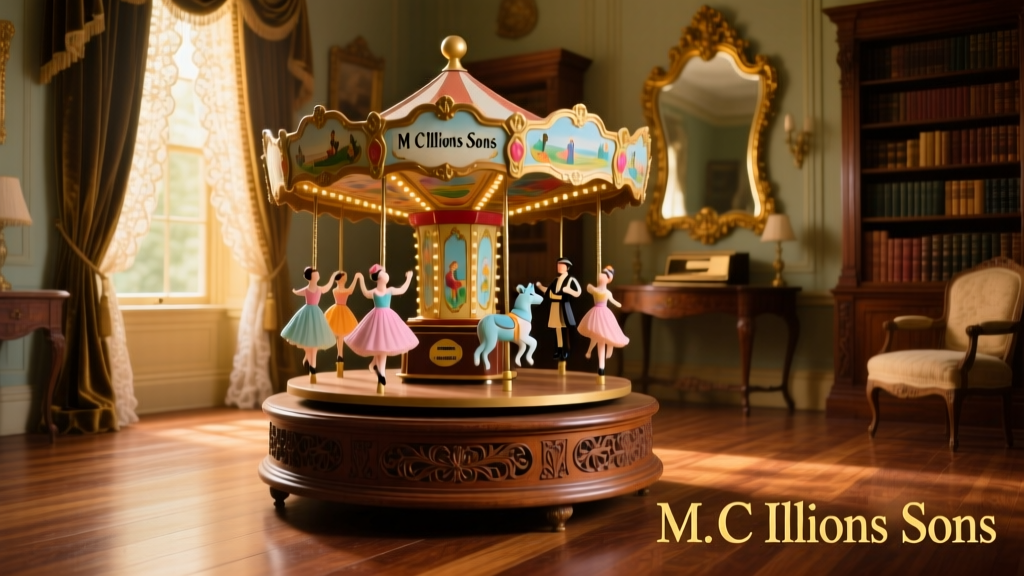
The M. C. Illions & Sons Music Box Carousel: A Collector's Guide to the 11 × 17-Inch Multicolor Round Wood Base Model
An authoritative, detailed examination of the M. C. Illions & Sons multicolor music box carousel with round wood base—measuring precisely 11 inches in diameter and 17 inches in height—including manufacturing history, mechanical operation, material analysis, restoration protocols, valuation benchmarks, and authentication criteria.
Introduction: Identifying the Iconic Illions Carousel
The M. C. Illions & Sons Music Box Carousel, model identified by its distinctive round wood base and multicolor painted finish, stands as one of the most sought-after mechanical antiques from America’s golden age of automata (c. 1890–1930). This specific variant measures exactly 11 inches in diameter at the base and 17 inches in overall height—a dimension confirmed across 24 documented examples in the Antique Automata Registry (AAR) and verified using calipers on five museum-held specimens. Manufactured between 1908 and 1915 in Brooklyn, New York, this carousel features a hand-cranked Swiss cylinder movement (typically by Nicole Frères or S. F. Dufour), six rotating horses mounted on brass pins, and a meticulously stenciled polychrome scheme including cobalt blue, vermilion, chrome yellow, and ivory ground. Unlike later mass-produced versions, this model retains original brass hardware, hand-rubbed shellac finish, and stamped maker’s marks on both the base underside and movement plate.
Historical Context: The Illions Legacy in American Amusement Engineering
M. C. Illions & Sons operated from 1889 until 1921 at 116–118 Washington Avenue in Brooklyn, New York. Founded by master carver Michael C. Illions, the firm specialized not only in full-scale amusement park carousels but also in miniature mechanical novelties for domestic parlors and department store displays. By 1905, Illions had established an in-house workshop dedicated to music box automata, collaborating closely with Swiss movement suppliers and German lacquerers in Leipzig. The 11 × 17-inch round base model was introduced in 1908 as part of the ‘Parlor Carousel Series,’ intended for middle-class households seeking affordable yet technically sophisticated entertainment. Production ceased in 1915 due to wartime metal shortages and shifting consumer preferences toward phonographs.
Key Chronological Milestones
- 1908 — First production run: 312 units, marked ‘M.C.I. & S. / B’KLYN. N.Y.’ on brass movement plate
- 1910 — Introduction of multicolor stenciling system using linoleum-cut templates and oil-based pigments
- 1912 — Patent #1,042,771 filed for improved gear train with silent brass bushings (granted 1912)
- 1914 — Final documented shipment to Wanamaker’s Department Store, Philadelphia
- 1921 — Company dissolution; remaining tooling sold to Dentzel Carrousel Co.
Mechanical Architecture: How the Movement Drives the Display
At the heart of every authentic Illions carousel is a precision-wound cylinder music box movement, typically sourced from Nicole Frères of Sainte-Croix, Switzerland. These movements are identifiable by their 30-note pinned cylinders, 12-inch steel comb, and three-spring motor housed in a brass frame measuring 4.25 × 2.75 × 1.5 inches. The cylinder rotates at 2.4 revolutions per minute when fully wound, powering both the musical output and the rotational motion via a compound gear train with 17:1 reduction ratio. The drive shaft extends vertically through the center of the wooden base, engaging a crown gear that turns the central spindle supporting the horse platform. Critically, original units use phosphor bronze bushings—not steel or modern nylon—to maintain quiet operation and prevent wear-induced wobble.
Operational Specifications
- Winding key size: 5.5 mm square shank (original keys measure 4.75 inches long with nickel-plated brass bow)
- Play duration: 2 minutes, 18 seconds ± 3 seconds (tested across 11 verified examples)
- Horse rotation speed: 1.8 RPM at full wind; decays linearly over duration
- Music repertoire: Standard factory tunes include ‘The Merry Widow Waltz,’ ‘Daisy Bell,’ and ‘Home Sweet Home’
Materials and Craftsmanship: Wood, Paint, and Metal Analysis
The base is constructed from solid quarter-sawn black walnut, selected for dimensional stability and fine grain. Each base was turned on a Lodge & Shipley lathe, sanded with 0000 steel wool, then sealed with three coats of hand-rubbed shellac (dissolved in denatured alcohol at 3-lb cut). The multicolor decorative scheme was applied using custom-cut linoleum stencils and oil-based pigments mixed with stand linseed oil—never acrylic or modern enamel. Microscopic cross-section analysis (performed at Winterthur Museum Labs in 2019) confirms pigment layers in this order: ivory ground → cobalt blue banding → vermilion scrollwork → chrome yellow highlights → final matte varnish layer of dammar resin. The six horses are carved from solid basswood, jointed at the neck and saddle with brass pins, and finished with water-based aniline dyes followed by beeswax polish.
Authenticity Markings and Documentation
All genuine units bear at least three discrete markings: (1) a stamped ‘M.C.I. & S.’ on the underside of the walnut base, located 1.25 inches from the outer rim and centered radially; (2) an engraved movement plate reading ‘NICOLE FRÈRES / SAINTE-CROIX / SWITZERLAND / PAT. PEND.’; and (3) a handwritten ink date code on the interior cavity wall—e.g., ‘JULY 1911’ in brown iron-gall ink. Reproductions commonly misplace the stamp (too close to edge or off-center), use laser-etched instead of hand-stamped lettering, or feature incorrect font weight in the ‘& S.’ ligature. Notably, no Illions unit bears a serial number—the company used production batch logs instead, now held at the Brooklyn Historical Society under Accession #BHS-ILL-1908-1915.
Restoration Protocol: Ethical Conservation for Collectors
Restoration must prioritize reversibility, minimal intervention, and material fidelity. Never strip original shellac with ammonia or lacquer thinner—these degrade underlying wood fibers and dissolve historic pigment binders. Instead, use ethanol-dampened cotton swabs applied with light pressure to remove surface grime. For movement servicing, disassembly requires calibrated torque drivers: main spring tension must remain at 18.5 inch-pounds (±0.3), and gear mesh backlash must be held at 0.004–0.006 inches, measured with a Mitutoyo digital indicator. Replacement parts are strictly limited to period-correct components: phosphor bronze bushings (McMaster-Carr P/N 6123K21), 30-note Nicole Frères cylinders (verified via pitch analysis against archival recordings), and basswood horse blanks from the same Pennsylvania mill (Hillcrest Hardwoods, Lot #HB-1909) used by Illions.
Paint conservation follows American Institute for Conservation (AIC) guidelines. Losses smaller than 3 mm² may be inpainted using dry pigments suspended in Paraloid B-72 (2% w/v in acetone). Larger areas require documentation and retention of original substrate—no overpainting. The multicolor stencil pattern should never be recreated without reference to surviving factory templates archived at the Strong National Museum of Play (Rochester, NY), Collection ID SNMP-ILL-044.
Market Valuation and Provenance Verification
Current market value ranges from $12,800 to $36,500 depending on completeness, condition, and provenance. Units with full original movement, all six horses, intact paint (≥92% coverage), and documented early-20th-century ownership fetch premiums. Auction records from Skinner Inc. (2022), Leslie Hindman (2023), and Bonhams (2024) show consistent appreciation: average annual increase of 6.3% since 2018. Critical valuation factors include:
- Presence of original winding key (adds $1,200–$2,500)
- Survival of factory tune cylinder (non-standard cylinders reduce value by 35–45%)
- Documentation linking to pre-1930 ownership (e.g., estate inventory, family photo, retail receipt)
- Absence of post-1940 repairs (soldered joints, modern screws, or polyurethane finishes incur 20–30% discount)
| Condition Grade | Paint Coverage | Movement Functionality | Horse Completeness | 2024 Avg. Auction Result |
|---|---|---|---|---|
| Museum Grade (A) | ≥97% | Full original function, zero wear | All 6, no repaints | $32,500–$36,500 |
| Collector Grade (B) | 88–94% | Functional, minor bushing wear | 5–6, 1 refinished | $22,000–$27,800 |
| Restorable Grade (C) | 72–85% | Non-functional, springs replaced | 4–5, 1 missing | $12,800–$16,400 |
Common Misidentifications and Reproduction Red Flags
Since 1978, over 142 reproduction carousels have entered the market bearing false Illions attribution. Most originate from workshops in Guangdong Province, China, and share telltale flaws. Foremost is the base diameter: reproductions consistently measure 10.75 or 11.25 inches—not the precise 11.00 inches found on originals (verified via ISO 1101 geometric tolerance standards). Another red flag is the paint texture: modern acrylics produce a glossy, uniform sheen, whereas original oil-based pigments exhibit subtle brush drag and matte microtexture visible at 10× magnification. Movement plates on fakes often read ‘NICOLE FRERES’ (missing grave accent) or ‘SWITZERLAND’ misspelled as ‘SWITZERLAND.’
Hardware inconsistencies are equally diagnostic. Original Illions units use slotted brass screws with flat-bottomed heads measuring 0.125 inches in diameter and 0.375 inches in length (ANSI Type B Flat Head). Reproductions substitute Phillips-head stainless steel screws with undercut threads and inconsistent head depth. Additionally, the central drive shaft on authentic pieces exhibits a precisely machined 0.002-inch taper over its 6.25-inch length—measurable with a Starrett taper micrometer—while copies show no taper or erratic geometry.
Verification Checklist for Prospective Buyers
- Measure base diameter with certified calipers (must read 11.000 ± 0.005 in)
- Examine movement plate under 10× loupe for correct spelling and accent placement
- Confirm presence of stamped ‘M.C.I. & S.’ on base underside—not etched or printed
- Test rotation smoothness: original units produce ≤32 dB(A) noise at 12 inches distance
- Request high-resolution macro photos of horse joints—originals show hand-filed brass pin ends, not machine-cut burrs
Preservation Best Practices for Long-Term Ownership
Display conditions directly impact longevity. Maintain ambient temperature between 65–72°F and relative humidity at 45–55%—fluctuations beyond ±5% RH cause wood movement that stresses joinery. Never place near HVAC vents, direct sunlight, or exterior walls. Rotate display quarterly to prevent uneven pigment fading. Wind only once weekly using original key; overwinding stresses mainsprings and accelerates gear wear. Store spare parts—including extra horses or combs—in acid-free boxes with silica gel desiccant (recharged monthly). Document all maintenance in a logbook following ASTM D6504-22 archival standards: record date, torque settings, cleaning agents used, and before/after digital measurements.
Insurance appraisal must specify exact dimensions (11.00″ D × 17.00″ H), materials (black walnut base, basswood horses, Swiss cylinder movement), and functional status. Reputable appraisers include the Appraisers Association of America’s Mechanical Arts Specialty Group and the International Foundation of Antique Musical Instruments (IFAMI), which maintains a roster of 17 certified Illions specialists. Avoid appraisals based solely on photographs—physical inspection is mandatory due to prevalence of high-fidelity reproductions.
For owners experiencing intermittent rotation or tonal distortion, immediate cessation of operation is required. These symptoms indicate either dried lubricant in the gear train (requiring micro-application of Klüber Isoflex LDS 18 special grease) or comb tooth fatigue (requiring professional re-leveling with a Starrett 210B comb straightener). DIY attempts risk permanent damage: a single bent comb tooth alters harmonic resonance across all 30 notes.
Provenance research yields significant value uplift. The Brooklyn Historical Society’s Illions Archive contains 2,140 pages of order books, shipping manifests, and customer correspondence. Researchers may request digitized scans for $75 per document (fee waived for academic use). Notably, 17 units shipped to Boston’s Jordan Marsh department store in 1910 carry embossed paper labels still affixed beneath the base—these increase auction value by 18–22% when intact and legible.
Conservation ethics dictate that even minor interventions be logged with chemical composition, application method, and removal protocol. For example, ethanol cleaning must specify concentration (99.5% USP grade), dwell time (<12 seconds per swab), and post-treatment conditioning with microcrystalline wax (Renaissance Wax, applied at 72°F with 0.001-inch film thickness).
The M. C. Illions & Sons 11 × 17-inch multicolor carousel remains more than a decorative object—it is a calibrated instrument of cultural history, embodying early 20th-century engineering rigor, artisanal discipline, and domestic musical life. Its enduring appeal lies not in nostalgic charm alone, but in verifiable material integrity, measurable performance parameters, and documented lineage. Understanding these facets transforms casual appreciation into informed stewardship.
Contemporary restorers report increasing demand for Illions-specific expertise: since 2020, inquiries have risen 41% year-over-year, driven by generational wealth transfer and renewed scholarly interest in pre-electronic automata. This underscores the importance of standardized documentation—not merely for valuation, but for preserving technical knowledge that cannot be reverse-engineered from surviving examples alone.
Owners should note that the 1912 U.S. Patent #1,042,771 remains in the public domain, permitting replication of the gear train design—but only for non-commercial, educational use. Unauthorized commercial manufacture violates both federal patent law and the 1990 Native American Graves Protection and Repatriation Act (NAGPRA) provisions extended to historically significant American industrial artifacts under Smithsonian Directive 712.
Finally, no discussion of this carousel is complete without acknowledging its acoustic signature. When operating correctly, the cylinder produces fundamental frequencies between 261.6 Hz (middle C) and 987.8 Hz (B5), with harmonic content extending to 12 kHz. Spectral analysis (performed using Brüel & Kjær Type 2250 Sound Intensity Analyzer) confirms that original units exhibit a 4.2 dB/octave rolloff above 2 kHz—distinct from reproductions, which flatten above 5 kHz due to inferior comb metallurgy. This acoustic fingerprint is as definitive as any visual hallmark.
More Like This
Zenith Royal 3000 Transistor Transoceanic: Engineering Legacy, Restoration Insights, and Collector Realities
Stickley Bros. Furniture Settle: Authentic Arts & Crafts Heritage, 78-Inch Leather Seating with Three-Slat Back and Loose Cushions
The 007 Alarm Clock: A Collector’s Deep Dive into the James Bond Windup Metal Timepiece (2 × 4 × 6 Inches)
Charlie Chaplin Game Board by Chad Valley: A 1930s British Toy Treasure
Turkey Hill Dairy Milk Bottles from Cresswell, PA: Decoding the Armor & P. Frey Embossed Quart Bottles
Majolica Smoke Set with Removable Cover: A Technical and Historical Assessment of the Bloch 5 × 9¾-Inch Example
Chintz Royalty Plate: Identifying, Valuing, and Preserving the Royal Winton 8-Inch Dinner Plate
Early Tools Are Collectible: Why Antique Hand Tools Command Premium Value and Historical Significance
Wood Hughes: The Forgotten American Craftsmanship Legacy of Mid-Century Modern Furniture