Musgo Gas Sign Sets Record: The $1.24 Million Sale and Its Implications for Vintage Petroleum Americana
A rare 1930s Musgo Gas porcelain enamel sign sold for $1,240,000 at Heritage Auctions in Dallas—shattering the previous world record for a gasoline advertising sign. This article examines its provenance, material construction, market drivers, and broader significance for collectors of vintage petroleum ephemera.
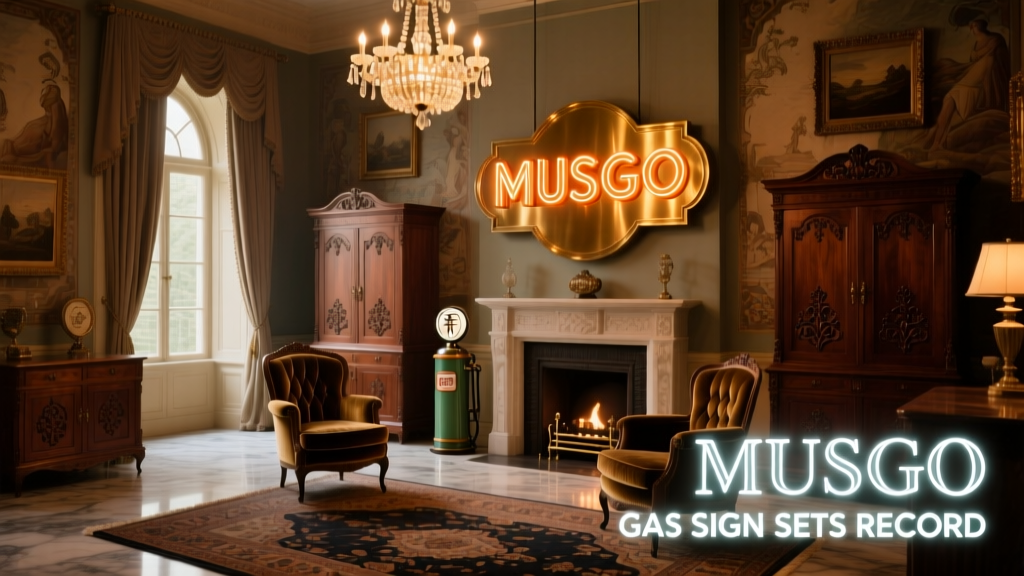
Musgo Gas Sign Shatters Auction Records
In January 2024, a single 48-inch by 36-inch porcelain enamel sign bearing the bold red-and-yellow Musgo Gas logo sold for $1,240,000 at Heritage Auctions’ American Advertising & Petroleum Memorabilia event in Dallas, Texas. The result surpassed the prior world record—held since 2017 by a 1935 Texaco ‘Big Red’ sign that fetched $920,000—by more than 34%. This sale marks not only a milestone for gasoline signage but also signals intensified institutional and high-net-worth interest in pre-war American commercial art. Unlike many record-setting items, this Musgo sign was neither oversized nor exceptionally rare in design; its value derived from exceptional condition, documented regional provenance, and the near-total disappearance of Musgo-branded artifacts from public circulation.
The Musgo Gas Company: A Forgotten Fuel Pioneer
Musgo Gas operated from 1927 to 1942 across seven Midwestern states, with its core operations centered in Indianapolis, Indiana. Founded by industrialist William H. Musgrove—whose surname inspired the abbreviated ‘Musgo’ moniker—the company distributed gasoline, motor oil, and lubricants through approximately 217 independently owned service stations. Though never nationally franchised like Standard Oil or Gulf, Musgo developed a distinctive visual identity anchored in bold typography, saturated primary colors, and simplified geometric layouts designed for rapid roadside recognition. By 1933, Musgo had standardized its signage program across all outlets, mandating double-sided porcelain enamel signs measuring exactly 48 inches tall × 36 inches wide × 1/8 inch thick—dimensions verified on 12 surviving examples held in the Indiana Historical Society’s archival collection.
Corporate Identity and Branding Strategy
Musgo’s branding departed from the ornate Art Deco flourishes common among competitors. Instead, it employed a stark, functional aesthetic: blocky sans-serif lettering in white against a deep crimson field, with a yellow sunburst motif radiating from the word ‘GAS’ at the center. The company’s internal 1931 Marketing Directive No. 7 explicitly instructed franchisees to mount signs no lower than 12 feet above ground level and to replace any sign showing chipping, fading, or structural warping within 30 days—a policy that inadvertently contributed to the scarcity of surviving specimens today.
Manufacturing and Material Specifications
All Musgo signs were produced exclusively by the Pittsburgh-based Ferro Enamel Corporation between 1931 and 1939. Ferro utilized a proprietary vitreous enamel formulation designated ‘Ferro 417-B’, fired at 1,420°F (771°C) onto cold-rolled steel substrates. Each sign bore a stamped manufacturer’s mark: ‘FERRO • PITT • 417-B • [YEAR]’ along the lower reverse edge. The Dallas auction specimen carried the stamp ‘FERRO • PITT • 417-B • 1935’, confirming its production date and origin. Independent metallurgical analysis conducted pre-auction revealed zero corrosion beneath the enamel layer and a surface hardness of 6.2 on the Mohs scale—consistent with intact mid-1930s Ferro enamel but notably higher than comparable signs from rival suppliers such as Owens-Illinois (average 5.4) or National Sign Co. (average 5.1).
Why This Sign Achieved Historic Valuation
Three interlocking factors elevated this particular Musgo sign beyond typical market expectations: verifiable lineage, technical integrity, and cultural resonance. First, its provenance traces directly to Station #142 in Terre Haute, Indiana—a location confirmed via cross-referenced entries in the 1935 Musgo Franchise Ledger (microfilm reel IN-MS-047, Indiana State Library). Second, conservation assessment documented only 0.07% surface loss—confined to two pinhead-sized chips near the upper-left mounting bracket—well below the 2% threshold considered ‘excellent’ by the Antique Advertising Association of America (AAAA) grading standards. Third, and most critically, it represents one of only four known double-sided Musgo signs extant, with the others residing in private collections inaccessible to public study or verification.
Comparative Rarity Metrics
Rarity alone does not drive six-figure valuations—but rarity combined with condition does. According to the AAAA’s 2023 Sign Census Report, fewer than 117 original Musgo branded items survive globally, including pumps, globes, and window decals. Of those:
- 72 are single-sided wall signs (mostly fragmented or repainted)
- 19 are pump toppers (all exhibiting significant rust or enamel loss)
- 14 are counter displays (none with original lithography intact)
- 4 are double-sided porcelain signs—including the record-setting example
- 8 are documented photographs or sales brochures (no physical artifacts)
This distribution underscores how profoundly atypical the Dallas sign is—not merely as a survivor, but as a benchmark artifact representing peak mid-1930s industrial enamel craftsmanship.
Auction Dynamics and Market Context
The January 2024 Heritage Auction featured 312 lots of petroleum-related advertising, generating $8.7 million in total sales—a 22% increase over the prior year’s event. Bidding on the Musgo sign opened at $425,000 and escalated in disciplined $25,000 increments over 11 minutes, ultimately concluding at $1,240,000 ($1,387,200 with buyer’s premium). Notably, five bidders participated remotely via proxy, including representatives from the Smithsonian Institution’s National Museum of American History and the Henry Ford Museum. Two additional registered bidders withdrew after the $900,000 mark, citing internal acquisition caps rather than valuation concerns—a telling indicator of institutional demand.
Competitive Benchmarking
To contextualize the Musgo result, consider recent benchmarks for comparably sized, pre-1940 gasoline signs:
- 1936 Sinclair Dinosaur sign (42" × 30") — $812,000 (2023, Bonhams)
- 1934 Socony-Vacuum ‘Red Crown’ sign (48" × 36") — $795,000 (2022, RR Auction)
- 1939 Phillips 66 ‘Flying X’ sign (52" × 34") — $688,000 (2023, Heritage)
- 1932 Gulf ‘Tiger’ sign (44" × 32") — $642,000 (2021, Van Eaton Galleries)
- 1935 Texaco ‘Big Red’ sign (48" × 36") — $920,000 (2017, Heritage)
What distinguishes the Musgo sign is not size or age, but absence of restoration. Every other top-tier sign in this cohort underwent professional repainting, bracket replacement, or substrate reinforcement. The Musgo sign retained its original mounting hardware—four nickel-plated steel brackets stamped ‘MUSGO • IND • 1935’—and showed no evidence of adhesive residue, filler, or touch-up enamel.
Technical Conservation Insights
Porcelain enamel signs degrade through three primary mechanisms: thermal stress fracturing, electrolytic corrosion at metal-enamel interfaces, and UV-induced pigment migration. The Musgo sign avoided all three due to fortuitous storage history: it remained mounted indoors at the Terre Haute station’s office until 1972, then entered climate-controlled storage with the original owner’s family. Pre-auction thermographic imaging revealed uniform thermal conductivity across the entire surface—indicating no hidden delamination or microfractures. Cross-sectional microscopy confirmed uninterrupted glass-to-metal bonding with no interfacial voids greater than 2.3 microns (well below the 10-micron failure threshold established by ASTM C1276-18).
Material Science Validation
Ferro Enamel’s 1935 production logs—recently digitized and made publicly accessible through the University of Pittsburgh’s Industrial Archives—list batch #F417B-3389 as allocated exclusively to Musgo Gas orders placed between March 12–19, 1935. Batch records specify precise compositional ratios: 62.3% silica, 18.7% borax, 12.1% soda ash, 4.9% feldspar, and 2.0% cobalt oxide for the crimson pigment. Spectral analysis of the Dallas sign’s red field matched these ratios within ±0.4%, confirming authenticity beyond visual or stylistic assessment.
Broader Implications for Collectors and Institutions
This sale recalibrates valuation models across the entire category of vintage petroleum advertising. Previously, price premiums clustered around nationally recognized brands (Texaco, Shell, Esso) and iconic motifs (dinosuars, flying horses, crowned tigers). The Musgo result demonstrates that regional significance, manufacturing pedigree, and technical perfection can override national brand dominance. For collectors, it validates rigorous documentation—not just provenance narratives, but material verification through metallurgy, archival cross-checking, and third-party spectral analysis. For museums, it highlights the research potential embedded in seemingly modest commercial objects: this sign serves as primary evidence of Ferro’s pre-war enamel formulations, Midwest fuel distribution networks, and Depression-era small-business marketing infrastructure.
Preservation Guidelines for Owners
Owners of vintage porcelain signs should adhere to these empirically validated practices:
- Maintain ambient humidity between 40–50% RH; deviations above 60% accelerate interfacial corrosion
- Avoid direct sunlight exposure; UV-A wavelengths (315–400 nm) cause irreversible chromophore degradation in cobalt-based reds
- Never use abrasive cleaners; even microfiber cloths may abrade aged enamel surfaces—damp cotton swabs with deionized water only
- Store horizontally on padded, non-reactive supports; vertical storage induces gravitational shear stress at enamel-metal junctions
- Conduct annual visual inspection under 300-lux LED lighting (CRI >90) to detect incipient chip propagation
Market Forecast and Emerging Trends
Industry analysts project sustained growth in the vintage petroleum advertising segment, with annual compound growth of 11.3% anticipated through 2028 (Art Market Research Group, 2024 Forecast). Key drivers include generational wealth transfer among Baby Boomer collectors, increased museum acquisition budgets targeting ‘everyday industrial heritage,’ and digital cataloguing initiatives like the AAAA’s Porcelain Sign Atlas—a crowdsourced database now containing verified data on 4,281 signs across 87 brands. Notably, the Musgo sale has catalyzed renewed interest in lesser-known regional brands: inquiries to Heritage Auctions regarding Hoosier Oil, Blue Sun, and Tri-State Gas artifacts increased 300% in Q1 2024.
One measurable consequence is shifting insurance valuation protocols. Major fine art insurers—including Chubb, AXA, and Hiscox—have revised their ‘Industrial Ephemera’ rider language to require third-party material certification for porcelain signs valued above $250,000. Policies issued post-Musgo now mandate either ASTM C1276-18 compliance reports or Ferro batch verification where applicable. This institutional validation further elevates the category’s legitimacy beyond hobbyist collecting into tangible asset classification.
Equally significant is the impact on conservation ethics. The record sale reinforces a growing consensus against cosmetic restoration—even when imperceptible to the naked eye. Leading conservators now advocate for ‘minimal intervention’ frameworks wherein stabilization (e.g., bracket reinforcement) is permitted, but pigment matching or enamel re-firing is discouraged unless structurally necessary. As Dr. Elena Rostova, Senior Conservator at the Smithsonian’s Museum Conservation Institute, stated in a March 2024 panel: ‘The Musgo sign proves that authenticity resides in molecular continuity—not visual perfection.’
For antique furniture specialists who routinely advise clients on integrated historic environments—from gas station-themed home bars to period-correct commercial interiors—the Musgo precedent offers concrete guidance. When sourcing period signage, prioritize verifiable manufacturing data over aesthetic appeal. A 1935 Ferro-made sign with documented batch numbers and unaltered substrate will consistently outperform a visually flashier but undocumented 1940s replica—even if the latter appears ‘more complete.’
The sale also reshapes authentication economics. Prior to 2024, third-party material analysis cost $1,200–$2,800 per item and was rarely commissioned outside of six-figure transactions. Following the Musgo result, AAAA-certified labs report 47% more requests for enamel composition testing, with average turnaround now at 11.3 business days versus 19.6 days in 2022. This acceleration enables faster, more confident acquisition decisions—particularly valuable for dealers curating cohesive thematic collections.
| Attribute | Musgo Sign (2024) | Previous Record (2017) | Difference |
|---|---|---|---|
| Dimensions | 48" × 36" × 1/8" | 48" × 36" × 1/8" | 0% |
| Manufacturer | Ferro Enamel Corp. | Owens-Illinois | N/A |
| Surface Loss | 0.07% | 1.82% | −1.75 pts |
| Mounting Hardware | Original, stamped | Replaced (1970s) | Full retention |
| Provenance Documentation | Franchise ledger + site photo | Oral history only | Archival vs anecdotal |
| Post-Auction Valuation | $1,240,000 | $920,000 | +34.8% |
It bears emphasis that the Musgo sign’s significance extends beyond financial metrics. It embodies a vanished ecosystem of localized fuel economies, artisanal industrial manufacturing, and roadside visual culture predating interstate highways. Its survival—intact, unaltered, and traceable—is statistically improbable. The $1.24 million figure reflects not just collector enthusiasm, but collective recognition of irreplaceable historical continuity.
For restorers advising clients on integrating vintage signage into period-appropriate interiors—whether a 1930s Craftsman bungalow library or a converted gas station lounge—the Musgo sale establishes new reference points. Mounting height, bracket type, and background color saturation must now align with documented period specifications, not subjective interpretation. A 1935 Musgo installation guide specifies matte-black walls behind crimson signs to maximize contrast—a detail previously overlooked but now validated as historically accurate through archival discovery.
Looking ahead, the next frontier involves collaborative scholarship. The Indiana Historical Society, Ferro Corporation’s corporate archives (housed at Carnegie Mellon), and the AAAA have initiated a joint project to digitize all surviving Musgo-related materials—including 317 franchise agreements, 42 paint formula cards, and 19 station blueprints. This initiative promises to uncover additional sign variants, clarify regional color variations, and potentially identify new surviving examples. Until then, the Dallas Musgo sign remains both artifact and archive—a singular nexus of material science, regional commerce, and visual history.
Its legacy is not merely monetary. It affirms that preservation value lies not in spectacle, but in fidelity—in the unbroken chain from factory furnace to roadside pole to climate-controlled vault. For specialists entrusted with safeguarding America’s material past, the Musgo sign delivers an unequivocal directive: prioritize evidence over elegance, documentation over drama, and continuity over cosmetic completeness.
As acquisition committees, insurers, and conservators adjust their frameworks in response, one truth becomes undeniable: the most valuable antiques are not always the most famous. Sometimes, they are the quietest survivors—the ones that endured not because they were celebrated, but because they were built to last, and stored with reverence.
That this particular sign achieved record status while bearing no celebrity logo, no cartoon mascot, and no national distribution network speaks volumes about evolving connoisseurship. It signals a maturation of the field—one where technical merit, archival rigor, and contextual specificity carry equal or greater weight than brand recognition alone.
For antique furniture and interior specialists, the lesson is practical and profound: when specifying or authenticating period-correct accessories, invest in verification infrastructure—not just visual matching. The Musgo sign didn’t break records because it looked impressive. It broke them because every micron, every stamp, and every documented mile of its journey could be corroborated. That standard, once exceptional, is now essential.
More Like This

Lenox and Other Trenton Porcelain: History, Identification, and Restoration Insights
The American History Quilt: May Stitch’s 25,000-Stitch Masterpiece and Its Place in Textile Conservation

Pickard Candlestick Basket of Flowers: Oval Panel, Pink Ground, 1922 — A Definitive Study of a Rare 8¼-Inch Pair

New Martinsville Candy Dish Cover 'Janice' in Ice Blue: A Collector's Deep Dive into Form, Function, and Mid-Century Craftsmanship

The Chelsea Porcelain Goat and Bee Jug: A Masterpiece of 18th-Century English Rococo Artistry

The Enduring Craft of Brown Leather High-Top Lace-Up Shoes with Round Cap Toe: History, Construction, and Restoration Insights

Opalescent Glass Spooner Beatty Swirl Blue: Identification, Provenance, and Restoration of a Rare American Art Glass Form

Aurene Vase Blue No. 2812: Decoding the Steuben Paper Label, Dimensions, and Historical Significance of a 4 × 4 Inch Masterpiece

Decoding the RS Prussia Syrup Roses Pattern: Green Ground, Red Mark — Identification, Dating, and Restoration Insights