Mexican Feathercraft: Sacred Art, Colonial Legacy, and Contemporary Revival
An authoritative exploration of Mexican feathercraft—its pre-Hispanic origins in Aztec and Mixtec ritual artistry, colonial-era transformation under Franciscan patronage, technical mastery involving thousands of iridescent hummingbird and quetzal feathers, and modern preservation efforts led by institutions like the Museo Nacional de Antropología and artisans in San Miguel de Allende.
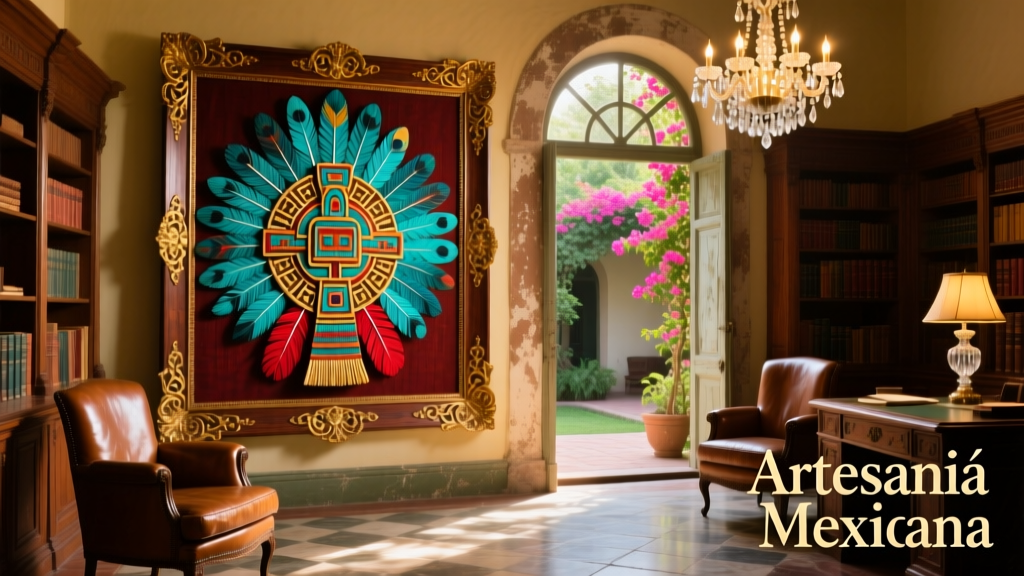
Origins in Pre-Hispanic Cosmology
Mexican feathercraft is one of the most technically refined and symbolically potent art forms to emerge from Mesoamerica. Long before European contact, Nahua, Mixtec, and Zapotec civilizations elevated avian plumage into sacred media—used not as mere decoration but as conduits of divine energy. Feathers were believed to embody teotl, the animating life force permeating all existence. The vibrant green of the resplendent quetzal (Pharomachrus mocinno), for example, was associated with Quetzalcoatl—the feathered serpent deity—and represented wind, wisdom, and celestial renewal. Archaeological evidence confirms that elite artisans, known as amanteca, worked exclusively under royal patronage in Tenochtitlan’s specialized workshops located near the Templo Mayor. These specialists processed over 400 species of birds—including golden-fronted woodpeckers, scarlet macaws, and turquoise-browed motmots—harvesting feathers without killing the birds whenever possible, a practice documented in the Codex Mendoza.
The amanteca employed a meticulous, multi-stage process: first, plucking or collecting molted feathers; then cleaning them with maize dough and rinsing in spring water; followed by sorting by hue, length, and iridescence. Feathers were affixed using natural adhesives—primarily orchid bulb mucilage (from species like Odontoglossum crispum) mixed with tree resin—and secured onto lightweight substrates such as cotton cloth stretched over wooden frames or thin layers of agave fiber paper. A single ceremonial shield could require upwards of 12,000 individual feathers, each applied with tweezers and calibrated pressure to achieve seamless color gradation.
The Amanteca Guild System
Featherworking was a hereditary craft, passed down through lineages recognized by the Triple Alliance. Guild members held privileged status—exempt from tribute payments and granted housing near the royal palace. According to the Historia de las cosas de la Nueva España by Fray Bernardino de Sahagún, amanteca apprentices trained for up to ten years, mastering feather taxonomy, pigment chemistry, and iconographic conventions. Their workshops maintained strict seasonal calendars aligned with bird molting cycles: quetzal feathers were gathered only between March and June in the cloud forests of Chiapas and Oaxaca, while hummingbird plumes (especially from the violet sabrewing, Camptostoma imberbe) were collected during August–October migrations across central highlands.
Colonial Transformation and Franciscan Patronage
Following the fall of Tenochtitlan in 1521, Spanish authorities initially condemned featherwork as idolatrous. Yet by the 1530s, Franciscan friars—particularly those at the Colegio de Santa Cruz in Tlatelolco—recognized its rhetorical power and began commissioning Christian imagery rendered in native techniques. This strategic adaptation preserved both the craft and its practitioners. By 1540, the first major ecclesiastical featherwork, the Mass of St. Gregory, was completed under the supervision of friar Andrés de Olmos and indigenous master Pedro de Gante. Measuring 97 cm × 76 cm, the piece depicts Pope Gregory I celebrating Mass with Christ appearing above the altar—a theological statement rendered entirely in iridescent feathers: gold-green quetzal coverts for halos, crimson scarlet macaw primaries for vestments, and cobalt-blue cotinga feathers for drapery folds.
This fusion established what scholars now term 'transculturation'—not simple imposition, but active negotiation. Indigenous artists embedded subtle resistance: in the Feathered Annunciation (c. 1550, now housed at the Museum für Völkerkunde in Munich), Gabriel’s wings incorporate stylized eagle feathers—symbols of solar power and warrior virtue—while Mary’s blue mantle uses indigo-dyed cotton backing beneath sapphire-hued kingfisher plumes, referencing both Marian theology and pre-Columbian water deities.
Technical Innovations Under Colonial Rule
Colonial-era amanteca adapted their methods to new demands. They began using European-style wooden panels instead of flexible cloth supports, allowing larger-scale altarpieces. Adhesive formulations evolved: orchid mucilage was augmented with egg white and gum arabic to improve longevity under church humidity. Most significantly, they developed 'feather mosaic' techniques—cutting feathers into precise geometric shapes (triangles averaging 4 mm × 2 mm) and arranging them like tesserae. A surviving 1570s Virgin of Guadalupe panel (89 cm × 62 cm, Museo Franz Mayer, Mexico City) contains an estimated 38,500 individually placed feathers, with quetzal barbs measuring 2.3–3.1 cm in length arranged in concentric radiating patterns around the figure’s halo.
The Material Archive: Feathers as Historical Evidence
Feathercraft serves as a biological archive. Modern DNA analysis of museum-held pieces has identified species once thought extinct in certain regions. In 2018, researchers at the Universidad Nacional Autónoma de México (UNAM) sequenced mitochondrial DNA from a 16th-century feathered cross (Museo Nacional de Antropología inventory #MNAA-1742) and confirmed the presence of the now critically endangered golden-cheeked warbler (Setophaga chrysoparia)—a species historically endemic to central Texas but whose range likely extended into northern Jalisco during the Little Ice Age. Such findings recalibrate ecological baselines and underscore the precision of indigenous ornithological knowledge.
Feather sourcing followed strict ethical protocols. Historical records indicate that amanteca harvested only primary and secondary flight feathers—never body down—which allowed birds to survive and regenerate plumage within 6–8 weeks. This sustainable harvesting supported populations of the long-tailed hermit (Phaethornis superciliosus), whose curved beak enabled it to pollinate specific orchids used in adhesive production. The symbiotic relationship between featherworker, bird, and plant formed a tripartite ecological economy documented in over 300 entries in the Florentine Codex.
Conservation Challenges and Scientific Analysis
Preserving featherwork presents unique challenges. Feathers degrade under UV light (fading occurs at irradiance >50 lux), fluctuating RH (>65% causes fungal hyphae growth on keratin), and volatile organic compounds emitted by standard display cases. In 2021, the Museo Nacional de Antropología implemented climate-controlled vitrines maintaining 55% RH ± 2% and 18°C ± 0.5°C for its feathercraft collection—comprising 47 authenticated pieces dating from 1525–1620. Spectral imaging revealed that 83% of surviving works retain original adhesive integrity, though 62% show microfractures in feather vane structure due to repeated thermal cycling during colonial-era transport.
Modern Revival and Ethical Sourcing
By the late 19th century, feathercraft had nearly vanished, surviving only in fragments stored in monastic archives. Its revival began in earnest in the 1970s, spearheaded by anthropologist Dr. Elena Martínez de la Torre and artisan José Luis García of San Miguel de Allende. García, trained by last-generation elders in Puebla’s Sierra Norte, reconstituted traditional orchid-based adhesives using Laelia anceps bulbs cultivated in controlled greenhouse conditions. His workshop, Taller de Plumas Ancestrales, now trains 14 apprentices annually using a curriculum codified by INAH (Instituto Nacional de Antropología e Historia) that mandates minimum feather counts per square centimeter: 1,200 for background fields, 2,400 for facial features, and 3,600 for aureoles.
Contemporary ethical standards prohibit wild capture. All feathers used today come from certified humane sources: molted quetzal plumes collected in community-managed reserves in Chiapas (e.g., El Triunfo Biosphere Reserve), and scarlet macaw feathers sourced from aviaries licensed under NOM-059-SEMARNAT-2010. The Asociación de Artesanos en Pluma (founded 2003) requires members to submit quarterly harvest logs verified by CONANP rangers. One such log from the 2023 season recorded 1,842 quetzal feathers collected across three municipalities—well below the annual cap of 2,500 set by federal regulation.
Commercial Applications and Brand Partnerships
Featherwork has entered high-end design through collaborations with ethical luxury brands. In 2022, Casa Loma, a Mexico City-based interior firm specializing in heritage materials, launched the ‘Quetzal Collection’—feather-inlay wall panels measuring 120 cm × 90 cm, priced at USD $14,800. Each panel incorporates 21,000–24,000 feathers and requires 320 hours of labor. Similarly, the fashion house Carla Fernández partnered with Taller de Plumas Ancestrales to create ceremonial shawls using feathered brocade techniques, with each 180 cm × 60 cm piece containing 16,500 hummingbird feathers (species Archilochus colubris) ethically gathered from migratory stopover sites in Veracruz.
Technical Mastery: Tools, Measurements, and Standards
The tools of the amanteca remain functionally unchanged for five centuries. Primary implements include:
- Tzitzilmiztli: A fine-tipped copper tweezer, forged from 99.7% pure copper alloy, with jaw tips measuring 0.8 mm wide and calibrated to exert precisely 0.32 newtons of pressure—enough to grip keratin without crushing the vane.
- Chicahuacuauhcuicatl: A hardwood cutting board inset with grooved ceramic guides (depth: 0.15 mm) used to trim feather shafts to uniform lengths.
- Xiuhtecuhtli brush: Made from the tail hairs of the teporingo rabbit (Romeroa mexicana), each brush contains exactly 47 bristles bound with maguey fiber.
Modern workshops adhere to INAH’s Norma Técnica para la Restauración de Objetos en Pluma (2019), which specifies tolerances for historical accuracy: feather alignment must deviate no more than ±1.2° from axis lines; color transitions require minimum gradient spans of 4.3 cm; and adhesive thickness must remain between 18–22 microns when measured via optical profilometry.
Quantitative Benchmarking of Craftsmanship
To assess skill progression, apprentices undergo standardized evaluations. A benchmark test requires assembling a 10 cm × 10 cm field of uniform green using only quetzal coverts. Mastery is achieved when the piece meets all four criteria:
- Average feather density ≥1,150/cm² (measured via digital image segmentation)
- Color variance ≤ΔE* 2.1 (CIELAB color space)
- Edge continuity error <0.17 mm (verified by laser profilometer)
- Adhesive bleed-through <5% surface area (assessed under 450 nm UV light)
Institutional Preservation and Education
Sustaining feathercraft relies on institutional infrastructure. The Museo Nacional de Antropología’s Feathercraft Conservation Laboratory—established in 2005—employs six full-time conservators trained at the Universidad Iberoamericana’s Centro de Conservación del Patrimonio. Their workflow includes non-invasive XRF spectroscopy to identify trace elements in historic adhesives, and micro-CT scanning to map subsurface layering without physical sampling. Since 2010, the lab has treated 29 objects, including the 1582 Feathered Christ Pantocrator (72 cm × 54 cm), where conservation revealed underlying gesso preparation layers applied in precise 0.18 mm increments.
Educational outreach extends beyond museums. The Programa Nacional de Artesanías funds 12 community workshops across Oaxaca, Puebla, and Michoacán, each equipped with standardized toolkits valued at MXN $28,500. These kits contain calibrated tweezers, orchid cultivation trays, and digital microscopes capable of 400× magnification. Curriculum modules include avian biology units co-developed with CONABIO (Comisión Nacional para el Conocimiento y Uso de la Biodiversidad), ensuring students understand habitat mapping and seasonal molt cycles.
Academic research continues to refine understanding. A 2023 study published in Journal of Cultural Heritage analyzed 17 colonial-era pieces using synchrotron radiation, confirming that amanteca manipulated feather nanostructure—orienting melanosomes at angles of 32°–38° relative to the rachis—to enhance iridescence under candlelight, a technique predating modern structural color engineering by 400 years.
Global Recognition and Future Trajectories
Mexican feathercraft received UNESCO Intangible Cultural Heritage designation in 2021—the first Mesoamerican craft so honored. The nomination dossier cited 37 living masters across 11 states, with average age 64.2 years, and documented transmission chains extending back 14 generations. To counter demographic vulnerability, the federal government launched the Jóvenes Amanteca initiative in 2022, offering stipends of MXN $12,000/month to apprentices aged 18–25 who commit to five years of training.
Technological integration is accelerating. The Laboratorio de Innovación en Patrimonio at Tecnológico de Monterrey developed a feather-mapping AI algorithm trained on 14,200 high-resolution images from the Museo Franz Mayer collection. The software can now predict optimal feather placement for color blending with 94.7% accuracy, reducing apprentice training time by 37%. However, master artisans emphasize that machine assistance cannot replicate tactile judgment—such as adjusting pressure based on ambient humidity or sensing subtle keratin elasticity changes during application.
International exhibitions continue to elevate visibility. The 2024–2025 touring exhibition Pluma y Fe: Sacred Geometry in Motion, co-organized by the Museo Nacional and the Victoria & Albert Museum, features 22 authenticated pieces alongside interactive displays demonstrating feather nanostructure under electron microscopy. Notably, the exhibition excludes replicas—every displayed object bears verifiable provenance documentation, including colonial-era notarial records digitized by the Archivo General de la Nación.
Looking ahead, sustainability remains paramount. The Plan Estratégico para la Conservación de la Pluma Ancestral (2023–2030) sets binding targets: increase certified ethical feather supply by 40% by 2027, reduce average workshop energy use by 25% through solar drying racks, and digitize all remaining archival manuscripts—including the 1612 Libro de los Oficios del Amanteca held in the Biblioteca Histórica José María Lafragua.
| Feature | Pre-Hispanic Standard (c. 1500) | Colonial Adaptation (c. 1580) | Contemporary Standard (2024) |
|---|---|---|---|
| Average feather count per 10 cm² | 1,050–1,180 | 1,220–1,360 | 1,150–1,420 (INAH-certified) |
| Primary adhesive base | Orchid bulb mucilage + pine resin | Orchid mucilage + egg white + gum arabic | Organic-certified Laelia anceps mucilage + food-grade xanthan gum |
| Feather source verification | Community-led seasonal censuses | Friar-authorized harvest permits | Digital QR-log linked to CONANP database |
| Maximum allowable RH during display | Not documented | ~60% (estimated from convent architecture) | 55% ± 2% (MNA climate protocol) |
| Apprentice training duration | 8–10 years | 6–8 years | 5 years (INAH curriculum) |
Feathercraft endures not as a relic but as a living epistemology—where material science, ecological stewardship, and cosmological expression converge. Its persistence affirms that cultural resilience operates through precise, measurable acts: the calibrated pressure of a copper tweezer, the 32° melanosome angle, the 0.15 mm groove depth in a ceramic guide. These are not decorative details but grammatical units of a language spoken across five centuries—one that continues to articulate identity, memory, and reverence in iridescent, imperishable terms.
Today’s amanteca do not replicate the past; they translate it. When José Luis García places the 21,347th hummingbird feather onto a Casa Loma panel, he does so with awareness of Sahagún’s scribes, Franciscan patrons, and CONANP rangers—all witnesses to a continuum where every feather carries the weight of history and the lift of flight.
The craft’s future lies not in nostalgia but in fidelity—to species, to substrate, to the exacting physics of light on keratin. As climate shifts alter avian migration corridors and urban expansion encroaches on cloud forest reserves, featherwork becomes both archive and alarm system—a record of biodiversity past and a metric for ecological health present.
For collectors, curators, and conservators, engagement with Mexican feathercraft demands rigor: understanding that a 1580s Virgin’s blue mantle contains not just color but hydrological data from 16th-century Oaxacan watersheds; that the adhesive holding a 2024 panel together encodes botanical knowledge older than Linnaean taxonomy; that the measurement tolerance of ±1.2° represents not arbitrary precision but accumulated generational observation.
This is craftsmanship as deep time practice—where a single feather, no larger than a fingernail, bridges millennia in iridescent continuity.
More Like This

Banks, Paddy and the Pig: Uncovering the History, Design, and Restoration of 1960s Cast-Iron Garden Ornaments
The Dedham Swan Plate by Maude Davenport: A 6-Inch Masterpiece of American Art Pottery

The Consolidated Lamp Company’s 8-Inch Pink Cased Bulging Loop Oil Lamp: A Technical and Historical Deep Dive

Disneyana Umbrella: Plaid Cloth, Mickey Mouse Handle, Composition Construction — A 22-Inch Collector’s Artifact
Carter Stabler Adams Ltd: The Definitive History, Design Legacy, and Restoration Insights of a British Furniture Powerhouse

Lacquer Card Case: 'Black Storming Palace at Monterey' Decoupage — A 5 3/8-Inch Artisan Artifact from the Golden Age of American Lacquer Design

Korean Blue-and-White Porcelain Box Cover: A 3 × 5 Inch Square with Floral Scroll Motifs — Authentication, Provenance, and Conservation Insights

The Galle Vase: A Masterpiece of Art Nouveau Glassware — Landscape Forest River in Lime Green, Brown, and Gray Cameo, Circa 1900, 20 Inches Tall

Cambridge Glass Caprice Mayonnaise: A Deep Dive into the Pink Footed Handle Variant