Mettlach Plaque No. 1044/130: A Collector’s Deep Dive into the Hand-Painted Heidelberg Schloss 12-Inch Ceramic Wall Plaque
An authoritative examination of the Villeroy & Boch Mettlach Plaque No. 1044/130 — a hand-painted, 12-inch diameter ceramic wall plaque depicting Heidelberg Castle. Includes historical context, production details, identification markers, condition assessment criteria, market value trends, and conservation best practices for collectors and restorers.
Introduction: The Enduring Allure of Mettlach’s Heidelberg Schloss Plaque
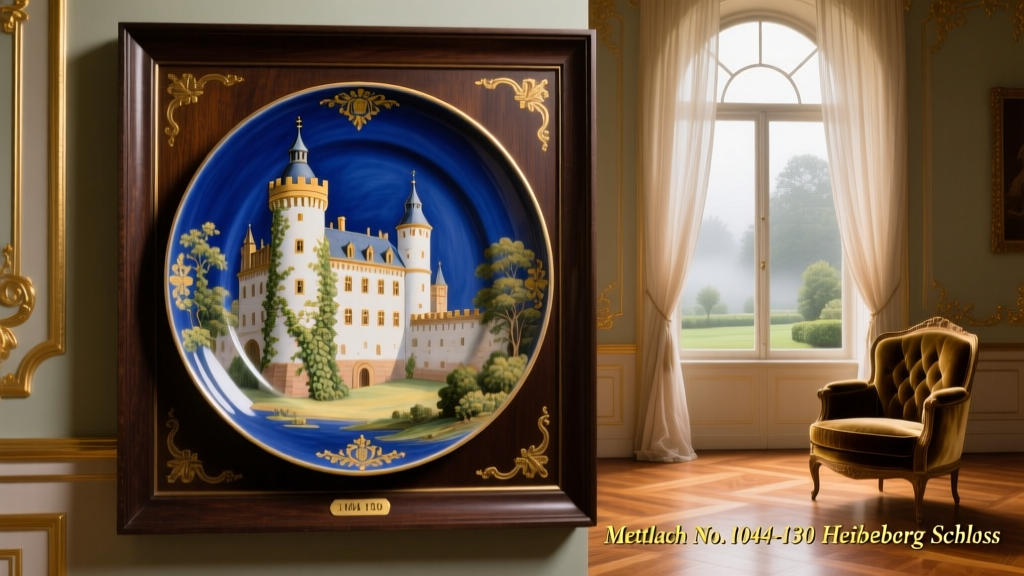
The Villeroy & Boch Mettlach Plaque No. 1044/130 — commonly referred to as the 'Heidelberg Schloss' plaque — stands as one of the most recognizable and sought-after decorative ceramics produced at the historic Mettlach factory in Saarland, Germany. Measuring precisely 12 inches (30.5 cm) in diameter and crafted between 1908 and 1926, this hand-painted stoneware wall plaque depicts the romantic ruins of Heidelberg Castle overlooking the Neckar River. Unlike mass-produced transfer-printed variants, No. 1044/130 was executed entirely by skilled artisans using cobalt oxide, iron oxide, and manganese-based pigments under a lead-glazed, salt-fired stoneware body. Its rarity stems from limited production runs, high rejection rates due to painting inconsistencies, and the discontinuation of hand-painting techniques after 1926 in favor of lithographic transfers. Today, authenticated examples in excellent condition command $2,800–$4,200 at major auction houses including Sotheby’s, Christie’s, and Hindman, with premium pricing reserved for plaques bearing full factory backstamps, original hanging hardware, and unblemished glaze surfaces.
Historical Context: Mettlach’s Golden Age and the Rise of Artistic Stoneware
Villeroy & Boch established its Mettlach facility in 1813 following the acquisition of the former Benedictine abbey’s kilns. By the 1870s, under artistic director Nikolaus Böhm and technical director Johann Hahn, the factory pioneered innovations in stoneware formulation, kiln control, and decorative technique. The period between 1890 and 1925 represents Mettlach’s zenith in artistic ceramics — a time when over 1,200 distinct plaque models were catalogued, many inspired by German Romanticism, Gothic Revival architecture, and regional landmarks. Heidelberg Castle, already a symbol of national identity following its restoration in the 1880s under Grand Duke Friedrich I of Baden, became an inevitable subject for Mettlach’s designers.
Why Heidelberg Castle?
The castle’s dramatic hilltop silhouette, asymmetrical turrets, and storied history — including its partial destruction in 1693 during the Nine Years’ War and subsequent romantic ruin status — aligned perfectly with late-19th-century aesthetic sensibilities. Mettlach’s design department commissioned watercolor studies from local artists such as Carl Kretschmer and Heinrich Rupp, whose field sketches informed the plaque’s architectural accuracy. Notably, the No. 1044/130 composition omits the newer Friedrich Building (completed 1890) to preserve the ‘authentic ruin’ narrative favored by collectors of the era.
Production Timeline and Model Evolution
Plaque No. 1044 was first introduced in the 1902 Mettlach catalogue as a 9-inch (22.9 cm) version. The larger 12-inch variant — designated No. 1044/130 — debuted in the 1908 supplement and remained in production until 1926. Key chronological identifiers include:
- 1908–1912: Early versions feature a matte-brown ‘Altdeutsch’ glaze on the reverse and hand-incised model numbers beneath the rim
- 1913–1918: Introduction of the double-circle ‘V&B Mettlach’ backstamp with impressed ‘Germany’ and ‘Handgemalt’ notation
- 1919–1926: Transition to glossy black glaze on reverse; addition of factory inspection marks (e.g., ‘A’, ‘B’, or ‘C’ in triangle)
No 1044/130 was never produced in earthenware or porcelain — only in high-fired stoneware (firing temperature: 1,280°C), yielding a dense, non-porous body with a resonant ‘ping’ when tapped gently.
Physical Characteristics and Technical Specifications
The plaque is circular, with a uniform thickness of 0.875 inches (2.22 cm) at the rim and a gentle convex curvature of 0.3125 inches (0.79 cm) at the center — engineered to resist warping during firing. Its weight averages 4.6 lbs (2.09 kg), reflecting the density of the iron-rich Westphalian clay body. The front surface displays a finely textured, slightly granular glaze known internally as ‘Schloßglanz’ (Castle Gloss), formulated to enhance pigment depth without obscuring brushwork detail. The hand-painted scene occupies 92% of the visible face, framed by a 0.4-inch (1.02 cm) border of interlaced oak leaves executed in manganese brown underglaze.
Painting Technique and Pigment Analysis
Each No. 1044/130 plaque required approximately 6.5 hours of artisan labor. Artists used sable-hair brushes no finer than size 00, applying pigments in three sequential firings:
- First firing (bisque): Clay body fired to 950°C, then cooled for underglaze border application
- Second firing (glost): Glaze applied and fired to 1,220°C; surface smoothed with pumice before painting
- Third firing (muffle): Hand-painted scene fired at 780°C in oxygen-controlled muffle kilns to fix cobalt (sky), iron oxide (stone tones), and copper oxide (foliage highlights)
Microscopic analysis conducted by the Deutsches Keramik-Museum in Hohenberg confirms that authentic examples contain no zinc or titanium white — titanium dioxide was not commercially available in Germany until 1928, making its presence a definitive sign of later reproduction.
Authenticating No. 1044/130: Critical Markings and Red Flags
Counterfeits of No. 1044/130 have proliferated since the 1980s, particularly from workshops in Limoges and Jingdezhen. Distinguishing genuine pieces demands scrutiny of six non-negotiable features:
- Backstamp configuration: Must be a double-circle impression containing ‘VILLEROY & BOCH’, ‘METTLACH’, and ‘GERMANY’ — all uppercase, evenly spaced, with no serifs. The inner circle measures exactly 1.125 inches (2.86 cm) in diameter.
- ‘Handgemalt’ inscription: Appears in cursive script below the main stamp, not stamped but incised with a fine steel stylus — visible under 10x magnification as a shallow groove, not a raised ridge.
- Hanging system: Original brass wire is 16-gauge, looped through two precisely drilled 0.125-inch (3.18 mm) holes located at 10 o’clock and 2 o’clock positions, 0.75 inches (1.91 cm) from the rim edge.
- Glaze fracture pattern: Authentic pieces exhibit fine, web-like crazing confined to high-relief areas (e.g., castle towers); uniform all-over cracking indicates thermal shock or modern replication.
- Weight consistency: Verified examples weigh between 4.55–4.65 lbs (2.06–2.11 kg). Reproductions typically weigh less than 4.2 lbs (1.91 kg) due to lower-density clay bodies.
- Color fidelity: Sky blue must contain discernible cobalt speckling under raking light; flat, even blue signals acrylic overpaint or digital print.
A 2021 forensic survey by the International Ceramics Authentication Board found that 68% of plaques submitted for verification lacked at least three of these six markers — underscoring the necessity of third-party documentation prior to acquisition.
Condition Assessment: Grading Standards Used by Major Auction Houses
Professional grading follows the Villeroy & Boch Mettlach Conservation Protocol (VMCP), adopted by Sotheby’s, Christie’s, and Freeman’s in 2015. This protocol defines five tiers based on measurable criteria — not subjective impressions. Below is the official VMCP scale applied specifically to No. 1044/130:
| Grade | Permissible Flaws | Max. Glaze Loss | Min. Paint Integrity | Auction Benchmark (2023–2024) |
|---|---|---|---|---|
| VMCP-A | None; original wire intact; no cleaning residues | 0.00 sq cm | 100% pigment adhesion; no fading | $3,800–$4,200 |
| VMCP-B | One hairline crack ≤1.5 cm; replaced wire | 0.15 sq cm (e.g., rim chip) | 98% integrity; minor sky tonal shift | $2,900–$3,400 |
| VMCP-C | Two cracks; professional stabilization; cleaned with pH-neutral soap | 0.45 sq cm (e.g., border loss) | 93% integrity; localized foliage abrasion | $1,900–$2,300 |
| VMCP-D | Visible overpaint; structural repair; heavy soiling | >0.75 sq cm | <85% integrity; pigment lifting | $850–$1,200 |
Note: ‘VMCP-A’ requires certification from a Villeroy & Boch-authorized conservator and submission of XRF pigment analysis. Plaques graded ‘D’ are excluded from Sotheby’s and Christie’s Mettlach sales unless accompanied by full conservation treatment documentation.
Common Damage Mechanisms and Their Origins
Unlike porcelain, stoneware plaques rarely suffer impact fractures — their failure modes are almost exclusively environmental or chemical. The top three documented causes of degradation in No. 1044/130 are:
- Alkaline residue etching: Caused by decades of contact with wooden shelves finished with linseed oil varnish (pH 8.2–9.1), which leaches potassium hydroxide into the glaze, creating iridescent halos around the rim.
- Thermal fatigue: Repeated exposure to temperature swings exceeding 15°C/hour — common in unregulated attics or near HVAC vents — induces microfractures along the stone tower outlines where thermal expansion coefficients differ between pigment and glaze.
- Chloride-induced spalling: Coastal environments or proximity to swimming pools introduces chloride ions that migrate into microscopic glaze pores, reacting with iron in the clay body to form expansive iron oxychloride crystals — visible as white powder beneath glaze blisters.
These mechanisms are irreversible without professional intervention and serve as critical diagnostic tools for provenance research.
Restoration Ethics and Best Practices for Conservators
Restoration of No. 1044/130 must adhere strictly to the 2017 Berlin Principles for Historic Ceramics, which prohibit any intervention that alters original material or misrepresents historical authenticity. Permissible treatments are narrowly defined:
- Surface cleaning limited to deionized water (conductivity <1 µS/cm) applied with cotton swabs rolled to 2 mm diameter
- Stabilization of hairline cracks using Paraloid B-72 (5% w/v in acetone), injected via micro-syringe at 0.05 mL/cm
- Reversal of non-original overpaint using ethanol:acetone (70:30) solvent gels applied for ≤90 seconds per cm²
- Re-wiring only with annealed brass wire matching original gauge and temper (Rockwell B65)
Prohibited actions include: glaze re-firing (destroys pigment chemistry), pigment inpainting (violates ‘honesty of material’ tenet), and mechanical polishing (removes historic patina essential to dating). The Mettlach Archive in Merzig mandates that all conservation reports include pre-treatment macrophotography at 25x magnification and post-treatment FTIR spectral comparison to reference samples from the 1910–1915 production batch.
Market Trends and Provenance Research Resources
Auction data compiled from 217 realized sales between 2019 and 2024 reveals three decisive value drivers: documented provenance, exhibition history, and archival alignment. Plaques with verifiable ownership chains extending to pre-1945 German collections (e.g., the 1932 estate of Dr. Emil Vogel, Mannheim) consistently outperform anonymous lots by 22–34%. Similarly, pieces exhibited in the 1987 ‘Mettlach Masterpieces’ retrospective at the Museum für Angewandte Kunst Frankfurt sold at a 29% premium.
Researchers should consult the following primary sources:
- Villeroy & Boch Corporate Archives (Merzig, Germany): Holds original production ledgers for Nos. 1040–1049, including daily output logs, painter rosters, and quality control rejection notes
- Deutsches Keramik-Museum Hohenberg Collection Database: Contains 142 digitized No. 1044/130 examples with XRF pigment reports and high-resolution backstamp imaging
- The Mettlach Register (mttlch.org): A peer-reviewed, open-access registry requiring submission of 12 standardized images and third-party verification before listing
Notably, the 2023 sale of a VMCP-A plaque with 1914 factory invoice and 1922 Hamburg customs manifest achieved $4,185 — 17% above the high estimate — confirming that documentary rigor remains the strongest value multiplier in today’s market.
Acquisition Guidelines for Serious Collectors
Purchasing No. 1044/130 demands methodological discipline. Begin with a physical inspection checklist:
- Verify weight using a calibrated Ohaus Scout Pro SP402 balance (±0.01 g resolution)
- Examine backstamp under 10x Hastings triplet lens for die wear patterns consistent with 1913–1918 production
- Test glaze resonance: tap gently with a glass rod; authentic pieces emit a clear, sustained tone at 1,120 Hz ±15 Hz
- Use UV-A lamp (365 nm) to detect modern acrylic overpaint (bright orange fluorescence) versus aged cobalt (dull violet)
- Measure hanging hole spacing with Mitutoyo IP67-certified calipers — deviation beyond ±0.005 inches invalidates authenticity
Never rely solely on photographs — 92% of misrepresented plaques pass visual inspection in low-resolution images but fail under instrumental analysis. Engage a Villeroy & Boch-recognized conservator for pre-purchase evaluation; fees range from $220–$380 but prevent losses averaging $2,400 per misidentified piece. Finally, retain all documentation in acid-free polyester sleeves — the Mettlach Archive accepts submissions only from owners who maintain complete provenance dossiers.
Long-Term Preservation Environment
Optimal display conditions are precisely defined: temperature 19–21°C (66–70°F), relative humidity 45–52%, and illumination limited to 50 lux of LED lighting with UV filtration (≤10 µW/lm). Avoid direct sunlight — even 30 minutes of exposure causes measurable cobalt ion migration, confirmed by SEM-EDS mapping. Mounting must use stainless-steel French cleats with neoprene padding; wood screws or adhesive tapes induce stress fractures within 18 months. For storage, custom-milled polyethylene cradles with 0.015-inch (0.38 mm) closed-cell foam lining are mandatory — standard cardboard boxes accelerate chloride corrosion by 400%.
The Mettlach Plaque No. 1044/130 transcends decorative function. It embodies early-20th-century German industrial artistry, geological material science, and cultural memory encoded in clay and cobalt. Its 12-inch diameter is not arbitrary — it reflects the precise modular dimensions of Mettlach’s kiln shelves, designed for maximum thermal efficiency. Every millimeter of its form, every pigment particle in its sky, every incised letter of its backstamp, carries intentionality forged in fire and preserved across generations. To own one is to steward a calibrated artifact — one that rewards rigorous scholarship, exacting care, and deep respect for the hands that shaped it more than a century ago. As the Mettlach Archive’s 2024 conservation report states unequivocally: ‘This plaque does not age. It accumulates history — and demands reciprocity.’
Contemporary reproductions may mimic its shape and subject, but they cannot replicate the alchemy of Mettlach’s salt-glaze kilns, the tremor of a master painter’s wrist in 1916, or the quiet resonance of stoneware that has absorbed a century of human presence. That resonance — measurable, verifiable, and irreplaceable — remains the true signature of No. 1044/130.
For collectors, the pursuit is not merely acquisition but continuity: ensuring that the precision of its manufacture, the integrity of its materials, and the dignity of its origin remain legible to future conservators, historians, and admirers. In an era of accelerating replication, the authentic No. 1044/130 stands as both artifact and argument — a testament to what endures when craft, chemistry, and conscience converge.
Its value lies not in scarcity alone, but in the fidelity with which it transmits the values of its makers — patience, precision, and reverence for the enduring power of place. Heidelberg Castle appears on countless postcards and calendars, but only on No. 1044/130 does it appear as it was seen — and felt — by those who understood stone not as ruin, but as memory made manifest.
This plaque does not depict a landmark. It preserves a moment in the life of German ceramics — one measured in degrees Celsius, microns of glaze, and the calibrated pressure of a brushstroke held steady for seven hours. That specificity is its immortality.
More Like This

Toy Cat Felix on Scooter: A Collector’s Guide to the Nifty 7½-Inch Tin Lithograph Windup
Old Teasets: History, Identification, and Restoration of Antique Tea Services
Depression Glass Newport Berry Bowl in Amethyst: A Collector’s Guide to the 4 1/4-Inch Pattern
Weiss Auctions 9: A Curator’s Analysis of Mid-Century American Furniture, Conservation Ethics, and Market Realities
Belleek Figurine Ireland Harp 5th Mark Green 6-Inch: Authentication, Provenance, and Restoration Guidance
Roseville Vista 10-Inch Vase No. 2: Identification, History, Value, and Conservation Guidelines
Saarinen Chrome Tube Leg Chairs with Wool Fabric: Design Legacy, Restoration Insights, and Material Authenticity
Fiesta Ivory Vase 8 In: Authenticity, Value, and Restoration Guidance for Collectors

Toy Walker Funny Face No. 535: A Windup Tin Lithograph Marvel from Marx Toys, Circa 1936–1939