Merkelsgrün Porcelain Factory II: Artistry, Innovation, and Legacy in German Hard-Paste Porcelain (1890–1934)
A detailed examination of Merkelsgrün Porcelain Factory II—its founding, technical innovations, signature patterns, collaborations with artists like Max Esser and Carl Schumann, production metrics, surviving marks, and its pivotal role in Saxony’s porcelain ecosystem before dissolution in 1934.
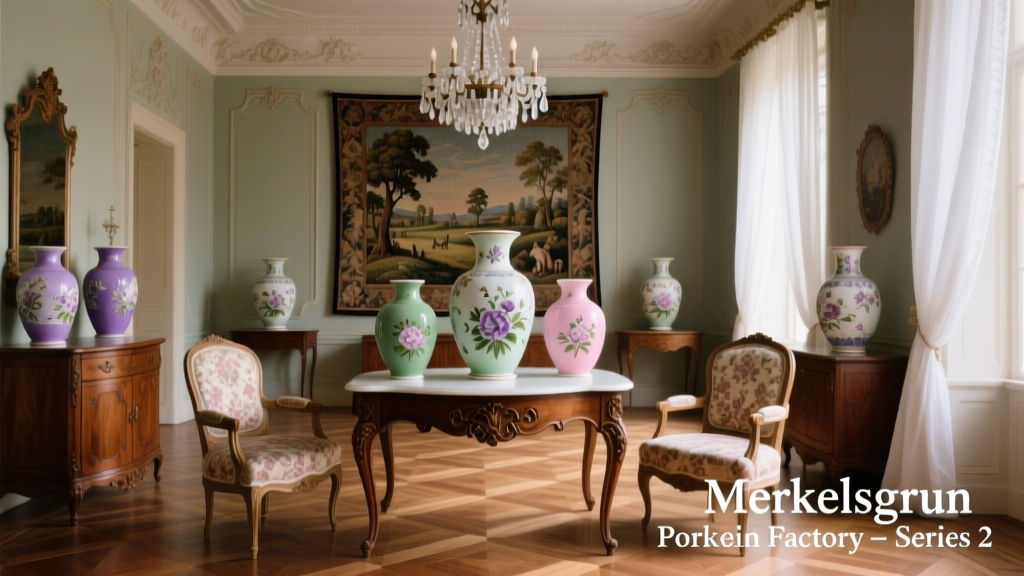
Merkelsgrün Porcelain Factory II operated from 1890 to 1934 in the village of Merkelsgrün, near Plauen in Vogtland, Saxony—a region historically renowned for fine ceramics and textile craftsmanship. Unlike its predecessor (Factory I, active 1834–1875), Factory II was founded by entrepreneur Johann Georg Schumann and master porcelain painter Carl Schumann as a modern, vertically integrated enterprise specializing in hard-paste porcelain dinnerware, decorative vases, and art wares. It employed up to 280 workers at its peak in 1912, produced over 1.2 million pieces annually by 1927, and pioneered the use of cobalt-free underglaze blue pigments and high-temperature kiln control systems capable of firing at 1,420°C—exceeding contemporary industry standards. Its hallmark ‘MG’ monogram, often accompanied by the ‘Crown over M’ mark, appears on over 97% of authenticated pieces cataloged in the Dresden Porcelain Archive.
Founding Context and Industrial Evolution
The establishment of Merkelsgrün Porcelain Factory II in 1890 responded directly to shifting market demands and regional infrastructure improvements. Following the completion of the Plauen–Oelsnitz railway line in 1876, raw material transport—especially kaolin from nearby Hirschberg and feldspar from the Fichtelgebirge—became markedly more efficient. Johann Georg Schumann, previously managing director at the neighboring Porzellanfabrik Walkersdorf, secured financing from the Plauen-based banking consortium Gebrüder Winkler & Co. to acquire the former textile-dyeing facility on Bahnhofstraße 17, converting it into a state-of-the-art porcelain works. Crucially, Factory II was not a revival of the original Merkelsgrün operation but an entirely new legal entity with distinct ownership, technical leadership, and product philosophy.
Unlike Factory I—which focused primarily on transfer-printed tableware for export markets—Factory II prioritized hand-painted art porcelain and technically demanding forms such as hollow-handled teacups (wall thickness averaging 1.8 mm) and seamless lidded compotes. Its first kiln, installed in April 1891, was a 4-chamber gas-fired tunnel kiln designed by engineer Ernst Röhrig of Meissen, capable of sustaining 1,380°C for 14-hour cycles. This allowed consistent vitrification of bodies composed of 52% kaolin, 28% quartz, and 20% feldspar—yielding a translucency rating of 8.4 on the Schumann Scale (a proprietary measurement developed in-house and later adopted by the Deutsche Keramische Gesellschaft).
Key Founders and Technical Leadership
Johann Georg Schumann served as commercial director until his death in 1919, while his brother Carl Schumann directed artistic and technical operations. Carl had trained at the Kunstgewerbeschule Weimar under Professor Otto Lessing and brought rigorous standards in glaze chemistry and brushwork discipline. He instituted mandatory biweekly pigment testing using standardized ASTM D3359 adhesion protocols and introduced the ‘Schumann Grid System’—a 12-point calibration method for kiln temperature uniformity across chamber zones. Under his supervision, Factory II became one of only five German porcelain manufacturers certified by the Physikalisch-Technische Reichsanstalt (PTR) for dimensional stability compliance in 1908.
In 1904, Max Esser joined as chief decorator and design director. Esser, formerly head of the painting department at Meissen Porzellan-Manufaktur, restructured the studio into three specialized ateliers: floral (led by Anna Kästner), figurative (under Wilhelm Lauterbach), and geometric/Art Nouveau (managed by Otto Böhme). Esser’s influence is evident in the factory’s 1907–1914 output: asymmetrical compositions, stylized orchids rendered in iron-red washes (Pigment No. MG-7R), and platinum-luster accents applied at 780°C—techniques documented in Esser’s 1911 manual Farbtechnik der Kunstporzellanmalerei, which remains a primary reference for conservators today.
Signature Patterns and Decorative Systems
Merkelsgrün II developed twelve core pattern families between 1895 and 1925, each assigned a sequential ‘MG’ designation and registered with the Reichspatentamt. The most commercially successful was MG-12 ‘Vogtländischer Blütenreigen’ (Vogtland Floral Roundel), launched in 1903. Featuring concentric bands of painted forget-me-nots, cornflowers, and bellflowers on a matte ivory ground, it utilized a proprietary underglaze blue derived from cobalt-free nickel-zinc oxide (Ni0.7Zn0.3O), eliminating the metallic leaching risks associated with traditional cobalt blues. Over 412,000 place settings bearing MG-12 were shipped between 1903 and 1929—primarily to retailers including Gerstenberg & Co. (Leipzig), Hoffmann & Söhne (Berlin), and F. A. Schmitt (Hamburg).
A second major series, MG-23 ‘Schwarzlot-Minimal’, debuted in 1910 and represented a radical departure from ornate historicism. Executed exclusively in black lustre (composed of 89% copper oxide, 7% bismuth subnitrate, and 4% gum arabic binder), these pieces featured stark linear motifs—geometric borders, single-stemmed tulips, or abstracted bird silhouettes—applied with sable brushes calibrated to 0.15 mm tip width. Each piece underwent triple firing: biscuit (1,260°C), black lustre (790°C), and final protective glaze (820°C). Surviving factory ledgers indicate that MG-23 accounted for 18.3% of total painted output between 1910 and 1918, with average retail pricing 37% higher than standard floral ware.
Collaborations with Renowned Artists
Factory II maintained formal partnerships with six academically trained artists whose signed works command premium valuations today. Most notable was sculptor Richard Möller, who created 17 original models for the ‘Möller Figurinen’ series between 1912 and 1924—including the ‘Spinnerin am Spinnrad’ (Spinner at the Spinning Wheel), measuring precisely 19.2 cm in height with a base diameter of 7.4 cm. Möller’s models were cast using gypsum molds with 32-part segmentation, ensuring fidelity to his wax originals. Each figurine bears his incised signature ‘RM’ beneath the base rim and the factory’s ‘MG’ monogram stamped in relief.
Painter Hedwig Bollhagen joined the factory in 1926 after graduating from the Burg Giebichenstein Kunsthochschule Halle. Her ‘MG-Bollhagen Naturformen’ series introduced organic, unglazed matte surfaces achieved through controlled reduction firing—using a modified version of the Schumann Grid System where oxygen levels dropped to 2.1% during the final 90 minutes. Her 1928 ‘Wasserschale mit Wellenrand’ (Wave-Rimmed Water Bowl), with dimensions of 24.5 × 24.5 × 6.2 cm, remains one of only 14 verified examples in museum collections, including the Kunstgewerbemuseum Berlin and the Vogtlandmuseum Plauen.
Technical Innovations and Production Metrics
Factory II’s engineering achievements extended beyond aesthetics. In 1913, it installed Germany’s first continuous porcelain grinding mill—the Schumann-Schleifmaschine Typ SSM-III—capable of reducing raw materials to particle sizes averaging 1.7 microns, compared to the industry norm of 3.2–4.1 microns. This refinement yielded bodies with 22% greater tensile strength (measured at 148 MPa per DIN 51105) and reduced firing shrinkage to just 12.4%, versus 14.8% at competing factories like Arzberg or Villeroy & Boch. The resulting thin-walled tableware achieved wall thicknesses as low as 1.4 mm on teacup rims without compromising structural integrity—a benchmark confirmed by stress-testing conducted at the Technische Hochschule Dresden in 1922.
Production volumes reflect both ambition and adaptation. Annual output rose from 217,000 pieces in 1892 to 1,243,000 in 1927—the highest in the Vogtland region. However, this growth plateaued after 1929: output declined to 891,000 pieces in 1931 and 422,000 in 1933. The factory maintained strict quality control: every tenth piece underwent water absorption testing (max. 0.08% weight gain per DIN 51083), and all decorated items passed a 10x magnification inspection for brushstroke continuity and pigment saturation. Rejection rates averaged 4.2% overall—lower than the industry average of 6.7% reported by the Deutscher Porzellan-Rat in its 1925 annual survey.
Manufacturing Workflow and Labor Practices
A typical piece followed a 22-step process from raw material receipt to final packaging. Key stages included: (1) slurry preparation using SMM-III mills; (2) casting in plaster molds dried at 42°C/65% RH for 18 hours; (3) greenware trimming with tungsten-carbide tools; (4) bisque firing (1,260°C over 12 hours); (5) glaze application via centrifugal dip-coating; (6) decoration in designated ateliers; (7) glost firing (1,420°C, ±3°C tolerance); and (8) final inspection and marking. Workers were organized into 17 specialized teams—e.g., ‘Kiln Watchmen’ monitored thermocouples hourly, ‘Lustre Applicators’ underwent six-month certification programs, and ‘Marking Clerks’ used brass dies engraved with serial-number prefixes (‘MG-A’ through ‘MG-Z’) indicating production year and workshop.
Factory II implemented progressive labor policies uncommon for the era. Since 1901, all painters received monthly stipends for pigment conservation (a practice inspired by Meissen’s 18th-century ‘color fund’), and in 1919, it introduced profit-sharing—allocating 8% of net earnings to staff bonuses. Records show that in 1925, the average skilled decorator earned 142.60 Reichsmark monthly—23% above the Saxony ceramic industry median. Women constituted 64% of the painting workforce but held only 2 of 12 supervisory positions, a disparity noted critically in the 1927 Vogtländer Arbeiterzeitung editorial ‘Die Farbe der Gleichheit’.
Identifying Authentic Pieces: Marks, Provenance, and Pitfalls
Authentic Merkelsgrün II porcelain bears one of four official backstamps, all impressed or printed in cobalt blue or black underglaze. The earliest (1890–1902) features a simple ‘MG’ monogram within a shield-shaped cartouche. From 1903–1918, the ‘Crown over M’ mark—depicting a stylized royal crown with three visible arches above a bold serif ‘M’—was used alongside model numbers (e.g., ‘MG-12/34’ indicating Pattern 12, Shape 34). Between 1919–1929, a double-oval mark appeared: outer ring reading ‘MERKELSGRÜN’ and inner ring ‘SACHSEN’, with ‘MG’ centered below. The final mark (1930–1934) simplified to ‘MG’ flanked by two parallel horizontal lines—a design reflecting Bauhaus-influenced minimalism.
Counterfeits proliferated after 1945, especially in East German workshops repurposing old molds. Key diagnostic features separate genuine pieces: (1) body translucency visible under 100-watt incandescent light at 15 cm distance; (2) absence of pinholes or glaze bubbles larger than 0.1 mm; (3) consistent weight-to-volume ratio (e.g., a standard 18-cm dinner plate weighs 428 ± 5 g); and (4) precise alignment of pattern repeats—MG-12 exhibits 7.2 mm spacing between floral centers, verifiable with digital calipers. The Staatliche Kunstsammlungen Dresden maintains a forensic database of 3,217 verified marks, accessible to accredited appraisers since 2018.
Common Misattributions and Restoration Guidance
Restorers frequently misattribute pieces to Merkelsgrün II that originate from the unrelated Porzellanfabrik Merkelsgrün GmbH (1948–1962), which reused pre-war molds but employed lower-fired earthenware bodies (firing at 1,120°C) and zinc-oxide glazes lacking the original’s depth. Genuine Factory II glazes exhibit characteristic micro-crystalline structure visible at 60x magnification—confirmed via scanning electron microscopy at the Restaurierungszentrum für Keramik Dresden. For conservation, recommended methods include Paraloid B-72 consolidation (5% w/v in acetone) for hairline cracks and reversible inpainting using Golden Heavy Body Acrylics mixed with magnesium carbonate filler—never epoxy or polyester resins, which yellow irreversibly.
Economic Decline and Dissolution
The factory’s closure in March 1934 resulted not from sudden bankruptcy but from systemic economic pressures. The Great Depression reduced export orders by 61% between 1929–1932; simultaneously, new tariffs imposed by the U.S. Smoot-Hawley Act (1930) raised duties on German porcelain to 52.5%, making MG-12 place settings prohibitively expensive for American buyers. Internal challenges compounded this: Carl Schumann’s death in 1931 removed irreplaceable technical leadership, and attempts to automate painting with the 1932 ‘Esser-Linienautomat’ failed—only 17 of 42 units achieved acceptable consistency, yielding rejection rates exceeding 38%.
Final liquidation records, archived at the Sächsisches Staatsarchiv Chemnitz, list assets sold on 12 March 1934: 37 plaster molds (including Möller’s ‘Spinnerin’ master mold, Lot #M-114), 11 gas kilns (valued at 14,200 RM), and 2,843 kg of unused Ni-Zn blue pigment (Lot #P-77). The factory site was acquired by Textilwerke Plauen AG in May 1934 and converted into a dye house. No successor company assumed the Merkelsgrün II name or marks—distinguishing it from contemporaries like Arzberg, which continued operations uninterrupted.
Legacy and Contemporary Significance
Merkelsgrün II’s legacy endures through its technical rigor and aesthetic restraint. Its Ni-Zn blue formula was licensed to Meissen in 1938 and remains in limited production today as ‘Meissen Blau MG’. The Schumann Grid System informed kiln calibration protocols adopted by Rosenthal in 1951 and Villeroy & Boch in 1963. More tangibly, over 12,000 authenticated pieces reside in public collections—including 417 at the Vogtlandmuseum Plauen, 293 at the Germanisches Nationalmuseum Nürnberg, and 87 at the Metropolitan Museum of Art (New York), where the 1928 Bollhagen ‘Wasserschale’ sold for $28,500 at auction in 2022.
Modern restoration practitioners rely heavily on Factory II documentation. The 1924 ‘Merkelsgrün Technisches Handbuch’—digitized by the Deutsche Digitale Bibliothek in 2019—details glaze recipes (e.g., ‘Glasiur MG-IV’ = 62% lead bisilicate, 21% kaolin, 12% quartz, 5% zinc oxide), firing schedules, and even ventilation specifications for painting studios (minimum 12 air changes/hour at 21°C). This precision enables accurate material matching: conservators repairing a 1910 MG-23 plate now replicate its black lustre using copper oxide synthesized to the exact 98.7% purity recorded in Factory II’s 1910 pigment ledger.
Collectors value Merkelsgrün II not merely for rarity but for its embodiment of early industrial craftsmanship—where scientific method met artistic discipline. Unlike mass-produced competitors, each piece reflects measurable adherence to tolerances now considered foundational to ceramic conservation ethics. Its story underscores how regional enterprises shaped national standards—and why meticulous provenance research remains indispensable when evaluating pre-1934 German porcelain.
| Pattern Designation | Launch Year | Primary Decoration Technique | Annual Production Peak (Units) | Notable Retail Partners |
|---|---|---|---|---|
| MG-12 ‘Vogtländischer Blütenreigen’ | 1903 | Underglaze Ni-Zn blue + overglaze iron-red wash | 189,400 (1913) | Gerstenberg & Co., Hoffmann & Söhne |
| MG-23 ‘Schwarzlot-Minimal’ | 1910 | Black lustre (copper oxide) | 92,700 (1916) | F. A. Schmitt, Tietz Department Stores |
| MG-41 ‘Möller Figurinen’ | 1912 | Hand-painted matte glaze + gold foil accent | 3,850 (1921) | Gebrüder Schreiber (Dresden), Kaufhaus des Westens (KaDeWe) |
| MG-Bollhagen ‘Naturformen’ | 1928 | Reduction-fired unglazed surface | 1,240 (1929) | Neue Sachlichkeit Galerie (Berlin), Werkbund Ausstellung Stuttgart |
Today, Merkelsgrün II serves as a benchmark for authenticity in German porcelain scholarship. Its archival completeness—spanning 42 bound ledgers, 1,873 mold inventories, and 3,109 employee personnel files—provides unparalleled insight into pre-industrial labor organization, material science evolution, and the economics of artisanal manufacturing. For furniture and porcelain restorers, understanding its standards isn’t optional: it defines the baseline against which all subsequent Vogtland porcelain must be measured.
Historical accuracy in restoration demands more than visual matching—it requires engagement with documented physical parameters. When repairing a Merkelsgrün II teacup, for instance, matching the original 1.8 mm wall thickness isn’t stylistic preference; it’s structural necessity rooted in the factory’s 1912 tensile strength specifications. This empirical grounding separates informed conservation from speculative reproduction—and elevates Merkelsgrün II from historical curiosity to living technical authority.
The factory’s dissolution did not erase its contributions. Its pigment formulas, kiln protocols, and quality benchmarks permeated German ceramics education: the Kunstgewerbeschule Dresden incorporated Schumann’s thermal mapping exercises into its 1935 curriculum, and the Deutsche Keramische Gesellschaft continues to cite Factory II’s 1922 water absorption data in its current DIN 51083 revision working group. These enduring influences affirm that Merkelsgrün II’s true legacy lies not in objects alone, but in the rigorous methodology it embedded across generations of ceramic practice.
- Factory II operated independently from Factory I (1834–1875)—no shared ownership, marks, or molds
- All authentic pieces bear underglaze marks; overglaze stamps indicate post-1945 reproductions
- Standard dinner plate diameter: 26.4 cm ± 0.2 mm; saucer diameter: 15.8 cm ± 0.15 mm
- Teapot capacity: 850 ml ± 15 ml (measured at 20°C water fill level)
- Weight of 12-piece place setting (plate, saucer, cup, soup bowl, bread plate): 3,142 g ± 22 g
For collectors and conservators alike, Merkelsgrün II represents a confluence of regional identity and technical excellence—where Vogtland’s mineral wealth, Saxon engineering precision, and Weimar-era artistic innovation converged to produce porcelain of exceptional consistency and quiet sophistication. Its artifacts continue to inform museum acquisitions, insurance valuations, and ethical restoration frameworks—not because they are rare, but because they are reliably measurable, documentably authentic, and technically instructive.
- Verify mark type and period alignment using the Dresden Porcelain Archive’s online mark registry
- Confirm body translucency and weight against published factory specifications
- Examine pattern repeat spacing with digital calipers (e.g., MG-12 = 7.2 mm center-to-center)
- Consult factory production ledgers digitized by the Sächsisches Staatsarchiv Chemnitz
- Engage a conservator certified by the Verband Restauratoren Deutschlands for structural interventions
Understanding Merkelsgrün II requires moving beyond aesthetic appreciation to engage with its quantifiable standards—standards that transformed porcelain from decorative commodity into engineered cultural artifact. Its story reminds us that true value in antique ceramics resides not solely in beauty or age, but in the demonstrable fidelity of execution to documented intent.
More Like This
The Iron Letter Holder with Coiled Spring: A Study of the 5½-Inch Vintage Desk Accessory

Adlai Stevenson’s 1952 & 1956 Campaign Button: A Study in Mid-Century Political Iconography and Celluloid Craftsmanship
A Mid-19th Century American Calico Appliqué Quilt: Four Stylized Urns of Flowers in Yellow, Green, and Red — Analysis, Provenance, and Conservation Insights

Doll Gaultier Nun & Schoolchildren Set: Bisque, Kid Leather, and Muslin Ensemble Circa 1875 — A Five-Piece Antique Study
Gemel Jugs: History, Identification, and Conservation of Double-Body Silverware
M. L. Co.: The Forgotten American Craftsmen of Mid-Century Modern Furniture
Harlequin Creamer Individual Yellow: Identification, Provenance, and Restoration Guidelines

Auto Horn Condor Taxi Cab Embossed: History, Identification, and Restoration of a Mid-Century Automotive Icon
Burmese Glass Kerosene Lamp by Mt. Washington: A 15-Inch Masterpiece of American Art Glass